IIoT for Pharmaceutical Manufacturing: Real-Time Monitoring for GMP Compliance, Batch Quality, and Equipment Reliability

Pharmaceutical manufacturing operates under constraints that most industries never face. Every batch must meet exact specifications. Every process parameter must be documented. Every deviation must be investigated. And every minute of downtime on a high-value drug production line can cost hundreds of thousands of dollars.
Industrial IoT in pharma isn't about general "Industry 4.0" buzzwords — it's about solving the specific tension between regulatory compliance, batch quality, and operational efficiency.

Why Pharmaceutical Manufacturing Is Uniquely Challenging for IIoT
Regulatory Burden Is the Dominant Constraint
The FDA's Current Good Manufacturing Practice (cGMP) regulations, 21 CFR Parts 210 and 211, require pharmaceutical manufacturers to document every process parameter, maintain data integrity throughout the batch record, and investigate every out-of-specification (OOS) result. The EU's Annex 11 and Annex 15 add additional requirements for computerized systems and qualification/validation.
According to FDA enforcement data, data integrity violations remain among the top causes of FDA warning letters. Manual data recording — the traditional approach — is inherently vulnerable to transcription errors, timing gaps, and intentional falsification.
IIoT addresses this by capturing process data directly from equipment controllers, eliminating manual transcription, and creating timestamped, tamper-evident digital records. The compliance value alone justifies deployment for many pharma manufacturers.
Batch Process Complexity
Unlike discrete manufacturing where you count parts, pharmaceutical manufacturing often involves batch processes: blending, granulation, coating, filling, and packaging. Each batch has a recipe with specific parameter windows — mix at exactly 45°C ± 2°C for 30 minutes, granulate at 500 RPM with a 15% binder solution, coat at 52°C with 3 kg/hr spray rate.
Every parameter must stay within its specified range for the entire duration. A 30-second excursion outside the range can invalidate an entire batch worth hundreds of thousands of dollars.
Equipment Validation Requirements
Every piece of automated equipment in pharmaceutical manufacturing must be validated: IQ (Installation Qualification), OQ (Operational Qualification), and PQ (Performance Qualification). Any monitoring system added to the process becomes part of the validated environment and must itself be qualified and maintained.
This means IIoT platforms for pharma must be deployable without modifying the equipment they monitor. Reading data from the PLC without altering control logic is critical — any modification triggers expensive revalidation.
IIoT Applications in Pharmaceutical Manufacturing
Environmental Monitoring
Pharmaceutical cleanrooms, storage areas, and processing zones require continuous environmental monitoring. Temperature, humidity, differential pressure, and particle counts must remain within specified ranges and be continuously logged.
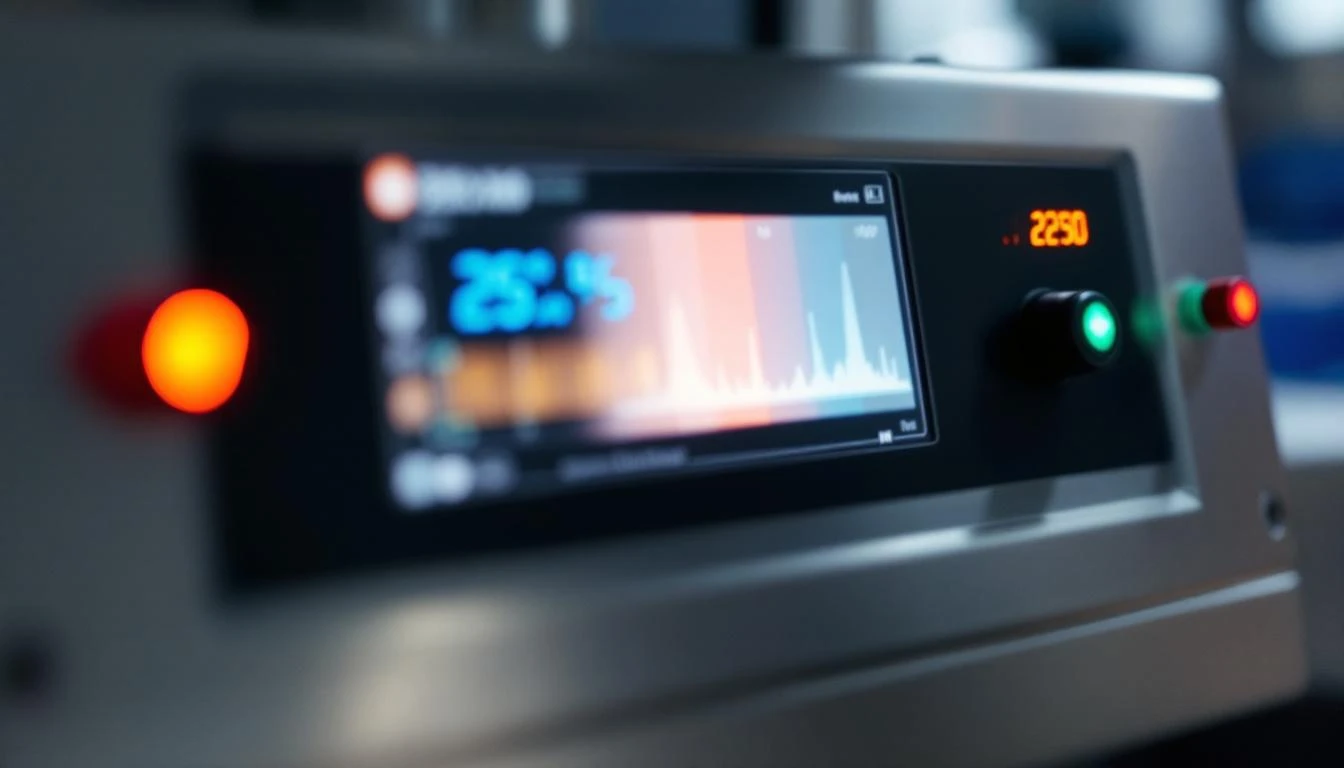
What IIoT monitors:
- Room temperature — critical for both product quality and personnel comfort
- Relative humidity — affects powder flow properties, coating processes, and product stability
- Differential pressure — maintains cleanroom classification by ensuring proper airflow direction
- Particle counts — validates cleanroom classification (ISO 5, 7, 8)
- HVAC performance — air handling unit parameters that maintain environmental conditions
How threshold alerting helps: Environmental excursions are the most common cause of batch investigation in pharma. MachineCDN's two-tier threshold alerting — approaching and active — gives facilities teams advance warning before environmental parameters leave their qualified range. An "approaching" alert at ±1.5°C gives the HVAC team time to investigate and correct before the temperature actually exceeds the ±2°C batch specification.
Batch Process Monitoring
During pharmaceutical batch processing, multiple parameters must be monitored simultaneously and continuously. Traditional approaches rely on chart recorders or SCADA historians — both have limitations in accessibility and cross-site visibility.
What IIoT monitors in batch processing:
- Mixing speed and torque — consistency of blending operations
- Temperature profiles — heating and cooling rates during granulation, coating, and drying
- Pressure — reactor pressure for chemical synthesis, autoclave pressure for sterilization
- Flow rates — binder addition in granulation, spray rate in coating, fill volumes in packaging
- Weight/mass — material additions, loss on drying (LOD), yield calculations
- Time-at-parameter — duration within specified ranges for each process step
How MachineCDN adds value: By connecting directly to batch processing equipment PLCs through industrial protocols, MachineCDN captures all monitored parameters without modifying the equipment's control system. This is critical in validated environments — the monitoring system reads data passively, so the validated equipment state is unchanged. No revalidation required.
Packaging Line Monitoring
Pharmaceutical packaging lines run at high speeds with stringent quality requirements — every unit must be correctly filled, sealed, labeled, serialized, and inspected. Line efficiency directly impacts product availability and cost of goods.
What IIoT monitors:
- Line speed and output — units per minute against target rate
- Reject rates — by reject reason (fill weight, seal integrity, label placement, serialization)
- Equipment stoppages — frequency and duration by cause code
- Changeover time — actual vs. target for product/format changes
- OEE — availability, performance, and quality for each packaging line
Equipment Reliability and Predictive Maintenance
Pharmaceutical equipment — from tablet presses to lyophilizers to centrifuges — represents major capital investments. Unplanned downtime doesn't just cost production time; it can compromise in-process batches and create regulatory investigation obligations.
Critical equipment for predictive monitoring:
- Tablet presses — compression force, turret speed, punch condition tracking
- Coating pans — drum speed, air temperature, spray rate, exhaust temperature
- Fluid bed dryers — inlet temperature, product temperature, air volume, filter differential pressure
- Centrifuges — vibration, bearing temperature, motor current
- Compressors and vacuum pumps — critical utilities that serve multiple process areas
- HVAC systems — maintaining cleanroom conditions requires reliable air handling
How MachineCDN helps: MachineCDN's preventative maintenance scheduling connects PM tasks directly to actual equipment operating data. Instead of maintaining tablet presses every 500,000 tablets (a time-based interval that doesn't account for different product hardness), PM can be scheduled based on actual compression force trends, vibration patterns, and motor current data.
The platform's spare parts tracking ensures that when a PM task is scheduled, the required parts (punches, dies, gaskets, filters) are confirmed available before maintenance begins.
GMP Compliance Considerations for IIoT Deployment
Data Integrity (ALCOA+ Principles)
FDA and EMA expect data integrity following ALCOA+ principles: Attributable, Legible, Contemporaneous, Original, Accurate, Complete, Consistent, Enduring, Available.
IIoT platforms must support:
- Attributable — every data point linked to a specific instrument/sensor
- Contemporaneous — real-time data capture with accurate timestamps
- Original — direct capture from the source instrument
- Accurate — calibrated instruments with documented uncertainty
- Complete — no gaps in data recording during batch execution
MachineCDN's direct PLC connectivity addresses several ALCOA+ requirements natively: data is captured from the original source (the PLC), timestamped at the point of collection, and stored without manual transcription — eliminating the most common data integrity risks.
21 CFR Part 11 / Annex 11 Compliance
Electronic records and electronic signatures in pharmaceutical manufacturing must comply with 21 CFR Part 11 (FDA) and Annex 11 (EU). This includes:
- Audit trails for data changes
- Electronic signatures for record approvals
- System access controls based on user roles
- Data backup and archiving
- System validation documentation
MachineCDN's multi-tenant architecture with user roles and access controls supports these requirements. Data captured from PLCs is timestamped and stored with full audit capability.
Computer System Validation (CSV)
Any computerized system used in GMP manufacturing must be validated according to GAMP 5 (Good Automated Manufacturing Practice) guidelines. The validation effort depends on the system category:
- Category 3 (Non-configured) — off-the-shelf software used as-is
- Category 4 (Configured) — configurable software
- Category 5 (Custom) — bespoke applications
IIoT platforms typically fall into Category 4 — they require configuration (which tags to read, what thresholds to set, which users have which access) but don't involve custom code. This significantly reduces validation effort compared to custom SCADA or MES implementations.
ROI for Pharmaceutical IIoT
Batch Loss Prevention
A single lost batch of a specialty pharmaceutical can represent $500K-$5M in value. If environmental monitoring with approaching thresholds prevents even one batch excursion per year, the ROI is immediate.
Reduced Investigation Time
OOS investigations in pharma require root cause analysis with documented evidence. When process data is automatically captured from equipment PLCs, investigation teams spend hours finding root cause instead of weeks reconstructing what happened from manual records.
Improved OEE on Packaging Lines
Pharmaceutical packaging lines typically run at 50-65% OEE — well below the 85% benchmark. Real-time monitoring that identifies micro-stops, speed losses, and quality rejects by cause code provides the data needed for systematic OEE improvement.
Conservative estimate: 5% OEE improvement on a $20M/year packaging line = $1M/year in additional capacity.
Compliance Cost Reduction
Manual environmental monitoring, batch record review, and data transcription consume significant labor hours. Automating data capture reduces the labor cost of compliance while simultaneously improving data quality.
Implementation Guide for Pharma Manufacturers
Phase 1: Environmental Monitoring (Week 1-3)
Start with cleanroom and storage area environmental monitoring. Connect to HVAC system PLCs to read temperature, humidity, and differential pressure. Configure threshold alerts at specification limits. This provides immediate compliance value without touching production equipment.
Phase 2: Critical Process Equipment (Week 4-8)
Connect to PLCs on your highest-value batch processing equipment. Read process parameters passively (no control system modifications). Validate that IIoT-captured data matches existing instrumentation readings.
Phase 3: Packaging Line OEE (Week 9-12)
Deploy on packaging lines to capture OEE data, downtime reasons, and reject rates. Use the data to drive systematic improvement in packaging line efficiency.
Phase 4: Fleet Management and Standardization (Ongoing)
For multi-site pharma manufacturers, deploy fleet management views to standardize operating practices across plants. Compare environmental excursion rates, OEE, and maintenance metrics across facilities.
Getting Started
Pharmaceutical manufacturing's combination of regulatory requirements, high-value batches, and complex processes makes IIoT both more valuable and more demanding than in most industries. The platform you choose must read data without modifying validated equipment, support data integrity requirements, and provide the threshold alerting that prevents batch excursions.
See how pharmaceutical IIoT works without touching your validated equipment. Book a MachineCDN demo and see passive PLC data capture in action.