BACnet for IIoT Engineers: Object Types, COV Subscriptions, and the Building-Industrial Crossover [2026]
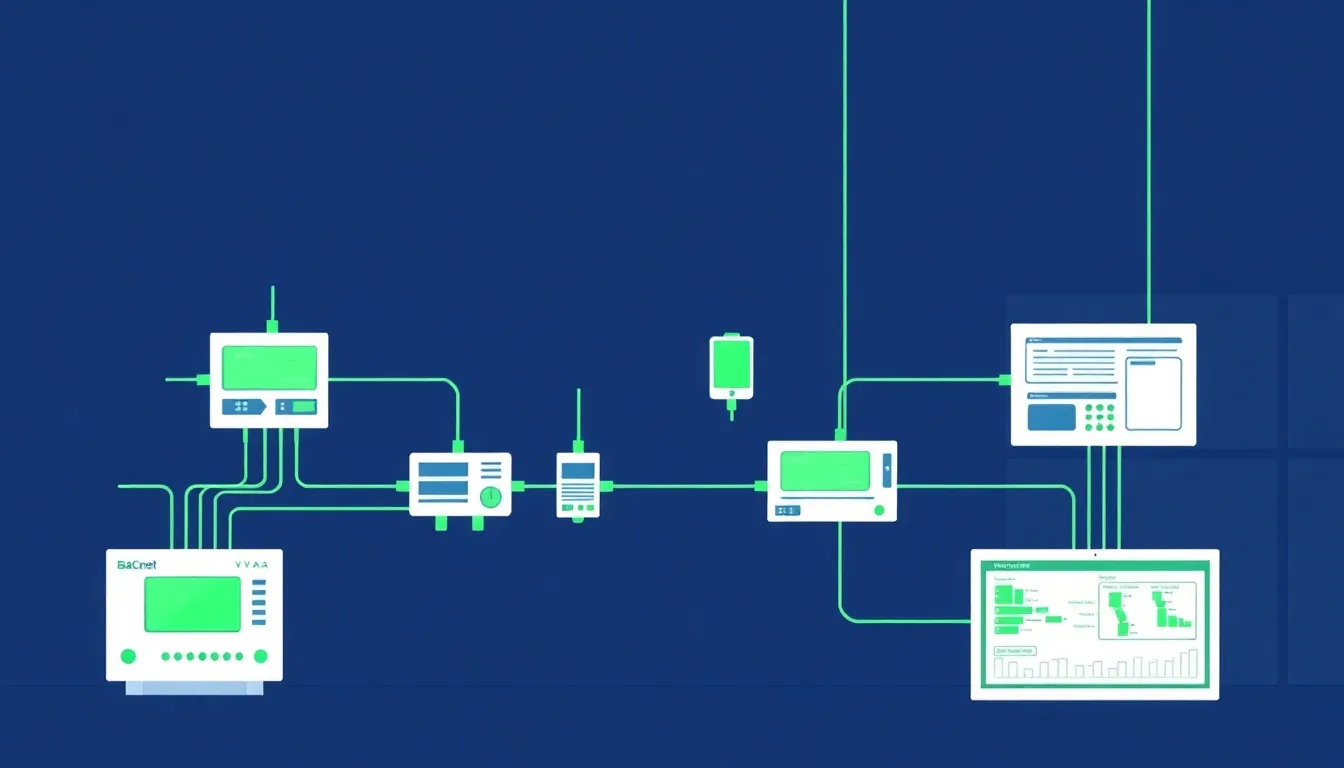
Most IIoT engineers live in the world of Modbus registers, EtherNet/IP CIP objects, and MQTT topics. BACnet — the dominant protocol in building automation — rarely appears on their radar. But as manufacturing facilities increasingly integrate HVAC, energy management, and environmental monitoring into their operational technology (OT) stacks, understanding BACnet becomes a practical necessity.
This article explains BACnet from the perspective of someone who already understands industrial protocols. If you can read a Modbus register map, you can understand BACnet's object model. The concepts map more cleanly than you might expect.
Why BACnet Matters for Manufacturing
Here's the scenario that's becoming increasingly common: you're running a plastics processing plant. Your injection molding machines, dryers, chillers, and conveying systems communicate via Modbus TCP or EtherNet/IP. The data flows to your IIoT platform for OEE tracking, predictive maintenance, and alarm management.
But the building itself — the HVAC system keeping your clean room at spec, the lighting controls in the warehouse, the fire alarm panel, the access control system — all of that runs on BACnet. And increasingly, operations teams want a single view of both.
Real-world crossover examples:
- Chiller integration: Industrial chillers (like portable or central chillers) often serve both process cooling and building HVAC. The same compressor data — discharge pressure, suction temperature, superheat — matters to both the process engineer and the facilities manager.
- Energy monitoring: Manufacturing plants are major energy consumers. Correlating production line power draw with HVAC load requires reading both Modbus energy meters and BACnet-connected building management systems.
- Environmental compliance: Pharmaceutical and food processing facilities need continuous monitoring of temperature, humidity, and air pressure — often from BACnet-connected HVAC sensors alongside process-specific Modbus instruments.
BACnet Object Model: The Modbus Engineer's Rosetta Stone
If Modbus organizes data into four register types (coils, discrete inputs, holding registers, input registers), BACnet organizes everything into objects with properties. This is conceptually closer to EtherNet/IP's CIP object model, but with building-specific semantics built in.
Core Object Types
| BACnet Object | Modbus Equivalent | Description |
|---|---|---|
| Analog Input (AI) | Input Register (3xxxx) | Read-only analog value (temperature, pressure, humidity) |
| Analog Output (AO) | Holding Register (4xxxx) | Writable analog value (setpoint, valve position) |
| Analog Value (AV) | Internal register | Calculated or derived value |
| Binary Input (BI) | Discrete Input (1xxxx) | Read-only boolean (alarm state, switch position) |
| Binary Output (BO) | Coil (0xxxx) | Writable boolean (relay, fan enable) |
| Binary Value (BV) | Internal coil | Calculated or derived boolean |
| Multi-State Input (MSI) | Enum in register | Enumerated read-only state (mode: heating/cooling/off) |
| Multi-State Output (MSO) | Enum in register | Writable enumerated value (fan speed: low/med/high) |
Object Properties
Every BACnet object has a standardized set of properties. The most important ones:
Object: Analog Input #1 (Zone Temperature)
├── Object_Identifier: AI-1
├── Object_Name: "Zone 3 Temperature"
├── Present_Value: 72.4  ← This is where the actual data lives
├── Units: degrees-fahrenheit
├── Status_Flags: {in_alarm: false, fault: false, overridden: false, out_of_service: false}
├── Out_Of_Service: false
├── COV_Increment: 0.5  ← Minimum change to trigger COV notification
├── High_Limit: 85.0
├── Low_Limit: 60.0
├── Reliability: no-fault-detected
└── Description: "RTD sensor, Zone 3, AHU-2"
Why this matters: In Modbus, a register at address 300001 might be "Chiller out temperature" — but you only know that from the documentation. The register itself is just a 16-bit integer. In BACnet, every data point carries its own metadata: units, description, alarm limits, reliability status. This self-describing quality makes BACnet significantly easier to integrate when you're connecting a new building system for the first time.
The Device Object
Every BACnet device has exactly one Device object (Object_Type = 8) that describes the device itself:
Device Object #389001
├── Object_Name: "AHU-2 Controller"
├── Vendor_Name: "Trane"
├── Model_Name: "Tracer SC+"
├── Firmware_Revision: "5.1.2"
├── Application_Software_Version: "3.2"
├── Protocol_Version: 1
├── Protocol_Revision: 22
├── Max_APDU_Length_Accepted: 1476
├── Segmentation_Supported: segmented-both
├── Database_Revision: 42  ← Increments when config changes
└── Object_List: [AI-1, AI-2, ... AO-1, ... BO-1, ...]
The Database_Revision property is particularly useful: if it changes, you know the device's point configuration has been modified and you should re-discover its objects.
Communication: MS/TP vs BACnet/IP
BACnet defines multiple data link layers, but two dominate in practice:
BACnet MS/TP (Master-Slave/Token-Passing)
This runs over RS-485 serial — the same physical layer as Modbus RTU. If you've dealt with Modbus RTU's serial parameters (baud rate, parity, data bits, stop bits), MS/TP will feel familiar.
Key differences from Modbus RTU:
- Token passing, not polling: MS/TP uses a token ring protocol where each master device passes the token to the next. This is more efficient than Modbus's constant poll/response cycle, especially with many devices.
- Baud rates: Typically 9600, 19200, 38400, or 76800 bps (vs. Modbus RTU's common 9600 or 19200)
- Maximum 127 devices per MS/TP trunk (vs. Modbus's 247 theoretical, ~32 practical)
- Maximum cable length: 4,000 feet (1,200 m) at 76800 bps — significantly longer than Modbus's 1,200 m at 9600 bps
When you'll encounter MS/TP:
- VAV (Variable Air Volume) box controllers
- Zone controllers
- Older rooftop unit controllers
- Any building device connected via RS-485 twisted pair
BACnet/IP
This runs over standard UDP/IP on port 47808 (0xBAC0 — yes, they really did that). It's the modern standard and what you'll use for any new installation.
Key technical details:
- Transport: UDP (not TCP) — all BACnet/IP messages are datagrams
- Port: 47808 (both source and destination)
- Broadcast: BACnet uses directed broadcasts for device discovery (Who-Is / I-Am)
- BBMD: BACnet Broadcast Management Device — required when BACnet/IP spans multiple subnets (it forwards broadcasts between subnets)
The BBMD problem: BACnet's reliance on broadcasts for device discovery means it doesn't play well with routed networks out of the box. If your BACnet devices are on different subnets, you need at least one BBMD on each subnet to relay broadcasts. This is the #1 configuration issue in BACnet/IP installations.
BACnet/SC (Secure Connect) — The New Standard
Released in 2019 and gaining adoption, BACnet/SC replaces UDP broadcasts with WebSocket connections over TLS. Key improvements:
- No more BBMDs: Uses a hub-and-spoke model with a central "hub"
- TLS encryption: All traffic is encrypted (finally)
- NAT-friendly: Works through firewalls without special configuration
- Certificate-based auth: Mutual TLS authentication
If you're designing a new building automation integration in 2026, push for BACnet/SC where device support exists.
Change of Value (COV): BACnet's Killer Feature
This is where BACnet truly outshines Modbus's polling model. COV subscriptions let a client say "notify me when this value changes by more than X" — and the server only sends data when that condition is met.
How COV Works
- Client subscribes: "Tell me when AI-1 (Zone Temperature) changes by more than 0.5°F"
- Server acknowledges: "Subscription confirmed, lifetime 300 seconds"
- Server monitors: Internally tracks the Present_Value of AI-1
- Server notifies: When the value changes by ≥ 0.5°F, sends a COV notification with the new value
- Client re-subscribes: Before the lifetime expires, client renews the subscription
COV vs. Polling: The Numbers
Consider monitoring 200 zone temperature sensors:
Polling approach (Modbus-style):
- 200 sensors × 1 poll every 10 seconds = 20 requests/second
- Each request/response: ~20 bytes = 400 bytes/second baseline
- Most readings return the same value — wasted bandwidth and processing
COV approach:
- 200 subscriptions established once
- In a stable building: maybe 5–10 notifications per second (only the zones actually changing)
- 90%+ reduction in network traffic during steady-state operation
This maps directly to how well-designed IIoT edge systems handle data: only transmitting values when they change (or at a maximum stale timer). If you're familiar with the concept of "report by exception" or change-based data delivery — where a system compares the current read against the last delivered value and only sends when different — that's exactly what BACnet COV does at the protocol level.
In fact, many IIoT platforms that connect to Modbus or EtherNet/IP devices implement their own version of this pattern: reading tags at configured intervals, comparing against the last known value, and only batching and transmitting data that has actually changed. BACnet just does it natively.
COV Subscription Types
| Type | Confirmed | Use Case |
|---|---|---|
| Confirmed COV | Yes — server waits for acknowledgment | Critical alarms, control setpoints |
| Unconfirmed COV | No — fire-and-forget | Non-critical monitoring, trending |
COV Increment Configuration
The COV_Increment property on Analog objects defines the minimum change threshold. Setting this correctly is critical:
- Too small (0.01°F): Generates excessive notifications from sensor noise
- Too large (5.0°F): Misses meaningful changes
- Just right (0.5°F for zone temp, 0.1 PSI for duct pressure): Captures real changes, ignores noise
For binary objects, COV triggers on every state change — there's no increment to configure.
Priority Array: BACnet's Conflict Resolution
One of BACnet's most elegant features is the priority array on commandable objects (AO, BO, MSO). It's a 16-level priority stack that determines which command source controls the output:
| Priority | Typical Use | Example |
|---|---|---|
| 1 | Manual Life Safety | Fire system override |
| 2 | Automatic Life Safety | Smoke damper close |
| 3 | Available | — |
| 4 | Available | — |
| 5 | Critical Equipment Control | Chiller anti-freeze protection |
| 6 | Minimum On/Off | Minimum ventilation requirements |
| 7 | Available | — |
| 8 | Manual Operator | BMS operator override |
| 9–13 | Available | Custom application logic |
| 14 | Available | — |
| 15 | Scheduling | Time-based programs |
| 16 | Default (Relinquish_Default) | Fallback value |
Why this matters for IIoT integration: If your IIoT platform is writing setpoints to a BACnet controller, you need to write at the appropriate priority level. Writing at priority 8 (manual operator) means the BMS schedule (priority 15) won't override your setpoint — which might be what you want, or might cause an energy management nightmare.
Integrating BACnet Into Your IIoT Stack
Gateway Approaches
The most practical path for manufacturers is a BACnet gateway that translates BACnet objects to a protocol your existing IIoT platform already speaks:
BACnet → Modbus TCP:
- Maps BACnet AI/AO/BI/BO to Modbus holding registers
- Simple but loses BACnet's metadata (units, descriptions, alarm limits)
- Works with any Modbus TCP client
BACnet → MQTT:
- Maps BACnet objects to MQTT topics
- Preserves metadata as JSON payloads
- Natural fit for cloud-connected IIoT platforms
- COV subscriptions can trigger MQTT publishes (event-driven end-to-end)
BACnet → REST API:
- Direct HTTP access to BACnet objects
- Good for dashboarding and one-off queries
- Not suitable for real-time monitoring
Data Normalization Challenges
When you're pulling BACnet data into an IIoT platform alongside Modbus and EtherNet/IP data, normalization is the key challenge:
-
Units: BACnet uses ASHRAE-defined engineering units (enumerated). Modbus just gives you a raw integer that could be tenths of degrees or hundredths of PSI — you need the documentation to know. Your platform must handle both.
-
Data types: BACnet Present_Value is always a REAL (IEEE 754 float) for analog objects. Modbus might give you a 16-bit integer that needs scaling (divide by 10 to get actual temperature) or two 16-bit registers that form a 32-bit float with byte order that varies by manufacturer.
-
Timestamps: BACnet supports trend logs with embedded timestamps. Modbus has no concept of timestamping — your edge device must add timestamps at read time.
-
Status/quality: BACnet's Status_Flags and Reliability properties give you rich quality information. Modbus has exception codes for communication errors, but nothing about data quality. A well-designed IIoT platform normalizes these into a unified quality model.
This is precisely the kind of cross-protocol normalization that machineCDN handles at the edge — taking raw data from various industrial protocols, understanding the native type system and status semantics of each, and delivering normalized, timestamped data to the cloud. Whether the source is a Modbus TCP chiller, an EtherNet/IP PLC, or a BACnet building controller, the data arrives in a consistent format.
Practical BACnet Configuration Example
Here's a real-world configuration for integrating an air handling unit (AHU) controller into an IIoT monitoring system:
Step 1: Device Discovery
Send: Who-Is (broadcast to 255.255.255.255:47808)
Receive: I-Am from Device 389001
  - Device: AHU-2 Controller
  - Vendor: Trane
  - Max APDU: 1476 bytes
  - Segmentation: supported
Step 2: Object Discovery
Send: ReadPropertyMultiple Device:389001, Object_List
Receive:
  AI-1: Supply Air Temperature
  AI-2: Return Air Temperature
  AI-3: Mixed Air Temperature
  AI-4: Outside Air Temperature
  AI-5: Supply Air Pressure
  AO-1: Cooling Valve Position
  AO-2: Heating Valve Position
  AO-3: Supply Fan VFD Speed
  BI-1: Filter Dirty Status
  BI-2: Freeze Protection Active
  BO-1: Supply Fan Enable
  BO-2: Return Fan Enable
Step 3: COV Subscriptions
Subscribe:
  AI-1 (Supply Air Temp): COV increment 0.5°F, lifetime 3600s
  AI-4 (Outside Air Temp): COV increment 1.0°F, lifetime 3600s
  AI-5 (Supply Air Pressure): COV increment 0.02 inWC, lifetime 3600s
  BI-1 (Filter Dirty): COV on any change, lifetime 3600s
  BI-2 (Freeze Protection): COV on any change, lifetime 3600s

Poll (not COV-capable on this device):
  AO-1 (Cooling Valve): every 60 seconds
  AO-3 (Fan Speed): every 60 seconds
Step 4: Data Delivery
Map the discovered objects to your IIoT platform's tag structure, preserving the BACnet metadata:
{
  "device": "AHU-2",
  "protocol": "bacnet-ip",
  "device_id": 389001,
  "tags": [
    {
      "id": "AI-1",
      "name": "Supply Air Temperature",
      "value": 55.2,
      "units": "degrees-fahrenheit",
      "status": "normal",
      "timestamp": "2026-02-28T14:23:01Z",
      "delivery": "cov"
    }
  ]
}
Security Considerations
BACnet was designed in the early 1990s with zero security. BACnet/IP traffic is unencrypted, unauthenticated, and trivially spoofable. This is a significant risk:
Minimum Security Measures
-
Network segmentation: BACnet traffic should never share a VLAN with IT or untrusted OT traffic. Use a dedicated BACnet VLAN with strict firewall rules.
-
BBMD access control: BBMDs should only peer with known BBMDs. Rogue BBMDs can inject malicious traffic across your entire BACnet network.
-
Disable BACnet routing at the internet edge: There are documented cases of BACnet devices exposed directly to the internet (Shodan finds thousands). This is inexcusable in 2026.
-
Adopt BACnet/SC where possible: TLS encryption and certificate-based authentication solve most of BACnet/IP's security weaknesses.
-
Monitor for anomalies: Unexpected Who-Is broadcasts, writes to safety-critical priority levels, or new devices appearing on the network should trigger alerts.
Key Takeaways for IIoT Engineers
-
BACnet's object model is richer than Modbus but simpler than OPC-UA. If you understand Modbus register types, BACnet objects are a natural progression with added metadata.
-
COV subscriptions eliminate wasteful polling. This is BACnet's biggest practical advantage and aligns perfectly with how modern IIoT platforms handle change-based data delivery.
-
The building-industrial crossover is real and growing. Chillers, energy meters, and environmental sensors often serve both domains. A unified IIoT platform that handles BACnet alongside industrial protocols eliminates the "building vs. plant" data silo.
-
Security is BACnet's Achilles heel. Push for BACnet/SC on new installations. On existing BACnet/IP networks, network segmentation is your primary defense.
-
Start with discovery, not configuration files. BACnet's self-describing objects mean you can discover what a device offers programmatically — unlike Modbus, where you need a register map document before you can read anything meaningful.
-
Priority arrays matter. If you're writing commands to BACnet devices from your IIoT platform, understand the priority hierarchy. Writing at the wrong priority level can override safety controls or be silently overridden by scheduling programs.
Need to integrate BACnet building data alongside your Modbus and EtherNet/IP equipment monitoring? machineCDN provides unified edge-to-cloud data collection that normalizes data from industrial and building automation protocols into a single platform.