Preventive vs Predictive Maintenance: Which Strategy Is Right for Your Manufacturing Plant?

The maintenance world has a tendency to present predictive maintenance as the obvious successor to preventive maintenance — as if every manufacturing plant should immediately abandon time-based maintenance for condition-based monitoring. The reality is more nuanced. Both strategies have their place, and the best maintenance programs use them together. The question isn't "preventive or predictive" — it's "which strategy for which assets?" This guide helps you make that decision with clear criteria, real cost comparisons, and practical implementation advice.
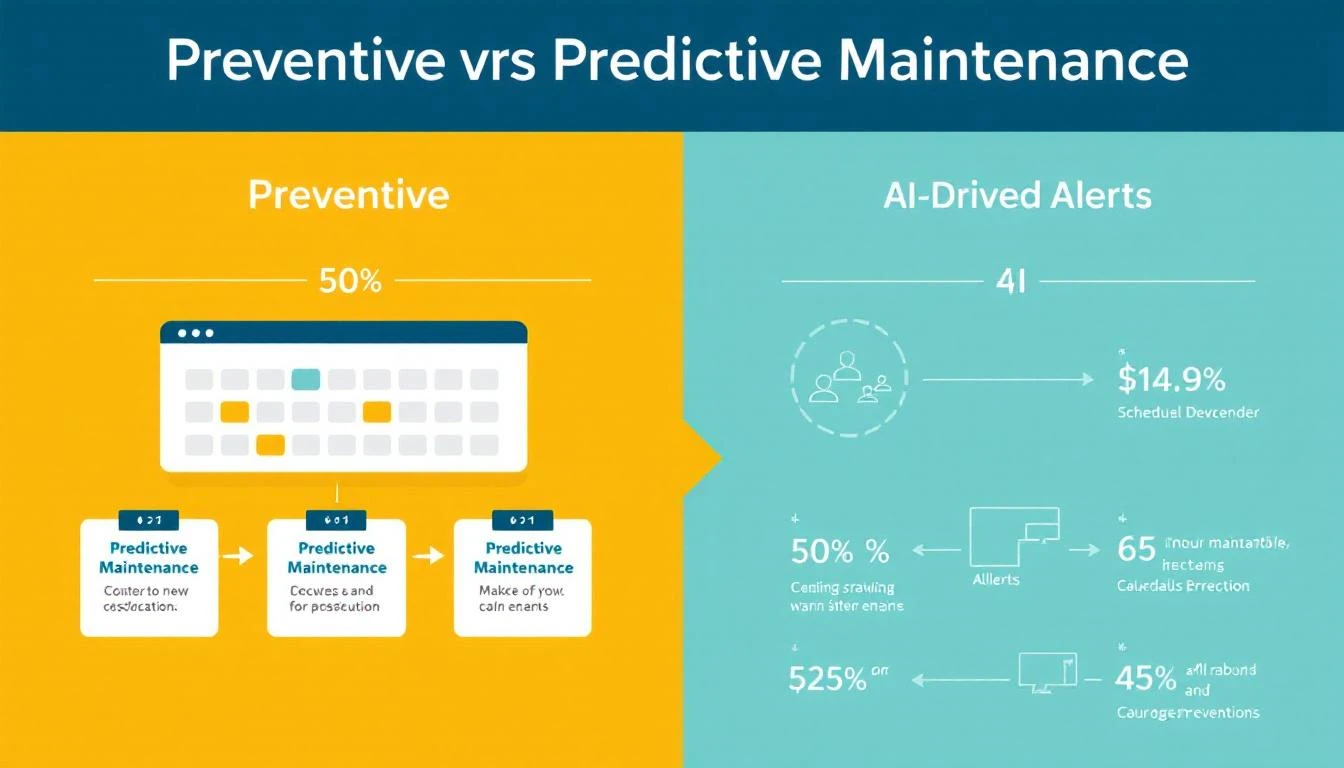
Defining the Terms (Without the Marketing Fluff)
Preventive Maintenance (PM)
Preventive maintenance performs maintenance tasks on a fixed schedule — regardless of equipment condition. Change the oil every 3 months. Replace the belt every 12 months. Inspect the bearings every 6 weeks. The schedule is based on manufacturer recommendations, historical failure data, or (more commonly) "that's what we've always done."
How it works:
- Create a PM schedule based on time or usage intervals
- Generate work orders automatically when intervals elapse
- Technicians perform the prescribed tasks
- Reset the counter, repeat
The core assumption: Components degrade predictably, and replacing them before they reach end-of-life prevents failures.
The core problem: Components don't degrade predictably. Studies by the Nowlan and Heap (the foundation of Reliability-Centered Maintenance) found that only 11% of components have age-related failure patterns. The remaining 89% fail randomly — meaning time-based replacement doesn't prevent their failure modes.
Predictive Maintenance (PdM)
Predictive maintenance monitors actual equipment condition and performs maintenance only when data indicates degradation is approaching a failure threshold. Instead of replacing a bearing every 12 months, you monitor its vibration signature, temperature, and acoustic emissions — then replace it when the data says it's approaching end-of-life.
How it works:
- Install sensors or connect to existing PLC data
- Establish normal operating baselines
- Monitor continuously for deviations from baseline
- When degradation patterns emerge, schedule maintenance
- Repair or replace at the optimal time — not too early (wasting component life), not too late (risking failure)
The core assumption: Equipment gives warning signals before failure, and those signals can be detected and interpreted in time to act.
The core reality: For most mechanical and electrical failure modes, this assumption is correct. Bearings, motors, pumps, gearboxes, fans, and compressors all exhibit measurable degradation patterns weeks to months before failure.
The Real Cost Comparison
Let's move beyond theoretical discussions and look at actual costs. We'll use a common example: a critical motor-driven pump in a manufacturing plant.
Scenario: 50HP Process Pump
Preventive Maintenance Approach:
| Task | Frequency | Labor Hours | Parts Cost | Annual Cost |
|---|---|---|---|---|
| Oil change | Quarterly | 2 hrs × 4 | $200 × 4 | $1,600 |
| Bearing replacement | Annual | 8 hrs | $800 | $1,440 |
| Seal replacement | Annual | 6 hrs | $600 | $1,080 |
| Vibration check (handheld) | Monthly | 1 hr × 12 | — | $960 |
| Alignment check | Semi-annual | 3 hrs × 2 | — | $480 |
| Total annual PM cost | $5,560 |
Additional hidden costs:
- Bearings replaced with 40-60% life remaining: ~$480 wasted per year
- Seals replaced unnecessarily: ~$360 wasted per year
- Production downtime for PM tasks: 20+ hours/year at $5,000/hr = $100,000+
- Still experience ~1 unplanned failure every 3-5 years: $25,000-$50,000 per event
Predictive Maintenance Approach:
| Item | Cost Type | Annual Cost |
|---|---|---|
| Vibration sensor (installed) | One-time (amortized over 5 years) | $200-$400 |
| Temperature sensor | One-time (amortized) | $50-$100 |
| IIoT platform subscription (per device) | Annual | $500-$1,500 |
| Oil analysis (condition-based) | 2-3x per year | $300-$450 |
| Bearing replacement (condition-based) | Every 18-24 months (vs 12) | $720 |
| Seal replacement (condition-based) | Every 18-24 months (vs 12) | $540 |
| Total annual PdM cost | $2,310-$3,710 |
Additional benefits:
- 50-70% fewer planned shutdowns (maintenance only when needed)
- 70-90% reduction in unplanned failures
- Extended component life: 40-100% longer bearing and seal life
- Production downtime reduced to 8-10 hours/year
Net savings per pump: $1,850-$3,250 annually + avoided unplanned failure costs.
Scale that across 50-100 pumps in a typical plant, and the annual savings reach $100,000-$300,000 — from pumps alone.
When Preventive Maintenance Is the Right Choice
Predictive maintenance isn't always the answer. Here's when PM wins:
Simple, Low-Cost Components
If the component is cheap and replacement is fast, monitoring it costs more than replacing it. Examples:
- Filters (air, oil, hydraulic) — replace on schedule
- Belts under $50 — replace on schedule
- Lubricants — change on schedule (though oil analysis can optimize intervals)
- Gaskets and O-rings — replace during planned shutdowns
The rule: If the sensor costs more than the component, stick with PM.
Regulatory-Mandated Inspections
Some industries require maintenance activities at prescribed intervals regardless of condition:
- Pressure vessel inspections (ASME, state codes)
- Elevator inspections
- Fire suppression system testing
- Electrical safety testing (arc flash, ground fault)
You must perform these tasks on schedule. However, you can supplement them with predictive monitoring between inspections to catch problems sooner.
Consumables with Known Degradation Curves
Some items genuinely do wear predictably:
- Cutting tools with known tool life per material
- Brake pads in conveyor systems
- Tires on forklifts and AGVs
- Chemical dosing system components (diaphragms, check valves)
When degradation is linear and predictable, time-based replacement is efficient because the monitoring overhead adds cost without adding insight.
Low-Criticality Equipment
If the machine can fail without affecting production (because you have redundancy, buffer stock, or alternative processes), the cost of predictive monitoring may not be justified. Save your monitoring budget for the critical path.
When Predictive Maintenance Is the Right Choice
High-Cost-of-Failure Equipment
The ROI of predictive maintenance scales with the cost of failure. Target assets where:
- Unplanned failure costs exceed $10,000 per event (including production loss)
- Mean time to repair (MTTR) exceeds 4 hours
- Spare parts have long lead times (weeks to months)
- Failure causes collateral damage to adjacent equipment
Examples: main drive motors, compressors, large pumps, gearboxes, critical HVAC, CNC spindles.
Equipment with Detectable Failure Modes
Predictive maintenance requires that failure modes produce measurable signals before catastrophic failure. Most mechanical and electrical failure modes do:
| Failure Mode | Detectable By | Warning Time |
|---|---|---|
| Bearing wear | Vibration, temperature, acoustics | 1-6 months |
| Motor insulation degradation | Current analysis, temperature | 2-12 months |
| Pump cavitation | Vibration, pressure, flow | Days to weeks |
| Gearbox wear | Vibration, oil analysis | 1-6 months |
| Electrical connection degradation | Thermal imaging, resistance | Weeks to months |
| Heat exchanger fouling | Approach temperature, flow | Weeks to months |
| Belt wear/misalignment | Vibration, visual | Weeks to months |
If the failure mode is instantaneous and unpredictable (lightning strike, foreign object damage), predictive maintenance won't help. But these represent a small minority of industrial failures.
Expensive PM Tasks That May Be Unnecessary
If your current PM program includes expensive tasks (major overhauls, complete bearing replacements, full lubrication changes) performed on schedule regardless of condition, predictive monitoring can extend those intervals significantly — performing the work only when the equipment actually needs it.
The Optimal Maintenance Strategy: RCM-Informed Hybrid
The best maintenance programs don't choose one strategy — they assign the right strategy to each failure mode on each asset. This is the core of Reliability-Centered Maintenance (RCM):
Step 1: Rank Assets by Criticality
Categorize every asset in your plant:
- A (Critical): Failure stops production. No redundancy. — PdM + PM for consumables
- B (Important): Failure reduces capacity but doesn't stop production. — PdM for major components, PM for minor
- C (Support): Failure is inconvenient but manageable. — PM only
- D (Non-critical): Run to failure is acceptable. — Reactive maintenance
Step 2: Identify Failure Modes per Asset
For each A and B asset, list the dominant failure modes and determine whether they're detectable through monitoring. Use the table above as a guide.
Step 3: Deploy Monitoring on A and B Assets
Modern IIoT platforms like MachineCDN make deploying condition monitoring straightforward. Edge devices connect to existing PLCs to read motor currents, temperatures, pressures, and vibration data — often without adding new sensors. The data is already in the PLC; it's just not being analyzed.
For machines not connected to PLCs, standalone vibration and temperature sensors can be added at the bearing locations and connected via the same edge infrastructure.
Step 4: Optimize PM Intervals for C and D Assets
Don't eliminate PM — optimize it. Use your new condition monitoring data to:
- Extend PM intervals where equipment consistently shows no degradation at the current interval
- Shorten PM intervals where equipment shows degradation before the current interval
- Convert from calendar-based to usage-based intervals (if you now have runtime data from the IIoT platform)
Implementation: Getting Started Without Boiling the Ocean
The biggest mistake in transitioning to predictive maintenance is trying to monitor everything at once. Start small and prove the value:
Month 1: Identify your top 10 assets by failure cost. Deploy condition monitoring on these first. With platforms like MachineCDN that use cellular connectivity and deploy in minutes, this is a week-long project, not a months-long one.
Months 2-3: Establish baselines for all monitored assets. Continue existing PM program unchanged — don't remove any PM tasks yet.
Months 4-6: First predictive alerts fire. Validate predictions against actual equipment condition. Begin extending PM intervals for assets where monitoring confirms healthy operation.
Months 7-12: Build confidence. Track how many PM tasks were extended without incident. Document avoided failures. Calculate actual ROI.
Year 2+: Expand monitoring to additional assets based on the proven ROI from Year 1. Begin formally removing unnecessary PM tasks from your CMMS schedule.
The Maturity Model: Where Are You Today?
| Level | Strategy | Characteristics | Cost Efficiency |
|---|---|---|---|
| 1 - Reactive | Fix when broken | No schedule, firefighting mode | Very low |
| 2 - Preventive | Fix on schedule | Calendar/usage-based PM, CMMS | Moderate |
| 3 - Condition-Based | Fix when needed | Basic monitoring, manual routes | Good |
| 4 - Predictive | Fix before failure | Continuous monitoring, AI analytics | High |
| 5 - Prescriptive | Optimize continuously | AI recommends actions, auto-scheduling | Highest |
Most plants are at Level 2, aspiring to Level 4. The path from 2 to 4 doesn't require a massive leap — it's a series of incremental improvements, starting with your most critical assets.
Conclusion
The preventive vs. predictive debate creates a false dichotomy. The question isn't which strategy to choose — it's which assets deserve which strategy. Critical equipment with detectable failure modes and high failure costs should be monitored predictively. Simple consumables and regulatory-mandated tasks stay on preventive schedules. Low-criticality equipment can run to failure.
The manufacturers seeing the best maintenance outcomes aren't the ones with the most sensors or the most sophisticated AI. They're the ones who've thoughtfully matched their maintenance strategy to each asset's risk profile — and deployed monitoring technology that's simple enough to scale across the plant.
Ready to build your hybrid maintenance strategy? Book a demo with MachineCDN and see how condition monitoring deploys in minutes — so you can start with your critical assets today and expand as the ROI proves itself.