Edge vs Cloud for Industrial Data: Where Should You Process Your Manufacturing Data?

The edge vs. cloud debate in industrial IoT has been argued for years, and both sides have valid points. Edge advocates emphasize latency, reliability, and bandwidth costs. Cloud advocates point to scalability, advanced analytics, and reduced on-site infrastructure. The reality — as experienced by anyone who's actually deployed IIoT in a manufacturing environment — is that the answer is almost always "both."
But "both" isn't helpful without specifics. Which data should be processed at the edge? What belongs in the cloud? How should the two layers communicate? And what does this architecture actually look like when you're connecting PLCs on a factory floor to AI-powered analytics?
This guide provides practical answers for manufacturing engineers and plant managers who need to make architecture decisions without a PhD in distributed systems.
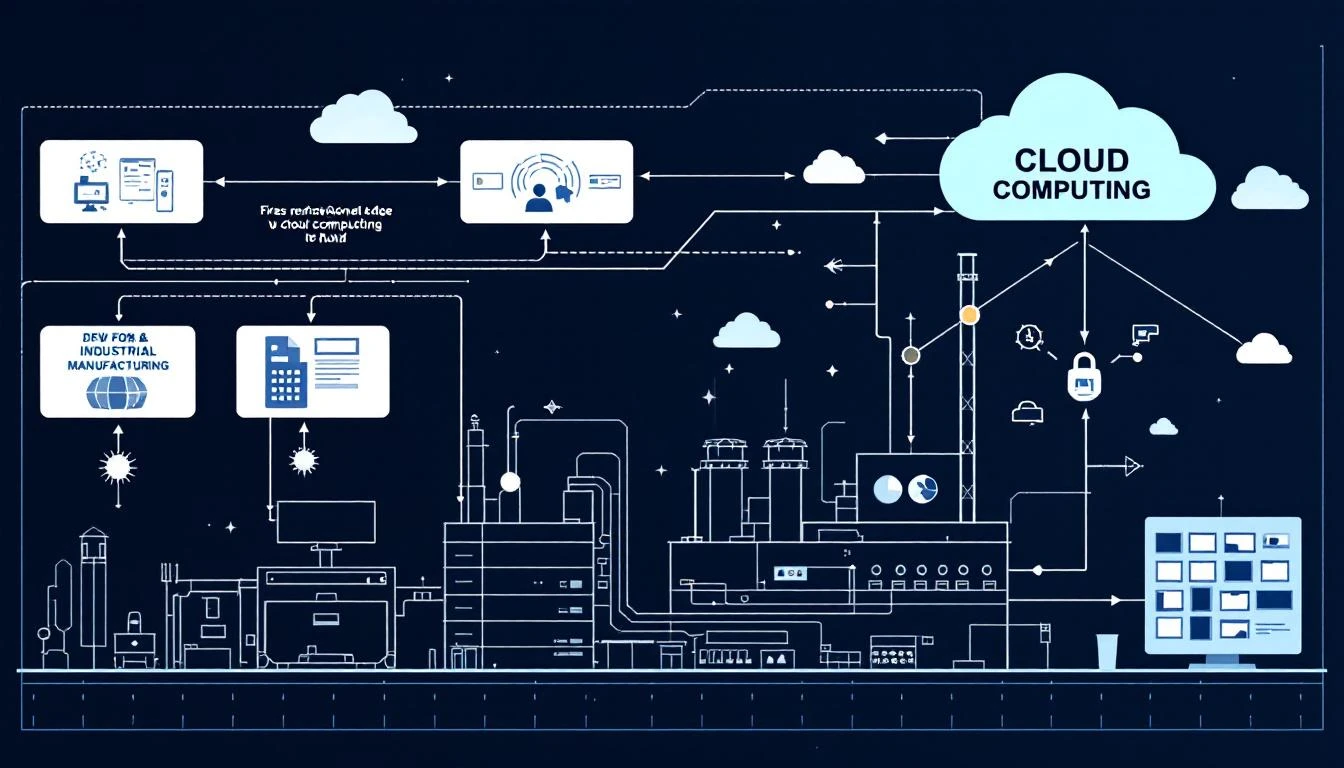
Understanding the Architecture Layers
Before comparing edge and cloud, let's define the physical layers in an industrial data architecture:
The Edge (Factory Floor)
What it is: Computing power located physically near or on the manufacturing equipment.
Physical form: Industrial PCs, hardened gateways, embedded controllers, or purpose-built edge devices.
What it does:
- Reads data from PLCs, sensors, and industrial equipment
- Filters, aggregates, and pre-processes raw data
- Makes time-critical decisions locally (sub-second response)
- Buffers data during connectivity interruptions
- Translates industrial protocols to cloud-friendly formats
The Cloud
What it is: Scalable computing infrastructure hosted in remote data centers.
Examples: AWS, Azure, Google Cloud, or private data center infrastructure.
What it does:
- Stores large volumes of historical data
- Runs computationally intensive analytics (ML/AI models)
- Provides dashboard and reporting access from anywhere
- Manages fleet-wide analytics across multiple sites
- Integrates with enterprise systems (ERP, CMMS, MES)
The Network (Between Edge and Cloud)
This is the layer most people forget — and where many IIoT deployments fail. The choice between plant Ethernet, WiFi, cellular, satellite, or private 5G determines reliability, latency, security, and cost.
When Edge Processing Is Essential
Real-Time Control Decisions
If a vibration sensor detects a bearing failure signature and the machine needs to stop within 50 milliseconds, that decision can't travel to the cloud and back. Round-trip latency to a cloud server is typically 50-200ms — too slow for safety-critical responses.
Rule of thumb: Any decision that requires sub-second response time must happen at the edge.
Manufacturing examples:
- Emergency stop triggers based on sensor thresholds
- Closed-loop quality control (adjust process parameters in real time)
- Collision avoidance in automated material handling
- Temperature/pressure safety interlocks
Bandwidth and Cost Management
A single CNC machine can generate 500+ data points per second. Across 100 machines, that's 50,000 data points per second — approximately 4.3 billion per day. Transmitting all of this raw data to the cloud is:
- Expensive: Cloud data ingestion costs $2-5 per million messages (Azure IoT Hub, AWS IoT Core)
- Wasteful: Most of that data is repetitive (machine running normally, same values)
- Slow: Upload bandwidth becomes a bottleneck
Edge processing solves this by:
- Filtering: Only send data that's changed (send-on-change mode)
- Aggregating: Send 1-minute averages instead of 1-second raw values
- Compressing: Reduce payload size through efficient encoding
- Prioritizing: Immediate transmission for alarms, batched transmission for trends
MachineCDN's edge devices implement intelligent data delivery — comparing current values against previous transmissions and sending only changes. This reduces bandwidth by 80-90% while preserving all meaningful information.
Connectivity Resilience
Cloud connectivity isn't always available. Factory environments present unique challenges:
- WiFi dead zones from metal structures, EMI, and RF interference
- Network outages from IT maintenance or equipment failures
- Cellular coverage gaps in remote or underground facilities
- Intentional network segmentation for security
Edge processing ensures that critical functions continue during connectivity interruptions:
- Local alerting and alarm management
- Data buffering until connectivity returns
- Autonomous machine monitoring
- Safety system independence
MachineCDN's approach: Cellular connectivity bypasses the plant network entirely, but the edge device also buffers data locally during any connectivity gaps. When connection restores, buffered data transmits automatically. No data loss, no manual intervention.
Data Security and Sovereignty
Some manufacturing data can't leave the facility:
- Defense and government contracts (ITAR, CMMC requirements)
- Proprietary process parameters (competitive IP)
- Regional data sovereignty laws (GDPR, China's data localization)
- Customer contractual requirements
Edge processing handles sensitive data locally while sending only aggregated, anonymized, or approved data to the cloud.
When Cloud Processing Is Superior
Machine Learning and AI Analytics
Training a predictive maintenance model requires analyzing months or years of historical data across multiple machines and failure events. This is computationally intensive and benefits enormously from cloud resources:
- GPU/TPU clusters for model training (prohibitively expensive at the edge)
- Large-scale data storage for training datasets
- Model versioning and A/B testing infrastructure
- Cross-fleet model training using data from all facilities
The optimal pattern: collect data at the edge, train models in the cloud, deploy inference back to the edge for real-time predictions.
MachineCDN uses this hybrid approach — AI-powered analytics run in the cloud with full access to historical data and fleet-wide patterns, while edge devices handle real-time data collection and threshold monitoring.
Fleet-Wide Analytics and Benchmarking
Comparing OEE across 20 plants, identifying the best-performing equipment configurations, or analyzing failure patterns across your entire fleet requires centralized data. This is cloud territory:
- Cross-plant performance benchmarking
- Fleet-wide failure pattern analysis
- Centralized reporting for executive dashboards
- Regulatory and compliance reporting (ESG, emissions)
MachineCDN's fleet management provides this centralized view — all locations, all zones, all equipment visible from a single cloud-based dashboard.
Integration With Enterprise Systems
Manufacturing doesn't operate in isolation. Production data needs to flow to:
- ERP (SAP, Oracle) for production planning and costing
- CMMS (Maximo, SAP PM) for maintenance work orders
- MES for production execution tracking
- Quality systems for SPC and compliance
- Business intelligence for executive reporting
These integrations are most practical in the cloud, where APIs, webhooks, and integration platforms (MuleSoft, Dell Boomi) operate.
Dashboard and Reporting Access
Modern manufacturing requires visibility beyond the control room. Plant managers, maintenance supervisors, operations directors, and executives need access from offices, conference rooms, and mobile devices. Cloud-hosted dashboards provide:
- Access from any device with a browser
- No VPN or special client software required
- Real-time data with configurable refresh rates
- Role-based access control
The Hybrid Architecture: Best of Both Worlds
The most effective IIoT architectures use edge and cloud together, with each layer handling what it does best:
Data Flow Pattern
PLC/Sensor → Edge Device → Cloud Platform → Dashboard/Analytics
     ↑              |              |
     |     Local alerting    AI/ML analysis
     |     Data filtering    Fleet analytics
     |     Protocol         Historical storage
     |     translation      Enterprise integration
     |              |              |
     ←── Config updates ←── Model deployment
Edge Responsibilities:
- Protocol translation — Read Ethernet/IP, Modbus, MTConnect from PLCs
- Data filtering — Send-on-change or interval-based sampling
- Local alerting — Immediate threshold-based alerts
- Data buffering — Store during connectivity gaps
- Edge inference — Run pre-trained models for real-time prediction
Cloud Responsibilities:
- Data storage — Historical data for trend analysis and compliance
- AI/ML training — Build and refine predictive models
- Fleet analytics — Cross-plant comparison and benchmarking
- Dashboards — Accessible from anywhere
- Integration — Connect to ERP, CMMS, BI tools
- Configuration management — Push updates to edge devices remotely
Network Design:
- Cellular (MachineCDN approach): Bypasses plant IT entirely. Simple, secure, independent.
- Plant Ethernet: Lower cost if IT cooperates, but adds network management complexity.
- Private 5G: Emerging option for high-bandwidth, low-latency requirements. Still expensive.
- Satellite: For remote sites (mining, oil & gas) where cellular isn't available.
Practical Considerations for Manufacturing
Latency Requirements by Use Case
| Use Case | Required Latency | Best Layer |
|---|---|---|
| Safety interlocks | under 10ms | Edge (or PLC) |
| Closed-loop quality control | under 100ms | Edge |
| Operator alerts (machine stopped) | under 1 second | Edge |
| OEE dashboards | 1-5 seconds | Cloud (acceptable) |
| Maintenance alerts | 1-60 seconds | Cloud (acceptable) |
| Production reports | Minutes | Cloud |
| Predictive maintenance | Hours | Cloud |
| Fleet benchmarking | Daily | Cloud |
Cost Comparison
| Factor | Edge-Heavy | Cloud-Heavy | Hybrid |
|---|---|---|---|
| Hardware cost | Higher (powerful edge devices) | Lower (minimal edge) | Moderate |
| Cloud cost | Lower (less data transmitted) | Higher (all data in cloud) | Moderate |
| Bandwidth cost | Lower | Higher | Lower |
| Maintenance | On-site hardware management | Minimal on-site | Moderate |
| Scalability | Limited by edge hardware | Unlimited | Best balance |
| AI capability | Limited | Full | Full |
| Offline capability | Full | None | Partial |
The hybrid approach consistently delivers the best total cost of ownership for manufacturing environments.
Migration Strategy
If you're moving from a purely on-premise SCADA architecture to an IIoT hybrid architecture:
Phase 1: Deploy edge devices alongside existing SCADA (non-invasive). Start collecting data in the cloud.
Phase 2: Use cloud analytics to identify improvement opportunities. Validate ROI.
Phase 3: Expand edge deployment to more equipment. Begin using AI analytics.
Phase 4: Optimize edge-cloud data flow based on actual usage patterns. Refine what's processed where.
MachineCDN is designed for this gradual approach. Edge devices deploy alongside existing systems without disruption. The platform works immediately and becomes more valuable as more data accumulates. For details on parallel SCADA deployment, see our edge computing in manufacturing guide.
The Bottom Line
The edge vs. cloud debate is a false dichotomy for manufacturing. Real-time data collection and time-critical decisions belong at the edge. Advanced analytics, fleet management, and enterprise integration belong in the cloud. The architecture that serves manufacturing best uses both layers intelligently, with each handling what it does best.
The practical winner in this architecture isn't the company with the most powerful edge hardware or the most cloud compute. It's the company that deploys fastest — because every week spent in architecture debates is a week of unplanned downtime and hidden inefficiency that could have been prevented.
MachineCDN's hybrid architecture — purpose-built edge devices handling industrial protocol translation and intelligent data filtering, connected via cellular to cloud-based AI analytics and fleet management — embodies this practical approach. Deploy in minutes, start analyzing immediately, optimize over time.
For more on industrial data architecture, see our guides on getting started with IIoT, MQTT vs OPC UA protocols, and the best IIoT platforms in 2026.
Ready to see the hybrid edge-cloud architecture in action? Book a MachineCDN demo and watch your factory data flow from PLC to AI in minutes.