AI in Manufacturing: What's Real vs. What's Hype in 2026

Every industrial automation vendor now claims to be "AI-powered." Every conference keynote promises autonomous factories. Every analyst report projects trillions in AI-driven manufacturing value by 2030. And yet most plant managers you talk to will tell you their biggest maintenance tool is still a clipboard and a walkie-talkie.
The gap between the AI hype in manufacturing and the on-the-ground reality is enormous. This article separates the signal from the noise — based on what we've actually seen working on factory floors, not what looks good in a pitch deck.

The State of AI in Manufacturing — Honestly
Let's start with what the hype machine is saying:
- McKinsey (2024): AI could create $1.2-2 trillion in value for manufacturing by 2030
- Deloitte (2025): 93% of manufacturing executives believe AI will be a "pivotal" growth driver
- Gartner: By 2026, 30% of discrete manufacturers will use AI-augmented simulation
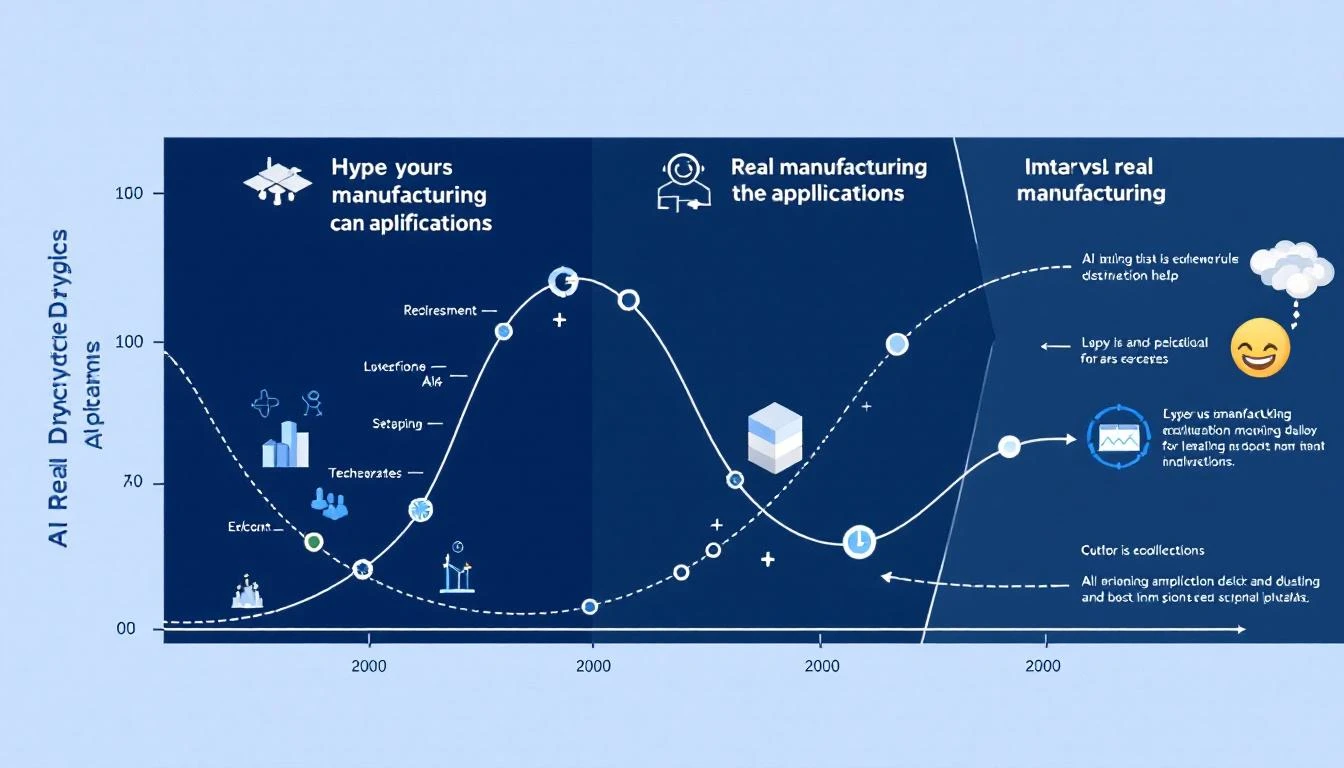
Now let's look at reality. According to the same surveys, only 5-10% of manufacturing AI projects make it from pilot to full-scale production deployment. Most stall at proof-of-concept, die from lack of data quality, or get killed by the gap between what data scientists build and what operations teams can actually use.
The honest truth: AI in manufacturing is real, but narrowly. A handful of applications deliver genuine, measurable ROI today. The rest is either too early, too complex, or too disconnected from the actual production workflow to matter.
What's Actually Working (The Real)
1. Predictive Maintenance — REAL ✅
This is the most mature and highest-ROI application of AI in manufacturing. And it works because the problem is well-defined: use historical sensor data to predict when equipment will fail.
Why it works:
- Clear, measurable outcome (prevented downtime = saved money)
- Data is available from PLCs, sensors, SCADA systems
- Failure patterns are often consistent and learnable
- Small improvements in failure prediction yield outsized ROI
Real results:
- Average 25-30% reduction in maintenance costs (U.S. Department of Energy)
- 70-75% reduction in breakdowns (McKinsey, manufacturing sector)
- Typical 5-8 week ROI when using modern IIoT platforms
MachineCDN's AI engine, for example, uses anomaly detection on streaming PLC data to identify degradation patterns weeks before failure. It doesn't require labeled failure data — it learns what "normal" looks like and flags deviations. This is the approach that actually scales in real manufacturing environments where historical failure records are spotty at best.
Readiness level: Production-ready. If you're not using predictive maintenance in 2026, you're leaving money on the floor.
2. Automated Quality Inspection (Computer Vision) — REAL ✅
Vision-based defect detection is the second most mature AI application in manufacturing. Cameras + deep learning identify surface defects, assembly errors, and dimensional variations faster and more consistently than human inspectors.
Why it works:
- Visual inspection is repetitive, fatigue-prone, and subjective — perfect for AI
- Modern vision models (YOLO, EfficientNet) run at 30+ FPS on $500 edge hardware
- Training data is relatively easy to collect (take photos of good and bad parts)
- The ROI is clear: fewer escapes, less rework, lower warranty costs
Where it's genuinely deployed:
- Automotive (paint inspection, weld validation, assembly verification)
- Electronics (PCB inspection, solder joint quality)
- Packaging (label verification, fill level, seal integrity)
- Metals (surface defect detection on steel/aluminum)
Readiness level: Production-ready for controlled environments. Still struggles with highly variable products, poor lighting, and edge cases that weren't in the training data.
3. Energy Optimization — REAL ✅
AI-driven energy management in manufacturing works because the feedback loop is immediate and measurable. Power meters provide second-by-second data; utility rates provide the cost function; the optimizer adjusts equipment schedules, HVAC setpoints, and production sequencing to minimize energy spend.
Real savings: 10-25% energy cost reduction is typical, primarily from:
- Load shifting to off-peak rate periods
- Identifying and eliminating energy waste (machines idling at full power)
- Optimizing compressed air, HVAC, and chiller systems
- Energy monitoring per machine to pinpoint inefficiencies
Readiness level: Production-ready. Especially for energy-intensive operations (metals, chemicals, glass, plastics).
4. Demand Forecasting / Production Scheduling — MOSTLY REAL ⚡
AI-based demand forecasting for production planning is effective but context-dependent. It works well for stable, high-volume production with historical patterns. It struggles with:
- New product introductions (no historical data)
- Highly volatile demand (fashion, seasonal, pandemic-driven shifts)
- Make-to-order environments with long lead times
Where it genuinely adds value:
- Consumer goods with seasonal patterns
- Automotive component suppliers with stable programs
- Food & beverage with predictable consumption patterns
Readiness level: Production-ready for stable-demand environments. Experimental for volatile markets.
What's Mostly Hype (In 2026)
5. "Autonomous" Manufacturing — HYPE ❌
The vision: lights-out factories where AI runs everything, humans are optional, and production optimizes itself in real-time.
The reality: No factory runs autonomously. Not one. Not even close. The most automated plants in the world (semiconductor fabs, highly automated automotive lines) still have hundreds of humans managing exceptions, quality decisions, material handling, and the inevitable equipment issues that automation can't handle.
Why it's still hype:
- Manufacturing has too many edge cases for fully autonomous operation
- Material variability, supplier changes, and product mix shifts create constant new situations
- Regulations (especially pharma, food, aerospace) require human decision-making and accountability
- The cost of autonomy failure in manufacturing is catastrophic (scrap, safety, customer escapes)
What's actually happening: Increasing automation of specific, well-defined tasks (robotic assembly, automated inspection, autonomous mobile robots for material movement). But "autonomous manufacturing" as a concept? A decade away at minimum.
6. Generative AI for Product Design — MOSTLY HYPE ⚡
Every CAD vendor now offers "AI-generated designs." The demos are impressive. The production reality is different.
What works:
- Generative design for topology optimization (lightweighting, structural optimization) — this is real and used in aerospace and automotive
- AI-assisted design space exploration (suggesting design variants)
What doesn't work yet:
- Generating production-ready CAD models from text descriptions (the "ChatGPT for engineering" dream)
- Replacing DFM (design for manufacturability) expertise with AI
- Understanding manufacturing constraints (tooling, material availability, process capability) from training data alone
Readiness level: Useful as an engineering tool. Not a replacement for engineering judgment.
7. Digital Twins for Real-Time Optimization — PARTIALLY REAL ⚡
Digital twins are real as a concept. The physics-based simulation of equipment and processes is well-established (Siemens, Ansys, Dassault). What's hyped is the "real-time" part.
A true real-time digital twin — one that continuously ingests live sensor data, updates its physics model, and makes production optimization recommendations — requires:
- Extremely accurate physics models (expensive to build)
- High-fidelity, low-latency sensor data (expensive to instrument)
- Calibration and validation against actual production data (time-consuming)
- Someone who can act on the recommendations (often the bottleneck)
What's real today:
- Offline simulation for process development and optimization
- Historical data-driven models for what-if analysis
- Asset monitoring dashboards that show real-time status (not really "twin" — just monitoring)
What's still hype:
- Real-time closed-loop optimization through digital twins
- Self-correcting production based on twin predictions
- Multi-physics simulation running at production speeds
Readiness level: Valuable for process development and what-if analysis. Real-time closed-loop optimization is 3-5 years out for most manufacturers.
8. Natural Language Interfaces for Manufacturing — EARLY ⚡
"Ask your factory a question in plain English." It sounds amazing. And the underlying language models (GPT-5, Claude, Gemini) are genuinely capable of understanding manufacturing concepts.
The problem: The interface isn't the hard part. The data integration is. Before you can ask "why did Line 3 produce 8% fewer units last Tuesday," you need:
- Line 3's production data flowing to the cloud in real-time
- Downtime reasons properly coded and categorized
- Quality data linked to production timestamps
- Recipe/batch information correlated with output data
If you have all that data integrated (which most plants don't), then yes, a natural language interface adds value. But the NLP layer is 5% of the problem. The data infrastructure is 95%.
Readiness level: The AI is ready. The data integration in most plants isn't.
How to Cut Through the Hype
When evaluating any "AI-powered" manufacturing solution, apply these filters:
Filter 1: Where Does the Data Come From?
If the vendor can't clearly explain how their AI gets data from YOUR equipment — your specific PLC models, your protocols, your network — the product isn't real. It's a demo running on sample data.
The best IIoT platforms (like MachineCDN) solve this first — they connect to your actual PLCs via standard industrial protocols, stream real production data, and THEN apply AI. The data pipeline is the product. The AI is the value-add.
Filter 2: What's the Measurable Outcome?
"AI-powered insights" is not an outcome. Measurable outcomes look like:
- Unplanned downtime reduced by X%
- Maintenance costs reduced by $X/year
- Quality escapes reduced from X to Y ppm
- Energy costs reduced by X%
- OEE improved from X% to Y%
If the vendor can't point to specific, quantified results from actual manufacturing customers (not simulated lab results), be skeptical.
Filter 3: How Long to Value?
Enterprise AI projects that take 12-18 months to deliver first results have a high probability of failure. Organizational patience, budget cycles, and technology changes all work against long implementation timelines.
Look for platforms that deliver initial value in weeks, not months. Threshold alerts and anomaly detection should work within days of connecting equipment. MachineCDN's 5-week ROI timeline is realistic because the cellular connectivity model eliminates the 3-6 month IT integration phase that kills most IIoT projects.
Filter 4: Does It Work Without a Data Science Team?
If the AI requires your team to build, train, and maintain custom machine learning models, the total cost of ownership is massive. Most manufacturers don't have (and can't recruit) data scientists who also understand manufacturing processes.
The best solutions embed AI into the platform so that manufacturing domain experts — the people who know what the data means — can use it without writing code or managing models.
The Practical AI Roadmap for 2026
If you're a plant manager or manufacturing engineer wondering where to invest:
- This quarter: Connect your critical assets to a cloud IIoT platform. Get data flowing. Set up threshold alerts for obvious problems.
- Next quarter: Activate predictive maintenance on your top 10 machines. Measure downtime reduction.
- This year: Deploy automated visual inspection on one quality-critical process. Validate defect detection accuracy against human inspection.
- Next year: Explore energy optimization, production scheduling, and advanced analytics. By then, you'll have a year of historical data to work with.
Don't try to do everything at once. Don't buy the "AI-powered everything" platform. Start with the highest-ROI, most proven applications (predictive maintenance + quality inspection) and build from there.
The Bottom Line
AI in manufacturing is not a revolution — it's an evolution. The factories that will lead in 2026 and beyond are the ones that start with pragmatic, proven applications today, build their data infrastructure incrementally, and resist the temptation to chase every new AI buzzword.
The technology is ready. The gap is in execution, data infrastructure, and organizational readiness. Close that gap, and the returns are massive.
Book a demo with MachineCDN to see how AI-powered predictive maintenance works on your actual equipment — with real data, real results, and a real timeline.
Related reading: