The State of IIoT in 2026: What's Changed, What Hasn't, and What's Next

Six years ago, every analyst report predicted that IIoT would transform manufacturing by 2025. Billions of connected devices. AI-driven factories. Industry 4.0 fully realized. The estimates ranged from $500 billion to over $1 trillion in market value by now.
We're in 2026. Some of those predictions came true. Most didn't — at least not at the scale or speed predicted. The IIoT market has matured, but in different ways than the hype cycle anticipated. This article provides an honest, data-grounded assessment of where we actually stand.
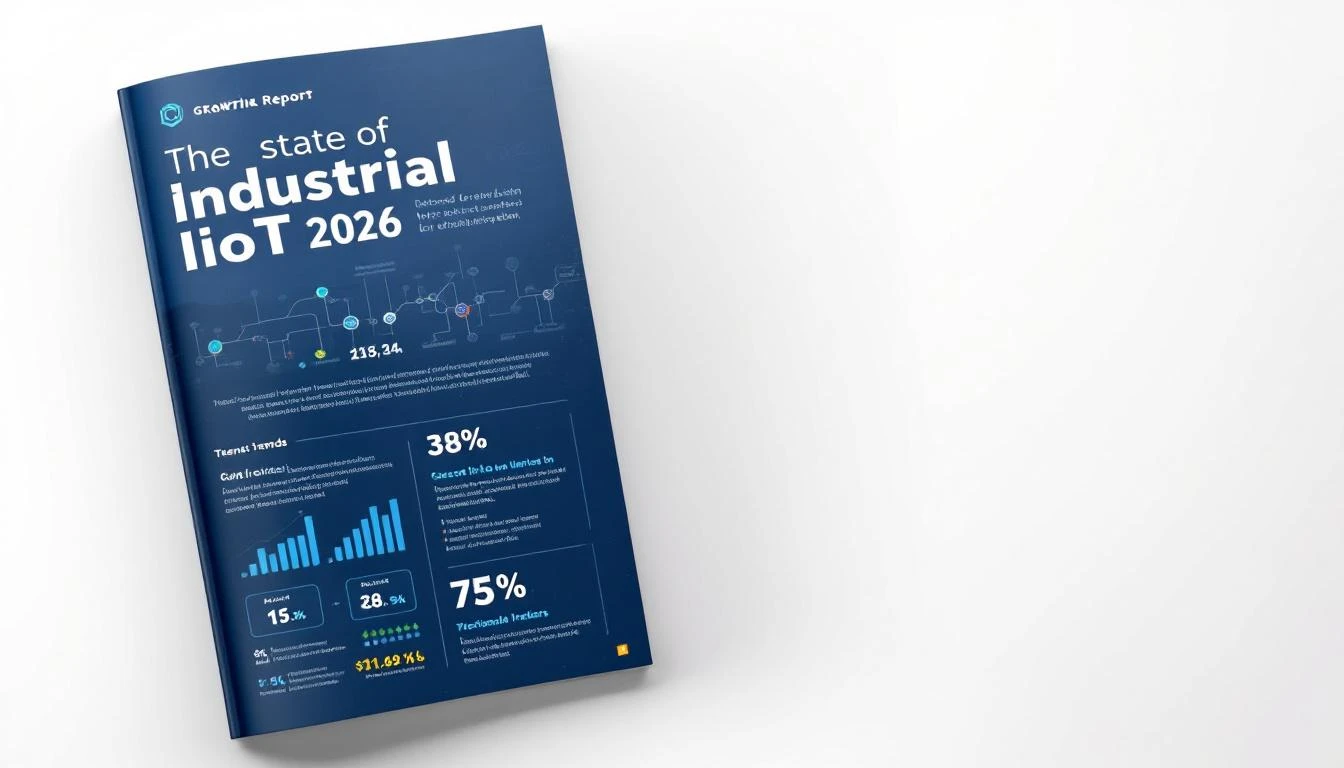
By the Numbers: IIoT in 2026
Let's start with what we know:
Market size: The global IIoT market is valued at approximately $280-320 billion in 2026, growing at 13-16% CAGR (IoT Analytics, Markets and Markets, Mordor Intelligence). That's real and substantial — but well below the $500B-1T forecasts from 2019.
Connected industrial devices: Approximately 15-17 billion IoT devices worldwide in 2026 (IoT Analytics), up from 12 billion in 2023. About 5-6 billion are in industrial/commercial settings. Growth is steady but not explosive.
Adoption rates:
- 72% of large manufacturers (1,000+ employees) have at least one IIoT pilot or production deployment (McKinsey, 2025)
- Only 25-30% have scaled IIoT beyond pilot to enterprise-wide deployment
- Small and mid-sized manufacturers (under 500 employees): 15-25% adoption rate
- The pilot-to-production gap remains the industry's biggest problem
Spending priorities (Gartner, 2025 survey):
- Predictive maintenance and asset monitoring (68% of respondents)
- Quality inspection and control (54%)
- Energy management and sustainability (48%)
- Production optimization and OEE (45%)
- Supply chain visibility (38%)
- Digital twins (22% — down from the hype peak)
What Actually Changed (2020-2026)
1. Cellular IIoT Became Mainstream
The single biggest shift in IIoT deployment patterns has been the move from plant-network-dependent architectures to cellular connectivity.
Why this matters: The #1 barrier to IIoT adoption was never technology — it was IT/OT convergence politics. Convincing IT departments to allow OT equipment on the corporate network took 6-18 months of security reviews, VLANs, firewall rules, and organizational negotiation. Many projects died during this phase.
Cellular-first IIoT platforms like MachineCDN eliminated this bottleneck entirely. Edge gateways with built-in cellular modems connect PLCs directly to the cloud without touching the plant network. Deployment timelines went from months to days. The IT department went from blocker to bystander.
5G Private Networks are emerging in large factories (automotive, semiconductor), but 4G LTE remains the workhorse for most IIoT deployments. The bandwidth requirements for typical machine monitoring (50-200 KB/s per machine) are well within LTE capabilities.
2. AI-Powered Monitoring Replaced Rules-Based Alerting
In 2020, most IIoT alerting was threshold-based: "If temperature exceeds 180°F, send alert." These systems generated so many false alarms that maintenance teams learned to ignore them.
By 2026, anomaly detection and predictive maintenance are the standard for serious IIoT deployments. Machine learning models learn what "normal" looks like for each machine in its operating context and flag meaningful deviations — not just threshold crossings.
The key enabler: cloud AI services (Azure OpenAI, AWS SageMaker, Google Vertex AI) made it possible to run sophisticated ML models on manufacturing data without hiring a data science team. Platforms like MachineCDN embed these capabilities natively.
3. Edge Computing Matured
"Edge computing" was a buzzword in 2020. By 2026, it's a standard architectural component. Modern edge gateways:
- Filter and pre-process data before cloud transmission (reducing bandwidth by 60-90%)
- Run basic anomaly detection locally (alert even during cloud connectivity gaps)
- Buffer data during network outages (store-and-forward)
- Support OTA firmware and configuration updates
- Handle protocol translation (Ethernet/IP, Modbus, OPC UA → MQTT/HTTPS)
The edge computing layer went from "nice to have" to "essential infrastructure" for any industrial deployment.
4. Consolidation Hit the Vendor Landscape
The IIoT platform market went through significant consolidation:
- PTC acquired ServiceMax (2023), doubling down on asset lifecycle management
- Siemens rebranded MindSphere to Insights Hub and integrated it into Xcelerator
- GE Digital sold off to private equity, fragmenting the Predix customer base
- AWS, Azure, and GCP all launched manufacturing-specific IIoT services, competing with pure-play vendors
- Dozens of startups either folded, were acquired, or pivoted — the market couldn't support 200+ IIoT platform vendors
The survivors fall into three categories:
- Industrial conglomerates (Siemens, Rockwell, Honeywell) — deep manufacturing expertise, expensive, complex
- Cloud giants (AWS IoT SiteWise, Azure IoT Hub) — powerful but requires significant assembly
- Purpose-built platforms (MachineCDN, MachineMetrics, Samsara) — fastest time to value, manufacturing-focused
5. Sustainability Became a Buying Criteria
ESG reporting requirements (EU's CSRD, SEC climate disclosure rules) made energy monitoring and sustainability tracking a boardroom priority, not just an engineering nice-to-have.
IIoT platforms that include energy consumption monitoring per machine saw increased demand. The ability to prove — with data — that your factory is reducing energy consumption and carbon emissions became a competitive advantage in both regulatory compliance and customer sales processes.

What Hasn't Changed (Despite the Predictions)
1. The Pilot Purgatory Problem
The most cited statistic in IIoT is still true: most pilots don't scale. According to McKinsey's 2025 manufacturing survey, 70% of IIoT pilots remain pilots after 18 months.
Root causes (unchanged from 2020):
- Unclear ROI measurement (deployed the tech, can't prove the value)
- Organizational resistance (maintenance teams don't change their workflow)
- IT/OT cultural divide (still the biggest organizational barrier)
- Vendor lock-in fear (committed to a platform, worried about switching costs)
- Talent gap (not enough people who understand both manufacturing AND data)
What works: Starting small, proving value on 5-10 machines, quantifying the ROI (ideally a prevented downtime event with clear cost avoidance), then expanding. Plants that follow this pattern scale successfully 70%+ of the time. Plants that try to do 500 machines at once succeed less than 20% of the time.
2. Legacy Equipment Remains the Majority
Despite predictions of massive equipment modernization, the average age of manufacturing equipment in the U.S. is still 15-20 years. Most factories run PLCs from the 2000s and 2010s. Many have equipment from the 1990s or earlier.
The good news: you don't need new equipment for IIoT. Modern edge gateways connect to legacy PLCs via Modbus RTU (RS-485 serial) — a protocol that's been around since 1979 and is supported by virtually every industrial controller ever made. Even equipment that predates digital controllers can be instrumented with retrofit sensors.
3. Standards Fragmentation Persists
There is still no single IIoT standard. OPC UA is the closest thing to universal, but adoption is uneven. The protocol landscape:
- Ethernet/IP: Dominant in North America (Allen-Bradley/Rockwell)
- Profinet: Dominant in Europe (Siemens)
- OPC UA: Growing but not universal
- MQTT: Standard for cloud communication but not for PLC-level
- Modbus: The cockroach of industrial protocols — unkillable, everywhere
The practical response: use a platform that abstracts protocol differences at the edge. MachineCDN's edge gateways handle Ethernet/IP, Modbus TCP/RTU, and OPC UA — your experience is the same regardless of what PLC you're connecting to.
4. Cybersecurity Anxiety Remains High
Every IIoT conversation still starts (or stalls) with "what about security?" This anxiety is justified — OT networks were never designed for internet connectivity, and the consequences of a manufacturing cyberattack are physical, not just digital.
The Colonial Pipeline attack (2021), attacks on water treatment facilities, and the increasing ransomware targeting of manufacturers have kept cybersecurity as the #1 concern in every IIoT adoption survey.
The best response continues to be architectural: use cellular connectivity to keep OT networks isolated, implement read-only data collection (never write to PLCs from the cloud), use TLS encryption for all cloud communication, and authenticate every device with certificates.
What's Next: IIoT Trends for 2026-2028
Trend 1: Generative AI Meets Manufacturing Data
LLMs that can query manufacturing data in natural language are emerging. Imagine asking: "Which machines are trending toward failure in the next 30 days?" or "What was the root cause of the quality spike on Line 5 last Wednesday?" and getting an accurate, data-backed answer.
The prerequisite: connected machines generating structured data in the cloud. If you don't have the data foundation, generative AI has nothing to query.
Trend 2: IIoT-as-a-Service
The trend toward fully managed IIoT — hardware, connectivity, platform, analytics bundled as a monthly subscription per machine — is accelerating. This model removes the CapEx barrier and puts the vendor responsible for uptime and data quality.
MachineCDN's model (edge gateway + cellular connectivity + cloud platform + AI as a subscription) represents this trend.
Trend 3: Autonomous Maintenance Planning
The next evolution beyond predictive maintenance: AI systems that not only predict failures but automatically schedule repairs, order spare parts, and optimize maintenance windows based on production schedules, parts availability, and labor capacity.
This requires integration between the IIoT platform, CMMS, ERP, and supply chain systems — integration that's becoming feasible as platforms mature.
Trend 4: Carbon-Aware Manufacturing
As carbon pricing mechanisms expand (EU ETS, potential US carbon pricing), manufacturers will need real-time carbon accounting at the machine level. IIoT energy monitoring data feeds directly into carbon calculations, making it a regulatory compliance tool, not just an optimization tool.
Trend 5: SMB Adoption Accelerates
The cost and complexity reductions in IIoT (cellular connectivity, platform-native AI, managed services) are finally making IIoT accessible to small and mid-sized manufacturers. The $50-200/machine/month price point, with no IT infrastructure requirement, removes the barriers that kept SMBs on the sidelines.
The Honest Assessment
IIoT in 2026 is real, valuable, and growing — but it's not the revolution that the hype cycle promised. It's an evolution. The manufacturers winning with IIoT are the ones who:
- Started simple — connected critical assets, proved ROI on a few machines
- Chose cellular — eliminated the IT bottleneck
- Focused on outcomes — reduced downtime, improved OEE, cut maintenance costs
- Picked platforms, not projects — used purpose-built solutions instead of building custom
- Scaled incrementally — 5 machines → 50 → 500, not 500 on day one
The technology is mature enough. The question isn't whether IIoT works — it's whether your organization is ready to use it.
Getting Started
If you're in the 70%+ of small and mid-sized manufacturers that haven't started your IIoT journey, the barrier has never been lower. Connect one machine, see the data, experience the value. Then decide how fast to scale.
Book a demo with MachineCDN to see the state of the art in 2026: 3-minute device setup, cellular connectivity, AI-powered predictive maintenance, and ROI in 5 weeks.
Related reading: