How to Choose an IIoT Platform: The Manufacturing Engineer's Evaluation Framework

Choosing an Industrial IoT platform is one of the most consequential technology decisions a manufacturing organization can make. Get it right, and you unlock real-time visibility, predictive maintenance, and measurable OEE improvements within weeks. Get it wrong, and you're looking at a 12-18 month implementation that never reaches production — a scenario that plays out in roughly 75% of IIoT projects, according to Cisco's widely cited research.
The problem isn't a lack of options. There are dozens of IIoT platforms on the market, ranging from hyperscaler offerings (AWS IoT SiteWise, Azure IoT) to industrial incumbents (Siemens MindSphere, Rockwell FactoryTalk) to purpose-built solutions like MachineCDN. The problem is that most evaluation frameworks focus on the wrong criteria — feature checklists and vendor demos rather than the factors that actually determine whether a platform will work in your plant.
This guide gives you the evaluation framework that plant engineers and maintenance leaders actually need. Not marketing fluff. Not analyst quadrants. A practical, field-tested set of criteria based on what separates IIoT platforms that deliver value from those that become expensive shelfware.
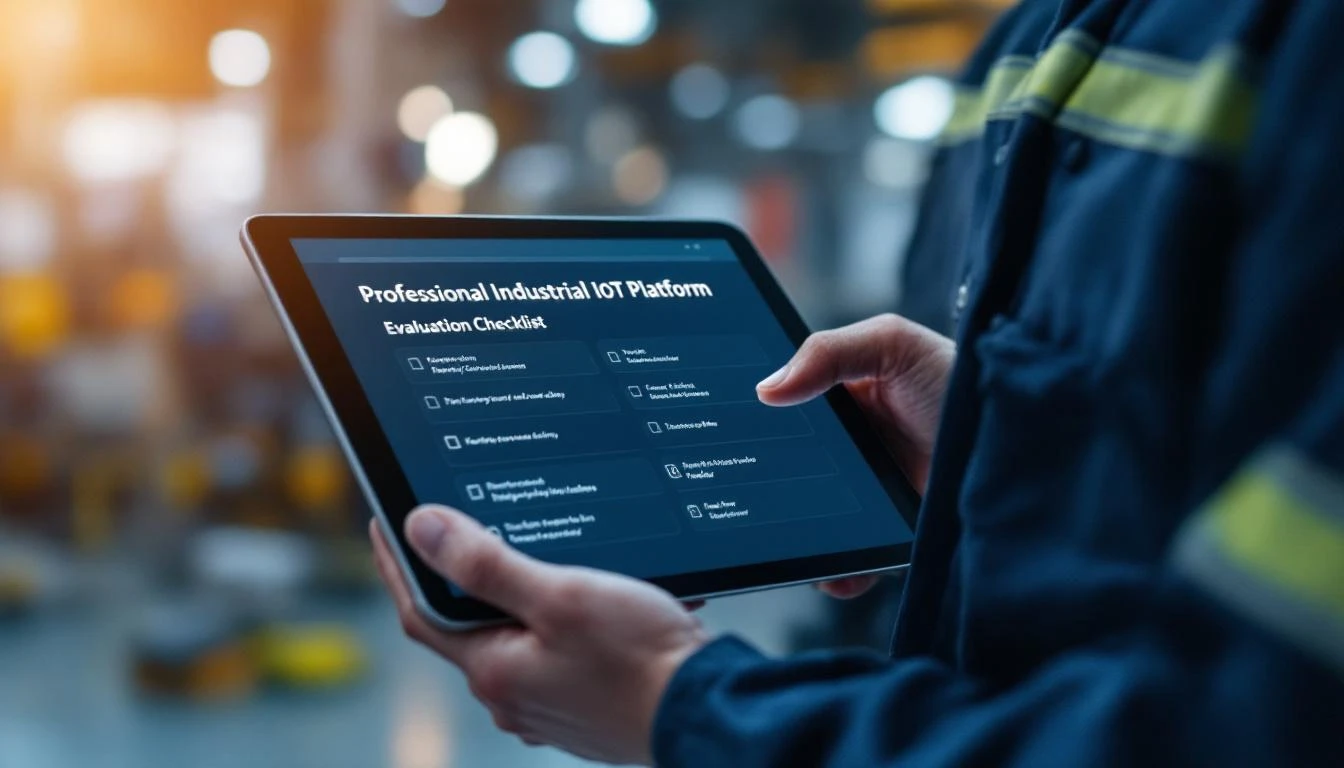
Criterion 1: Time to First Data — The Single Most Important Metric
Before evaluating any other feature, ask one question: how long does it take to see live data from one machine on the platform?
This is the single most predictive metric for IIoT project success. Platforms that require weeks of configuration, gateway programming, and IT coordination before you see your first data point have a dramatically higher failure rate than platforms that get you to live data in hours or days.
Here's why this matters so much: IIoT projects lose organizational momentum faster than almost any other technology initiative. Every week between "we bought this" and "look, here's live OEE data from Line 3" is a week where skeptics gain ground, budgets get questioned, and the maintenance team goes back to their spreadsheets.
What to look for:
- Can you connect a single machine and see live data in under a day?
- Does the platform require custom gateway programming, or is configuration-based?
- How many IT tickets need to be filed before the first device goes online?
- Can maintenance engineers set up devices, or is a controls engineer required?
MachineCDN is designed around this principle — devices connect in roughly 3 minutes, and you're seeing live PLC data immediately. No gateway programming. No IT involvement. Cellular connectivity means you bypass the plant network entirely. This isn't a marketing claim — it's an architectural decision that changes the entire deployment dynamic.
Red flags:
- "Typical deployment timeline: 3-6 months"
- Requires a professional services engagement to connect the first device
- Gateway hardware requires custom firmware or scripting
- IT network team must provision VLANs, firewall rules, or VPN tunnels before deployment
Criterion 2: Protocol Coverage — Can It Actually Talk to Your Equipment?
Manufacturing floors are not homogeneous. A typical discrete manufacturing plant might have Rockwell PLCs on newer lines, Siemens on older ones, Modbus devices on auxiliaries, and analog sensors on legacy equipment. A platform that only speaks OPC UA — or worse, requires proprietary sensors — will leave significant gaps in your visibility.
What to evaluate:
- Ethernet/IP support: Essential for Rockwell/Allen-Bradley environments (still the largest installed base in North America)
- Modbus TCP and RTU: Covers the long tail of industrial devices — VFDs, power meters, environmental sensors, older PLCs
- OPC UA: Important for multi-vendor environments, especially with newer Siemens, Beckhoff, and B&R equipment
- Analog/digital I/O: Some platforms support direct sensor connections for equipment without PLCs
The critical question isn't "what protocols do you support?" — every vendor will claim broad support. The question is "can I connect to this specific Rockwell CompactLogix running firmware v32 and read these specific tags without custom scripting?" Ask for a proof of concept with your actual equipment.
Industry benchmarks: According to IoT Analytics, Modbus and Ethernet/IP together account for over 60% of industrial protocol traffic in discrete manufacturing. If a platform can't handle both natively, it's not ready for manufacturing.
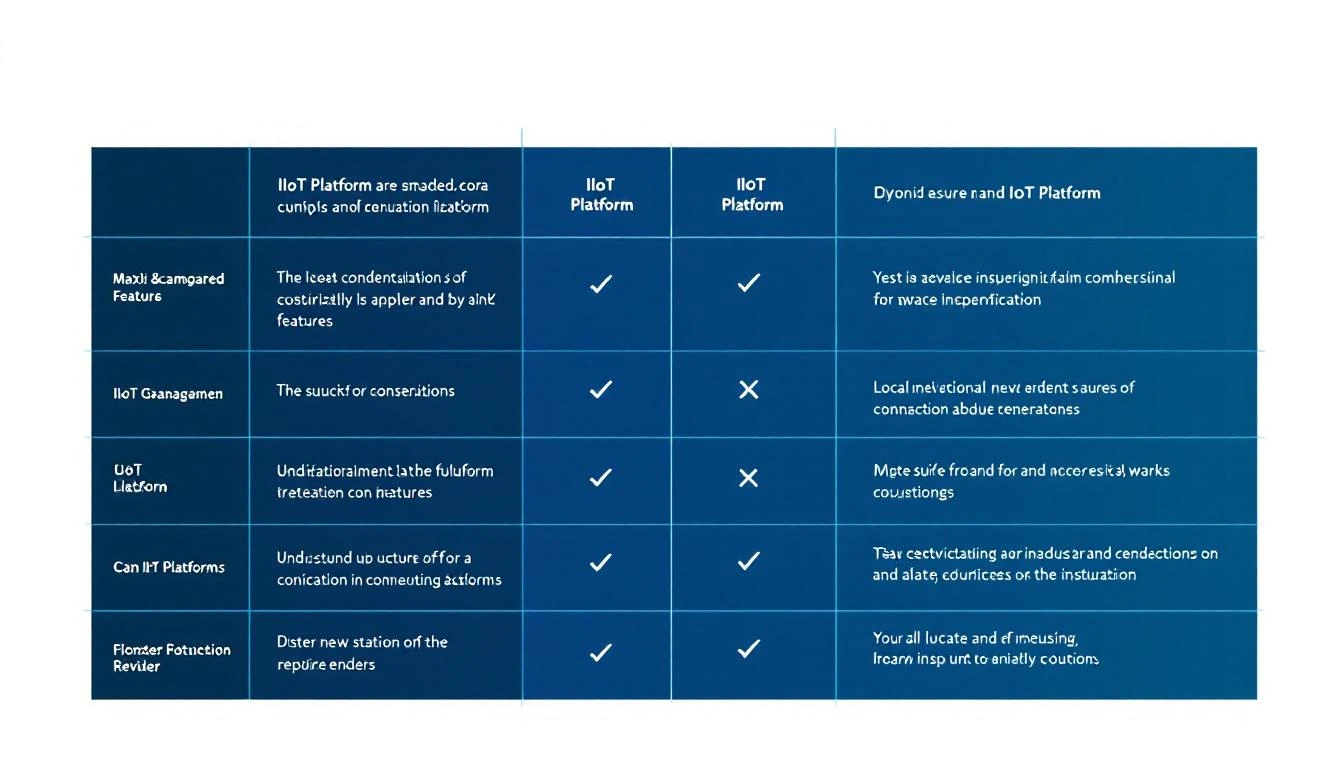
Criterion 3: Edge Architecture — Where Does Data Processing Happen?
The edge architecture question has enormous implications for latency, bandwidth costs, reliability, and security. There are three basic models:
Cloud-only: All data ships to the cloud for processing. Simple architecturally, but creates bandwidth bottlenecks, adds latency for real-time alerts, and fails completely when internet connectivity drops. Most hyperscaler IIoT offerings started here.
Edge-heavy: Most processing happens at the edge, with aggregated or anomaly data sent to the cloud. Better for latency and bandwidth, but edge hardware becomes complex and expensive. PTC ThingWorx and some AVEVA configurations fall here.
Intelligent edge: The edge device handles data collection, local buffering, and threshold detection, while the cloud handles analytics, ML/AI, visualization, and long-term storage. This is the architecture that most successful IIoT deployments use in 2026.
What matters in practice:
- Store-and-forward: When connectivity drops (and it will), does the edge device buffer data locally and forward it when connectivity returns? If not, you'll have gaps in your historical data — gaps that make trend analysis and root cause investigation unreliable.
- Edge processing for alerts: Threshold alerts that route through the cloud add 2-15 seconds of latency. For critical alarms (temperature exceedances, vibration spikes), that delay can mean the difference between an early warning and a failure event.
- Bandwidth costs: A single PLC reading 50 tags at 1-second intervals generates roughly 4 GB/month of raw data. Multiply by 100 machines and you're looking at 400 GB/month of cloud ingestion — a meaningful cost at hyperscaler pricing.
MachineCDN uses an intelligent edge architecture — the edge device handles data collection and local processing at configurable intervals, while cloud-based AI handles predictive analytics and visualization. Cellular connectivity keeps bandwidth costs predictable and eliminates IT network dependencies.
Criterion 4: Maintenance Integration — Beyond Monitoring
Monitoring without action is just an expensive way to watch things break. The real value of an IIoT platform comes when machine data drives maintenance decisions — and that requires integration between your monitoring platform and your maintenance workflows.
Three levels of maintenance integration:
Level 1 — Alerting: The platform sends notifications when thresholds are exceeded. Most platforms do this. It's table stakes, not a differentiator.
Level 2 — Work order integration: The platform connects to your CMMS (Fiix, UpKeep, Limble, SAP PM) and automatically creates work orders when conditions warrant maintenance. Better, but still reactive — you're responding to conditions that have already deteriorated.
Level 3 — Predictive maintenance with built-in workflows: The platform uses machine learning to predict failures before they occur AND has built-in maintenance management capabilities (PM scheduling, spare parts tracking, technician assignment). This eliminates the gap between "we detected a problem" and "someone is working on it."
Evaluate where each platform falls on this spectrum. Platforms that stop at Level 1 will leave you managing two systems — one for monitoring and one for maintenance. That's a recipe for data silos and missed maintenance windows.
MachineCDN operates at Level 3, with AI-powered predictive maintenance, built-in PM scheduling, spare parts tracking, and comprehensive alarm management. You're not just monitoring — you're managing the entire maintenance lifecycle from a single platform.
Criterion 5: Multi-Site Scalability — The Fleet Management Test
Here's a pattern that repeats across the industry: a platform works beautifully in a single-plant pilot but falls apart when you try to scale across 5, 10, or 50 sites. The reasons are usually architectural.
Questions to ask:
- Multi-tenant architecture: Can you see all sites in a single dashboard with drill-down capability? Or do you need separate instances per site?
- Centralized device management: Can you push configuration changes to edge devices across all sites from a central console? Or does someone need to physically visit each location?
- Role-based access: Can you give plant managers visibility into their site only, while giving corporate engineering a cross-plant view?
- Standardized deployment: Is the setup process identical across sites, or does each site require custom configuration?
The fleet management litmus test: Ask the vendor to show you a dashboard with 10+ sites, 500+ machines, and real data. Not a demo environment — real customer data (anonymized). If they can't show this, they haven't proven multi-site scalability.
MachineCDN was built for fleet management across multiple locations. Zones, locations, and hierarchical views let you manage machine fleets the way you actually organize your operations — by plant, by line, by work cell.
Criterion 6: Total Cost of Ownership — The Hidden Expenses
IIoT platform pricing is notoriously opaque. The license fee you see on the proposal is typically 30-40% of the total cost of ownership over three years. The rest hides in places that only become visible after you've committed.
Hidden cost categories:
- Gateway hardware: Some platforms require $2,000-$10,000 industrial PCs at each site. Others use $200-$500 industrial routers. The hardware delta across 10 sites is $18K-$95K.
- Professional services: Enterprise IIoT platforms (ThingWorx, MindSphere, AVEVA) typically require $50K-$200K in professional services for initial deployment. Purpose-built platforms often include deployment support in the license fee.
- Cloud infrastructure: Hyperscaler-based platforms (AWS IoT SiteWise, Azure IoT) charge separately for cloud compute, storage, and data ingestion. These costs scale linearly with data volume and are difficult to predict.
- Connectivity: Ethernet-based platforms have no connectivity cost but require IT involvement. Cellular-based platforms have a predictable monthly cost per device but eliminate IT dependency.
- Training and ongoing support: Complex platforms require dedicated engineers. Simple platforms let existing maintenance staff manage the system.
Build a 3-year TCO model that includes all of these categories. Compare platforms on total cost per monitored machine per month — this normalizes the comparison across different pricing structures.
For more detail on how specific platforms price, see our guides on Litmus pricing, Samsara pricing, and IoTFlows pricing.
Criterion 7: Vendor Viability and Ecosystem
This criterion is uncomfortable but essential. IIoT is a market where vendors disappear, get acquired, or pivot away from manufacturing. GE Predix was the poster child for IIoT — until GE Digital was spun off and Predix was effectively sunset. Uptake raised $250M+ and pivoted away from its original manufacturing focus.
What to evaluate:
- Revenue and growth trajectory: Is the vendor growing? Can they sustain operations independently?
- Customer concentration: Is the vendor dependent on a small number of large customers?
- Technology independence: Is the platform built on proprietary infrastructure, or does it leverage cloud providers that ensure portability?
- Data portability: Can you export your historical data if you need to switch? In what format?
- Integration ecosystem: Does the platform integrate with the tools you already use (CMMS, ERP, BI)?
The Evaluation Playbook: From Shortlist to Decision
Here's the practical process for selecting an IIoT platform:
Week 1-2: Define requirements. Document your specific use cases, equipment types, protocol requirements, and success metrics. Don't start evaluating until you know what you're solving for.
Week 3-4: Shortlist. Use the seven criteria above to narrow the field to 3-4 platforms. Eliminate any platform that can't meet your core protocol and scalability requirements.
Week 5-6: Proof of concept. Run a POC with your top 2 candidates using your actual equipment on your actual factory floor. Not a demo with synthetic data — a real deployment with real PLCs.
Week 7-8: Evaluate and decide. Score each platform against the criteria with input from maintenance, engineering, IT, and operations. Weight the criteria based on your organization's priorities.
What kills most evaluations: Analysis paralysis. Manufacturing teams that spend 6-12 months evaluating platforms almost always end up with decision fatigue and default to the "safe" choice (usually an incumbent's offering) rather than the best choice. Set a timeline and stick to it.
Start With a Pilot That Proves Value
The best way to evaluate an IIoT platform is to deploy it. Not as a 12-month project — as a 2-week pilot on 3-5 machines that matter.
MachineCDN was designed for exactly this kind of evaluation. Book a demo and we'll show you live data from your machines in the first session. No gateway programming. No IT tickets. No professional services engagement. Just plug in a device and start seeing what your machines are actually doing.
Because the best evaluation framework in the world can't replace seeing your own data on your own machines.