Condition-Based Monitoring vs Predictive Maintenance: What's the Difference and Which Do You Need?

The terms "condition-based monitoring" (CBM) and "predictive maintenance" (PdM) get thrown around interchangeably in the IIoT world, and that confusion costs manufacturers real money. They're related — PdM is essentially the evolution of CBM — but they're not the same thing, and understanding the difference changes how you implement your maintenance strategy.
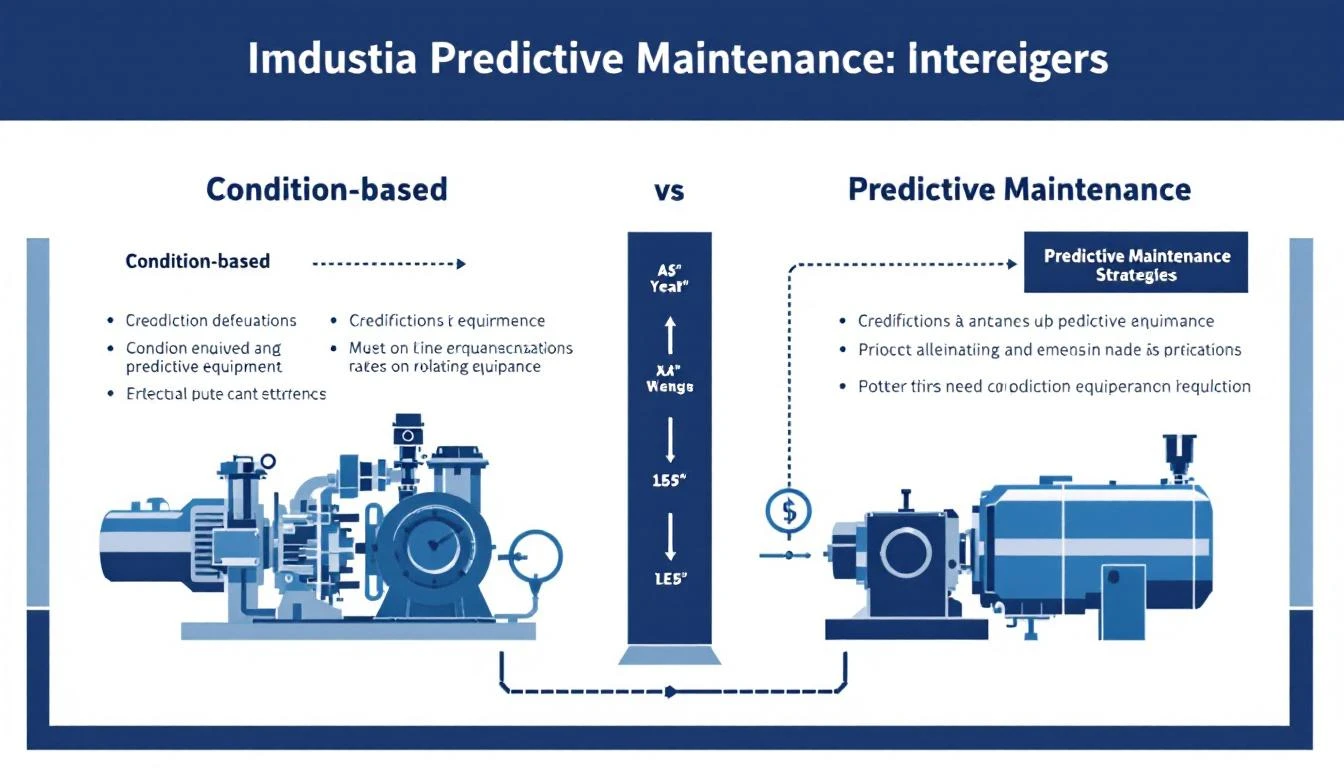
If you've been evaluating predictive maintenance software or debating whether your plant should invest in a CMMS or predictive maintenance platform, this guide clarifies exactly where CBM ends and PdM begins — and why the best approach combines both.
Defining the Terms Clearly
Condition-Based Monitoring (CBM)
CBM answers the question: "What is the current condition of this equipment?"
It involves continuous or periodic measurement of equipment parameters — vibration, temperature, pressure, current draw, oil quality, acoustic emissions — and comparing those measurements against established thresholds. When a parameter crosses a threshold, an alert fires and maintenance investigates.
CBM is reactive to condition, not to failure. It's a significant improvement over calendar-based maintenance (changing oil every 3 months regardless of condition) or run-to-failure (waiting for something to break). But CBM tells you what IS happening — not what WILL happen.
Example: A vibration sensor on a pump bearing reads 12 mm/s RMS, which exceeds the 10 mm/s alarm threshold. CBM flags the alert. A technician inspects and finds bearing wear. They schedule a replacement for the next maintenance window.
Predictive Maintenance (PdM)
PdM answers the question: "When is this equipment likely to fail, and how much useful life remains?"
PdM uses the same sensor data as CBM but applies machine learning models, statistical analysis, and pattern recognition to predict future condition based on current trends. Instead of firing an alert when a threshold is crossed, PdM estimates remaining useful life (RUL) and provides a timeline for degradation.
PdM is proactive. It doesn't just tell you the bearing is wearing — it predicts when the bearing will reach failure condition based on the current degradation rate, historical failure patterns, and operating conditions.
Example: The same pump bearing currently reads 7 mm/s RMS — well below the alarm threshold. PdM analyzes the trend: vibration has increased from 4 mm/s to 7 mm/s over the past 6 weeks, accelerating in the last 2 weeks. The AI model predicts the bearing will reach critical condition in 18–24 days. Maintenance orders the replacement bearing now, schedules the repair during a planned downtime window in 2 weeks, and avoids both an unplanned stop and unnecessary early intervention.
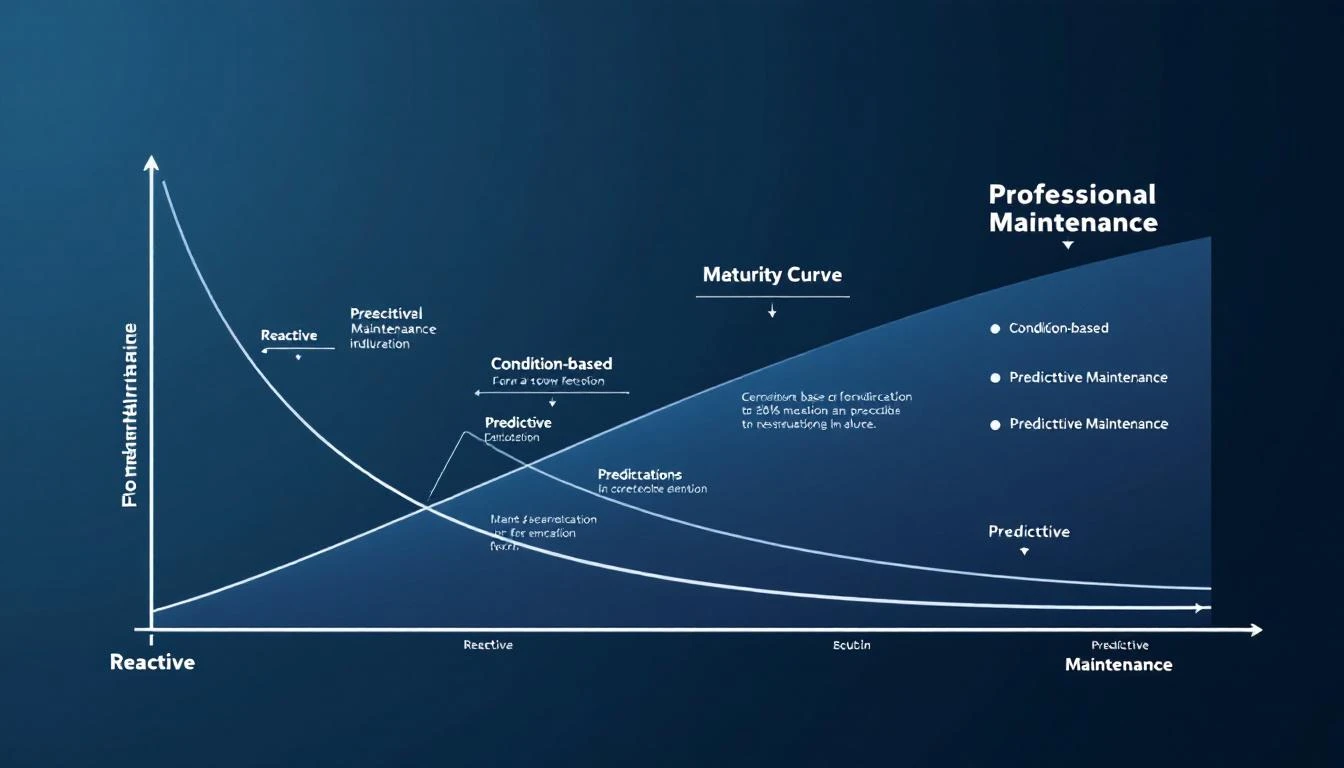
The Five Maintenance Maturity Levels
Understanding CBM vs. PdM requires seeing where they fit in the broader maintenance evolution:
| Level | Strategy | Approach | Cost Profile |
|---|---|---|---|
| 1 | Reactive (Run-to-Failure) | Fix it when it breaks | Highest total cost: emergency repairs, production losses, safety risk |
| 2 | Calendar-Based (Preventive) | Replace/service on a fixed schedule | Over-maintains healthy equipment, under-maintains stressed equipment |
| 3 | Condition-Based (CBM) | Monitor condition, act on thresholds | Better targeting but limited lead time — alerts fire when problems are already developing |
| 4 | Predictive (PdM) | AI predicts failures, estimates remaining life | Optimal maintenance timing with weeks of advance warning |
| 5 | Prescriptive | AI recommends specific actions and operating changes | Emerging — combines prediction with actionable recommendations |
Most manufacturers today are at Level 2 (calendar-based) and aspire to Level 3 or 4. The jump from Level 2 to Level 3 (CBM) is primarily an instrumentation and monitoring investment. The jump from Level 3 to Level 4 (PdM) is primarily a data science and AI investment — which is why IIoT platforms with built-in AI are so valuable.
CBM vs. PdM: Detailed Comparison
Detection Window
CBM: Alerts when condition crosses a threshold. By definition, the equipment is already in a degraded state when you learn about it. Depending on the equipment and failure mode, you might have hours, days, or weeks before failure — but you're already on the clock.
PdM: Identifies degradation trends early — often weeks or months before threshold-based alerts would fire. This extended detection window is the primary financial benefit: you have time to order parts, schedule repairs during planned downtime, and optimize maintenance labor.
False Alarm Rate
CBM: Threshold-based alerts are binary — above or below the limit. This creates two problems:
- False positives: A momentary spike (transient load, measurement noise) triggers an alarm even though the equipment is healthy
- Missed detections: Gradual degradation that stays just below the threshold until sudden failure
PdM: AI models analyze patterns and trends, reducing false alarms significantly. A momentary spike doesn't trigger an alert because the model considers the full context — historical baseline, operating conditions, time-series trend. Research from the International Society of Automation shows that AI-based predictive models reduce false alarm rates by 60–80% compared to threshold-based monitoring.
Data Requirements
CBM: Relatively straightforward — collect sensor data, set thresholds, trigger alerts. Can be implemented with basic industrial instrumentation and SCADA.
PdM: Requires historical data (typically 3–6 months minimum) to train models. Needs higher-frequency data collection for pattern recognition. Benefits from contextual data (operating conditions, load profiles, environmental factors) that CBM typically ignores.
Maintenance Planning Impact
CBM: Improves maintenance by replacing calendar-based schedules with condition-based triggers. But lead time is limited — you're reacting to a condition that already exists.
PdM: Transforms maintenance from reactive to truly planned. With 2–4 weeks of advance warning:
- Parts can be ordered without expediting fees (typically 2–5x normal cost)
- Repairs can be scheduled during planned downtime (no production loss)
- Maintenance labor can be optimized (no emergency overtime)
- Multiple repairs can be batched for efficiency
Cost Impact
According to Deloitte's predictive maintenance research, the financial impact breaks down as:
| Metric | Calendar-Based | CBM | PdM |
|---|---|---|---|
| Maintenance cost reduction | Baseline | 10–20% | 25–40% |
| Unplanned downtime reduction | Baseline | 20–35% | 40–60% |
| Parts inventory reduction | Baseline | 5–10% | 15–25% |
| Equipment life extension | Baseline | 10–15% | 20–35% |
| Safety incident reduction | Baseline | 15–25% | 30–50% |
The gap between CBM and PdM is significant, but so is the gap between doing nothing and implementing CBM. Both represent meaningful improvements.
When to Use Each Approach
Use CBM (Threshold-Based) When:
- Equipment has clear failure thresholds — pump vibration limits, motor temperature limits, pressure vessel ratings. These are well-established in standards (ISO 10816 for vibration, IEEE for electrical equipment).
- Failure modes are sudden — some equipment goes from normal to failed quickly, with limited degradation pattern. CBM catches the event; PdM may not have enough trend data.
- Historical data is limited — new equipment or new monitoring installations don't have enough history for predictive models. Start with CBM, graduate to PdM as data accumulates.
- Simplicity is paramount — small maintenance teams without data science expertise may benefit more from clear, actionable threshold alerts than from probabilistic predictions.
Use PdM (AI-Powered Prediction) When:
- Equipment is critical — assets where unplanned failure costs $10K+ per hour justify the investment in predictive analytics
- Failure modes are gradual — bearing wear, pump degradation, motor insulation breakdown, heat exchanger fouling. These show trends over days or weeks that PdM excels at predicting.
- You have 3+ months of historical data — enough for AI models to learn normal operating patterns and detect anomalies
- Parts have long lead times — if replacement parts take 4–8 weeks to deliver, you need 4–8 weeks of advance warning. CBM often can't provide that.
- Multiple variables interact — when equipment health depends on combinations of temperature, vibration, current, pressure, and flow, AI models detect multi-variable patterns that threshold monitoring misses
Use Both (The Optimal Approach):
The best maintenance strategies layer CBM and PdM:
- PdM for early warning — catch degradation trends weeks in advance
- CBM thresholds as safety nets — even the best AI model can miss a failure mode. Threshold alerts provide the last line of defense before the safety system or physical failure
- PdM for planning, CBM for protection
This is exactly how platforms like MachineCDN work — threshold alerting runs continuously as CBM, while AI-powered analytics layer PdM on top. If the AI misses something, the threshold alert catches it. If the threshold hasn't fired yet, the AI might already be warning you.

Implementing CBM + PdM in Your Plant
Phase 1: Instrument and Monitor (CBM — Months 1-2)
- Identify critical assets — use a criticality matrix (failure probability × consequence)
- Connect to your IIoT platform — MachineCDN's 3-minute setup means you can instrument a machine during a shift break
- Set threshold alerts — start with manufacturer recommendations and industry standards (ISO, IEEE)
- Train operators — ensure the maintenance team knows how to respond to threshold alerts
- Collect baseline data — run for 30–60 days to establish normal operating patterns
Phase 2: Enable Prediction (PdM — Months 3-6)
- Validate baseline data — ensure you have representative data across operating conditions (load levels, product types, ambient temperatures)
- Enable AI models — platforms with built-in predictive analytics activate automatically once sufficient data exists
- Calibrate predictions — compare AI predictions against actual equipment behavior. Tune sensitivity as needed.
- Integrate with maintenance workflows — connect predictions to work orders and PM schedules
Phase 3: Optimize (Ongoing)
- Review prediction accuracy — monthly audits of predicted vs. actual failures
- Expand coverage — add more assets as the team gains confidence
- Benchmark across sites — use fleet management to compare equipment health across plants
- Connect to energy data — energy consumption changes are often the earliest predictive signal
The Technology Stack
To implement CBM + PdM effectively, you need:
| Component | CBM | PdM |
|---|---|---|
| Sensors/Data Source | PLC data, dedicated sensors | Same + historical time-series |
| Data Collection | Real-time, threshold comparison | Real-time + batch processing |
| Analytics | Fixed thresholds, band limits | Machine learning, trend analysis |
| Alerting | Binary (above/below threshold) | Probabilistic (% risk, RUL estimate) |
| Output | Alarm → investigate | Prediction → plan → schedule |
| Platform | SCADA, basic IIoT | Advanced IIoT with AI |
The key insight: platforms that combine both capabilities in a single deployment — like MachineCDN reading PLC data for real-time threshold monitoring AND applying AI for predictive analytics — deliver the best results because you instrument once and get both CBM and PdM from the same data stream.
Bottom Line
Condition-based monitoring tells you what's happening now. Predictive maintenance tells you what's going to happen next. Together, they form the foundation of a modern maintenance strategy that eliminates both the waste of calendar-based maintenance and the catastrophic cost of run-to-failure.
Don't get paralyzed choosing between them. Start with CBM (it's simpler and delivers immediate value), then graduate to PdM as your data matures. The right IIoT platform supports both from day one — so your investment in instrumentation and connectivity pays dividends at every maturity level.
Ready to start your journey from reactive to predictive? Book a demo with MachineCDN and see how threshold alerting and AI-powered prediction work together on your equipment.