IIoT for Chemical Manufacturing: How to Monitor Reactors, Distillation Columns, and Process Equipment in Real Time

Chemical manufacturing is one of the most complex — and highest-stakes — environments for industrial IoT deployment. A pharmaceutical plant or specialty chemical facility runs continuous processes where temperature deviations of 2°C, pressure spikes of 5 PSI, or flow rate fluctuations of 0.5 GPM can mean the difference between a quality product and a batch rejection worth $100,000 or more.
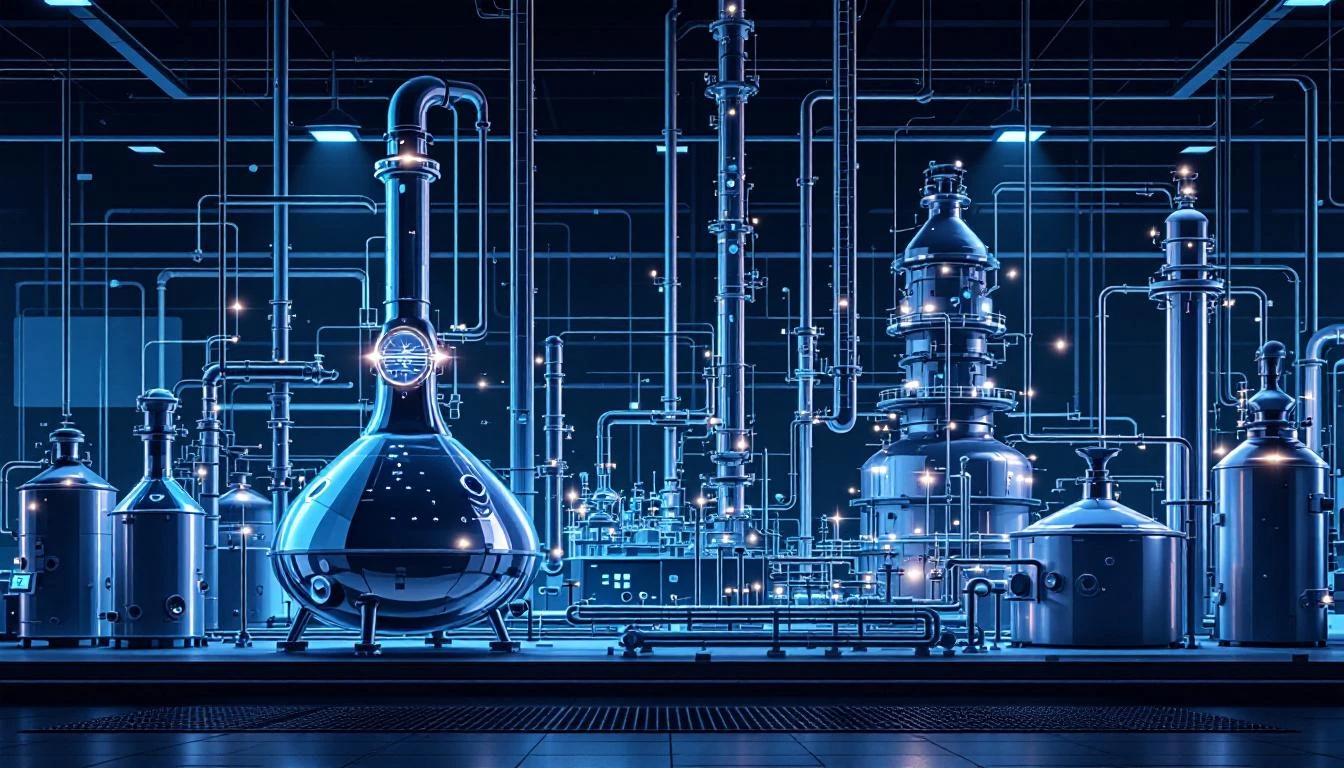
Yet many chemical plants still rely on DCS (Distributed Control Systems) and SCADA architectures designed in the 1990s — systems that excel at process control but fall short on predictive analytics, cloud-based visibility, and multi-site operational intelligence. This guide covers how modern IIoT platforms complement your existing process control infrastructure to deliver capabilities that legacy DCS simply can't provide.
What Makes Chemical Manufacturing Different for IIoT
Continuous Process vs. Discrete Manufacturing
Most IIoT platforms are built for discrete manufacturing — counting parts, tracking cycle times, monitoring CNC spindles. Chemical manufacturing operates fundamentally differently:
- Continuous flow processes — reactors, distillation columns, and heat exchangers run 24/7 for weeks or months between shutdowns
- Batch processes — reaction vessels follow precise recipes with time, temperature, and pressure profiles
- Multi-variable interdependency — changing one parameter (flow rate) affects multiple others (temperature, pressure, concentration, residence time)
- Safety-critical operations — runaway reactions, toxic releases, and pressure vessel failures have catastrophic consequences
- Regulatory burden — FDA (pharma), EPA (environmental), OSHA (safety), and industry-specific standards demand documented monitoring and traceability
The DCS/SCADA Gap
Your DCS handles real-time process control beautifully. It maintains temperatures, adjusts flow rates, and manages safety interlocks. But it wasn't designed for:
- Predictive maintenance — identifying equipment degradation before it causes process upsets
- Cross-plant analytics — comparing reactor performance across multiple facilities
- Cloud-based visibility — giving corporate engineering teams real-time insight without VPN tunnels into each plant's DCS
- Energy optimization — correlating energy consumption with production output and process efficiency
- AI-powered pattern recognition — detecting subtle process drift that human operators miss
IIoT doesn't replace your DCS. It sits alongside it, reading the same process data through industrial protocols and delivering analytics, predictions, and visibility that your control system was never designed to provide.
Key IIoT Applications in Chemical Manufacturing
1. Reactor Monitoring and Optimization
Reactors are the heart of chemical manufacturing. Whether you're running batch reactors, CSTRs (Continuously Stirred Tank Reactors), or tubular reactors, IIoT monitoring adds layers of intelligence:
Temperature profiling: Monitor jacket temperatures, internal temperatures at multiple points, and coolant flow rates. AI detects subtle thermal patterns that indicate:
- Catalyst deactivation (declining reaction rate requiring higher temperatures)
- Fouling on heat transfer surfaces (increasing temperature differential between jacket and internal)
- Approaching thermal runaway conditions (accelerating exotherms)
Pressure monitoring: Track reactor pressure, headspace composition, and relief valve status. Predictive models identify:
- Fouled vent lines (gradually increasing operating pressure)
- Seal degradation (pressure decay patterns)
- Process upsets before they trigger safety systems
Agitation monitoring: Motor current on agitator drives correlates with:
- Viscosity changes (reaction progress or batch quality)
- Mechanical wear (bearing degradation, shaft misalignment)
- Impeller fouling or damage
2. Distillation Column Optimization
Distillation columns are among the most energy-intensive unit operations in chemical manufacturing. Even small optimizations deliver significant savings:
Temperature profile monitoring: Track tray-by-tray temperatures to detect:
- Column flooding (sudden temperature profile flattening)
- Tray damage or fouling (abnormal temperature gradients between trays)
- Feed composition changes (shifting temperature profile)
- Suboptimal reflux ratio (energy waste)
Reboiler and condenser performance: Monitor heat transfer efficiency over time. Declining UA values indicate fouling that increases energy consumption before it causes operational problems.
Product quality prediction: Correlate column operating parameters with laboratory analysis results to predict product purity in real-time, reducing the need for frequent lab sampling.

3. Rotating Equipment Health
Chemical plants rely on hundreds of rotating machines — pumps, compressors, blowers, agitators, centrifuges. These are the workhorses that keep processes running, and their failure causes both production losses and safety hazards.
Pump monitoring:
- Discharge pressure and flow rate trending (pump curve degradation)
- Motor current analysis (cavitation, impeller wear, bearing failure)
- Seal flush system monitoring (seal leaks before they become environmental events)
Compressor monitoring:
- Suction and discharge pressure profiling
- Vibration trending (bearing condition, rotor balance)
- Surge detection and anti-surge valve monitoring
- Lubricant system condition
For more on rotating equipment monitoring, see our vibration monitoring systems guide and equipment health monitoring overview.
4. Heat Exchanger Performance Tracking
Heat exchangers foul over time, reducing efficiency and increasing energy consumption. Traditional cleaning schedules are either too frequent (wasting production time) or too infrequent (wasting energy). IIoT enables condition-based cleaning:
- Monitor approach temperatures — the difference between hot and cold outlet temperatures indicates fouling
- Track pressure drops — increasing ΔP across the exchanger signals flow restriction
- Calculate real-time UA values — declining heat transfer coefficients quantify fouling severity
- Predict optimal cleaning timing — clean based on data, not calendar
5. Safety and Environmental Monitoring
Chemical manufacturing has zero tolerance for safety lapses. IIoT augments your Safety Instrumented Systems (SIS) with:
- Fence-line monitoring — track ambient gas concentrations at facility boundaries
- Flare system monitoring — flow, temperature, and pilot status
- Relief valve monitoring — detect partial lifts and weeping that indicate process upsets
- Tank level trending — predict overflow events before they happen
- Corrosion monitoring — pipe wall thickness trending from UT sensors or corrosion coupons
Implementing IIoT in a Chemical Plant: Practical Considerations
Protocol Compatibility
Chemical plants typically use:
- Modbus TCP/RTU — dominant in process instrumentation (transmitters, analyzers, flow meters)
- HART — widely used for smart transmitter diagnostics
- Foundation Fieldbus / PROFIBUS PA — in DCS-integrated environments
- OPC UA — increasingly used as a bridge between DCS and higher-level systems
- Ethernet/IP — common in utility systems and discrete portions of chemical plants
Platforms like MachineCDN that support Ethernet/IP and Modbus TCP/RTU natively can connect to a wide range of chemical plant instrumentation without additional protocol converters.
Cybersecurity in Chemical Plants
Chemical plants are classified as critical infrastructure. IIoT cybersecurity must address:
- Network segmentation — IIoT data should flow through a DMZ, never directly from the DCS to the cloud
- Cellular connectivity advantage — platforms using cellular gateways bypass the plant network entirely, eliminating the largest attack surface. This is a significant architectural benefit over platforms requiring IT network integration
- IEC 62443 compliance — the international standard for industrial cybersecurity
- Air-gapped DCS — IIoT reads data without writing to the control system (read-only mode eliminates control risks)
For more on IIoT security, see our cybersecurity for industrial IoT guide.
Integration with Existing DCS
The key principle: IIoT complements your DCS, it doesn't replace it. Your DCS handles real-time process control. IIoT handles analytics, prediction, and visibility.
Integration approaches:
- OPC UA gateway — read DCS tags through OPC UA without affecting control performance
- Historian integration — pull historical data from PI or Aveva Historian into the IIoT platform
- Direct PLC/RTU connection — read auxiliary instrumentation not wired into the DCS (common for newer sensors added to legacy plants)
- Parallel instrumentation — install separate sensors for IIoT monitoring on equipment not covered by the DCS
Regulatory Considerations
- FDA 21 CFR Part 11 (pharmaceutical) — electronic records and signatures, audit trails, validated systems
- EPA RMP (Risk Management Program) — monitoring requirements for hazardous chemical processes
- OSHA PSM (Process Safety Management) — process hazard analysis must account for IIoT integration
- REACH/GHS — product quality monitoring for chemical classification compliance
IIoT platforms used in regulated environments need audit trail capabilities, user access controls, and data integrity safeguards. Cloud platforms should maintain SOC 2 Type II certification at minimum.
ROI Drivers for IIoT in Chemical Manufacturing
| ROI Area | Typical Improvement |
|---|---|
| Unplanned downtime reduction | 15–30% |
| Energy optimization (distillation, compressed air) | 10–20% |
| Batch quality improvement (reduced rejects/rework) | 5–15% |
| Predictive vs. reactive maintenance labor | 20–35% less |
| Environmental incident reduction | 25–50% |
| Regulatory compliance labor savings | 10–20% |
For a mid-size specialty chemical plant ($100M revenue, $5M maintenance budget), IIoT typically delivers $750K–$1.5M in annual value across these categories.
Choosing the Right IIoT Platform for Chemical Manufacturing
The ideal platform for chemical plants should:
- Support process-relevant protocols — Modbus TCP/RTU, Ethernet/IP, OPC UA
- Deploy without IT involvement — cellular connectivity avoids cybersecurity conflicts with DCS networks
- Provide predictive maintenance — AI-powered analytics that detect equipment degradation
- Scale across sites — fleet management for multi-plant operations
- Set up quickly — 3-minute device setup means you can pilot on one reactor today, not after a 6-month IT security review
- Integrate with maintenance workflows — spare parts tracking, PM scheduling, work order generation
Chemical plants that try to build IIoT on top of their DCS vendor's platform (Emerson, Honeywell, ABB, Yokogawa) often face 12–18 month deployments and $500K+ costs. Independent IIoT platforms like MachineCDN deploy in days and work alongside any DCS vendor — because they connect to the instrumentation, not the control system.
Getting Started
The best approach for chemical plants is phased:
- Pilot (4 weeks): Connect IIoT to 5–10 critical rotating machines (pumps, compressors, agitators). Establish baselines. Demonstrate predictive value.
- Expand (3 months): Add heat exchangers, distillation columns, and utility systems. Start energy monitoring.
- Optimize (6 months): Deploy AI-powered analytics across all monitored assets. Integrate with CMMS for work order automation. Begin multi-site benchmarking.
- Scale (12 months): Standardize across all facilities. Connect to ESG reporting. Begin advanced digital twin development.
Ready to see how IIoT works in your chemical plant? Book a demo with MachineCDN and we'll walk through monitoring your specific process equipment.