IIoT for Metals and Steel Manufacturing: How to Monitor Furnaces, Rolling Mills, and Casting Operations in Real Time

Metals and steel manufacturing operates at extremes that few other industries match. Electric arc furnaces hit 3,000°F. Rolling mills apply thousands of tons of force. Casting operations pour molten metal at speeds where a 10-second process deviation scraps an entire heat worth $50,000–$500,000.
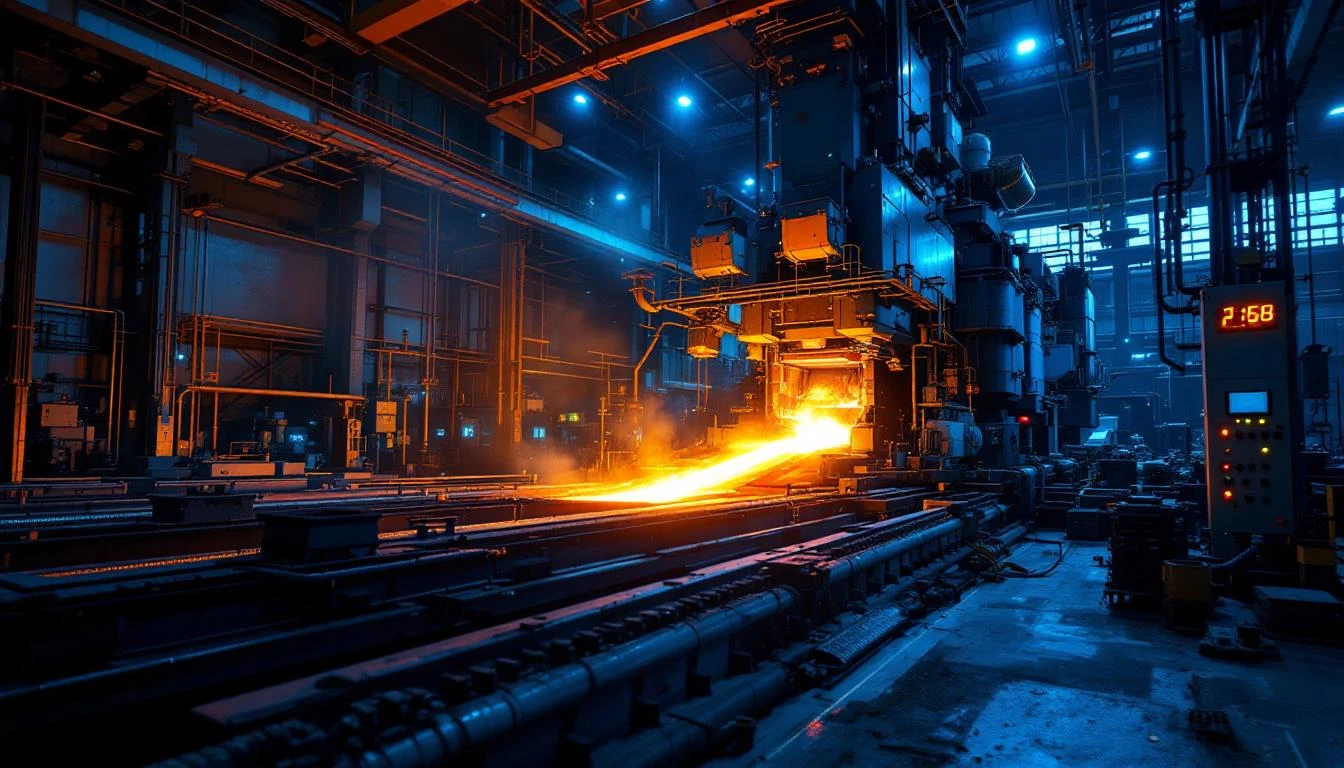
These harsh conditions create both the greatest need for monitoring and the greatest challenge in implementing it. Sensors fail faster. Connectivity is disrupted by electromagnetic interference. Equipment vibrates violently enough to shake loose anything not bolted, welded, or embedded. But the manufacturers who've successfully deployed IIoT in metals operations are seeing 15–35% reductions in unplanned downtime and 8–15% improvements in energy efficiency.
This guide covers how IIoT platforms work in metals and steel environments — the specific applications, the practical challenges, and the ROI drivers that make the investment worthwhile.
Why IIoT in Metals Manufacturing Is Different
Extreme Operating Conditions
Every IIoT deployment decision in metals manufacturing starts with the environment:
- Temperatures: 500–3,000°F at process points, 100–200°F ambient near furnaces and casters
- Electromagnetic interference (EMI): Electric arc furnaces generate massive EMI that disrupts wireless communications and sensitive electronics
- Vibration: Rolling mills, forging presses, and shaker tables create vibration levels that exceed most industrial norms
- Dust and particulate: Steel mills generate metal dust, scale, and airborne particulate that coats and degrades equipment
- Chemical exposure: Pickling lines use hydrochloric acid. Galvanizing uses zinc and flux baths. Coatings involve solvents and paints.
Equipment Scale and Cost
A hot strip mill can cost $500M to build and $1M+ per hour to operate. An electric arc furnace transformer costs $2M to replace and takes 6–12 months to deliver. At these scales, even small improvements in reliability or efficiency generate enormous returns.
Energy Intensity
Steel manufacturing is among the most energy-intensive industries. A typical integrated steel mill consumes 15–20 GJ per tonne of steel produced. Electricity alone represents 20–40% of production cost for electric arc furnace operations. Energy monitoring isn't optional — it's a competitive advantage.
Key IIoT Applications in Metals and Steel
1. Electric Arc Furnace (EAF) Monitoring
The EAF is the most energy-intensive and process-critical piece of equipment in steel recycling operations. IIoT monitoring targets several key parameters:
Electrical monitoring:
- Power consumption per heat (kWh/ton) — the primary efficiency metric
- Electrode consumption tracking — electrodes cost $2,000–$5,000 each
- Harmonic analysis — identifies electrical imbalances and flicker
- Transformer tap position optimization — matching power input to melt stage
Thermal monitoring:
- Sidewall and roof cooling water temperatures — panel hotspot detection predicts refractory failures
- Off-gas temperature — indicates combustion efficiency and process stage
- Slag door temperature — early warning for breakouts
Predictive maintenance signals:
- Hydraulic system pressure trending (electrode positioning, tilting, roof swing)
- Cooling water flow rate degradation (panel fouling or pump wear)
- Transformer insulation health (dissolved gas analysis via connected sensors)
According to World Steel Association data, optimized EAF operations achieve 350–400 kWh/ton, while poorly monitored operations waste 450–550 kWh/ton. For a 150-ton EAF running 20 heats/day, that efficiency gap represents $5,000–$15,000/day in wasted electricity.
2. Rolling Mill Optimization
Rolling mills — hot strip, cold strip, plate, bar, and section — are the backbone of steel shaping operations. IIoT monitoring enables:
Thickness and profile control:
- Monitor hydraulic gap positioning system response time — degradation indicates servo valve wear
- Track roll force variations across the strip width — identifies crown issues before they cause quality rejects
- Speed control loop performance — drifting speed control wastes energy and causes gauge deviations
Roll and bearing monitoring:
- Roll bearing temperature trending — the primary failure predictor for work rolls and backup rolls
- Vibration analysis on gear drives and motor bearings — condition monitoring adapted for extreme loads
- Lubricant condition monitoring — oil temperature, particle count, and water contamination
Cooling system performance:
- Header spray pressure and flow — uniform cooling prevents flatness defects
- Coolant temperature — rising temperatures indicate heat exchanger fouling
- Roll coolant contamination — tramp oil from lubricants reduces cooling effectiveness

3. Continuous Casting Monitoring
Continuous casting converts molten steel into solid billets, blooms, or slabs in a process where precision timing and temperature control directly determine product quality and safety.
Mold monitoring:
- Mold level control performance — oscillation frequency and amplitude
- Mold friction monitoring — indicates sticking or breakout risk (the most dangerous failure mode in continuous casting)
- Copper mold wall temperature mapping — thermocouple arrays detect hot spots that predict breakouts 30–60 seconds before they occur
Secondary cooling:
- Spray nozzle flow rates per zone — clogged nozzles cause uneven cooling and internal cracking
- Surface temperature profiling — pyrometer data correlated with spray patterns
- Strand speed optimization — casting speed vs. cooling capacity balance
Cut-length optimization:
- Torch cutting gas pressure and flow monitoring
- Cut quality tracking (burr formation, kerf width)
- Yield optimization through optimal cut-length planning
4. Reheating Furnace Efficiency
Walking beam, pusher, and rotary hearth furnaces reheat steel billets and slabs before rolling. These furnaces are major energy consumers:
Energy optimization:
- Zone-by-zone temperature profiling — match heating to product requirements
- Combustion air ratio monitoring — optimize air-to-fuel ratio for efficiency
- Scale loss reduction — over-heating increases oxidation and material loss (1–3% of production)
- Soak time optimization — reduce cycle time without compromising through-heating
Predictive maintenance:
- Refractory condition monitoring through shell temperature mapping
- Burner performance degradation tracking (combustion temperature, flame pattern)
- Walking beam/pusher mechanism monitoring (hydraulics, drives, mechanical wear)
5. Auxiliary Systems
The unglamorous but critical systems that keep a steel mill running:
Water treatment and cooling towers:
- Cooling tower fan vibration and motor current
- Water chemistry monitoring (pH, conductivity, biocide levels)
- Make-up water consumption trending
Compressed air and hydraulics:
- Compressor efficiency tracking (kW per m³ of air)
- Hydraulic power unit monitoring (pump pressure, oil temperature, filter differential pressure)
- Accumulator pre-charge pressure verification
Overhead cranes:
- Motor current profiling on hoist, bridge, and trolley drives
- Brake wear monitoring
- Wire rope fatigue tracking (critical safety equipment)
Practical Deployment Challenges and Solutions
Challenge 1: EMI from Electric Arc Furnaces
Problem: EAFs generate massive electromagnetic interference during melting, disrupting wireless communications and corrupting sensor signals within 100–300 meters.
Solutions:
- Cellular connectivity — platforms like MachineCDN that use cellular gateways are naturally more resistant to localized EMI than Wi-Fi or plant network-based solutions
- Shielded cabling — use shielded twisted pair for all analog sensor connections near EAFs
- Signal conditioning — install isolation barriers and filters between sensors and gateways
- Strategic gateway placement — position gateways outside the EMI radius with shielded cable runs to sensors
Challenge 2: Extreme Temperatures
Problem: Ambient temperatures near furnaces and casters can reach 150–200°F, far exceeding typical electronics ratings.
Solutions:
- NEMA 4X enclosures with active cooling for gateways and electronics
- Remote sensor mounting — use thermowells, standoff mounts, and infrared pyrometers to keep sensors away from direct heat
- Industrial-rated components — use sensors rated for the actual environment, not "industrial" marketing labels
Challenge 3: Dust and Scale
Problem: Metal dust, mill scale, and airborne particulate coat everything, block cooling vents, and corrode electronics.
Solutions:
- Positive-pressure enclosures — NEMA 4X with filtered air purge
- Regular maintenance schedules — monthly cleaning of enclosures and sensors in heavy-dust areas
- Non-contact sensing — infrared temperature measurement, acoustic monitoring, and motor current analysis avoid contact with the harsh process environment
Challenge 4: Vibration
Problem: Rolling mills, forging presses, and shaker tables generate extreme vibration levels.
Solutions:
- Vibration-rated mounting — spring isolators and vibration-damping pads for gateway enclosures
- Remote mounting — locate electronics on structural steel away from vibrating equipment, run cables to sensors
- Industrial connectors — M12 or similar locking connectors that can't vibrate loose
ROI in Metals Manufacturing
The financial case for IIoT in metals is compelling because the cost of failure is so high:
| ROI Driver | Typical Impact |
|---|---|
| Unplanned downtime reduction | 15–35% ($500K–$5M/year per major line) |
| Energy optimization (EAF, reheat furnaces) | 8–15% ($200K–$2M/year) |
| Quality improvement (fewer rejects/downgrades) | 3–8% of production value |
| Predictive maintenance labor savings | 20–30% of maintenance budget |
| Extended equipment life | 10–25% longer between major overhauls |
| Yield improvement (less scale, better cutting) | 0.5–2% of material throughput |
For a steel mill producing 500,000 tonnes/year at $700/tonne, even a 1% improvement in yield saves $3.5M/year. A 10% reduction in unplanned downtime on a hot strip mill saves $2–5M/year. The ROI math is aggressive.
Choosing an IIoT Platform for Metals Manufacturing
The ideal platform for metals and steel operations must handle the unique challenges of this environment:
- Cellular connectivity — bypasses plant networks and is resistant to localized EMI. No IT involvement means faster deployment in security-conscious facilities. MachineCDN's approach using cellular gateways is purpose-built for this.
- Protocol support — Modbus TCP/RTU and Ethernet/IP cover the majority of metals plant instrumentation. Platforms that support these natively connect without additional middleware.
- 3-minute setup — in a steel mill, every hour of production time is worth thousands of dollars. The ability to connect a gateway to a PLC during a brief maintenance window — not a scheduled outage — is the difference between a pilot that happens and one that doesn't.
- Predictive maintenance AI — AI-powered analytics that learn normal operating patterns and detect degradation across hundreds of variables simultaneously.
- Multi-site fleet management — most metals companies operate multiple facilities. A single pane of glass across all plants enables corporate engineering to benchmark and optimize.
Getting Started
The fastest path to IIoT value in metals manufacturing:
- Week 1: Connect to 5–10 critical motors and pumps (hydraulic power units, cooling water pumps, compressors). These are standard rotating equipment with immediate predictive maintenance value.
- Month 1: Add furnace and rolling mill auxiliary systems (cooling systems, lubrication, hydraulics). Establish energy baselines.
- Month 3: Expand to process monitoring on primary equipment (EAF power monitoring, rolling mill gap control, casting mold monitoring). Deploy threshold alerts.
- Month 6: Full fleet management across the facility. Connect to CMMS for automated work orders. Begin multi-site benchmarking if applicable.
Ready to see IIoT in action for your metals operation? Book a demo with MachineCDN and we'll walk through monitoring your specific equipment — from EAF to finishing line.