Best Machine Monitoring Software 2026: 10 Platforms for Real-Time Factory Visibility

Machine monitoring software has become table stakes for competitive manufacturing. Plants running without real-time visibility into equipment status, utilization, and health are operating blind — losing 5-20% of capacity to unplanned downtime, slow changeovers, and invisible micro-stops that no operator catches until the shift report reveals the damage.
The market has matured significantly since the early SCADA and historian days. Today's machine monitoring platforms combine real-time data collection, automated OEE calculations, predictive analytics, and mobile alerts into unified solutions. But the range of approaches — from legacy systems that require six-figure implementations to plug-and-play platforms that connect in minutes — means choosing the wrong tool can cost you a year of productivity gains.
This guide evaluates the ten best machine monitoring software platforms available in 2026, ranked on deployment speed, depth of analytics, integration flexibility, and total cost of ownership.
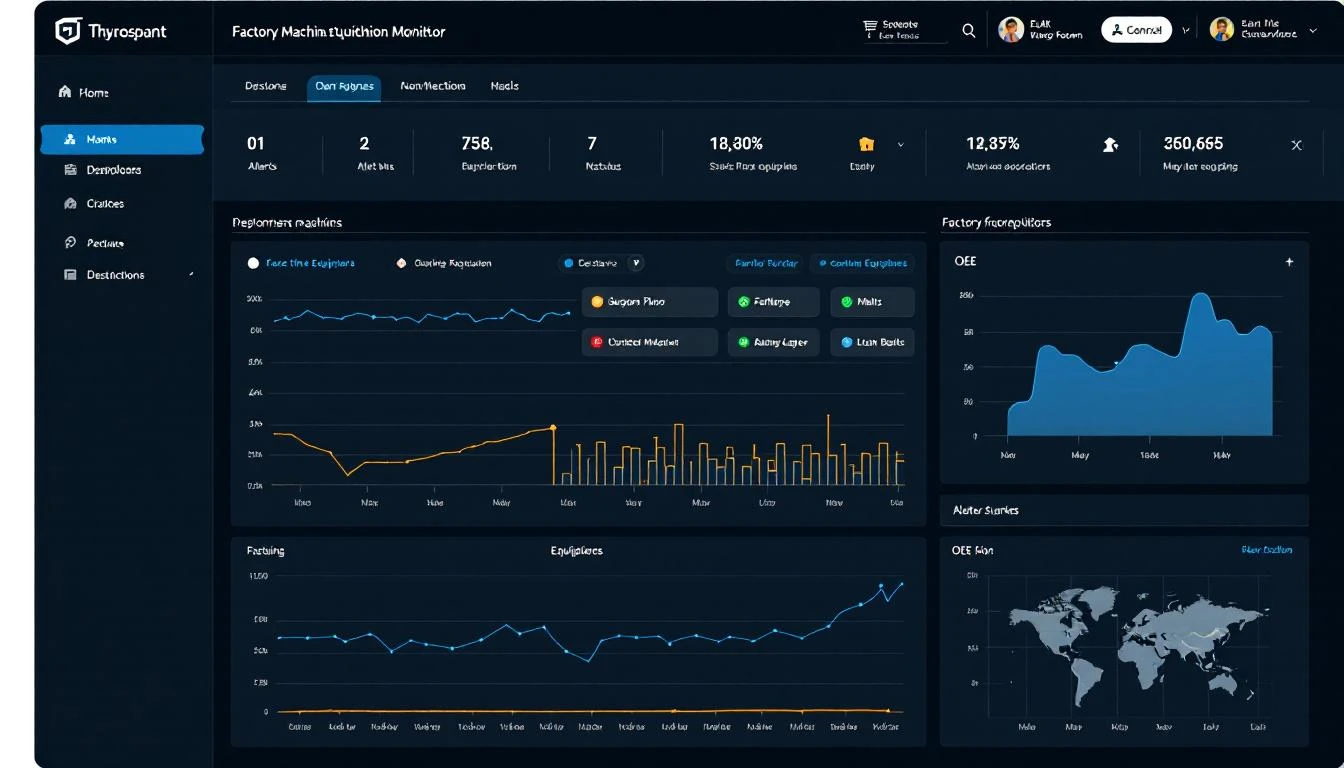
What to Look for in Machine Monitoring Software
Before comparing platforms, establish your evaluation criteria. The most important factors for manufacturing teams are:
Data Collection Method
How does the software connect to your machines? Options range from direct PLC integration to sensor overlays to manual data entry. Direct PLC connectivity (via Ethernet/IP, Modbus, or OPC-UA) provides the richest data with zero operator burden.
Deployment Complexity
How long from purchase order to live data on a dashboard? Some platforms require months of professional services. Others connect in minutes. For a pilot proving ROI, speed to first insight matters enormously.
Analytics Depth
Basic machine monitoring shows status (running/idle/down). Advanced platforms add OEE calculations, cycle time analysis, downtime categorization, and predictive maintenance. The analytics should match your maturity level.
Network Requirements
Does the platform require IT involvement to connect to your plant network? Network-independent solutions (cellular, wireless sensors) eliminate the biggest deployment bottleneck in most factories.
Scalability
Can the platform grow from a 5-machine pilot to a 500-machine enterprise deployment? Some tools work brilliantly for a single line but lack multi-site fleet management.
The 10 Best Machine Monitoring Platforms
1. MachineCDN — Best for Speed-to-Value
MachineCDN leads this list because it solves the two problems that stall most machine monitoring initiatives: IT involvement and deployment time.
How it works: A cellular-connected edge device plugs into your PLC's Ethernet port and begins reading machine data via Ethernet/IP or Modbus. No plant network connection, no OPC-UA server, no IT ticket. Data flows over cellular to the cloud platform where dashboards, alerts, OEE calculations, and AI-powered predictions are available immediately.
Key strengths:
- 3-minute device setup — plug in, auto-registers, start monitoring
- Zero IT involvement — cellular means no network dependency
- AI-powered predictive maintenance — not just monitoring, prediction
- Complete OEE tracking — availability, performance, quality calculated automatically
- Fleet management — manage hundreds of machines across locations
- Threshold alerting — active and approaching alarm states
- Downtime tracking with root cause categorization
- Materials and inventory management
- Energy consumption monitoring per machine
Best for: Manufacturers who need monitoring live in days, not months. Particularly strong for multi-site operations where IT support varies by location.
Limitations: Focused on discrete manufacturing — may not cover continuous process industries as deeply as specialized process tools.

2. MachineMetrics — Best for CNC Monitoring
MachineMetrics specializes in CNC machine monitoring with deep integration into machine tool controls. The platform uses edge devices (MachineMetrics Edge) that connect directly to CNC controllers from Mazak, Haas, Okuma, DMG MORI, and others.
Key strengths:
- Direct CNC controller integration (MTConnect, FANUC FOCAS)
- Excellent cycle time and utilization analytics
- Production counting and reject tracking
- Operator interface for categorizing downtime reasons
- Good reporting and data export capabilities
Limitations: Primarily focused on CNC/machine tools — less suitable for general manufacturing equipment. Deployment requires network connectivity and integration effort beyond CNC shops.
3. Samsara — Best for Mixed Fleet
Samsara originally built its platform for fleet management (trucks, vehicles) and has expanded into industrial monitoring. Their IoT platform handles both mobile assets and fixed equipment through a unified dashboard.
Key strengths:
- Broad sensor ecosystem (temperature, vibration, power, environmental)
- Strong mobile app and alert management
- Unified platform for vehicle fleet + factory equipment
- API integrations with ERP and maintenance systems
Limitations: Not purpose-built for manufacturing — lacks deep PLC connectivity, OEE calculations, and predictive maintenance capabilities. Better for environmental monitoring and basic asset tracking than production analytics.
4. Litmus Edge — Best for Data Integration
Litmus Edge focuses on the data layer — collecting, normalizing, and routing industrial data to enterprise systems. It excels as a middleware platform connecting factory floor data to cloud and business applications.
Key strengths:
- 250+ industrial protocol drivers (OPC-UA, MQTT, Modbus, Ethernet/IP, PROFINET)
- Edge computing capabilities for local processing
- Strong data normalization and transformation
- Integration marketplace for cloud platforms
Limitations: Litmus is primarily a data platform, not a monitoring application. You'll need to build dashboards, alerts, and analytics on top using other tools — making it more complex and expensive than solutions with built-in visualization.
5. PTC ThingWorx — Best for Digital Twin
PTC ThingWorx provides a comprehensive IoT application development platform with strong connections to PTC's Creo (CAD) and Windchill (PLM) ecosystem. ThingWorx is particularly strong for organizations building digital twin applications.
Key strengths:
- Model-based approach connecting CAD designs to live machine data
- Vuforia integration for augmented reality work instructions
- Kepware integration for broad protocol support
- Enterprise-grade scalability
Limitations: Requires significant implementation effort and PTC ecosystem investment. Not practical for organizations wanting quick monitoring deployments. Pricing reflects enterprise positioning ($100K+ annually).
6. Siemens MindSphere (Insights Hub) — Best for Siemens Shops
Rebranded as Insights Hub, Siemens' cloud IoT platform provides deep integration with Siemens automation equipment and the Xcelerator portfolio.
Key strengths:
- Native integration with Siemens PLCs and drives
- Industrial edge computing with containerized apps
- Strong analytics and visualization tools
- Siemens' extensive industrial domain expertise
Limitations: Strongest value for Siemens-heavy environments. Multi-vendor support exists but is secondary. Complex pricing and deployment process.
7. Tulip — Best for Frontline Operations
Tulip takes a different approach — composable manufacturing applications built by frontline engineers using a no-code platform. Machine monitoring is one of many applications you can build.
Key strengths:
- No-code app builder for manufacturing
- Machine vision and IoT device integration
- Digital work instructions alongside monitoring
- Rapid prototyping of manufacturing apps
Limitations: You're building your monitoring solution, not deploying one. Works well for tech-forward teams but requires ongoing development effort.
8. AVEVA (Schneider Electric) — Best for Process Industries
AVEVA's portfolio, now part of Schneider Electric, spans from SCADA/HMI to MES to enterprise performance management. Their monitoring capabilities are strongest in process industries (oil & gas, chemicals, pharma).
Key strengths:
- Deep process industry expertise
- Comprehensive historian capabilities
- Integration with Schneider Electric hardware
- Regulatory compliance features (FDA 21 CFR Part 11)
Limitations: Enterprise complexity and cost. Not designed for quick deployment or discrete manufacturing monitoring.
9. Inductive Automation (Ignition) — Best for Customization
Ignition is a server-based SCADA/HMI platform with a passionate community and unlimited licensing model. It's extremely flexible but requires significant development to create monitoring solutions.
Key strengths:
- Unlimited tags, screens, and connections with a single license
- Strong community and module marketplace
- Cross-platform (runs on any OS with Java)
- OPC-UA native with extensive driver support
Limitations: Ignition is a development platform — you must build your monitoring application. Requires programming skills (Python/Jython, SQL). On-premises server infrastructure needed.
10. Fiix (Rockwell Automation) — Best for CMMS Integration
Fiix, acquired by Rockwell Automation, combines CMMS (computerized maintenance management) with IoT connectivity. It bridges the gap between maintenance management and machine monitoring.
Key strengths:
- Strong work order and maintenance management
- Integration with Rockwell FactoryTalk ecosystem
- AI-powered maintenance scheduling
- Spare parts and inventory management
Limitations: Primary focus is maintenance management, not real-time machine monitoring. IoT connectivity is supplementary to the CMMS core.
Comparison Matrix
| Platform | Deployment Speed | PLC Connectivity | OEE Built-in | Predictive AI | Network Independent | Pricing |
|---|---|---|---|---|---|---|
| MachineCDN | Minutes | Direct (EIP, Modbus) | ✅ | ✅ | ✅ (cellular) | $$ |
| MachineMetrics | Weeks | CNC controllers | ✅ | Limited | ❌ | $$$ |
| Samsara | Days | Sensors only | ❌ | ❌ | Partial (cellular) | $$ |
| Litmus Edge | Weeks-Months | 250+ protocols | ❌ | ❌ | ❌ | $$$ |
| PTC ThingWorx | Months | Via Kepware | Build it | Build it | ❌ | $$$$ |
| Siemens Insights Hub | Months | Siemens native | Build it | Available | ❌ | $$$$ |
| Tulip | Weeks | Build it | Build it | ❌ | ❌ | $$ |
| AVEVA | Months | Broad (process) | Build it | Available | ❌ | $$$$ |
| Ignition | Months | Via drivers | Build it | Build it | ❌ | $$ |
| Fiix | Weeks | Limited | ❌ | Limited | ❌ | $$ |
How to Choose the Right Platform
Start with Your Constraint
If IT is your bottleneck: Choose a network-independent solution like MachineCDN. Cellular connectivity eliminates the number one cause of stalled IIoT projects.
If you're a CNC shop: MachineMetrics' direct controller integration gives you the deepest CNC-specific analytics.
If you need to integrate with enterprise systems first: Litmus Edge or PTC ThingWorx excel as data middleware, though you'll build the monitoring application on top.
If you're a Siemens house: Insights Hub provides the deepest native integration with your existing automation stack.
Pilot First, Scale Second
No matter which platform you choose, start with a 5-10 machine pilot on your most problematic line. The platform that gets you from purchase to running pilot fastest will likely be the one you scale — because internal stakeholders lose patience for projects that take quarters to show results.
According to a 2025 McKinsey report on industrial IoT adoption, 70% of IIoT pilots that take longer than 6 months to deploy never scale to production. Speed to first value is not just a nice-to-have — it's a predictor of program survival.
Calculate Total Cost of Ownership
Don't compare sticker prices. Calculate the full cost:
- Software licensing (monthly/annual)
- Hardware (sensors, gateways, servers)
- Implementation services (internal and external)
- Network infrastructure changes
- Ongoing maintenance and administration
- Training for operators and engineers
- Opportunity cost of delayed deployment
A platform that costs 2x more per month but deploys in 2 days instead of 6 months often delivers a lower total cost of ownership over a 3-year horizon — because those 6 months of unmonitored downtime were the most expensive cost of all.
The Bottom Line
The best machine monitoring software is the one that gets live data on your dashboard fastest and delivers insights your team actually acts on. Monitoring platforms that take months to deploy are solving yesterday's problem with yesterday's approach.
MachineCDN was built on the principle that manufacturing teams shouldn't need IT departments, data scientists, or systems integrators to know what their machines are doing. Plug in, see data, reduce downtime.
Related Reading:
- Best OEE Monitoring Software 2026
- How to Reduce Unplanned Downtime
- Best Predictive Maintenance Software 2026
- MachineCDN vs MachineMetrics
- MachineCDN vs Samsara
Ready to monitor your machines without the IT overhead? Book a demo with MachineCDN and see live machine data in minutes.