MachineCDN vs Uptake: Industrial AI Platform Comparison for Manufacturing

Uptake built its reputation as an industrial AI company — one of the first to apply machine learning to equipment failure prediction at scale. At its peak, the Chicago-based startup was valued at $2.3 billion and counted Caterpillar and Berkshire Hathaway Energy among its customers. But the company's journey from AI darling to a more focused industrial intelligence platform tells a cautionary tale about complexity in manufacturing technology.
For manufacturing engineers evaluating predictive maintenance and IIoT solutions, the MachineCDN vs. Uptake comparison highlights a fundamental question: Do you need a data science platform that happens to serve manufacturing, or a manufacturing platform with built-in intelligence?
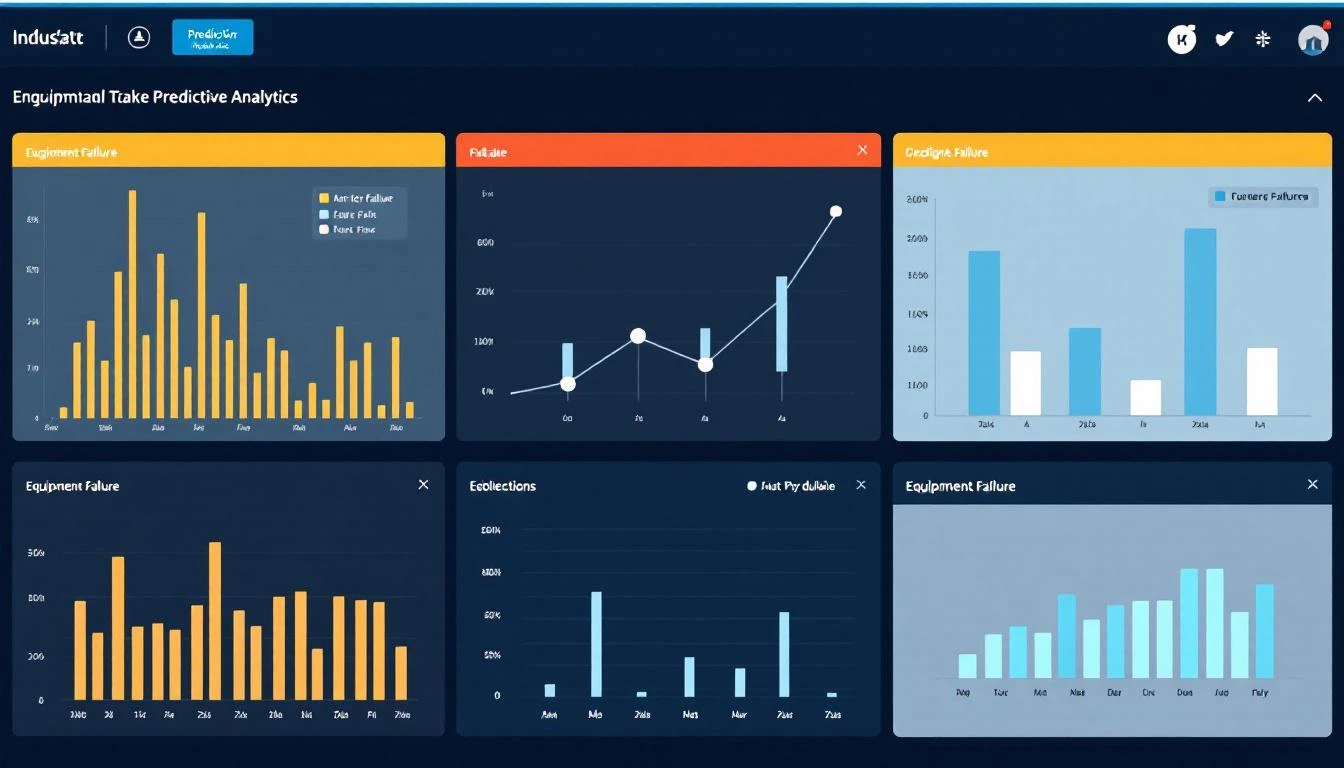
What Is Uptake?
Uptake positions itself as an industrial intelligence platform powered by AI. The company's core product, Uptake Fusion, ingests data from industrial assets — machines, vehicles, turbines, compressors — and applies machine learning models to predict failures, optimize maintenance schedules, and improve asset utilization.
Key Uptake capabilities include:
- Failure prediction — ML models trained on equipment telemetry data
- Remaining useful life (RUL) estimation — predicting when components will fail
- Maintenance optimization — recommending the right maintenance at the right time
- Asset performance management — tracking equipment health scores
- Data integration — connecting to SCADA, historians, CMMS, and ERP systems
Uptake's strength is its library of pre-trained models for specific equipment types — particularly in mining, energy, and heavy industry. The platform has analyzed billions of hours of machine data across thousands of asset types.
What Is MachineCDN?
MachineCDN is a purpose-built IIoT platform for discrete manufacturing. It handles the entire stack from edge data collection (connecting directly to PLCs via Ethernet/IP and Modbus), through cellular connectivity (no IT network required), to cloud-based analytics including AI-powered predictive maintenance, OEE monitoring, and fleet management.
MachineCDN's differentiation is the complete, integrated experience: you plug in an edge device, and within minutes you have real-time monitoring, threshold alerts, downtime tracking, and predictive analytics — no data science team required.
Data Collection: Where the Gap Starts
Uptake is fundamentally a software analytics layer. It doesn't collect data from equipment — it ingests data that's already been collected by other systems. This means before you can use Uptake, you need:
- SCADA or historian systems collecting equipment data
- Data pipelines to extract, transform, and load into Uptake
- API integrations or batch data transfers
- Data quality processes (tag mapping, unit normalization, gap handling)
For a plant that already has comprehensive data collection infrastructure, this isn't a problem. But for the majority of manufacturers — McKinsey estimates that 70% of manufacturers haven't yet achieved meaningful IIoT data collection — Uptake requires solving the data collection problem first.
MachineCDN handles data collection natively. The edge device connects directly to PLCs, reads tag data at configurable intervals, and transmits it to the cloud. There's no prerequisite infrastructure. If your machines have PLCs (and virtually all modern manufacturing equipment does), MachineCDN can start collecting data immediately.
This distinction matters enormously. Many predictive maintenance projects fail not because the analytics don't work, but because the data collection effort takes so long that the project loses executive sponsorship before delivering results.
Deployment Complexity
Uptake deployments typically follow this path:
- Data assessment (2-4 weeks): Evaluate available data sources and quality
- Data integration (4-8 weeks): Build pipelines from SCADA/historian/CMMS into Uptake
- Model training (4-8 weeks): Train ML models on your specific equipment data
- Validation (2-4 weeks): Verify model accuracy against historical failures
- Deployment and tuning (4-8 weeks): Roll out to production, adjust sensitivity
Total timeline: 4-8 months for a single facility. Cost: $200,000-$500,000+ depending on scope and existing infrastructure.
MachineCDN compresses this dramatically:
- Edge device installation (~3 minutes per device): Plug in, auto-discover PLCs
- Data flowing (immediate): Real-time monitoring active within minutes
- Analytics active (immediate): Threshold alerts, downtime tracking, OEE from day one
- AI predictions (days to weeks): Predictive models begin working as data accumulates
Total time to value: Minutes to hours for monitoring, 5 weeks for demonstrated ROI including predictive maintenance.
AI and Machine Learning Approach
Uptake's AI is genuinely sophisticated. The platform uses supervised and unsupervised learning, physics-informed models, and a large library of pre-trained failure signatures. For heavy industrial assets (gas turbines, mining haul trucks, wind turbines), Uptake's model library is extensive.
However, Uptake's AI approach has trade-offs:
- Data-hungry models: Many require 6-12 months of historical data to be effective
- Domain specificity: Pre-trained models may not match your exact equipment
- Data science dependency: Custom models require ML expertise to build and tune
- False positive management: Industrial ML generates alerts that need human review and model adjustment
MachineCDN's AI takes a more integrated approach:
- AI-powered anomaly detection works across equipment types
- Threshold alerting with approaching and active states provides graduated warnings
- Pattern analysis runs automatically — no data science team needed
- Predictions improve continuously as more data flows through the system
- Results are actionable through integrated maintenance management
The difference: Uptake gives you a powerful ML workbench for data scientists. MachineCDN gives you actionable maintenance intelligence for manufacturing engineers.
Maintenance Management Integration
Uptake generates predictions and insights but relies on external systems for maintenance execution. Typically, Uptake integrates with:
- CMMS platforms (SAP PM, Maximo, Fiix, UpKeep)
- ERP systems for parts ordering
- Notification systems for alert routing
These integrations are bidirectional but require configuration and maintenance. When Uptake predicts a bearing failure, the work order creation happens in your CMMS — if the integration is properly configured.
MachineCDN includes maintenance management natively:
- Spare parts tracking with availability monitoring
- Preventive maintenance task scheduling
- Downtime reason codes and root cause analysis
- Equipment health tracking with alarm history
- Material and inventory management
This closed-loop approach means predictions flow directly into maintenance actions without integration gaps. When MachineCDN detects an anomaly, the maintenance team sees it in the same interface where they track parts, schedule PMs, and log downtime.
For a detailed comparison of CMMS and predictive maintenance approaches, see our guide on CMMS vs predictive maintenance.
Multi-Site and Fleet Management
Uptake supports multi-asset deployments and can aggregate insights across fleets. However, because data collection depends on per-site infrastructure (SCADA, historians, data pipelines), expanding to new facilities means repeating the integration effort at each location.
MachineCDN was designed for multi-plant manufacturing operations. Adding a new facility means deploying edge devices — a process measured in minutes. Fleet management provides:
- Centralized dashboard across all locations and zones
- Cross-plant equipment comparison
- Fleet-wide OEE tracking
- Centralized alarm management
- Location and zone hierarchies for logical organization
For growing manufacturers, this scalability difference compounds. Each new Uptake site is a project. Each new MachineCDN site is a deployment.
Industry Focus
Uptake has the broadest industry coverage of the two platforms:
- Mining and metals
- Oil and gas
- Power generation and utilities
- Transportation and logistics
- Heavy equipment manufacturing
This breadth is genuine — Uptake's pre-trained models span hundreds of equipment types across these verticals. If you're operating a mining fleet or a wind farm, Uptake's domain expertise is substantial.
MachineCDN is focused specifically on discrete manufacturing:
- Automotive and tier suppliers
- Electronics and semiconductor
- Food and beverage production
- Pharmaceutical manufacturing
- General industrial manufacturing
- Plastics and packaging
This focus means every feature, every interface element, and every AI model is optimized for manufacturing use cases. OEE calculations, production line monitoring, and shift-based reporting aren't afterthoughts — they're core features.
Pricing and Business Model
Uptake typically uses enterprise pricing with:
- Platform license fees (often six figures annually)
- Per-asset or per-model pricing for AI capabilities
- Professional services for implementation and model customization
- Annual support and maintenance fees
Total cost for a mid-sized manufacturer: $300,000-$700,000 for the first year, $150,000-$300,000 annually thereafter.
MachineCDN uses a subscription model that bundles the complete stack — edge hardware, cellular connectivity, cloud platform, analytics, and AI. Pricing is predictable and transparent, with ROI typically demonstrated within 5 weeks.
When Uptake Is the Right Choice
Uptake makes sense when:
- You operate heavy industrial assets (turbines, compressors, mining equipment)
- You already have comprehensive data collection infrastructure (SCADA + historian)
- You have data science resources to customize and maintain ML models
- Your budget supports a 6+ month implementation timeline
- You need failure prediction for very specific, high-value asset types
Uptake's pre-trained model library is genuinely valuable for companies in mining, energy, and transportation. If you're managing a fleet of $5M gas turbines, the investment in sophisticated failure prediction pays for itself with a single avoided catastrophic failure.
When MachineCDN Is the Right Choice
MachineCDN is the better fit when:
- You're in discrete manufacturing (not process/heavy industry)
- You need data collection AND analytics, not just analytics
- Your team includes manufacturing engineers, not data scientists
- You need results in weeks, not months
- You want a single platform (not a data layer bolted onto existing systems)
- You're managing equipment across multiple plants
- You need OEE, downtime tracking, and maintenance management alongside AI
For manufacturers who haven't yet achieved comprehensive data collection — which is the majority — MachineCDN eliminates the infrastructure gap that makes platforms like Uptake inaccessible.
The Bottom Line
Uptake and MachineCDN solve different aspects of the same problem. Uptake is a powerful analytics engine for organizations that already have data flowing and need sophisticated ML-driven failure prediction for specific, high-value assets. MachineCDN is a complete manufacturing intelligence platform that handles everything from data collection to predictive maintenance in a single, rapidly deployable solution.
The question isn't which platform has better AI — it's which platform gets you to measurable results faster. For discrete manufacturers who need monitoring, analytics, and predictive maintenance without a year-long implementation project, MachineCDN's integrated approach delivers value in weeks instead of quarters.
For more IIoT platform comparisons, explore our analyses of MachineCDN vs C3 AI, MachineCDN vs MachineMetrics, and our guide to the best predictive maintenance software.
Want to see how fast MachineCDN can connect your equipment? Book a demo and watch your machines come online in minutes.