Binary Telemetry Encoding for IIoT: Why JSON Is Killing Your Bandwidth [2026]

· 11 min read

If you're sending PLC tag values as JSON from edge gateways to the cloud, you're wasting 80–90% of your bandwidth. On a cellular-connected factory floor with dozens of machines, that's the difference between a $50/month data plan and a $500/month one — and the difference between sub-second telemetry and multi-second lag.

This guide breaks down binary telemetry encoding: how to pack industrial data efficiently at the edge, preserve type fidelity across the wire, and design batch grouping strategies that survive unreliable networks.
Binary telemetry encoding for IIoT edge devices

Intelligent Polling Strategies for Industrial PLCs: Beyond Fixed-Interval Reads [2026]

· 14 min read
MachineCDN Team
Industrial IoT Experts

If you've ever watched a gateway hammer a PLC with fixed 100ms polls across 200+ tags — while 90% of those values haven't changed since the shift started — you've seen the most common mistake in industrial data acquisition.

Naive polling wastes bus bandwidth, increases response times for the tags that actually matter, and can destabilize older PLCs that weren't designed for the throughput demands of modern IIoT platforms. But the alternative isn't obvious. How do you poll "smart"?

This guide covers the polling strategies that separate production-grade IIoT systems from prototypes: change-of-value detection, register grouping, dependent tag chains, and interval-aware scheduling. We'll look at concrete timing numbers, Modbus and EtherNet/IP specifics, and the failure modes you'll hit in real plants.

MQTT Store-and-Forward for IIoT: Building Bulletproof Edge-to-Cloud Pipelines [2026]

· 12 min read

Factory networks go down. Cellular modems lose signal. Cloud endpoints hit capacity limits. VPN tunnels drop for seconds or hours. And through all of it, your PLCs keep generating data that cannot be lost.

Store-and-forward buffering is the difference between an IIoT platform that works in lab demos and one that survives a real factory. This guide covers the engineering patterns — memory buffer design, connection watchdogs, batch queuing, and delivery confirmation — that keep telemetry flowing even when the network doesn't.

MQTT store-and-forward buffering for industrial IoT

Multi-Protocol PLC Discovery: How to Automatically Identify Devices on Your Factory Network [2026]

· 12 min read
MachineCDN Team
Industrial IoT Experts

Commissioning a new IIoT gateway on a factory floor usually starts the same way: someone hands you an IP address, a spreadsheet of tag names, and the vague instruction "connect to the PLC." No documentation about which protocol the PLC speaks. No model number. Sometimes the IP address is wrong.

Manually probing devices is tedious and error-prone. Does this PLC speak EtherNet/IP or Modbus TCP? Is it a Micro800 or a CompactLogix? What registers hold the serial number? You can spend an entire day answering these questions for a single production cell.

Automated device discovery solves this by systematically probing known protocol endpoints, identifying the device type, extracting identification data (serial numbers, firmware versions), and determining the correct communication parameters — all without human intervention.

This guide covers the engineering details: protocol probe sequences, identification register maps, fallback logic, and the real-world edge cases that trip up naive implementations.

BACnet for IIoT Engineers: Object Types, COV Subscriptions, and the Building-Industrial Crossover [2026]

· 13 min read

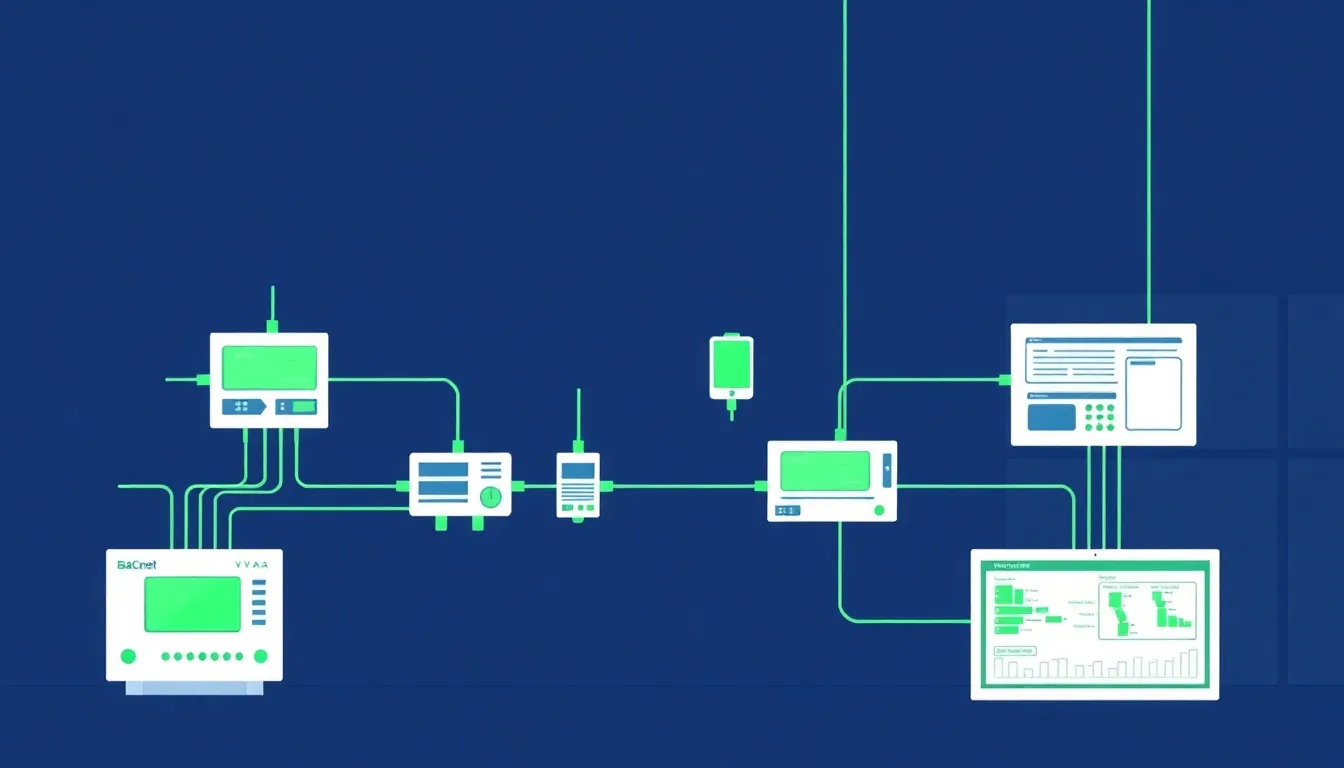
BACnet Building Automation and IIoT Crossover

Most IIoT engineers live in the world of Modbus registers, EtherNet/IP CIP objects, and MQTT topics. BACnet — the dominant protocol in building automation — rarely appears on their radar. But as manufacturing facilities increasingly integrate HVAC, energy management, and environmental monitoring into their operational technology (OT) stacks, understanding BACnet becomes a practical necessity.

This article explains BACnet from the perspective of someone who already understands industrial protocols. If you can read a Modbus register map, you can understand BACnet's object model. The concepts map more cleanly than you might expect.

Best SCADA Alternatives in 2026: Modern Platforms That Replace Legacy Systems

· 10 min read
MachineCDN Team
Industrial IoT Experts

SCADA systems have been the backbone of industrial monitoring for four decades. They've earned their place — when a plant needed visibility into process variables, alarms, and equipment status, SCADA was the only game in town.

But here's what's happening in 2026: manufacturers aren't replacing their SCADA systems because SCADA stopped working. They're looking for alternatives because SCADA was built for a world that no longer exists — a world where data lived on-premise, where remote access meant a VPN headache, where adding a new data point required an integrator and a purchase order.

The modern manufacturing floor demands real-time cloud analytics, mobile access, AI-powered predictive maintenance, and deployments measured in minutes, not months. Legacy SCADA can't deliver that. These alternatives can.

Data Normalization in IIoT: Handling Register Formats, Byte Ordering, and Scaling Factors [2026]

· 11 min read
MachineCDN Team
Industrial IoT Experts

Every IIoT engineer eventually faces the same rude awakening: you've got a perfectly good Modbus connection to a PLC, registers are responding, data is flowing — and every single value is wrong.

Not "connection refused" wrong. Not "timeout" wrong. The insidious kind of wrong where a temperature reading of 23.5°C shows up as 17,219, or a pressure value oscillates between astronomical numbers and zero for no apparent reason.

Welcome to the data normalization problem — the unsexy, unglamorous, absolutely critical layer between raw industrial registers and usable engineering data. Get it wrong, and your entire IIoT platform is built on garbage.

Data Normalization in IIoT: Handling PLC Register Formats, Byte Ordering, and Scaling Factors [2026 Guide]

· 13 min read
MachineCDN Team
Industrial IoT Experts

If you've ever stared at a raw Modbus register dump and tried to figure out why your temperature reading shows 16,838 instead of 72.5°F, this article is for you. Data normalization is the unglamorous but absolutely critical layer between industrial equipment and useful analytics — and getting it wrong means your dashboards lie, your alarms misfire, and your predictive maintenance models train on garbage.

After years of building data pipelines from PLCs across plastics, HVAC, and conveying systems, here's what we've learned about the hard parts nobody warns you about.

Edge Computing Architecture for IIoT: Store-and-Forward, Batch Processing, and Bandwidth Optimization [2026]

· 14 min read
MachineCDN Team
Industrial IoT Experts

Here's an uncomfortable truth about industrial IoT: your cloud platform is only as reliable as the worst cellular connection on your factory floor.

And in manufacturing environments — where concrete walls, metal enclosures, and electrical noise are the norm — that connection can drop for minutes, hours, or days. If your edge architecture doesn't account for this, you're not building an IIoT system. You're building a fair-weather dashboard that goes dark exactly when you need it most.

This guide covers the architecture patterns that separate production-grade edge gateways from science projects: store-and-forward buffering, intelligent batch processing, binary serialization, and the MQTT reliability patterns that actually work when deployed on a $200 industrial router with 256MB of RAM.

EtherNet/IP and CIP: A Practical Guide to Implicit vs Explicit Messaging for Plant Engineers [2026]

· 12 min read

EtherNet/IP is everywhere in North American manufacturing — from plastics auxiliary equipment to automotive assembly lines. But the protocol's layered architecture confuses even experienced controls engineers. What's the actual difference between implicit and explicit messaging? When should you use connected vs unconnected messaging? And how does CIP fit into all of it?

This guide breaks down EtherNet/IP from the wire up, with practical configuration considerations drawn from years of connecting real industrial equipment to cloud analytics platforms.