The Business Case for Cellular IIoT Connectivity: Why Smart Manufacturers Are Bypassing Plant Networks

Every IIoT deployment hits the same wall within the first week: IT. The factory floor needs to send machine data to the cloud. The IT department needs to approve network access, configure firewall rules, set up VLANs, conduct security reviews, and integrate the new traffic into their existing network architecture. What should be a two-day deployment becomes a three-month project — not because the technology is complex, but because the organizational process around network access was designed to prevent exactly the kind of connectivity that IIoT requires.
Cellular IIoT connectivity eliminates this wall entirely. Instead of routing machine data through the plant network, cellular-connected edge devices use their own mobile data connection to send data directly to the cloud. No IT involvement. No network configuration. No security review. No firewall rules. The machine data never touches the plant network at all.
This is not a workaround or a compromise. For a growing number of manufacturers, cellular connectivity is the architecturally superior approach to IIoT deployment — faster to deploy, more secure in practice, and cheaper when you account for the true cost of IT-dependent deployments.
The IT Bottleneck: Why Traditional IIoT Deployments Stall
To understand why cellular connectivity is gaining traction, you need to understand why traditional deployments fail. The pattern is remarkably consistent across manufacturing companies of all sizes:
Week 1: The operations team selects an IIoT platform and wants to connect their first machines. They contact IT to get network access for the edge devices.
Week 2-4: IT reviews the request. Questions arise: What ports does this device need open? What data is being transmitted? Where is it going? Is the vendor SOC 2 compliant? Who manages firmware updates? What happens if the device is compromised?
Month 2-3: IT conducts a security assessment. They may require a VLAN, network segmentation, intrusion detection rules, or a dedicated network for IIoT traffic. Each of these requirements adds cost, complexity, and delay.
Month 3-4: Network changes are implemented. Testing begins. Edge devices are connected to the production network. Everything works — until a firmware update changes a network configuration and breaks connectivity.
Month 5-6: The deployment is operational, but any change — adding a new machine, upgrading a device, switching platforms — restarts the IT review cycle.
The result: manufacturers that started their IIoT journey expecting to see data in days are still negotiating network access months later. The operations team loses momentum and enthusiasm. The CFO starts asking why the IIoT budget has been spent with nothing to show for it. And the project joins the 70% of IIoT initiatives that stall before reaching production, according to McKinsey.
This is not IT being obstructionist. Their concerns are legitimate. Adding unknown devices to a production network is a genuine security risk. OT networks that control manufacturing equipment must be protected. The problem is not that IT is wrong — it is that the traditional approach requires IIoT traffic to use the same network infrastructure that runs the factory, creating an inherent conflict between connectivity and security.
How Cellular Connectivity Solves the Problem
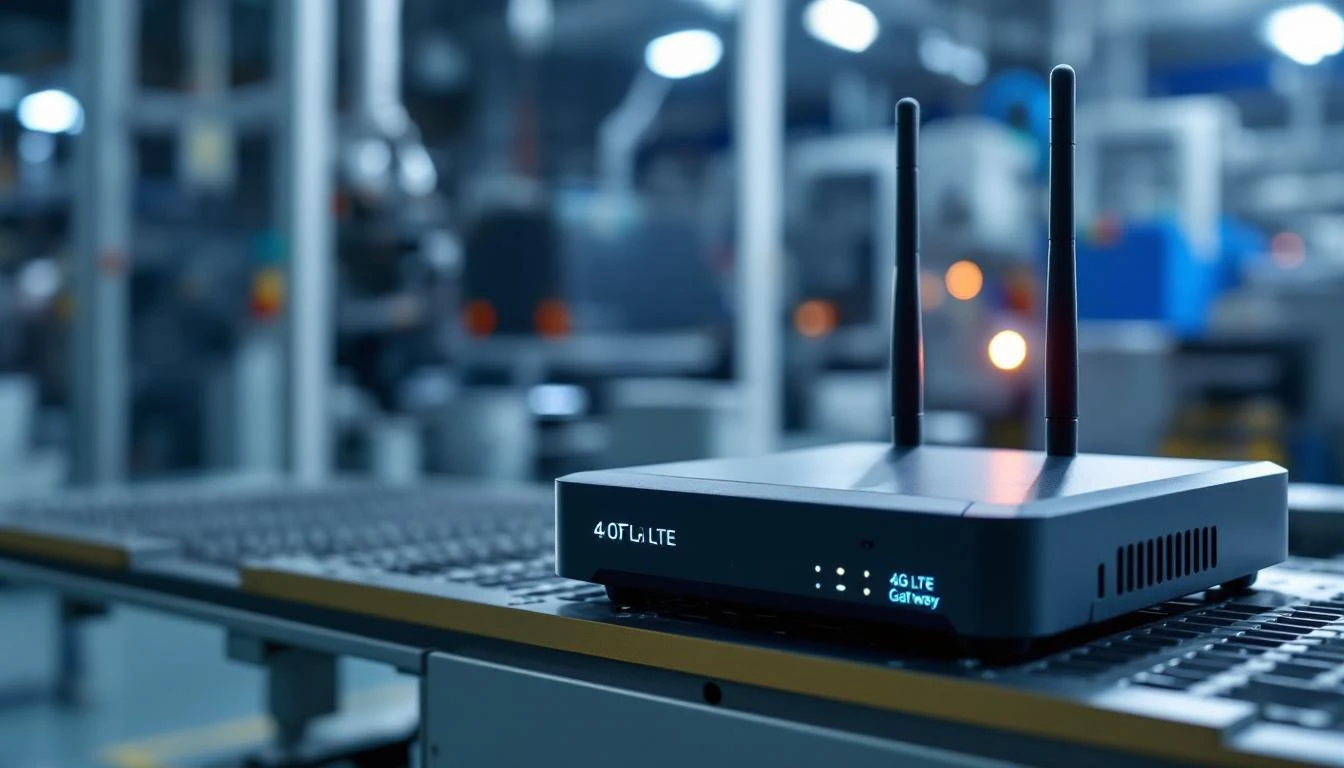
Cellular IIoT connectivity works by giving each edge device its own mobile data connection. The device reads data from your PLC or machine controller through a direct Ethernet connection, then transmits that data to the cloud over cellular — 4G LTE or 5G, depending on the hardware.
The machine data never touches the plant network. The edge device does not need a WiFi password, an Ethernet port on your network switch, or a firewall rule. It is a completely independent data path from the factory floor to the cloud.
What this means in practice:
Zero IT involvement. Installing a cellular-connected edge device requires no network changes, no IT approval, and no security review of the plant network. The device operates outside the plant network entirely.
No attack surface on the plant network. Because the edge device is not connected to the plant network, it cannot be used as an attack vector against OT systems. This eliminates the primary security concern that delays IT approval for traditional IIoT deployments.
Independent from plant network reliability. If the plant network goes down (switch failure, router issue, ISP outage), cellular-connected IIoT devices continue operating. Your monitoring does not depend on the same infrastructure that runs your email, ERP, and office systems.
Deployable by operations staff. Without the IT dependency, maintenance technicians and operations engineers can install and configure edge devices themselves. No network expertise required.
The Security Argument: Cellular Is Actually More Secure
This is the counterintuitive part. Most IT professionals initially assume that cellular connectivity is less secure than running IIoT traffic through the managed plant network. The opposite is true in most practical deployments.
Network isolation by default. A cellular-connected edge device is physically isolated from the plant network. There is no network path from the edge device to OT controllers, SCADA systems, or other networked equipment. An attacker who somehow compromises the edge device gains access to the device itself — not to the plant network.
Reduced attack surface. Traditional IIoT deployments add devices, ports, and traffic to the plant network — expanding the attack surface that IT must defend. Cellular deployments add zero new devices to the plant network. The attack surface does not change.
Encrypted by default. Cellular data connections use standard encryption. Data in transit between the edge device and the cloud is encrypted without any configuration effort.
No shared credentials. When IIoT devices join the plant WiFi or wired network, they need network credentials. Those credentials can potentially be extracted from a device and used to access other network resources. Cellular connections use SIM-based authentication that is tied to the specific device and carrier account.
OT/IT convergence without OT exposure. The whole point of IIoT is to get OT data into IT systems (cloud platforms, analytics tools, dashboards). Cellular connectivity achieves this convergence without exposing OT networks to IT-side threats.
This is why some of the most security-conscious manufacturers — defense contractors, pharmaceutical companies, critical infrastructure operators — are choosing cellular IIoT connectivity despite having sophisticated IT departments. The air gap between the IIoT system and the plant network is a security feature, not a limitation.
The Cost Analysis: Total Cost of Connected vs Cellular
At first glance, cellular connectivity seems more expensive. You are paying for mobile data plans on top of your existing network infrastructure. But when you account for the true total cost of traditional connected deployments, cellular often wins:
Traditional (Plant Network) Deployment Costs
- Network infrastructure: VLAN configuration, additional switch ports, access points, cabling — ,000-0,000 per deployment zone
- IT labor for setup: Security review, firewall configuration, network testing — 40-80 hours at 00-50/hour = ,000-2,000
- IT labor for ongoing management: Firmware updates, security patches, network monitoring — 5-10 hours/month = ,000-8,000/year
- Deployment delay cost: 2-4 months of delayed ROI while waiting for IT approval — varies widely but often the largest hidden cost
- Change management: Each new device addition triggers a mini IT review — 4-8 hours per device addition
Cellular Deployment Costs
- Cellular data plans: 0-0/month per device depending on data volume and carrier
- Hardware premium: Cellular-enabled edge devices may cost 0-00 more than WiFi/Ethernet-only versions
- IT labor for setup: Zero
- IT labor for ongoing management: Zero (carrier manages the network)
- Deployment delay cost: Zero (devices operational in minutes)
- Change management: Zero (adding a device means plugging it in and activating a SIM)
Example: 20-Machine Deployment, Year 1
Traditional: 5,000 (network setup) + ,000 (IT labor) + 2,000 (ongoing IT) + 0,000+ (delay cost at ,000/month opportunity cost for 3 months) = 5,000+
Cellular: 2,000 (data plans at 0/device/month) + ,000 (hardware premium) = 5,000
The math is not close. Even if you cut the delay cost in half and assume minimal IT overhead, cellular connectivity typically costs 50-70% less than traditional deployments in the first year. The gap narrows in subsequent years as the traditional deployment amortizes its setup costs, but the cellular approach still wins on ongoing management simplicity.
When Cellular Makes Sense (And When It Doesn't)
Cellular connectivity is ideal when:
- Your plant does not have dedicated OT network infrastructure
- IT approval cycles exceed 4 weeks
- You are deploying across multiple sites with different IT environments
- Security requirements mandate air-gapped IIoT systems
- Your IT resources are limited or fully allocated to other priorities
- You need to deploy quickly — days, not months
- Machines are in locations without reliable network coverage (outdoor yards, remote facilities, temporary sites)
Traditional network connectivity may be better when:
- You already have a mature, well-segmented OT network with IIoT infrastructure
- Data volumes exceed what cellular plans can economically support (streaming video, high-frequency data above 10 samples/second across hundreds of tags)
- Ultra-low latency is required for closed-loop control (sub-10ms response times)
- Your IT team is fully supportive and can deploy network changes within days
- The plant is in a location with poor cellular coverage
For most manufacturing IIoT use cases — machine monitoring, predictive maintenance, OEE tracking, alarm management — cellular data volumes are modest (typically 10-100 MB/month per device) and latency requirements are measured in seconds, not milliseconds. These parameters fit well within cellular capabilities.
Cellular IIoT in Multi-Plant Operations
Cellular connectivity becomes even more compelling for multi-plant manufacturers. Consider a company with five plants across three states:
Traditional approach: Each plant has its own IT team (or shares a regional IT team), its own network architecture, and its own security policies. Deploying IIoT across all five plants means five separate IT review processes, five network configurations, and five ongoing management relationships. Standardizing across plants is nearly impossible.
Cellular approach: A single IIoT platform with cellular-connected devices deploys identically at every plant. The same edge device, the same cellular carrier, the same cloud connection. A maintenance technician who has deployed devices at the Michigan plant can deploy at the Texas plant using the exact same process. Corporate can standardize monitoring, reporting, and analytics across all plants without coordinating with five different IT environments.
This consistency is why cellular IIoT is becoming the default architecture for manufacturers scaling beyond a single pilot site.
The Future: 5G and Private Cellular Networks
Looking ahead, the case for cellular IIoT connectivity only strengthens:
5G NR (New Radio) offers higher bandwidth and lower latency than 4G LTE, supporting more data-intensive IIoT applications like machine vision and real-time quality inspection.
5G URLLC (Ultra-Reliable Low-Latency Communication) promises sub-1ms latency, potentially enabling cellular-connected closed-loop control systems that today require wired connections.
Private 5G networks give manufacturers their own dedicated cellular infrastructure — combining the IT independence of cellular with the control and reliability of a dedicated network. Major carriers and equipment vendors are already offering private 5G solutions for manufacturing facilities.
As these technologies mature, the question shifts from "should we use cellular for IIoT?" to "why would we use anything else?"
Bottom Line
The business case for cellular IIoT connectivity is not about technology preference — it is about deployment speed, total cost of ownership, security architecture, and organizational agility. Traditional network-dependent IIoT deployments are slower, more expensive, and create ongoing IT management burden. Cellular deployments are faster, cheaper, more secure by design, and operationally independent of plant IT resources.
For manufacturers who have been stuck in the IT approval cycle, or who have been told that IIoT deployment requires a 6-month network infrastructure project, cellular connectivity is the answer to the question: "How do we actually get this done?"
Book a demo to see how MachineCDN's cellular-connected edge devices deliver real-time machine monitoring in 3 minutes — zero IT involvement, zero network configuration, zero security review.