IIoT for Aerospace Manufacturing: Monitoring CNC Machining, Heat Treatment, and NDT Equipment in Real Time

In aerospace manufacturing, a tolerance deviation of 0.001 inches on a turbine blade can ground a fleet. A heat treatment furnace that overshoots by 15°F for 3 minutes during a titanium solution treatment cycle creates a latent metallurgical defect that might not manifest for 10 years — when the part is at 35,000 feet.
This is the fundamental tension of aerospace manufacturing: the margins for error are measured in thousandths, the consequences of error are measured in lives, and the production pressure is measured in billions of dollars of backlogged orders.
Boeing and Airbus currently have a combined backlog of over 13,000 aircraft. Tier 1 suppliers like Spirit AeroSystems, Safran, and GE Aerospace are running at capacity. Every hour of unplanned downtime on a 5-axis CNC machining center or a vacuum heat treatment furnace ripples through a supply chain that's already stretched to its limits.
IIoT doesn't solve the backlog. But it solves the equipment reliability, process compliance, and quality traceability challenges that make aerospace manufacturing so demanding — and so expensive when things go wrong.
Why Aerospace Manufacturing Needs IIoT More Than Any Other Industry
Aerospace manufacturing sits at the intersection of extreme precision, regulatory scrutiny, and high-value materials. This combination makes equipment monitoring more valuable here than in virtually any other manufacturing sector.
The aerospace manufacturing cost amplifier:
| Factor | Typical Manufacturing | Aerospace Manufacturing |
|---|---|---|
| Material cost per part | $5-$500 | $500-$50,000+ |
| Tolerance requirements | ±0.005" | ±0.0005" |
| Quality documentation | Spot check | 100% inspection + full traceability |
| Rejection cost | Scrap + rework | Scrap + investigation + customer notification + potential fleet action |
| Regulatory framework | ISO 9001 | AS9100 + customer-specific (Boeing D6, Airbus AIMS) + NADCAP |
| Equipment downtime cost | $500-$5,000/hr | $2,000-$25,000/hr |
When a $15,000 titanium forging is machined on a 5-axis CNC center, the cost of a scrapped part isn't just the material — it's the 40 hours of machining time, the quality hold investigation, the replacement lead time (often 12-16 weeks for aerospace forgings), and the downstream impact on assembly schedules.
IIoT monitoring catches the process deviations that cause these losses — before the deviation produces a nonconforming part.
CNC Machining Monitoring for Aerospace
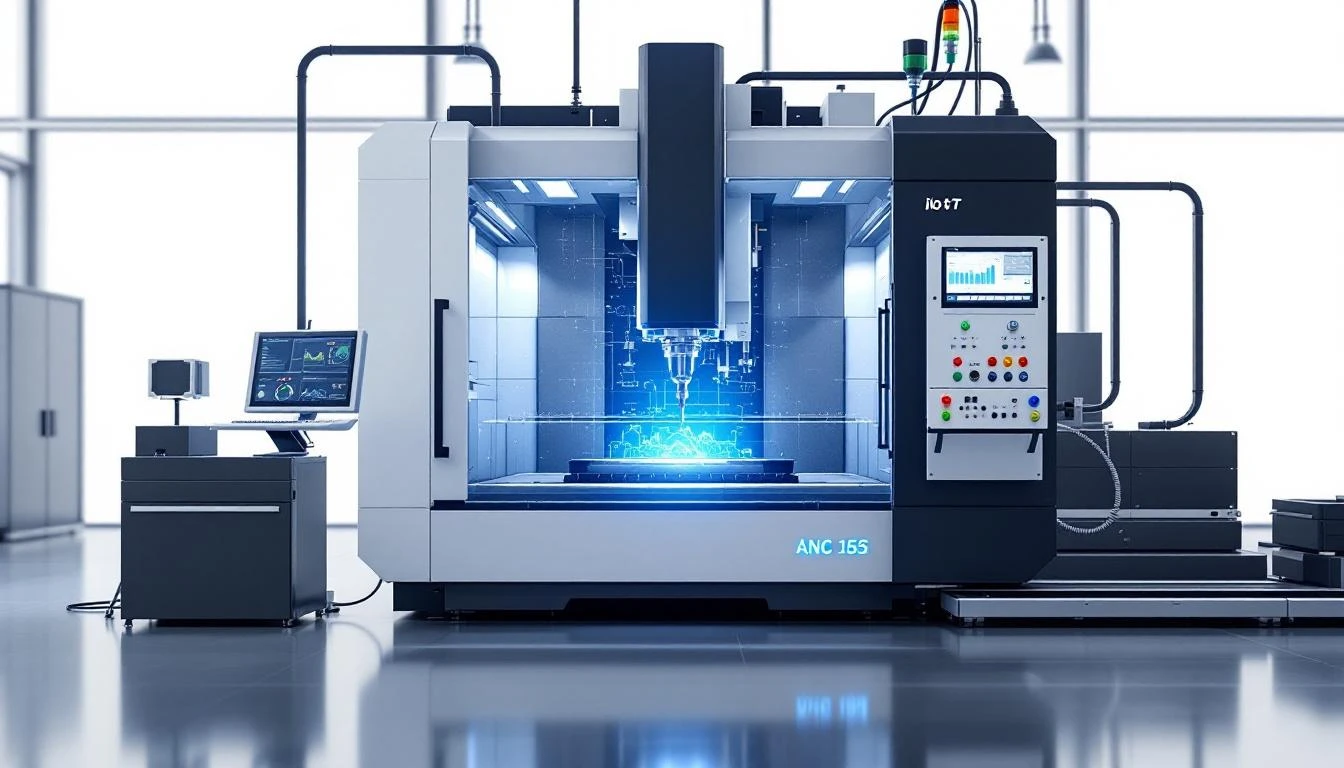
Aerospace CNC machining centers (Mitsui Seiki, DMG Mori, Mazak, Makino) represent the highest-value equipment in most aerospace machine shops. A single 5-axis horizontal machining center costs $1.5M-$5M and machines components that can't be produced any other way.
Critical Parameters to Monitor
1. Spindle Health
The spindle is the heart of the CNC machine and the single most expensive component to replace ($50K-$200K depending on machine size and speed rating).
- Spindle vibration — Monitor at bearing locations in radial and axial directions. Trend overall velocity (mm/s RMS) and track bearing defect frequencies (BPFI, BPFO). Increasing vibration directly correlates with surface finish degradation on aerospace parts.
- Spindle temperature — Front and rear bearing temperature. Elevated temperature indicates bearing preload change or lubrication issues. Aerospace surface finishes are sensitive to thermal growth of the spindle.
- Spindle current draw — At constant cutting conditions, increasing current indicates tool wear or spindle bearing drag. This parameter provides a second confirmation of what vibration data is telling you.
Threshold guidance for aerospace CNC spindles:
- Vibration: Good < 1.8 mm/s; Alert > 2.8 mm/s; Danger > 4.5 mm/s (tighter than ISO 10816 standard due to precision requirements)
- Temperature: Alert if bearing temperature > 60°C or if ΔT from baseline > 10°C
- Current: Alert if steady-state cutting current > 108% of baseline (same tool, same material, same parameters)
2. Axis Positioning Accuracy
Aerospace tolerances demand axis positioning accuracy better than ±0.0002" (5 microns). This accuracy degrades over time as ballscrews wear, linear guides develop play, and thermal effects shift the machine geometry.
- Positioning error — Track position error at multiple points along each axis. Increasing error indicates ballscrew wear or thermal deformation.
- Following error — The difference between commanded and actual position during motion. Increasing following error indicates servo drive issues or mechanical binding.
- Reversal error (backlash) — The difference in position when approaching from opposite directions. Increasing backlash indicates ballscrew nut wear.
3. Coolant System Health
Coolant performance directly affects tool life, surface finish, and chip evacuation — all critical in aerospace machining where materials like titanium (Ti-6Al-4V), Inconel 718, and Waspaloy are notoriously difficult to machine.
- Coolant temperature — Maintain within ±1°C for precision aerospace work. Most CNC machines have coolant chillers; monitor the chiller effectiveness.
- Coolant concentration — Refractometer-equivalent data from inline sensors. Low concentration causes corrosion; high concentration causes foam and residue.
- Coolant pressure and flow — Through-spindle coolant (TSC) pressure must be consistent for deep-hole drilling and boring operations common in aerospace parts.
Implementation for CNC Shops
Connect to the CNC machine's PLC or control system via Modbus TCP or Ethernet/IP. Most modern CNC controls (Fanuc, Siemens Sinumerik, Heidenhain) expose machine parameters through standard industrial protocols.
MachineCDN's edge devices connect directly to these controllers without touching the machine's control network — critical in aerospace where CNC machines are often on isolated networks for cybersecurity compliance. The cellular connectivity option bypasses the plant network entirely, satisfying even the most cautious IT/OT security requirements.
Heat Treatment Furnace Monitoring
Heat treatment is arguably the most process-critical operation in aerospace manufacturing. The metallurgical properties of every aerospace alloy are determined by precise temperature-time profiles. A deviation that would be insignificant in automotive manufacturing can create a rejectable condition in aerospace.
NADCAP Requirements Drive Monitoring
NADCAP (National Aerospace and Defense Contractors Accreditation Program) accreditation for heat treatment requires:
- Temperature uniformity surveys (TUS) — Furnaces must demonstrate temperature uniformity within ±10°F to ±25°F (depending on class) across the entire working zone
- System accuracy tests (SAT) — Instrumentation accuracy verification at regular intervals
- Continuous recording — Process temperature must be recorded at minimum every 2 minutes throughout the heat treatment cycle
- Thermocouple calibration — Load and control thermocouples must be calibrated per AMS2750
Parameters to Monitor
1. Temperature Profile Compliance
- Zone temperatures — Multi-zone furnaces (vacuum, atmosphere, salt bath) require monitoring at each zone independently
- Load temperature — Thermocouple attached to the actual part or load, not just the furnace atmosphere
- Ramp rate — Heating and cooling rates must comply with material specifications (e.g., AMS 2759 for steel, AMS 4999 for titanium)
- Soak time at temperature — Duration at target temperature must be within spec
2. Atmosphere Control (for atmosphere furnaces)
- Oxygen content — Parts per million of O2. Critical for preventing oxidation on nickel superalloys
- Carbon potential — For carburizing treatments, carbon potential determines case depth and hardness
- Dew point — Indicator of moisture content, which affects surface chemistry
- Gas flow rates — Nitrogen, argon, hydrogen, or endogas flow rates
3. Vacuum System Health (for vacuum furnaces)
- Vacuum level — Must reach and maintain specified vacuum (typically 10⁻⁴ to 10⁻⁶ torr for aerospace treatments)
- Leak-up rate — The rate at which vacuum degrades with pumps isolated. Increasing leak-up rate indicates seal degradation.
- Pump vibration — Roughing pumps and diffusion pumps are critical — monitor vibration for early failure detection
IIoT Value for Heat Treatment
The key value of IIoT for heat treatment isn't just monitoring — it's creating an automatic, tamper-proof record that satisfies NADCAP and customer audit requirements.
When furnace data flows continuously to a cloud platform, you have:
- Complete time-temperature records for every heat treatment cycle
- Automatic alerting when temperature excursions occur (even at 3am on Saturday)
- Trend data that predicts furnace maintenance needs (heating element degradation, thermocouple drift)
- Audit-ready reports generated automatically
MachineCDN's alarm management capabilities ensure that temperature excursions are caught and documented in real time — not discovered when the batch inspection reveals metallurgical defects hours or days later.
NDT Equipment Monitoring
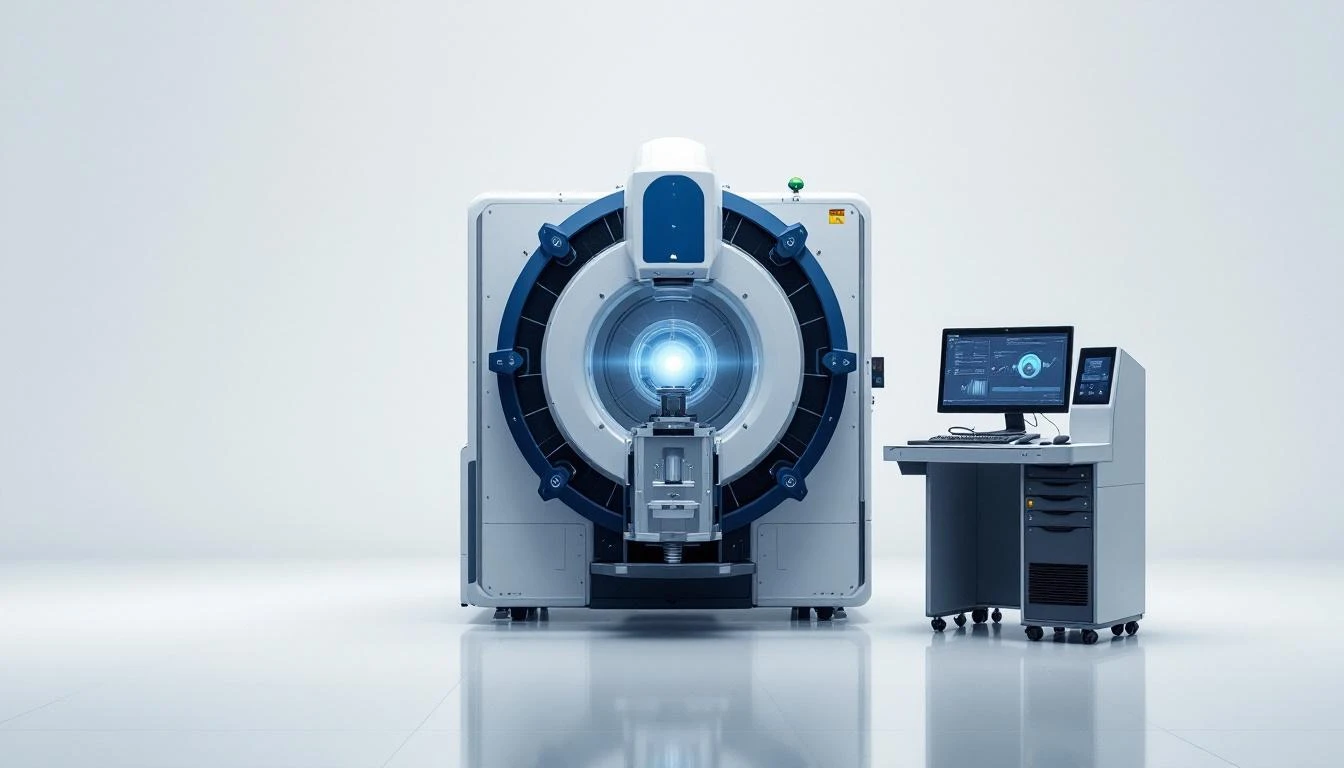
Non-destructive testing (NDT) is the final quality gate in aerospace manufacturing. Parts that pass machining and heat treatment go through X-ray, ultrasonic, fluorescent penetrant, magnetic particle, or eddy current inspection before shipping.
What to Monitor on NDT Equipment
Ultrasonic inspection systems:
- Transducer sensitivity (dB gain required to achieve reference level) — Increasing gain requirement indicates transducer degradation
- Water path distance and temperature — For immersion systems, consistent couplant conditions are critical
- System noise floor — Increasing noise indicates electronics degradation or electromagnetic interference
X-ray/CT systems:
- Tube voltage and current stability — Drift affects image quality and defect detectability
- Image quality indicator (IQI) readings — Automated tracking of resolution and contrast sensitivity
- Tube operating hours — Tubes have finite life (typically 2,000-5,000 hours)
Fluorescent penetrant inspection (FPI) systems:
- Penetrant temperature — Must be within spec (typically 60-125°F)
- Wash station pressure and flow — Over-washing removes indications; under-washing creates false indications
- UV light intensity — Must meet ASTM E1417/E3022 minimum intensity (1000 µW/cm² at 15 inches)
- Developer coverage time — Timed process, must be consistent
The Quality Traceability Chain
IIoT enables what aerospace quality engineers dream about: a complete, automated traceability chain from raw material through final inspection.
For each serialized part:
- Machining data — Machine ID, spindle speed, feed rate, tool number, cycle time, coolant temperature
- Heat treatment data — Furnace ID, time-temperature profile, atmosphere conditions, soak duration
- NDT data — Inspector, equipment ID, equipment calibration status, test results
This data, flowing automatically from IIoT-connected equipment to a central platform, replaces the manual logs, paper travelers, and Excel spreadsheets that currently require hours of clerical labor and are prone to transcription errors.
Cybersecurity Considerations for Aerospace IIoT
Aerospace manufacturing facilities are targets for state-sponsored cyber espionage. DFARS (Defense Federal Acquisition Regulation Supplement) requires protection of Controlled Unclassified Information (CUI), and CMMC (Cybersecurity Maturity Model Certification) adds specific cybersecurity requirements.
IIoT deployment must address:
- Network segmentation — IIoT devices must not create bridges between OT networks (CNC machines, furnace controllers) and IT networks or the internet
- Data encryption — All data in transit must be encrypted (TLS 1.2+ minimum)
- Access control — Role-based access to machine data, with audit logging
- Data sovereignty — Some aerospace data cannot leave the country of origin
MachineCDN's cellular connectivity approach is particularly valuable in aerospace environments because it creates a completely separate communication path from the plant network. The edge device reads PLC data via a direct Ethernet connection but sends data to the cloud via cellular — the IIoT system and the plant network never touch.
ROI for Aerospace IIoT
Conservative scenario for a mid-size aerospace machine shop (15 CNC machines, 3 furnaces, 2 NDT lines):
| Category | Annual Savings |
|---|---|
| Avoided scrap (0.5% scrap rate reduction on $10M material throughput) | $50,000 |
| Spindle failure prevention (1 avoided per year) | $150,000 |
| Reduced furnace temperature excursion events | $75,000 |
| Maintenance efficiency improvement (20% reduction in unplanned downtime) | $200,000 |
| Quality documentation labor savings (2 FTE hours/day automated) | $30,000 |
| Audit preparation time reduction | $15,000 |
| Total annual savings | $520,000 |
Against a platform cost of $5K-15K/month, the ROI is 3-8x in the first year — and the quality improvement and compliance benefits compound over time.
Conclusion
Aerospace manufacturing's combination of tight tolerances, expensive materials, stringent regulations, and critical safety requirements makes it the ideal environment for IIoT monitoring. The cost of undetected process drift — measured in scrapped titanium forgings, metallurgical rejections, and supply chain disruptions — far exceeds the cost of continuous monitoring.
Start with your highest-value equipment: 5-axis CNC machining centers and vacuum heat treatment furnaces. Connect via standard industrial protocols. Set thresholds based on aerospace-specific requirements (tighter than general manufacturing). Build toward a complete traceability chain that satisfies NADCAP, AS9100, and customer-specific requirements automatically.
Book a demo with MachineCDN to see how aerospace manufacturers are connecting their most critical equipment — with the cybersecurity posture that defense-adjacent manufacturing demands.
Manufacturing for aerospace? Book a demo to see real-time CNC, furnace, and NDT monitoring with defense-grade data security.