The Environmental Impact of Predictive Maintenance: How Preventing Failures Cuts Carbon Emissions

The sustainability conversation in manufacturing usually starts with solar panels on the roof, LED lighting, and maybe a heat recovery system on the compressors. These are important investments. They're also insufficient.
The largest single source of waste, excess energy consumption, and avoidable emissions in most manufacturing plants isn't the HVAC system or the lighting — it's equipment running inefficiently because nobody noticed the bearing was failing, the seal was leaking, or the motor was drawing 15% more current than it should.
Predictive maintenance is, quietly, one of the most effective sustainability initiatives a manufacturer can implement. Not because it was designed for ESG — but because preventing failures systematically eliminates the waste, energy overconsumption, and material losses that failing equipment creates.
The data on this is surprisingly clear, and almost entirely overlooked by sustainability teams.
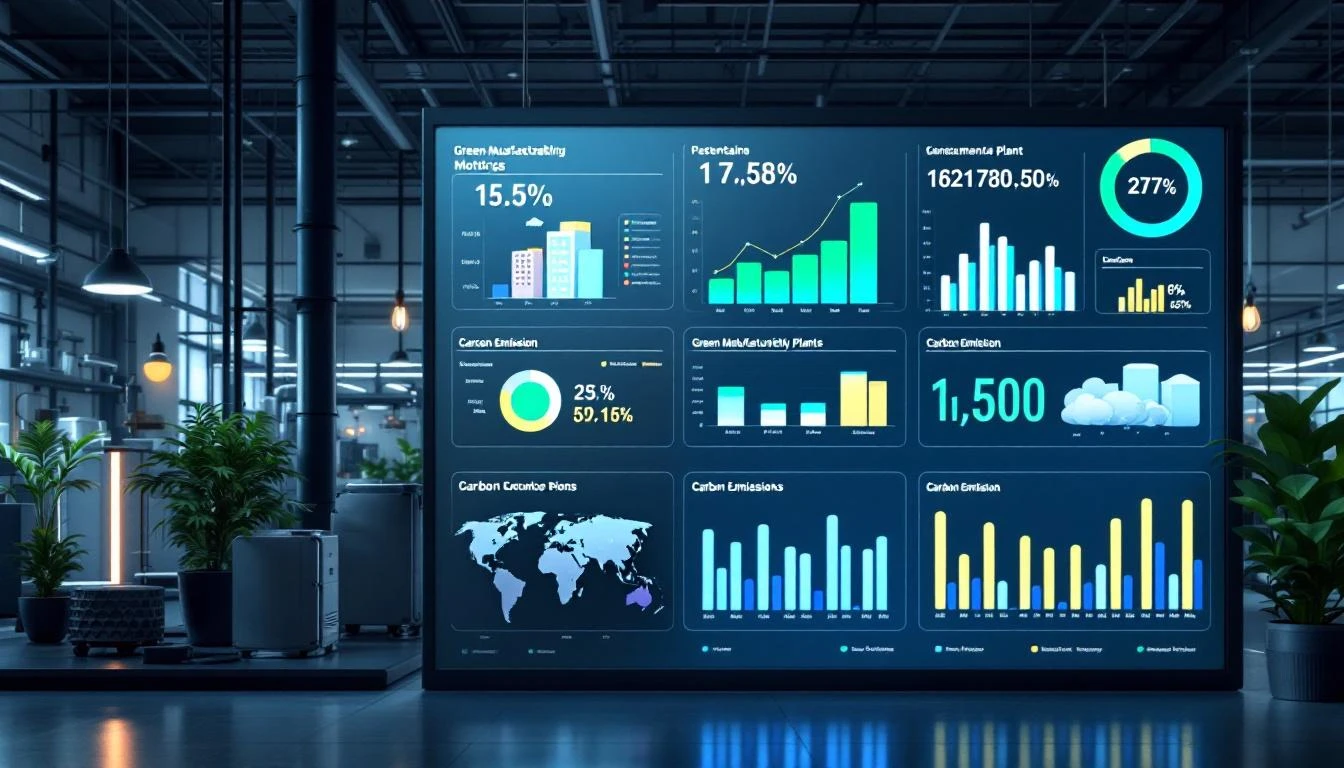
The Hidden Environmental Cost of Equipment Failure
When a motor bearing fails, the standard analysis looks at downtime cost and repair cost. What nobody calculates is the environmental cost that accumulated in the weeks and months before the failure.
The environmental cascade of a single failing bearing:
-
Weeks 1-4 (friction increasing): Motor draws 3-5% more current to maintain speed. Over 4 weeks on a 50kW motor running 16 hours/day, that's 150-250 kWh of excess energy consumption.
-
Weeks 5-8 (heat generation): Elevated bearing temperature increases lubricant degradation. Oil change interval shortens from 6 months to 3 months, doubling lubricant consumption (and disposal) for this motor.
-
Weeks 9-12 (vibration propagation): Vibration from the failing bearing accelerates wear on adjacent components — coupling, driven equipment seals, mounting bolts. The failure scope expands.
-
Week 13 (catastrophic failure): Bearing seizes. Motor burns out. Driven equipment is damaged. Scrap material from the production run at the time of failure: 200-500 units (depending on the process).
-
Post-failure cleanup: 3 gallons of lubricant on the floor requiring hazmat cleanup. Failed bearing and motor go to waste stream. Emergency parts shipped overnight by air freight (carbon footprint: 8x standard ground shipping).
Total environmental impact of one unplanned bearing failure:
- 250 kWh excess energy consumption (0.12 metric tons CO2 equivalent)
- 15 liters excess lubricant consumed and disposed
- 200-500 units of scrap product
- 12 kg metal waste (bearing, motor components)
- Air freight emissions for emergency parts
Now multiply by the 20-50 unplanned equipment failures a typical manufacturing plant experiences per year.
Quantifying the Sustainability Impact of Predictive Maintenance
Research from the U.S. Department of Energy's Advanced Manufacturing Office provides the most rigorous data on this topic. Their analysis found that predictive maintenance programs reduce:
- Energy consumption by 5-20% — Primarily through early detection of efficiency losses in motors, pumps, compressors, and HVAC systems
- Overall maintenance costs by 25-30% — Fewer emergency repairs means less waste from expedited shipping, overtime labor, and collateral damage
- Equipment downtime by 35-45% — Less downtime means less start-up waste (the scrap produced during ramp-up after a restart)
- Total waste generation by 10-20% — Fewer failures means fewer scrap runs, fewer emergency fluid changes, fewer damaged components
Let's translate these percentages to a real plant.
Scenario: Mid-size manufacturing plant (200 employees, 50 major machines)
| Environmental Metric | Before PdM | After PdM | Annual Reduction |
|---|---|---|---|
| Energy consumption | 8,000 MWh/yr | 6,800 MWh/yr | 1,200 MWh (15%) |
| CO2 emissions (energy) | 3,840 tons/yr | 3,264 tons/yr | 576 tons |
| Lubricant consumption | 4,500 liters/yr | 3,200 liters/yr | 1,300 liters |
| Scrap/waste material | 120 tons/yr | 90 tons/yr | 30 tons |
| Emergency air freight | 48 shipments/yr | 8 shipments/yr | 40 shipments |
| Hazardous waste events | 12/yr | 2/yr | 10 events |
576 tons of CO2 reduction per year from a single plant — comparable to taking 125 cars off the road. And unlike solar panels or LED lighting, predictive maintenance pays for itself through reduced maintenance costs and avoided downtime.
Five Pathways from Predictive Maintenance to Sustainability
Pathway 1: Motor Efficiency Monitoring
Electric motors consume approximately 70% of industrial electricity. A motor with a failing bearing, misalignment, or degraded winding draws more current to produce the same output. The efficiency loss is typically 3-15%, and it develops gradually enough that nobody notices the extra $2,000-$10,000 per year per motor in electricity costs.
How IIoT enables it:
Monitor motor current draw (amps) relative to mechanical output. When current increases without a corresponding increase in load, the motor is losing efficiency. MachineCDN's equipment health monitoring tracks these trends automatically, alerting maintenance when a motor's electrical consumption deviates from its baseline.
Environmental impact: A 10% efficiency improvement on a 75kW motor running 5,000 hours/year saves 37,500 kWh annually — equivalent to 18 metric tons of CO2.
Pathway 2: Compressed Air Leak Detection
Compressed air is the most expensive utility in most manufacturing plants — 8-10x more expensive per unit of energy delivered than direct electricity. The Compressed Air and Gas Institute estimates that 20-30% of compressed air in a typical plant is lost to leaks.
Every leak represents wasted energy. A single 1/4-inch leak at 100 PSI wastes approximately 25 CFM — equivalent to $8,000-$12,000 in annual energy costs and 20 metric tons of CO2.
How IIoT enables it:
Monitor compressor run time, load/unload cycles, and system pressure. When compressors run more frequently without corresponding production increases, you have a leak problem. Energy monitoring through IIoT platforms like MachineCDN can identify these patterns automatically.
Pathway 3: Hydraulic and Lubricant Optimization
Condition-based fluid changes — replacing hydraulic fluid and lubricants based on actual degradation data rather than calendar intervals — eliminates unnecessary fluid changes while preventing the equipment damage caused by fluid that's stayed in service too long.
How IIoT enables it:
Monitor fluid temperature, pressure, and equipment vibration as proxies for fluid condition. High temperature accelerates fluid degradation; elevated vibration indicates contamination or viscosity loss. Hydraulic press monitoring through IIoT provides continuous insight into fluid system health.
Environmental impact: A typical manufacturing plant with 15 hydraulic systems can reduce fluid consumption by 30-40% through condition-based changes — eliminating 1,000-2,000 liters of waste oil disposal annually.
Pathway 4: Scrap and Rework Reduction
Equipment operating outside optimal parameters produces off-spec product. In many processes, the degradation is gradual enough that defect rates increase by 1-3% before anyone notices — and by then, hundreds or thousands of defective units have been produced.
How IIoT enables it:
Monitor process parameters (temperature, pressure, speed, force) in real time with threshold alerting that catches deviations before they produce defective product. Real-time production monitoring ensures that quality issues are caught in minutes, not hours.
Environmental impact: Reducing scrap rate from 4% to 2% on a production line running 10,000 units per day eliminates 200 scrapped units daily — and all the raw material, energy, and emissions embodied in those units.
Pathway 5: Equipment Lifespan Extension
Replacing a 20-ton CNC machine has an enormous embodied carbon footprint — manufacturing, shipping (often internationally), installation, commissioning, and disposal of the old machine. Extending equipment life by 3-5 years through predictive maintenance defers this embodied carbon.
How IIoT enables it:
Continuous monitoring and condition-based maintenance keep equipment running within specifications longer. Machines maintained predictively last 20-40% longer than machines maintained reactively, according to the U.S. Department of Energy.
Environmental impact: Deferring the replacement of a single large CNC machine avoids 50-200 metric tons of embodied CO2 (depending on machine size and origin).
Predictive Maintenance and ESG Reporting
For manufacturers with ESG reporting obligations (whether voluntary or regulatory), predictive maintenance provides quantifiable, auditable data that sustainability teams can use directly.
What IIoT data feeds ESG reports:
- Scope 2 emissions reduction — Energy saved through motor efficiency monitoring, compressed air leak reduction, and optimized equipment operation. kWh data from your IIoT platform translates directly to CO2 using your utility's emission factor.
- Waste reduction metrics — Scrap rates, lubricant consumption, component waste — all tracked over time with before/after comparisons.
- Resource efficiency — Materials consumption per unit produced, trending over time as predictive maintenance improves process stability.
MachineCDN's energy monitoring capabilities provide the per-machine, per-shift, and per-product energy data that ESG teams need — without requiring a separate energy management system.
The ROI-ESG Alignment
Here's what makes predictive maintenance unique among sustainability initiatives: it's the rare case where financial ROI and environmental impact are perfectly aligned.
| Sustainability Initiative | Financial ROI | Environmental Impact | Implementation Time |
|---|---|---|---|
| Solar installation | 7-12 years payback | Significant (Scope 2) | 6-12 months |
| LED lighting retrofit | 2-4 years payback | Moderate (Scope 2) | 1-3 months |
| Heat recovery system | 3-5 years payback | Moderate (Scope 1) | 3-6 months |
| Predictive maintenance (IIoT) | 5-12 weeks payback | Significant (Scope 1+2+3) | 1-5 weeks |
| Water recycling | 3-6 years payback | Moderate (Water) | 3-9 months |
Predictive maintenance is the only initiative on this list that pays for itself within the first quarter. And it impacts all three emission scopes: energy reduction (Scope 2), reduced waste disposal (Scope 1), and reduced shipping and procurement (Scope 3).
MachineCDN's 5-week ROI isn't just a cost-saving metric — it's also a 5-week sustainability improvement metric. Every dollar of waste eliminated is also a reduction in environmental impact.
Building Your Sustainability Case for IIoT
If your organization has ESG commitments, use them to accelerate IIoT adoption:
- Quantify current waste — Energy overconsumption, scrap rates, lubricant disposal, emergency freight. These are your sustainability baseline metrics.
- Project IIoT impact — Use the DOE benchmarks (5-20% energy reduction, 10-20% waste reduction) as conservative estimates.
- Calculate carbon equivalent — Convert energy savings to CO2 using your utility's emission factor. Convert waste reduction to avoided emissions using lifecycle assessment data.
- Compare to other sustainability investments — IIoT-driven predictive maintenance almost always wins on ROI, time-to-impact, and scope of environmental benefit.
- Deploy and measure — Connect machines, baseline metrics, and report actual impact quarterly.
Conclusion
Predictive maintenance isn't a sustainability program — it's a maintenance program that happens to deliver extraordinary environmental benefits. By catching equipment degradation early, you eliminate the excess energy consumption, waste generation, emergency logistics, and premature equipment replacement that make manufacturing's environmental footprint larger than it needs to be.
The technology is ready. The ROI is proven. And every day you run equipment in degraded condition is a day you're consuming more energy, generating more waste, and producing more emissions than necessary.
Book a demo with MachineCDN to see how real-time equipment monitoring reduces both your maintenance costs and your environmental footprint — starting in weeks, not years.
Combining sustainability with ROI? Book a demo to see how MachineCDN helps manufacturers cut emissions while cutting costs.