How to Set Up Machine Downtime Reason Codes: A Classification System That Actually Gets Used

Every plant tracks downtime. Almost no plant tracks it well. The difference between useful downtime data and worthless downtime data usually comes down to one thing: reason codes. Get the classification system right, and you'll know exactly where to invest for maximum uptime improvement. Get it wrong, and you'll have a graveyard of "Other" and "Miscellaneous" entries that tell you nothing.
Here's how to design a downtime reason code system that operators actually use and that generates actionable data — including how IIoT platforms can automate the parts that humans get wrong.
Why Most Downtime Reason Code Systems Fail
Before building a better system, understand why existing ones don't work:
Too Many Codes
The most common mistake is creating a comprehensive list of every possible downtime reason. Plants with 200+ reason codes see completion rates drop below 40%. Operators scroll through endless lists, pick the first thing that's close enough, and move on. The data becomes unreliable.
Rule of thumb: No operator should have to choose from more than 15–20 options at any level of the hierarchy.
Too Few Codes
The opposite extreme is equally useless. A system with 5 codes (Mechanical, Electrical, Operator, Material, Other) tells you that you have downtime. It doesn't tell you where to focus improvement efforts.
No Hierarchy
Flat lists of reason codes force a tradeoff between specificity and usability. Hierarchical systems give you both: operators make quick top-level selections, then drill into specific causes when appropriate.
No Distinction Between Types of Downtime
Not all downtime is the same. A reason code system must distinguish between:
- Planned downtime: Scheduled PM, changeovers, breaks, cleaning
- Unplanned downtime: Equipment failures, unexpected breakdowns
- Performance losses: Equipment running but at reduced speed
- Quality losses: Equipment running but producing scrap
- External: No orders, no material, upstream/downstream blockages
Lumping these together destroys your OEE calculation accuracy.
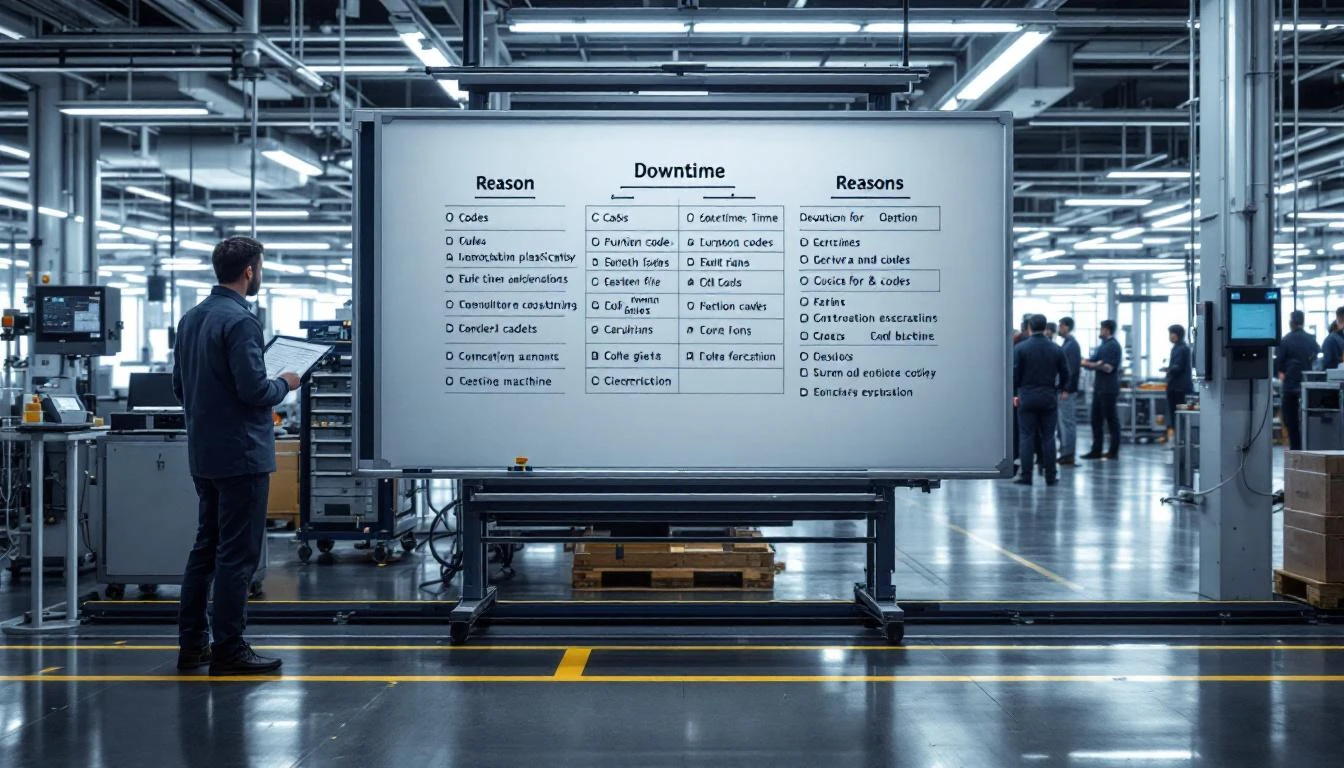
Designing Your Reason Code Hierarchy
The best downtime classification systems use a 3-level hierarchy:
Level 1: Category (5–8 options)
Level 1 answers "what type of downtime was this?" Operators should be able to make this selection in under 3 seconds. Example categories:
| Code | Category | Description |
|---|---|---|
| M | Mechanical | Physical equipment failure or degradation |
| E | Electrical | Electrical/electronic component failure |
| P | Process | Process-related stoppage (recipe, setup, changeover) |
| Q | Quality | Quality hold, rework, or scrap event |
| S | Supply | Material shortage, upstream/downstream blockage |
| O | Operational | Operator-related (break, training, no personnel) |
| PM | Planned Maintenance | Scheduled PM, cleaning, calibration |
| X | External | Utility failure, force majeure, no orders |
Level 2: Subsystem (5–10 per category)
Level 2 answers "what subsystem was involved?" This is where you get actionable data. Example for Mechanical (M):
| Code | Subsystem |
|---|---|
| M-HYD | Hydraulic system |
| M-PNE | Pneumatic system |
| M-DRV | Drive system (motors, gearboxes, belts) |
| M-BRG | Bearings and bushings |
| M-STR | Structural (frame, guards, fixtures) |
| M-TLG | Tooling (wear, breakage, change) |
| M-LUB | Lubrication system |
| M-FLT | Filtration and fluid systems |
| M-SEN | Sensors and instrumentation |
Level 3: Root Cause (3–8 per subsystem)
Level 3 answers "what specifically happened?" This is optional — only require it for events longer than a threshold (e.g., >15 minutes). Example for Bearings (M-BRG):
| Code | Root Cause |
|---|---|
| M-BRG-WEAR | Normal wear / end of life |
| M-BRG-CONT | Contamination |
| M-BRG-MISS | Misalignment |
| M-BRG-OVER | Overload |
| M-BRG-LUBF | Lubrication failure |
Rules for Effective Reason Codes
1. Every Event Gets a Code (No Exceptions)
If a machine stops for more than a defined threshold (typically 2–5 minutes), it gets a reason code. No blanks. No "I'll fill it in later." IIoT platforms enforce this by requiring reason code entry before the system records the event as resolved.
2. Planned vs. Unplanned Must Be Separate
Never let planned PM and unplanned breakdown share the same category. They have completely different implications for your improvement strategy and OEE calculation.
3. Include a "Waiting for Diagnosis" Option
Sometimes operators don't know why a machine stopped. Give them a temporary code rather than forcing them to guess. Then ensure your maintenance team reviews and re-classifies "waiting for diagnosis" events within 24 hours.
4. Review and Prune Quarterly
Reason codes that are never used should be retired. New failure modes should be added. Schedule a quarterly review with operations and maintenance to keep the system current.
5. Make Entry Effortless
If it takes more than 30 seconds to enter a reason code, operators will skip it. Touchscreen interfaces, barcode scanning, or IIoT-automated detection dramatically improve completion rates.
IIoT-Automated Downtime Classification
This is where modern IIoT platforms transform downtime tracking from a manual burden to an automated intelligence system.
Automatic Stop Detection
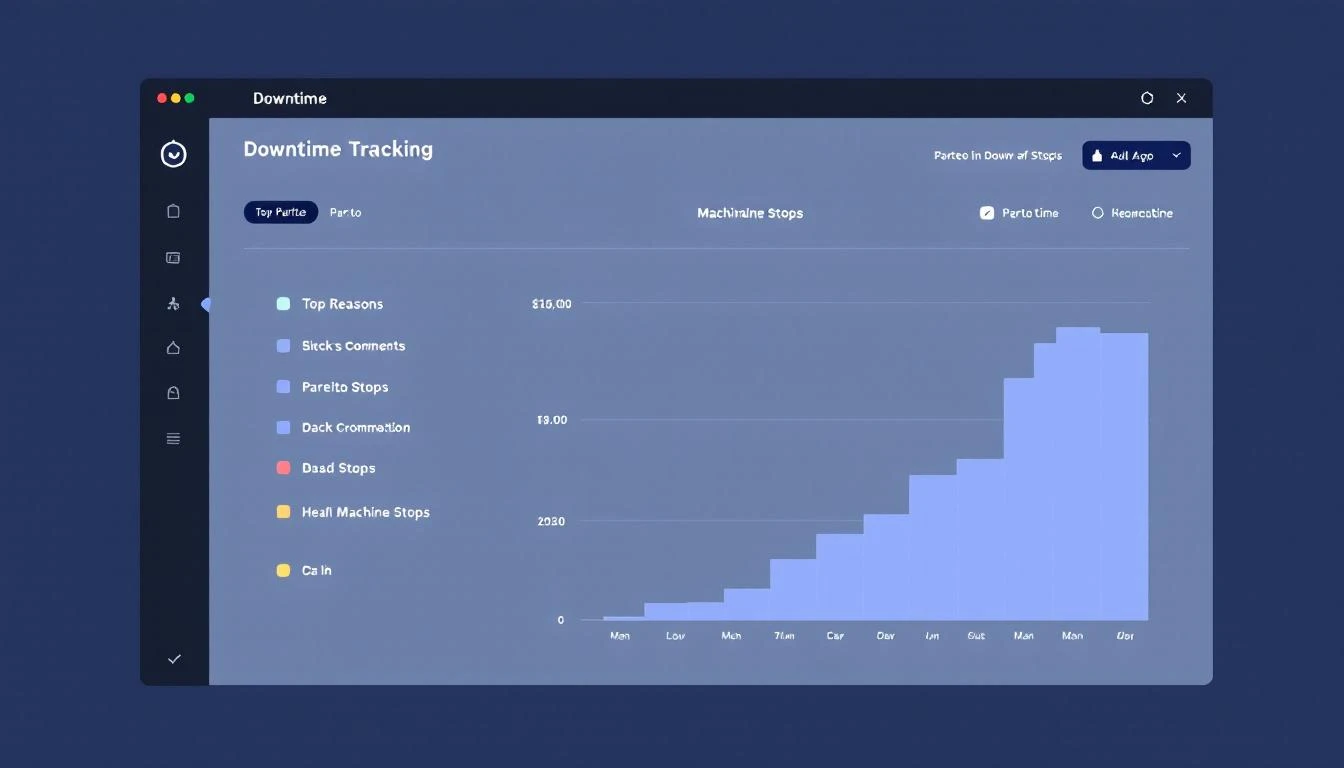
IIoT platforms like MachineCDN detect machine stops automatically by monitoring PLC signals — motor running status, cycle counting, power draw, and production counters. No operator input needed to register that a stop occurred.
Automatic Category Assignment
Some downtime causes can be classified automatically:
- Motor overload fault → Electrical > Drive > Overload
- Low hydraulic pressure alarm → Mechanical > Hydraulic > Pressure loss
- Recipe change in progress → Process > Changeover
- Scheduled PM window → Planned Maintenance
- Temperature exceeded threshold → Auto-classify based on which zone/component
MachineCDN's alarm management system categorizes equipment alarms into downtime types, pre-filling reason codes that operators can confirm or override. This reduces manual data entry by 60–80% while improving accuracy.
AI-Assisted Root Cause Suggestion
Machine learning models can analyze the pattern of sensor readings preceding a downtime event and suggest probable root causes:
- Gradually increasing vibration + temperature spike → Bearing degradation
- Intermittent pressure fluctuation + motor current spike → Hydraulic pump cavitation
- Slow cycle time degradation + increased rejects → Tooling wear
These AI suggestions appear alongside the operator's reason code entry, guiding them toward accurate classification without requiring deep diagnostic expertise.
Building Your Pareto: From Data to Action
The whole point of reason codes is to generate Pareto analysis — the ranked list of downtime causes that tells you where to invest.
Monthly Pareto Review
Run a monthly Pareto analysis showing:
- Top 10 downtime reasons by total hours lost
- Top 10 by frequency (number of events)
- Top 10 by production impact (lost units or revenue)
These three views tell different stories. A single long outage (high hours, low frequency) needs different action than dozens of short stops (low hours per event, high frequency).
The 80/20 Rule in Practice
In most plants, 20% of failure modes cause 80% of downtime hours. Your Pareto analysis should identify these critical few causes and drive focused improvement projects.
Example insights from well-coded downtime data:
- "Hydraulic seal failures on injection molding machines account for 23% of unplanned downtime — invest in predictive monitoring of hydraulic pressure trends"
- "Material shortages cause more downtime than equipment failures — fix the supply chain, not the machines"
- "Changeover time on Line 3 is 2.4x longer than Line 1 — standardize the setup procedure"
Connecting Reason Codes to Financial Impact
The most powerful analysis connects downtime reason codes to financial impact:
| Reason Code | Events/Month | Avg Duration | Monthly Hours | Cost/Hour | Monthly Cost |
|---|---|---|---|---|---|
| M-BRG-WEAR | 4 | 3.2 hrs | 12.8 | $5,000 | $64,000 |
| E-VFD-OVHT | 6 | 1.5 hrs | 9.0 | $5,000 | $45,000 |
| P-CHG-TOOL | 22 | 0.8 hrs | 17.6 | $5,000 | $88,000 |
| S-MAT-NONE | 8 | 2.1 hrs | 16.8 | $5,000 | $84,000 |
This analysis makes investment decisions obvious: a $20,000 project to reduce changeover time from 48 to 30 minutes would save $88,000/month in this example.
Implementing Reason Codes in MachineCDN
MachineCDN's downtime tracking system implements the three-level hierarchy natively:
- Automatic stop detection — No manual reporting of machine stops
- Downtime types and reasons — Configurable hierarchical reason codes matched to your equipment
- Alarm-to-reason mapping — Equipment alarms auto-populate reason codes
- Threshold alerting — Approaching and active alerts trigger before downtime occurs
- Shift-based reporting — Compare downtime patterns across shifts to identify training needs
- Pareto analysis — Built-in reporting for top downtime causes by duration, frequency, and impact
- Fleet-wide comparison — Compare downtime patterns across machines, lines, and plants
Common Mistakes to Avoid
- Starting with too many codes. Begin with 40–60 total codes across all levels. Expand only when you see "Other" being selected more than 10% of the time.
- Not training operators. Roll out reason codes with a 30-minute training session per shift. Show examples of what each code means.
- Ignoring the data. If you collect reason codes but never run Pareto analysis, operators will stop caring. Publish monthly Pareto charts in the break room.
- Making it punitive. If operators are penalized based on downtime data, they'll stop entering it honestly. Reason codes are diagnostic tools, not blame tools.
- Mixing planned and unplanned. Always keep these separate. They distort each other's Pareto analysis.
The Bottom Line
Downtime reason codes are the foundation of any serious continuous improvement program. Without them, you're guessing at where to invest. With them — especially when automated by an IIoT platform that detects stops, pre-classifies causes, and generates Pareto analysis — you have a data-driven roadmap for uptime improvement.
The best time to implement reason codes was when you commissioned the equipment. The second-best time is now.
Want to see automated downtime classification in action? Book a demo and see how MachineCDN turns raw machine data into actionable downtime intelligence.