IIoT for Mining Operations: How to Monitor Crushers, Conveyors, and Processing Equipment in Harsh Environments

Mining operations push equipment harder than almost any other industry. Jaw crushers processing 5,000 tons per hour. Conveyor belts running 24/7 across kilometers of terrain. Ball mills grinding ore at temperatures exceeding 200°F. Haul trucks cycling through 250-ton loads in extreme heat, freezing cold, and corrosive dust. When this equipment fails, the cost isn't measured in hours — it's measured in millions.
McKinsey estimates that unplanned downtime costs the mining industry $1.5 billion annually in lost production across the top 50 global miners. A single crusher failure at a copper mine can cost $200K-$500K per day in lost throughput. A conveyor failure on a primary transport line can cascade into a full operation shutdown.
Yet most mining operations still rely on time-based maintenance schedules and operator rounds for equipment monitoring. A maintenance tech walks past a crusher, listens for unusual sounds, checks the oil level, and moves on. By the time vibration is audible or visible, the bearing is days from catastrophic failure — not weeks.
IIoT changes this equation fundamentally. Continuous monitoring of vibration, temperature, pressure, oil quality, and motor current gives you weeks of warning before failure — time to order parts, schedule downtime, and prevent the cascading production losses that make mining maintenance so expensive.
This guide covers the practical implementation of IIoT in mining — the specific equipment to monitor, the harsh-environment challenges you'll face, and how to build a monitoring strategy that survives the realities of a mine site.
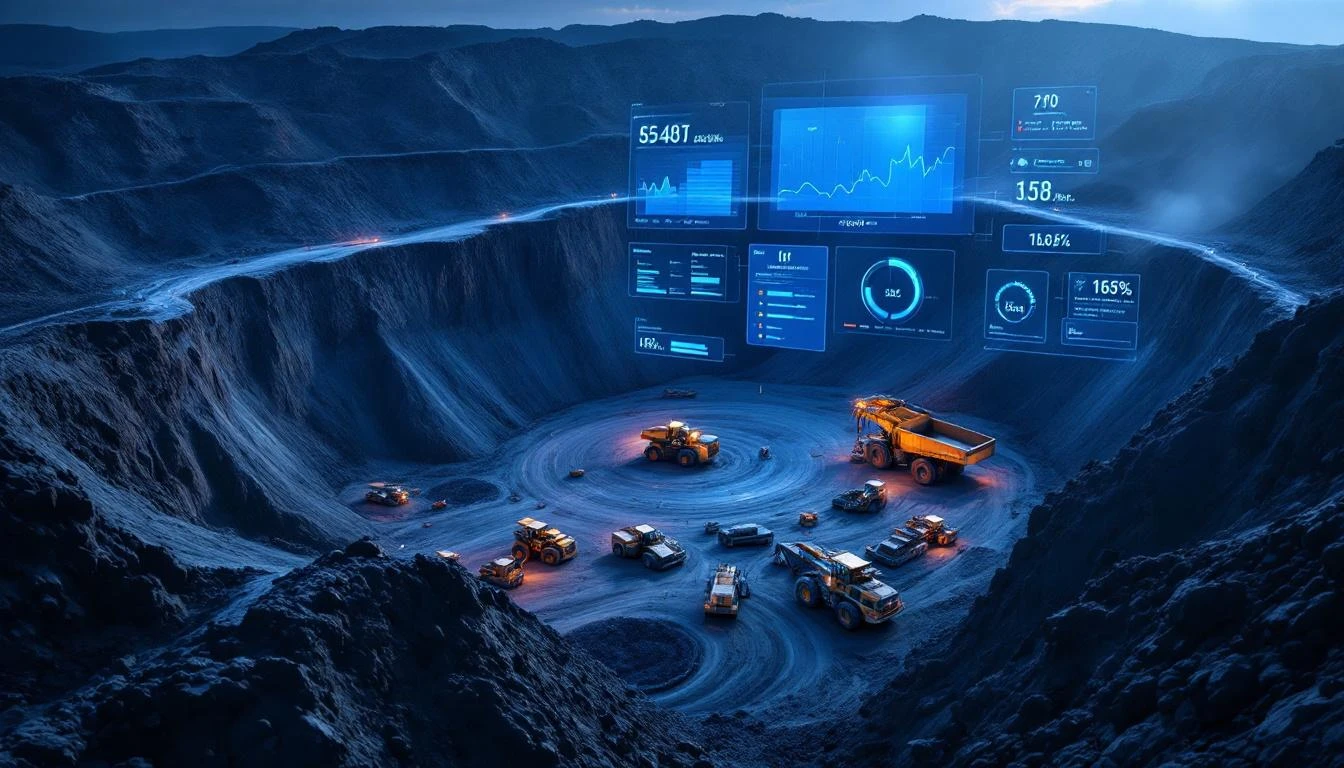
Why Mining Is Both the Best and Hardest IIoT Use Case
Mining is the best IIoT use case because the cost of failure is enormous. A $50/month sensor on a $2M crusher that prevents one failure per year delivers 100:1 ROI. The math is unambiguous.
Mining is the hardest IIoT use case because the operating environment is brutal:
- Temperature extremes: -40°F to 140°F operating ranges, depending on geography and process stage
- Dust and particulates: Airborne dust loads that destroy consumer-grade electronics within weeks
- Vibration: Equipment-generated vibration that exceeds military specifications
- Moisture and corrosion: Water, slurry, acidic dust, and chemical exposure
- Remote locations: Mine sites are often 50+ miles from the nearest town, with limited cellular coverage and no IT infrastructure
- Blast zones: Underground operations deal with blasting schedules that create electromagnetic interference and physical shock
These challenges don't make IIoT impossible in mining — they make platform selection critical. Consumer-grade IoT platforms that work in climate-controlled factories will fail spectacularly in a mine. You need industrial-grade edge hardware rated for extreme conditions, cellular connectivity that works in remote areas, and a platform architecture designed for intermittent connectivity.
Critical Mining Equipment to Monitor
1. Crushers (Jaw, Cone, Gyratory)
Crushers are the gateway to the processing circuit. When they stop, everything downstream stops.
What to monitor:
- Main bearing temperature: The most reliable failure predictor. Temperature trending above baseline indicates bearing wear. A 15°F increase from established baseline warrants investigation.
- Vibration (velocity and acceleration): Monitors liner wear, eccentric shaft bearing condition, and structural integrity. Acceleration measurements catch high-frequency impacts from tramp metal.
- Hydraulic pressure: Tramp iron release system pressure and accumulator pre-charge. Dropping accumulator pressure means the overload protection system won't function when needed.
- Motor current draw: Current trending upward at the same throughput rate indicates mechanical resistance — worn liners, bearing degradation, or drive train problems.
- CSS (closed side setting) position: Liner wear changes the CSS over time, affecting product size and throughput. Continuous monitoring replaces manual measurement.
- Lube oil temperature and flow: Oil temperature above 180°F indicates inadequate cooling. Low flow triggers should alert before bearings run dry.
Failure modes caught by IIoT: Bearing failure (30% of crusher downtime), liner cracking, eccentric shaft wear, hydraulic system degradation, and motor insulation breakdown.
2. Conveyor Systems
Conveyors are the circulatory system of a mine. They're also the most geographically distributed equipment, making them difficult and dangerous to inspect manually.
What to monitor:
- Belt alignment and tracking: Misaligned belts cause edge wear, spillage, and catastrophic belt failures. Tracking sensors at critical points detect drift before damage occurs.
- Idler bearing temperature: Failed idlers are the number one cause of conveyor belt fires in mining. Infrared temperature monitoring of idler bearings catches failures early.
- Drive motor current and temperature: Monitors belt loading, splice condition, and drive train health.
- Belt speed vs. motor speed: Speed differential indicates belt slip, which accelerates wear and reduces throughput.
- Take-up position: Monitors belt stretch over time. Approaching the end of take-up travel means belt replacement or splice insertion is needed.
- Chute blockage: Level sensors in transfer chutes detect blockages before they cause belt damage or spillage.
The IIoT advantage: A 5-kilometer overland conveyor has 25,000+ idler bearings. No human inspection program can check every idler every shift. Continuous temperature monitoring can. One large Australian mining operation reported a 73% reduction in conveyor-related fires after implementing IoT-based idler monitoring.

3. Grinding Mills (Ball Mills, SAG Mills, Rod Mills)
Grinding mills are the single most energy-intensive equipment in a mine, consuming 40-60% of total site electricity. They're also the production bottleneck in most processing circuits.
What to monitor:
- Bearing temperature (trunnion bearings): Large mill bearings are custom-manufactured with 6-12 month lead times. Early detection is not optional — it's existential.
- Vibration signatures: Shell vibration analysis detects ball charge level, liner wear pattern, and structural issues. Gearbox vibration monitoring catches gear tooth wear and pinion alignment.
- Mill load (bearing pressure or weight): Optimizing mill load directly affects grinding efficiency and throughput. Running underloaded wastes energy; overloaded causes liner damage.
- Motor current and power draw: Power draw correlates with mill charge and grinding efficiency. Trending analysis identifies optimal operating windows.
- Lube oil analysis (online): Particle counters and moisture sensors on the lubrication system provide continuous oil condition data without manual sampling.
- Cyclone overflow density: Downstream cyclone performance indicates grind quality, completing the grinding circuit feedback loop.
4. Haul Trucks and Mobile Equipment
Haul trucks represent 30-40% of a mine's operating cost. A fleet of 30 haul trucks at $5M each is a $150M asset base that depreciates rapidly under harsh conditions.
What to monitor:
- Engine parameters: Oil pressure, coolant temperature, exhaust gas temperature, turbo boost pressure, fuel consumption rate
- Transmission health: Shift pressure, converter lockup, torque converter temperature, clutch wear indicators
- Tire pressure and temperature: Tire failures are the number one safety hazard for haul trucks. Real-time TPMS monitoring prevents blowouts.
- Payload monitoring: Overloading accelerates frame fatigue, suspension wear, and tire damage. Underloading reduces productivity.
- Brake condition: Retarder and service brake temperatures during loaded descent. Overheating brakes are a mine-site safety emergency.
5. Pumps and Dewatering Systems
Slurry pumps and dewatering systems run continuously and wear rapidly due to abrasive particle loading.
What to monitor:
- Pump discharge pressure and flow rate: Declining pressure at constant speed indicates impeller wear.
- Vibration: Imbalance from impeller wear, bearing condition, cavitation detection.
- Motor current: Increasing current at constant flow indicates wear ring degradation or impeller erosion.
- Seal water pressure: Low seal water allows slurry intrusion into bearings — a rapid failure mode.
Solving the Connectivity Challenge in Mining
The biggest implementation barrier in mining IIoT isn't the sensors or the platform — it's connectivity. Mine sites are often in locations where traditional networking solutions don't work.
Cellular IIoT bypasses the problem. Instead of building a WiFi or Ethernet network across a mine site — an expensive and fragile proposition in an environment with blasting, dust, and mobile equipment — cellular-connected edge devices communicate directly with the cloud.
MachineCDN's architecture is purpose-built for this challenge. Each edge device connects via cellular (LTE/5G), eliminating the need for plant network infrastructure. No IT involvement. No VPN tunnels. No WiFi access points that need to survive blast vibration.
For underground operations where cellular coverage doesn't exist, a mesh of edge devices connected to a surface gateway provides data backhaul. The edge devices buffer data locally during connectivity gaps (shift changes, blasting windows) and forward when connectivity returns.
Implementation Roadmap for Mining IIoT
Phase 1 (Week 1-2): Critical Asset Pilot
- Select 5 critical assets: primary crusher, main conveyor drive, one grinding mill, two haul trucks
- Deploy edge devices and configure data collection
- Establish baseline vibration, temperature, and current signatures
- Set initial threshold alerts based on OEM specifications
Phase 2 (Week 3-6): Baseline and Pattern Recognition
- AI establishes normal operating patterns for each asset
- Fine-tune alert thresholds based on actual operating data (OEM specs are often too conservative or too aggressive)
- Identify first optimization opportunities (usually in grinding circuit efficiency)
- Calculate actual OEE improvements
Phase 3 (Month 2-3): Expansion to Full Processing Circuit
- Scale monitoring to all crushers, conveyors, mills, and critical pumps
- Integrate with maintenance scheduling for condition-based PM triggers
- Build predictive models using accumulated operating data
- Begin fleet management for mobile equipment
Phase 4 (Month 4-6): Enterprise Integration
- Connect to mine planning and scheduling systems
- Integrate with ERP for spare parts tracking
- Deploy dashboards for site management, maintenance planning, and corporate engineering
- Expand to secondary and tertiary processing equipment
ROI in Mining: The Numbers That Matter
Mining IIoT ROI is driven by three categories:
Avoided catastrophic failures: One prevented crusher bearing failure = $300K-$500K in avoided downtime and repair costs. One prevented conveyor fire = $1M+ in avoided damage, cleanup, and production loss. One prevented mill trunnion bearing failure = $2M+ in avoided costs (including 6-12 month parts lead time).
Throughput optimization: Mining operations typically run 5-15% below theoretical capacity due to unplanned downtime and suboptimal operating parameters. For a mine producing $500M in annual output, a 5% throughput improvement is $25M.
Energy optimization: Grinding mills alone consume $5M-$20M in electricity annually at a typical mine. Optimizing mill charge, ball loading, and classification circuit performance through real-time data typically saves 3-7%.
For a detailed framework on building the business case, see our Predictive Maintenance ROI Calculator.
Getting Started
Mining doesn't need another 18-month IIoT pilot program that produces a beautiful dashboard and no operational change. It needs equipment visibility that maintenance crews can act on — this shift, today.
MachineCDN connects to your crushers, conveyors, mills, and auxiliary equipment through standard industrial protocols. Edge devices are rated for harsh environments. Cellular connectivity works without mine site IT infrastructure. And AI-powered predictive maintenance gives your maintenance team the early warning they need to prevent failures — not just document them.
Book a demo and we'll show you what continuous monitoring looks like on your specific equipment. Because your maintenance crew deserves better than clipboard rounds and hope.