IIoT for Plastics and Injection Molding: How to Monitor Barrel Temperature, Clamp Pressure, and Cycle Times in Real Time

Injection molding is one of the most data-rich manufacturing processes in existence. A single injection molding machine generates hundreds of data points per cycle — barrel zone temperatures, injection pressure, clamp tonnage, screw position, cycle time, cooling time, cushion, and dozens more. Yet the vast majority of injection molding operations still rely on setup sheets, operator experience, and end-of-line quality checks to maintain process control.
This is the IIoT gap in plastics manufacturing. The data is there, inside the machine controller. The question is whether you're capturing it, analyzing it, and using it to prevent scrap before it happens — or whether you're discovering problems when bad parts come off the end of the line.
According to the Plastics Industry Association, scrap rates in injection molding average 5-8% across the industry. For a mid-size molder running 20 machines, that's $400K-$800K in annual waste. Most of that scrap is preventable with real-time process monitoring. You don't need a new machine. You need visibility into the machine you already have.
This guide covers the practical implementation of IIoT in plastics and injection molding — what to monitor, how to connect, and what ROI to expect.

Why Injection Molding Is Perfect for IIoT (and Why Most Molders Haven't Done It)
Injection molding has several characteristics that make it an ideal IIoT use case:
High-frequency, repeatable processes. A typical injection molding machine runs 15-60 second cycles, producing 500-5,000 parts per shift. Each cycle generates identical data points. This repetition creates massive datasets perfect for statistical analysis and anomaly detection.
Process parameters directly correlate with quality. Unlike many manufacturing processes where the relationship between machine settings and product quality is ambiguous, injection molding has well-understood process-quality relationships. Barrel temperature deviations of ±5°F can cause flash, short shots, or dimensional variation. Injection pressure profiles predict fill quality. Cycle time drift indicates process degradation.
Machines already have controllers with accessible data. Modern injection molding machines from Arburg, Engel, Husky, Sumitomo, and Nissei all have controllers that expose process data via Ethernet/IP or OPC UA. Even older machines with basic controllers typically support Modbus RTU. You don't need to add sensors — you need to read the data that's already being collected.
So why haven't most molders implemented IIoT?
Three reasons keep coming up in conversations with plastics manufacturers:
-
IT complexity. Traditional IIoT platforms require network infrastructure changes, VPN tunnels, and IT involvement. Plastics manufacturers — especially custom molders and mid-size operations — don't have dedicated IT departments.
-
Cost perception. Enterprise IIoT platforms price for large-scale manufacturing ($50K+ for deployment). Most injection molding operations can't justify that investment for 10-30 machines.
-
"We've always done it this way." Process technicians who've been setting up machines for 20 years resist digital monitoring because they believe (often correctly) that they know their machines better than any computer. The goal isn't to replace their knowledge — it's to capture it, quantify it, and make it available 24/7.
The 8 Critical Parameters to Monitor in Injection Molding
Not all process data is equally valuable. Here are the eight parameters that deliver the highest ROI when monitored in real time:
1. Barrel Zone Temperatures
Why it matters: Temperature uniformity across barrel zones directly affects melt homogeneity. A malfunctioning heater band can create cold spots that cause unmelted pellets, splay, or short shots. Temperature creep over time indicates heater degradation.
What to monitor: All barrel zone temperatures (typically 4-8 zones), nozzle temperature, and the delta between setpoint and actual temperature. A sustained delta of >5°F warrants investigation.
IIoT value: Real-time trending reveals heater band degradation weeks before failure. Instead of discovering a bad heater when scrap rates spike, you replace it during planned downtime.
2. Injection Pressure (Peak and Profile)
Why it matters: The injection pressure profile is the fingerprint of the molding process. Changes in peak injection pressure indicate viscosity changes (material variation), check ring wear, or mold flow restrictions.
What to monitor: Peak injection pressure, injection pressure at transfer, and ideally the full pressure-vs-time profile. A 10% shift in peak pressure from the validated process window is a clear action trigger.
3. Cycle Time
Why it matters: Cycle time directly determines throughput and is the most sensitive indicator of process drift. Cycle time increases typically indicate cooling issues, mold maintenance needs, or robot cycle problems.
What to monitor: Total cycle time, injection time, cooling time, mold open time, and ejection time. Break the cycle into components so you can pinpoint exactly where time is being lost.
4. Clamp Tonnage
Why it matters: Actual clamp tonnage vs. set tonnage reveals mold condition. Increasing tonnage requirements over time indicate parting line wear or core/cavity damage. Flash on parts often correlates with clamp tonnage insufficiency.
What to monitor: Actual clamp force, clamp open/close times, and any abnormal clamp pressure spikes that could indicate mold damage.
5. Cushion Position
Why it matters: Cushion (the material remaining in the barrel after injection) should be consistent shot to shot. Cushion variation indicates check ring wear, material inconsistency, or barrel wear. It's one of the earliest indicators of process degradation.
What to monitor: Cushion position at the end of pack/hold phase. Statistical process control (SPC) on cushion position catches check ring problems 2-4 weeks before they affect part quality.
6. Screw Recovery Time
Why it matters: Screw recovery time reflects material processing consistency. Increases indicate screw/barrel wear, material bridging in the hopper, or feed throat temperature issues.
7. Hot Runner Temperatures (if applicable)
Why it matters: Hot runner temperature variation causes quality issues at the gate — drool, stringing, freeze-off, or gate blush. Multi-drop hot runners are especially sensitive.
8. Hydraulic Oil Temperature
Why it matters: Hydraulic oil temperature affects machine performance across every axis. Oil temperature > 140°F degrades seal life and changes response times. It's also a leading indicator of cooling system problems.
How to Connect Injection Molding Machines to IIoT
The connectivity path depends on your machine vintage and controller type:
Modern Machines (2010+): Ethernet/IP or OPC UA
Most modern injection molding machines have Ethernet ports on the controller. Machines from Arburg (Selogica/Gestica controllers), Engel (CC300), and Husky (Altanium) support Ethernet/IP or OPC UA natively.
Connection process:
- Identify the controller's Ethernet port and protocol support
- Connect an IIoT edge device to the machine's Ethernet port
- Configure tag mapping — specify which PLC registers correspond to which process parameters
- Verify data flow — confirm live data appears on the IIoT platform
With MachineCDN, this process takes about 3 minutes per machine. The edge device connects via Ethernet/IP, you map the tags you want to monitor, and data flows immediately to the cloud dashboard. No IT network involvement required — cellular connectivity bypasses the plant network entirely.
Older Machines (Pre-2010): Modbus RTU
Older machines typically expose data via serial communication (RS-232 or RS-485) using the Modbus RTU protocol. This covers a large installed base of machines from Cincinnati Milacron, Van Dorn, and older Engel and Arburg models.
Connection process:
- Identify the serial port and communication parameters (baud rate, parity, stop bits)
- Connect an IIoT edge device with RS-485 support
- Map Modbus register addresses to process parameters
- Configure polling intervals (typically 1-5 seconds for injection molding)
Auxiliary Equipment
Don't forget the auxiliaries. Dryers, chillers, mold temperature controllers, granulators, and material handling systems all affect process quality and all generate monitorable data.
- Material dryers: Dew point, hopper temperature, regeneration cycles
- Mold temperature controllers (TCUs): Setpoint vs. actual temperature, flow rate, delta-T across mold circuits
- Chillers: Coolant temperature, pressure, flow rate
- Robots: Cycle time, position accuracy, fault codes
A complete IIoT implementation monitors the entire work cell — not just the molding machine.
Building a Plastics-Specific Monitoring Dashboard
Your IIoT dashboard for injection molding should be organized around the questions your team asks every day:
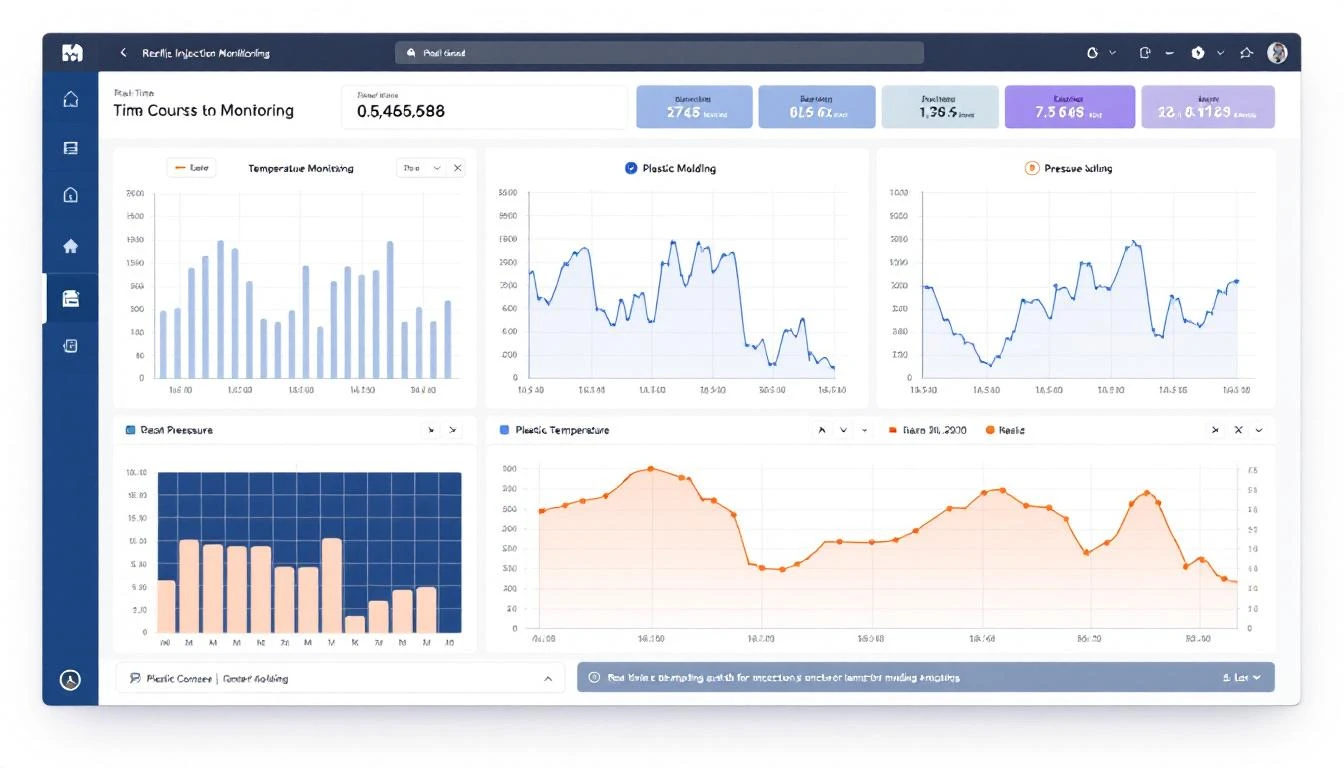
Shop floor view: Which machines are running? Which are down? What's the current cycle time vs. standard? Color-coded status for instant visual management.
Machine detail view: Live process parameters with SPC limits overlaid. Barrel zone temperatures. Injection pressure trend. Cycle time histogram. Cushion position chart with control limits.
Quality correlation view: Scatter plots of process parameters vs. quality metrics. Which barrel zone temperature most strongly correlates with dimensional variation? Is there a pressure profile that predicts sink marks?
Maintenance view: Equipment health scores based on parameter trends. Machines approaching threshold limits. PM schedule with hours-based triggers (not just calendar-based). Spare parts availability for critical components (heater bands, thermocouples, check rings).
MachineCDN provides all of these views out of the box, with AI-powered anomaly detection that learns your normal process windows and alerts you when parameters drift — even when they're still within SPC limits but trending in a concerning direction.
ROI Calculation for Injection Molding IIoT
Here's a realistic ROI model for a 20-machine injection molding operation:
Scrap reduction: Industry average scrap rate of 6% reduced to 3% through real-time process monitoring and early intervention. For a shop running $8M in annual revenue, that's $240K in recovered material and machine time.
Unplanned downtime reduction: Average injection molding operation experiences 8-12% unplanned downtime. Predictive monitoring of hydraulic systems, heater bands, and barrel wear can reduce this by 40-60%. At $300/hour average cost per machine, reducing 2 hours/week of unplanned downtime across 20 machines saves $600K annually. Read more about the true cost of unplanned downtime.
Energy savings: Real-time monitoring of heater band efficiency, hydraulic system health, and cooling system performance typically identifies 5-10% energy savings. For an operation spending $200K/year on electricity, that's $10K-$20K.
Cycle time optimization: Identifying and eliminating the root causes of cycle time variation typically improves throughput by 2-5%. On a $8M revenue base, that's $160K-$400K in additional capacity.
Total estimated annual benefit: $1.0M-$1.3M
Implementation cost with MachineCDN: A fraction of that annual benefit, with ROI typically visible within 5 weeks.
Getting Started: The 5-Machine Pilot
Don't try to instrument all 20 machines at once. Start with 5 machines that represent your highest-value or highest-problem work cells:
- Select 5 machines — choose a mix of machine sizes and ages to validate connectivity across your fleet
- Define 3 success metrics — e.g., reduce scrap rate by 2%, catch one unplanned downtime event before it happens, identify one cycle time optimization opportunity
- Deploy and monitor for 4 weeks — give the system enough data to establish baselines and demonstrate pattern detection
- Review results with your team — process technicians, quality, maintenance, and management
- Scale to full fleet — with proven results, the expansion business case writes itself
Book a demo and we'll show you how MachineCDN connects to your specific injection molding machines — whether they're running Ethernet/IP, OPC UA, or Modbus. See live data from your machines in under an hour, and start reducing scrap before the end of your first week.