IoT Monitoring for Injection Molding Machines: Catching Process Drift Before Defects

An injection molding machine running at spec produces parts within tolerance, cycle after cycle. But every experienced process engineer knows the truth: machines drift. Barrel zone temperatures creep. Check rings wear. Hydraulic valves degrade incrementally. By the time a quality issue shows up in finished parts, the process has been drifting for hours — sometimes days — burning material, cycle time, and margin the entire way.
IoT monitoring changes this equation fundamentally. Instead of catching drift through downstream inspection, connected sensors and real-time analytics flag the process variables that predict defects before they manifest in parts.

The Real Cost of Unmonitored Injection Molding
The injection molding industry operates on razor-thin margins. A typical custom molder runs at 2-5% net profit. Within that margin, scrap rates of 3-8% are common — and largely accepted as normal. But "normal" scrap is just undiagnosed process drift.
Consider what happens when a rear barrel zone heater starts to fail:
- Hour 0-2: Zone temperature drops 3-5°F below setpoint. The controller compensates by increasing the adjacent zone's output. Parts still pass inspection.
- Hour 2-6: Melt temperature becomes uneven. Viscosity variation increases. Fill time variability rises from ±0.02s to ±0.08s. Parts still technically pass, but dimensional consistency degrades.
- Hour 6-12: Short shots begin appearing intermittently — maybe 1 in 50 cycles. Operators increase pack pressure to compensate. Energy consumption rises 8-12%.
- Hour 12-24: Scrap rate climbs to 5-6%. An operator finally notices and calls maintenance. The machine goes down for heater band replacement.
Total cost: 6-12 hours of marginal parts, increased energy, a maintenance event, and lost production time. Multiply this across 20-50 machines in a typical shop, and you're looking at hundreds of thousands in annual waste that never shows up as a single dramatic failure.
This is exactly the problem IIoT monitoring solves. A connected machine would have flagged the zone temperature deviation in hour one — before any part quality impact.
Critical Parameters to Monitor on Injection Molding Machines
Not every data point on an injection molding machine is equally valuable. Effective IoT monitoring focuses on the parameters that are leading indicators of process drift, not lagging indicators of defects.
Barrel Zone Temperatures
Modern injection molding machines typically have 4-6 barrel heating zones plus nozzle heat. Each zone is independently controlled, but they interact thermally. The key monitoring targets are:
- Actual vs. setpoint deviation per zone. A healthy process holds ±2°F. Deviations beyond ±5°F warrant investigation; beyond ±10°F indicate heater band failure or thermocouple degradation.
- Zone-to-zone differential trends. Even if each zone is "in spec," changing differentials between zones indicate thermal profile shifts that affect melt homogeneity.
- Heat-up and recovery behavior. How long a zone takes to recover after a door-open event or purge cycle reveals heater element health. Increasing recovery times are an early predictor of heater failure.
With an IIoT platform like MachineCDN, these temperatures are sampled every few seconds and trended over days and weeks. Threshold alerts fire when a zone deviates beyond configured limits — long before an operator would notice on the machine's local HMI.
Cycle Time Decomposition
Total cycle time is the most commonly tracked metric in injection molding, but the total number hides critical detail. What matters is breaking the cycle into its constituent phases:
- Injection time (fill). Directly related to material viscosity, which is a function of melt temperature and material lot consistency. Fill time increasing by more than 5% from baseline signals viscosity changes.
- Pack and hold time. Critical for dimensional accuracy and sink marks. Variations here often indicate check ring wear or hydraulic system degradation.
- Cooling time. Driven by mold temperature and part geometry. Increasing cooling requirements can signal coolant flow issues or scale buildup in cooling channels.
- Mold open/close and ejection. Mechanical timing that should be extremely consistent. Variations indicate tie bar wear, platen alignment issues, or ejector system problems.
When these individual phase times are monitored via IoT, pattern recognition becomes possible. A gradual increase in fill time combined with stable barrel temperatures might indicate a material lot change or check ring wear — two very different root causes that require different responses.
Shot Weight and Cushion
Shot weight — the mass of material injected per cycle — is the single most important quality metric for injection molded parts. Monitoring shot weight variation tells you more about process stability than any other single measurement.
- Cushion position (the material remaining in the barrel after injection) should be consistent within ±0.05 inches for most processes. Increasing cushion variation indicates check ring bypass or barrel/screw wear.
- Shot-to-shot weight variation beyond ±0.5% typically indicates process instability that will eventually produce defects.
Real-time shot weight monitoring through connected load cells or nozzle pressure transducers gives immediate feedback on process stability. OEE dashboards that incorporate shot weight consistency provide a truer picture of "quality" than simple pass/fail inspection.
Scrap Rate Trending
Scrap rate is a lagging indicator — by definition, defects have already occurred. But IoT monitoring transforms scrap data from a retrospective metric into a predictive tool by correlating scrap events with process parameter history.
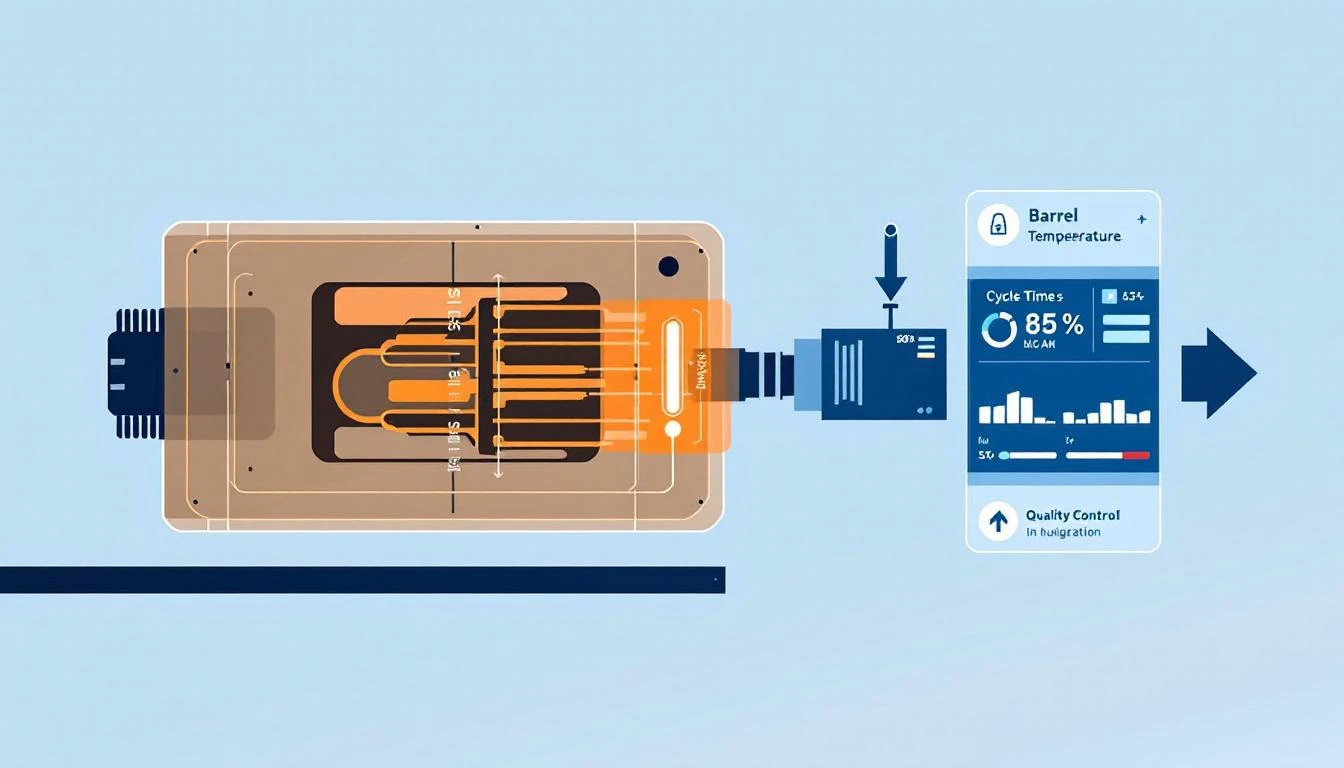
When every rejected part is tagged with a timestamp and defect code (short shot, flash, burn marks, sink, warp, splay), and that data is overlaid against the full process parameter history, patterns emerge:
- Burns correlating with residence time. Parts running burns after extended idle periods indicate material degradation from excessive barrel residence time.
- Flash spikes after mold maintenance. Clamp tonnage may need adjustment, or parting line surfaces may have been damaged during cleaning.
- Splay defects tracking ambient humidity. Moisture-sensitive materials like nylon and polycarbonate show splay that correlates with plant humidity levels — a variable that most molders don't monitor at all.
How IIoT Catches Process Drift Early
The fundamental advantage of IoT monitoring over traditional process control is the ability to detect trends across time scales that human operators cannot perceive. A process engineer reviewing a machine once per shift sees snapshots. An IoT platform sees the movie.
Threshold Alerting with Context
Basic alarming — "temperature exceeded X degrees" — has existed on machine controllers for decades. What IIoT adds is contextual, multi-variable threshold alerting:
- Approaching thresholds. MachineCDN's threshold system distinguishes between active alarms (limit exceeded) and approaching conditions (trending toward limit). This gives maintenance teams time to schedule corrective action during planned downtime rather than reacting to failures.
- Compound conditions. A single parameter deviation might be acceptable. Three parameters simultaneously trending outside normal ranges — even if none has technically violated a limit — is a strong signal of process drift. Multi-variable alerting catches these compound conditions.
- Shift and environmental context. The same process parameters may have different normal ranges depending on ambient temperature, material lot, or operator. IoT platforms that track these contextual variables avoid false alarms while catching real drift.
Baseline Learning and Deviation Detection
The most powerful application of IoT data in injection molding is establishing per-mold, per-material process baselines and monitoring for deviation.
Here's how this works in practice:
- Qualification runs establish baseline parameters: cycle time decomposition, zone temperatures, hydraulic pressures, cushion position, and shot weight for a specific mold-material-machine combination.
- IoT sensors continuously monitor these parameters during production runs.
- Statistical process control (SPC) algorithms running on the collected data identify when any parameter exceeds its normal variation band — not an arbitrary limit, but the statistically-derived range from the qualification baseline.
- Alerts notify process engineers of drift before it reaches the point of producing defects.
This approach is fundamentally different from traditional machine alarms. Machine alarms protect equipment from damage. IoT-driven process monitoring protects part quality by detecting the subtle, gradual changes that eventually produce defects.
Connecting Legacy Injection Molding Machines
One of the biggest barriers to IoT adoption in plastics manufacturing is the age of the equipment. The average injection molding machine in a North American shop is 15-20 years old. These machines were designed before IoT existed, and many run on proprietary controllers with limited or no network connectivity.
This is where edge computing solutions shine. Modern IIoT platforms connect to legacy machines through industrial protocols like Ethernet/IP and Modbus — the same protocols these machines already use for internal communication between their PLCs and HMIs.
The connection process for a typical legacy injection molding machine looks like:
- Identify available data points. Most injection molding machine PLCs expose barrel zone temperatures, hydraulic pressures, cycle status, and alarm states through their native protocol.
- Deploy an edge device. A compact industrial router sits on the machine's local network (or connects directly to the PLC's Ethernet port) and reads the available tags.
- Configure tag mapping. Map PLC register addresses to meaningful parameter names — Zone 1 Temperature, Cycle Time, Clamp Pressure, etc.
- Establish connectivity. Cellular connectivity bypasses the need to involve plant IT networks entirely. Data flows from the edge device directly to the cloud platform.
With MachineCDN, this entire process takes minutes per machine — not the weeks or months that traditional MES or SCADA deployments require. There's no software installation on the machine controller, no disruption to the existing control system, and no IT infrastructure changes.
Building a Plastics-Specific Monitoring Strategy
Injection molding has unique monitoring requirements compared to discrete manufacturing or CNC machining. A monitoring strategy built for plastics should account for:
Material Sensitivity
Plastics processing is fundamentally a thermal process. Unlike metal cutting, where tool wear is the primary variable, injection molding quality is driven by the thermal history of the polymer from hopper to mold. This means:
- Melt temperature monitoring is critical — and it's not the same as barrel temperature. The actual melt temperature depends on barrel zone settings, screw speed, back pressure, and residence time. IoT platforms that can calculate effective melt temperature from multiple input parameters provide more accurate process insight than zone temperature alone.
- Material drying conditions affect everything downstream. For hygroscopic materials (PC, nylon, PET, ABS), dryer temperature and dewpoint should be monitored alongside the molding machine. A dryer malfunction at 6 AM will produce splay defects at 8 AM — IoT monitoring connects these causally separated events.
Mold-Specific Parameters
Every mold has its own personality. A monitoring strategy needs to account for mold-specific baselines:
- Cooling water flow and temperature per circuit. Scale buildup in cooling lines is progressive and invisible without flow monitoring. A 20% reduction in coolant flow through a core circuit will increase cycle time and cause warpage — gradually, over weeks.
- Cavity pressure transducers (where installed) provide the closest available approximation of actual part quality. Cavity pressure profiles should be monitored and baselined per mold.
Environmental Factors
Plastics processing is more sensitive to ambient conditions than most manufacturers realize:
- Plant temperature variations of 10-15°F between seasons can shift cooling performance, hydraulic oil viscosity, and material behavior.
- Humidity affects material drying, mold condensation (causing surface defects), and cooling tower performance.
- Electrical supply quality — voltage sags and frequency variations affect heater output and hydraulic pump performance.
Monitoring these environmental parameters alongside machine data creates a complete picture of process influences. When a quality issue arises, having environmental data eliminates an entire category of potential root causes.
ROI: What IoT Monitoring Delivers for Injection Molders
The return on IoT monitoring in injection molding is driven by three primary value streams:
1. Scrap Reduction
Detecting process drift before it produces defects directly reduces scrap. Industry benchmarks suggest IoT-monitored injection molding processes achieve 25-40% scrap reduction compared to unmonitored baselines. For a shop running $5M in annual material, a 2% absolute scrap reduction represents $100K in direct savings.
2. Reduced Unplanned Downtime
Predictive maintenance based on trend data — heater degradation, hydraulic system wear, check ring bypass — converts unplanned downtime into scheduled maintenance. Unplanned downtime on an injection molding machine typically costs $5,000-15,000 per hour in lost production, scrap, and restart waste. Even modest improvements in uptime have significant financial impact.
3. Energy Optimization
Injection molding is energy-intensive. Barrel heating, hydraulic pumps, and cooling systems consume 3-12 kWh per kg of processed material. IoT monitoring identifies energy waste from:
- Overheating barrel zones (common operator habit of "running hot" as a short-shot prevention measure)
- Hydraulic leaks causing pump overwork
- Cooling system inefficiencies
- Extended idle periods with barrels at full temperature
Energy savings of 8-15% are typical after implementing IoT monitoring with energy tracking — a capability built into platforms like MachineCDN.
Getting Started: From One Machine to Full Fleet
The most effective IoT deployment strategy for injection molding shops follows a deliberate progression:
- Start with one problem machine. Every shop has one — the machine that generates the most scrap, the most downtime calls, the most process engineer headaches. Instrument it first.
- Establish baselines. Run monitored production for 2-4 weeks to establish normal parameter ranges for the primary mold-material combinations that run on that machine.
- Configure alerts. Set threshold alerts based on the established baselines, not arbitrary textbook values. Every machine is different; data-driven thresholds are far more effective than generic limits.
- Measure impact. Track scrap rate, unplanned downtime, and cycle time efficiency before and after IoT monitoring. This data builds the business case for fleet-wide deployment.
- Scale systematically. Expand to additional machines based on impact potential. Getting started with IIoT doesn't require instrumenting every machine on day one — a phased approach delivers faster ROI and builds organizational confidence.
The Bottom Line
Injection molding process drift is inevitable. Machines wear, materials vary, and environmental conditions change. The question isn't whether drift will occur — it's whether you'll detect it before or after it costs you money.
IoT monitoring shifts the detection point from downstream inspection to real-time process parameters. Instead of finding defects in parts, you find the conditions that cause defects — and correct them before a single bad part is produced.
For plastics manufacturers running on thin margins, this isn't a technology project. It's a competitive necessity.
Ready to monitor your injection molding fleet? Book a demo and see how MachineCDN connects your machines in minutes — not months.