Reducing Scrap Rates in Plastics Manufacturing with Real-Time Data

Scrap in plastics manufacturing isn't a single event — it's a slow accumulation of process variables drifting outside their optimal windows. A barrel zone running 8°F hot. An extruder screw wearing down imperceptibly over months. A coolant line scaling at 1% per week. None of these individually trigger an alarm. Together, they push scrap rates from an acceptable 2% to a margin-killing 6% — and the root cause is invisible without data.
Real-time monitoring changes this equation. When every extruder, injection molder, and blow molder on the floor is streaming process data to a central platform, the patterns that create scrap become visible — and correctable — before they reach the finished parts.
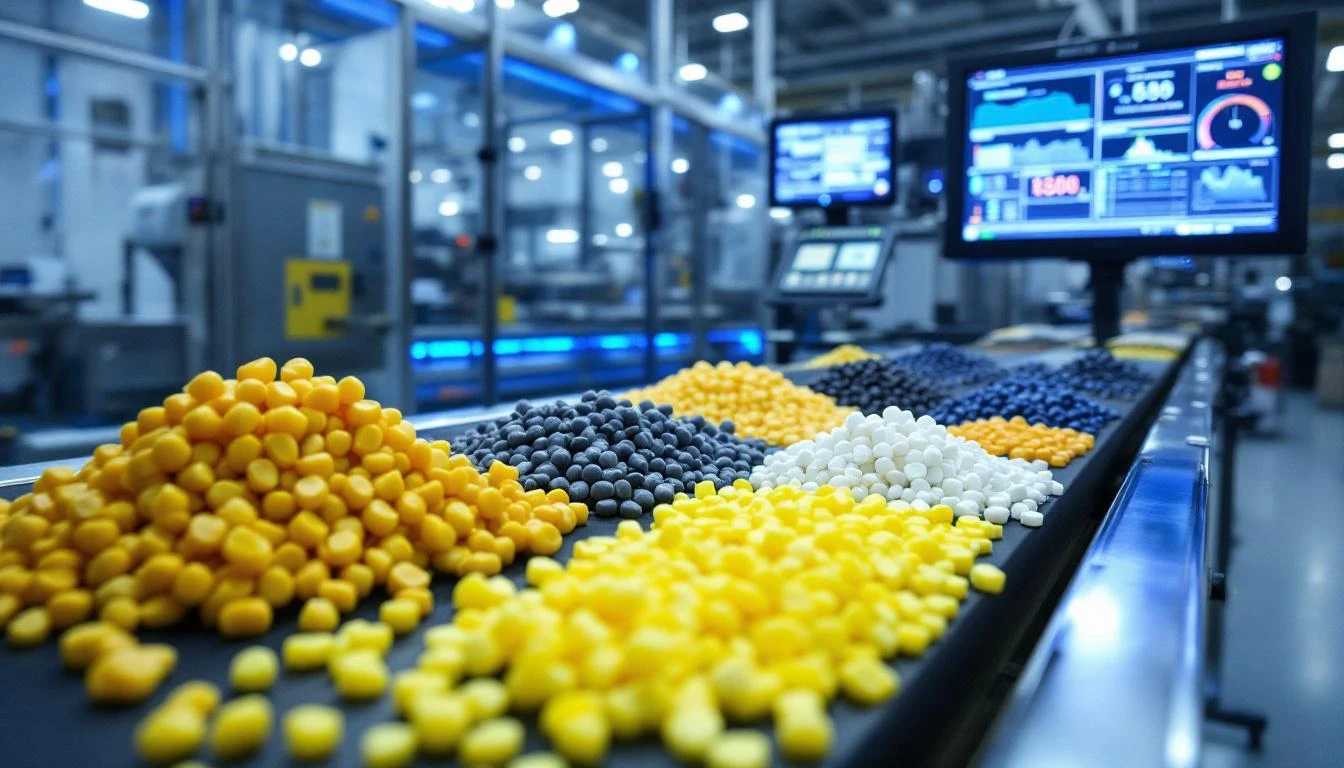
The Hidden Math of Plastics Scrap
Most plastics manufacturers track scrap as a single aggregate number — total rejected parts divided by total produced. The industry average sits between 3-8% depending on process type, material, and part complexity. Many operations accept these numbers as inherent to the process.
They're wrong.
Let's break down where scrap actually comes from in a typical plastics operation:
| Scrap Source | Typical Contribution | Root Cause Visibility |
|---|---|---|
| Process startup/purge | 15-25% of total scrap | Predictable, partially reducible |
| Material contamination | 5-10% | Often invisible until parts fail |
| Process drift | 30-45% | Highest opportunity — invisible without data |
| Mold/die wear | 10-15% | Gradual, hard to detect manually |
| Operator variation | 10-20% | Shift-dependent, inconsistent |
| Environmental factors | 5-10% | Rarely monitored |
The largest category — process drift — is also the one most amenable to IoT monitoring. Process drift scrap occurs when parameters gradually shift from their optimal values. Each individual shift is too small to trigger a machine alarm, but their cumulative effect produces parts that fail inspection or, worse, pass inspection but fail in service.
For a mid-size plastics operation processing 2 million pounds of resin annually at an average material cost of $1.50/lb, a scrap rate of 5% represents $150,000 in raw material waste alone. Add the labor, energy, and machine time consumed producing those scrapped parts, and the real cost is 2-3x the material value — approaching $300,000-450,000 per year.
Reducing scrap from 5% to 3% through real-time monitoring saves $60,000 in material and $120,000-180,000 in total operational cost. That's the ROI case, and it's conservative.
Connecting the Machines That Matter Most
Not every machine on the plastics manufacturing floor contributes equally to scrap. An effective monitoring strategy starts with the highest-impact equipment.
Injection Molding Machines
Injection molding generates the highest scrap rates in plastics manufacturing due to the number of interacting variables: melt temperature, injection speed, pack and hold pressure, cooling time, clamp force, and material condition. Each variable has a range of acceptable values, but the interaction between variables creates a narrow process window that's difficult to maintain without continuous monitoring.
Key parameters to stream:
- Barrel zone temperatures (all zones + nozzle). A typical injection molder has 4-6 heated zones. The thermal profile across these zones determines melt homogeneity. Monitoring zone-to-zone differentials reveals profile shifts that single-zone monitoring misses.
- Injection pressure profile. Peak injection pressure, transfer pressure, and pack/hold pressure should be monitored per cycle. Increasing peak pressure with stable settings indicates material viscosity changes, check ring wear, or nozzle restriction.
- Cycle time decomposition. Total cycle time is the headline metric, but breaking it into fill, pack, cool, and mold movement phases reveals which specific aspect of the process is drifting. A 0.3-second increase in fill time has a completely different root cause than a 0.3-second increase in cooling time.
- Cushion position. The material remaining in the barrel after injection. Consistent cushion = consistent shot weight = consistent parts. Cushion variation beyond ±0.05" warrants immediate investigation.
- Mold temperature (supply and return per circuit). Differential between supply and return water temperature reveals cooling efficiency per circuit. Increasing differentials indicate scale buildup, flow restrictions, or temperature control unit (TCU) degradation.
Extruders
Extrusion processes — film, sheet, pipe, profile — generate scrap differently than injection molding. The continuous nature of extrusion means that scrap tends to be produced in runs rather than individual parts. A gauge variation that goes undetected for 30 minutes can scrap an entire roll or run of material.
Critical extrusion parameters:
- Melt pressure and temperature at the die. These are the ultimate indicators of process stability. Melt pressure variation correlates directly with dimensional variation in the extrudate. A healthy extrusion process holds melt pressure within ±1-2% of setpoint.
- Screw speed and motor load. Increasing motor load at constant screw speed indicates material viscosity changes, screw/barrel wear, or contamination. Trending motor load over weeks reveals screw wear progression — a predictive maintenance insight that prevents catastrophic failure and the massive scrap event that accompanies it.
- Die lip or gap position. For adjustable dies, monitoring lip gap and correlating it with downstream gauge measurements creates a closed-loop quality picture.
- Downstream gauge measurements. Thickness, width, and diameter measurements from laser or ultrasonic gauges should flow into the same data platform as the extruder parameters. This connects cause (extruder settings) with effect (dimensional quality).
- Puller and winder speed. Speed variations in downstream equipment create thickness variations in the extrudate. Monitoring puller speed stability alongside extruder output identifies haul-off-induced scrap.
Blow Molding Machines
Blow molding — whether extrusion blow molding (EBM), injection blow molding (IBM), or injection stretch blow molding (ISBM) — has unique scrap sources tied to parison/preform formation and the blow process itself.
Monitor these parameters:
- Parison wall thickness profile. For EBM, the parison programming (wall thickness vs. length) directly determines bottle wall distribution. Monitoring the programmed profile vs. actual parison behavior reveals die swell variations and material consistency issues.
- Blow pressure and timing. Insufficient blow pressure causes incomplete forming. Excessive pressure causes blowouts. Both are scrap. Monitoring blow pressure per cycle catches air system degradation and leak development.
- Flash weight. In EBM, flash (the excess material trimmed from the molded part) should be consistent. Increasing flash weight indicates mold wear, clamp alignment drift, or parison positioning errors.
Building the Real-Time Data Architecture
Connecting plastics processing equipment to a monitoring platform involves three layers, each of which must function reliably for the system to deliver scrap reduction.
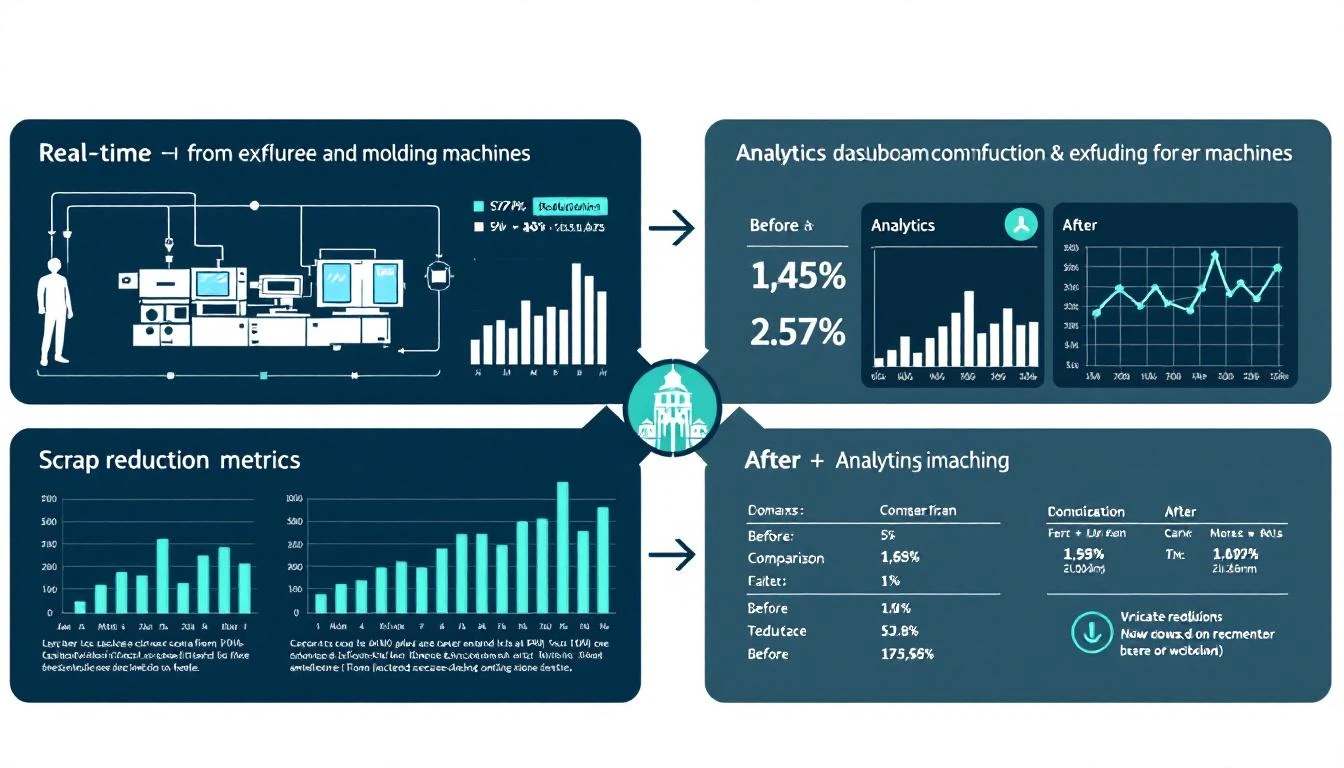
Layer 1: Machine Connectivity
Plastics processing equipment communicates through industrial protocols — primarily Ethernet/IP and Modbus (TCP and RTU). These protocols were designed for real-time machine communication and are supported by virtually every PLC manufacturer (Allen-Bradley, Siemens, Mitsubishi, Fanuc, B&R, Beckhoff).
The challenge isn't the protocol — it's the diversity. A typical plastics operation runs machines from multiple manufacturers, spanning multiple decades. The 2005 Van Dorn injection molder speaks a different Modbus dialect than the 2020 Engel machine. A capable IIoT platform handles this diversity through configurable protocol adapters, not custom integration for each machine.
Modern edge computing devices connect directly to machine PLCs through these native protocols. No modifications to the machine controller are required. No additional sensors need to be installed for basic process monitoring — the data is already in the PLC, it just isn't being collected.
For older machines without network-capable PLCs, analog-to-digital converters can capture 4-20mA signals from existing sensors (temperature, pressure, speed) and feed them into the same data pipeline.
Layer 2: Edge Processing and Transmission
Raw PLC data requires processing before it becomes useful for scrap reduction. Edge devices perform several critical functions:
- Data normalization. Converting raw register values into engineering units (°F, PSI, inches, seconds) with proper scaling and offset calculations.
- Cycle detection. Identifying individual production cycles from continuous data streams. This is essential for per-cycle analysis — comparing parameters on the cycle that produced a defect vs. the cycles that produced good parts.
- Data compression. Industrial machines can generate thousands of data points per second. Intelligent edge processing uses change-based transmission — only sending data when values change beyond a configured deadband — reducing bandwidth requirements by 80-95% without losing process-relevant information.
- Local buffering. If network connectivity is interrupted, edge devices must buffer data locally and forward it when connectivity resumes. In plastics manufacturing, a connectivity gap should never create a data gap.
Connectivity itself is a critical design choice. Traditional approaches require connecting IoT devices to the plant's IT network — a process that involves IT security reviews, firewall rules, VLAN configuration, and weeks of coordination. Cellular connectivity bypasses this entirely. An edge device with an embedded cellular modem transmits data directly to the cloud platform, with zero IT involvement. MachineCDN uses this approach, enabling machine connections in minutes rather than the weeks or months typical of network-dependent deployments.
Layer 3: Analytics and Alerting
Raw data becomes actionable through analytics — the layer that transforms millions of data points into scrap-reducing insights:
- Statistical Process Control (SPC). Automated control chart generation for key parameters. Western Electric rules, Nelson rules, and trend detection algorithms identify process drift while it's still within specification limits.
- Correlation analysis. Connecting upstream process parameters with downstream quality outcomes. When scrap occurs, the system automatically identifies which parameters were abnormal during the corresponding production cycle.
- Threshold alerting with multi-level severity. Not all deviations are equal. Threshold alert systems that distinguish between "approaching limit" (advisory) and "limit exceeded" (action required) prevent alert fatigue while ensuring critical conditions get immediate attention.
- Shift-over-shift and lot-over-lot comparison. Scrap often varies by shift or material lot. Analytics that segment data by these factors reveal operator-dependent or material-dependent quality issues that aggregate analysis obscures.
Five Scrap Reduction Wins from Real-Time Data
Theory is fine, but plastics manufacturers need concrete examples. Here are five common scrap-reduction scenarios that real-time monitoring addresses:
Win #1: Catching Material Lot Variation
Every plastics processor has experienced this: a new lot of resin arrives, meets the material certificate specifications, but processes differently than the previous lot. Melt flow index (MFI) can vary by 10-15% within specification, and that variation directly affects fill behavior, shrinkage, and part dimensions.
Without monitoring: Parts run for hours before the quality shift is detected. An entire shift's production may need to be quarantined and inspected.
With monitoring: Fill time and injection pressure shifts are detected within the first 10-20 cycles of the new lot. The system alerts the process engineer, who adjusts parameters proactively. Scrap from material lot transitions drops from hours of questionable production to minutes.
Win #2: Detecting Cooling System Degradation
Mold cooling accounts for 60-80% of injection molding cycle time. Cooling system degradation is progressive and invisible without monitoring:
- Scale builds up in cooling channels at 0.1-0.5mm per month in hard water areas
- TCU (temperature control unit) performance degrades as pumps wear and heating elements scale
- Hose connections develop partial blockages from debris and biofilm
Without monitoring: Cycle times gradually increase. Operators compensate by extending cooling time, accepting longer cycles as "normal." Nobody questions a 2-second cycle time increase that occurred over 3 months.
With monitoring: Coolant flow rates and supply/return temperature differentials are trended. A 15% flow reduction over 6 weeks triggers a maintenance alert. Downtime tracking is used to schedule descaling during planned maintenance rather than waiting for visible quality impact.
Win #3: Eliminating Shift-to-Shift Variation
Different operators produce different scrap rates — not because some operators are bad, but because small differences in machine setup, purge procedures, and process adjustment approaches accumulate.
Without monitoring: The difference between Shift A's 2% scrap rate and Shift C's 5% scrap rate is attributed to "experience" with no actionable detail.
With monitoring: Data shows that Shift C consistently runs barrel zones 5-8°F hotter than Shift A (an operator preference), resulting in longer cooling times and more thermal degradation. The process engineer establishes standard setup parameters based on the data. Scrap rates converge.
Win #4: Predicting Screw and Barrel Wear
Screw and barrel wear in both injection molding and extrusion is inevitable — but its rate depends on the materials processed. Glass-filled resins, mineral-filled compounds, and flame-retardant materials accelerate wear dramatically. A barrel running 30% glass-filled nylon may need replacement every 12-18 months.
Without monitoring: Screw/barrel wear is detected when parts start showing inconsistency that can't be corrected through process adjustment. By this point, the wear is severe, and weeks of sub-optimal production have already occurred.
With monitoring: Trending of recovery time (screw rotate time at constant back pressure) and cushion consistency reveals wear progression months before it impacts parts. Predictive maintenance scheduling aligns screw replacement with planned shutdowns.
Win #5: Environmental Compensation
Plastics processing is more sensitive to environmental conditions than most manufacturers acknowledge. A plant in Texas experiences 40°F ambient temperature swings between summer and winter. That variation affects:
- Cooling water temperature (tower-cooled systems are ambient-dependent)
- Hydraulic oil viscosity (cold oil = sluggish machine response)
- Material moisture pickup (humidity-dependent for hygroscopic resins)
- Mold surface condensation (humidity + cold mold = surface defects)
Without monitoring: Seasonal quality variations are accepted as normal. Process parameters are adjusted reactively as problems appear each season.
With monitoring: Environmental sensors (ambient temperature, humidity, cooling water temperature) are correlated with process and quality data. Process recipes automatically flag when environmental conditions shift outside the range where current parameters were optimized. AI-driven insights can recommend parameter adjustments based on environmental conditions.
Measuring What Matters: Scrap KPIs for Connected Plastics Operations
Once machines are connected and streaming data, the metrics framework needs to evolve beyond aggregate scrap percentage. Effective scrap KPIs for data-driven plastics operations include:
First-Pass Yield by Machine-Mold Combination
Aggregate scrap rate across the plant is a financial metric, not an operational one. First-pass yield tracked per machine-mold combination identifies exactly where quality problems exist. Some machine-mold combinations will run at 99.5% yield while others struggle at 94%. The data tells you where to focus improvement efforts.
Scrap Category Distribution
Not all scrap is created equal. Tracking scrap by defect category — short shots, flash, burns, splay, warpage, dimensional, contamination, startup/purge — reveals which failure modes dominate and where monitoring investments should be directed.
Time-to-Detection
How long does it take from when a process deviation begins to when it's detected? Traditional quality inspection might detect a problem in 30-60 minutes (when the next inspection sample is pulled). Real-time monitoring should detect parameter deviations in seconds. Tracking time-to-detection as a KPI drives continuous improvement of the monitoring system itself.
Scrap Cost per Machine Hour
Converting scrap to a cost-per-hour metric enables direct comparison across different machines, materials, and products. This normalization reveals the true economics of each production cell and supports data-driven investment decisions about machine replacement, automation, and process improvement.
The Implementation Roadmap
Moving from unmonitored to fully-connected plastics manufacturing doesn't happen overnight. A realistic roadmap looks like this:
Month 1: Pilot (3-5 machines) Connect your highest-scrap or most-critical machines. Focus on collecting data and establishing baselines. Resist the urge to set alerts immediately — you need data to set meaningful thresholds.
Month 2: Baseline and Alert Configuration With 4-6 weeks of production data, set threshold alerts based on actual process behavior. Use OEE monitoring to establish quality benchmarks for each machine-mold combination.
Month 3-4: Expand and Validate Roll monitoring to additional machines based on scrap contribution. Validate that alert-driven interventions are actually reducing scrap. Adjust thresholds based on operational experience.
Month 5-6: Plant-Wide and Predictive Full fleet monitoring enables plant-wide analytics — shift comparisons, machine-to-machine benchmarking, and predictive maintenance scheduling based on equipment trend data. At this stage, scrap reduction becomes systematic rather than reactive.
MachineCDN deployments typically show measurable scrap reduction within the first 5 weeks — often from the simple act of making process data visible to people who understand the process.
From Reactive to Predictive: The Real Transformation
The ultimate value of real-time data in plastics manufacturing isn't catching today's scrap events — it's predicting tomorrow's. When you have months of process data correlated with quality outcomes, patterns emerge that enable genuinely predictive quality management:
- Mold maintenance can be scheduled based on cavity pressure trends rather than fixed shot counts.
- Material can be qualified based on real processing behavior rather than just certificate specifications.
- Machine investments can be prioritized based on actual quality capability rather than age or brand.
- Digital twin approaches enable process simulation that optimizes parameters for new molds before the first production shot.
This is the transition from reactive quality control to predictive quality assurance — and it starts with connecting your machines.
Start Where the Scrap Is
You don't need to connect every machine, build a data lake, or hire a data science team. Start with your worst-performing machines, connect them to a platform that understands plastics processing, and let the data show you where the scrap is coming from.
The patterns are in the data. You just need to see them.
Ready to cut your scrap rates? Book a demo and see how MachineCDN connects your plastics processing equipment in minutes — with zero IT involvement and ROI in weeks.