OEE for Plastics: How to Measure and Improve Overall Equipment Effectiveness

OEE in plastics manufacturing is fundamentally different from OEE in metal stamping, CNC machining, or discrete assembly. The variables that destroy your availability, performance, and quality scores are process-specific — mold changes, purge cycles, cycle time variance from material viscosity shifts, and quality losses like short shots, flash, and sink marks that don't exist in other manufacturing verticals.
Yet most OEE implementations treat plastics like any other discrete manufacturing process. They slap a generic monitoring system on an injection molder, define "good parts" and "bad parts," and wonder why the resulting OEE number doesn't drive meaningful improvement. The problem isn't OEE as a metric — it's that the inputs aren't calibrated for the physics of polymer processing.
This guide breaks down OEE calculation specifically for plastics manufacturing — injection molding, extrusion, blow molding, and thermoforming — with the granularity needed to identify and eliminate the losses that actually matter.
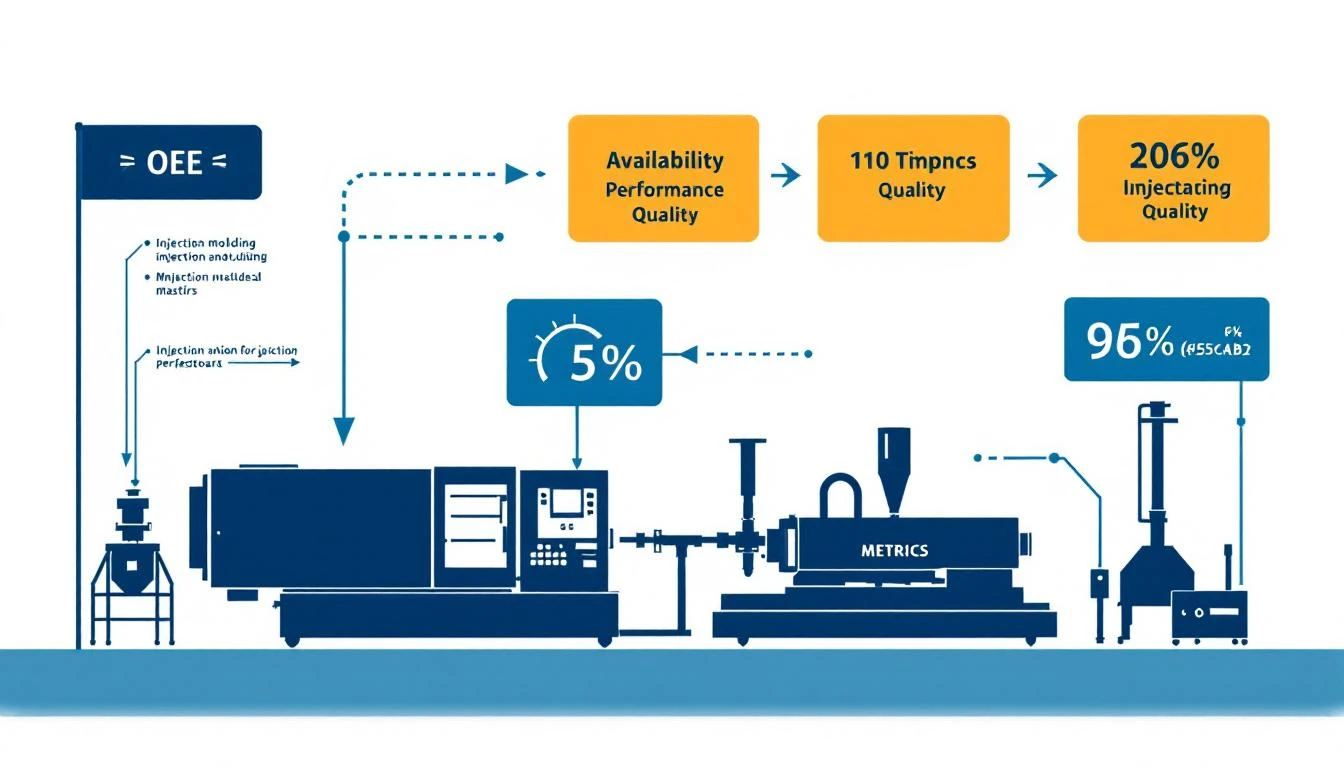
What OEE Means in Plastics (and Why Generic Calculations Miss the Mark)
OEE is the product of three factors:
OEE = Availability × Performance × Quality
For a general manufacturing operation, this is straightforward. For plastics, each factor contains unique sub-losses that generic OEE systems either ignore or misclassify.
World-class OEE benchmarks typically cite 85% as the target. In plastics manufacturing, reality looks more like this:
| Metric | World-Class | Typical Plastics | Common Range |
|---|---|---|---|
| Availability | 90%+ | 82-88% | 70-88% |
| Performance | 95%+ | 88-93% | 80-93% |
| Quality | 99%+ | 96-98% | 92-98% |
| OEE | 85%+ | 69-80% | 52-80% |
The compounding effect is brutal. An injection molding shop running 85% availability, 90% performance, and 97% quality — numbers that feel reasonable individually — produces an OEE of just 74.2%. That's a quarter of potential capacity lost, often invisible because no single metric looks alarming.
Understanding where those losses come from in plastics requires decomposing each OEE factor into its plastics-specific components.
Availability: The Hidden Cost of Mold Changes, Purging, and Material Switches
Availability measures the percentage of planned production time that the machine is actually running. In plastics, the major availability killers are:
Mold Changes and Setups
A mold change on a 500-ton injection molder typically takes 45-90 minutes with a trained crew. On a large-tonnage press (1,500+ tons), it can stretch to 2-4 hours. For shops running high-mix production with 4-6 mold changes per machine per day, this single factor can consume 15-25% of available time.
What to measure:
- Total mold change time — crane hook to first good part
- SMED components — internal vs. external setup time
- Mold preheat time — time from clamp close to process-ready temperature
- First-article qualification time — shots needed before good parts run
Most shops track mold change time as a single number. The improvement opportunity is in the decomposition. If 40% of a 90-minute mold change is spent waiting for the mold to reach process temperature, the fix isn't faster setup — it's mold preheaters or hot runner temperature management.
Purge Cycles and Color Changes
Material and color changes in plastics processing require purging — running material through the barrel to clear the previous resin or color. Depending on the materials involved, a purge cycle can take 15 minutes (same material family, light-to-dark color change) to over an hour (engineering resin to commodity, or dark-to-light color requiring extensive screw pulls).
Key metrics:
- Purge material consumption — pounds of purge compound or virgin material used per change
- Purge cycle time — time from last good part in old material to first good part in new material
- Purge frequency — color/material changes per shift
A shop processing 30 different colors across 10 molding machines doesn't have an OEE problem — it has a scheduling problem. Sequencing light-to-dark across a shift can reduce purge times by 40-60%.
Unplanned Downtime Specific to Plastics
Beyond the standard mechanical breakdowns that affect any manufacturing equipment, plastics processes have unique failure modes:
- Frozen runners and gates — hot runner zone failures that require disassembly
- Stuck parts — ejection failures requiring manual intervention
- Material bridging in hoppers — especially with regrind or hygroscopic materials
- Dryer failures — processing hygroscopic materials (nylon, PET, PC) without adequate drying creates defects within minutes, requiring shutdown
- Water system issues — chiller capacity, tower water temperature, manifold restrictions
Each of these failure modes should be tracked as separate downtime reason codes. A system that only records "unplanned downtime" loses the diagnostic value. When you can see that 35% of your unplanned downtime is water-system related, you know where to invest.
Real-time monitoring platforms like MachineCDN classify downtime automatically from machine state data — running, idle, alarm, setup — eliminating the manual logging that operators forget or fudge. If you're still relying on paper-based downtime tracking, your availability numbers are fiction.
Performance: Cycle Time Variance Is the Silent Killer
Performance measures whether the machine is running at its theoretical maximum speed. In plastics, "theoretical maximum" is itself a moving target — cycle times vary legitimately based on material, part geometry, mold temperature, and ambient conditions.
Defining Standard Cycle Time for Plastics
The standard cycle time for an injection molding process should account for:
- Injection time — fill + pack/hold phases
- Cooling time — the dominant factor (often 60-70% of total cycle)
- Mold open/close time — mechanical, relatively fixed
- Ejection time — part-dependent
- Robot extraction time — if automated
Critical mistake: Many shops set the "standard" cycle time based on the fastest cycle they've achieved, not the sustainable cycle for quality parts. When OEE calculations use an aggressive standard, performance scores look permanently depressed — and the data becomes useless for identifying real losses.
Better approach: Set standard cycle time at the 90th percentile of good-part cycles over a stable production run. This accounts for normal process variation while still capturing meaningful deviations.
Sources of Cycle Time Variance in Plastics
Material viscosity variation: Lot-to-lot viscosity differences in the same resin grade can shift fill times by 5-15%. With recycled content or regrind blending, the variation is larger. A "slow cycle" that's actually the machine compensating for higher-viscosity material isn't a performance loss — it's the process doing what it should.
Mold temperature drift: As cooling channels scale or ambient temperatures shift, the mold may not reach the setpoint temperature within the cooling time. The machine either produces dimensionally out-of-spec parts or the operator adds cooling time — both represent losses, but they're different losses with different fixes.
Hydraulic system degradation: On hydraulic injection molders, oil temperature rise over the course of a shift changes clamp speed, injection speed, and recovery time. A machine running 22-second cycles in the morning may drift to 24-second cycles by afternoon — a 9% performance loss that's invisible without continuous monitoring.
Screw recovery variance: As screws wear, the recovery time (plasticating time between shots) increases. A new screw may recover in 8 seconds; the same screw at 80% wear may take 11 seconds. That 3-second difference on a 30-second cycle is a 10% performance hit.

Extrusion Line Performance: Rate-Based OEE
Extrusion OEE works differently. Instead of discrete cycles, extrusion is a continuous process measured by line speed (feet per minute or meters per minute) against the standard rate.
Performance losses in extrusion:
- Haul-off speed reductions — operator slows line to compensate for die swell or dimensional issues
- Screw speed derations — running below rated screw RPM due to melt temperature or pressure concerns
- Downstream equipment constraints — printer, cutter, coiler, or puller limiting line speed
- Startup and shutdown speed ramps — time running at reduced speed during transitions
For a pipe extrusion line rated at 30 ft/min, running at 24 ft/min is a 20% performance loss. But if the line should be running at 24 ft/min because the die is wearing and higher speeds produce out-of-tolerance wall thickness, the real problem is die maintenance — not operator speed discipline.
This is where IIoT monitoring transforms OEE from a scoring system into a diagnostic tool. When process data streams continuously, you can correlate speed reductions with the process conditions that caused them — separating genuine performance losses from smart operator decisions.
Quality: Plastics-Specific Defect Categories
Quality in OEE measures the ratio of good parts to total parts produced. In plastics, the defect taxonomy is extensive and directly tied to process parameters:
Injection Molding Quality Losses
Short shots — Incomplete cavity fill. Caused by insufficient shot size, low injection pressure, cold mold, or flow restrictions from gate freeze-off. Short shots are usually 100% scrap (no rework path).
Flash — Excess material at parting lines or ejector pins. Caused by excessive clamp tonnage being insufficient for the projected area, worn mold surfaces, or overpacking. Flash may be deflashable (rework cost) or may scrap the part.
Sink marks — Surface depressions over thick sections. Caused by insufficient pack pressure or time, hot mold temperatures, or wall thickness transitions. Sink marks are cosmetic defects — acceptable in some applications, scrap in others (automotive Class A surfaces, medical devices).
Warpage — Part distortion after ejection. Caused by non-uniform cooling, differential shrinkage, residual stress from packing, or premature ejection. Warpage is the most insidious quality loss because it may not be detected until post-mold measurement — meaning the machine has produced hundreds of bad parts before detection.
Burns and degradation — Brown streaks or black specks from material degradation. Caused by excessive residence time, barrel temperatures too high, or dead spots in the flow path. Degraded material is always scrap and may indicate the start of a larger contamination event.
Splay and moisture defects — Silver streaks on the part surface caused by moisture in the resin. This is a material preparation failure (inadequate drying) but manifests as a quality loss. For hygroscopic materials like nylon, polycarbonate, or PET, dew point monitoring on the dryer is the first line of defense.
Extrusion Quality Losses
Dimensional out-of-tolerance — Wall thickness, OD/ID, or profile dimensions outside specification. On continuous extrusion, an out-of-tolerance condition may not be caught for hundreds of feet before the next gauge measurement.
Surface defects — Melt fracture (shark skin), die lines, gels, or contamination. Surface defects on extruded products often mean the entire run since the last good inspection is suspect.
Die swell variation — Inconsistent expansion of the extrudate as it exits the die. Affected by melt temperature, line speed, material lot, and die condition. Results in dimensional variation downstream.
Tracking Quality Losses in Real Time
Manual quality tracking in plastics — the operator marks a tally sheet every time they reject a part — captures maybe 60% of actual scrap. Parts that pass visual inspection but fail dimensional checks downstream aren't captured. Startup scrap during process stabilization often isn't counted. Purge material may or may not be logged.
Automated monitoring closes these gaps. When the platform knows the machine is in startup mode (first 15 shots after mold change), those parts can be automatically classified as startup scrap. When cycle-by-cycle data shows shot weight deviating beyond 2% of nominal, those cycles are flagged for quality review before defective parts ship.
Calculating OEE: A Plastics-Specific Worked Example
Let's walk through an OEE calculation for a 300-ton injection molder running automotive interior trim parts on a 24-hour production day.
Planned Production Time: 24 hours (1,440 minutes)
Availability Calculation
| Event | Duration | Category |
|---|---|---|
| Mold change (morning) | 75 min | Setup |
| Color change + purge | 35 min | Setup |
| Hot runner zone 4 failure | 45 min | Breakdown |
| Material dryer alarm — low dew point | 20 min | Breakdown |
| Stuck part — manual intervention (3 events × 8 min) | 24 min | Minor stops |
| Total downtime | 199 min |
Operating Time = 1,440 - 199 = 1,241 min Availability = 1,241 / 1,440 = 86.2%
Performance Calculation
Standard cycle time: 28 seconds (based on validated process sheet) Theoretical parts at speed: 1,241 min × (60/28) = 2,660 parts Actual parts produced: 2,344 parts Performance = 2,344 / 2,660 = 88.1%
The gap of 316 parts represents cycle time losses — slow cycles during startup, operator interventions (gate trim, visual inspections extending cycle), and the gradual cycle creep from afternoon hydraulic heating.
Quality Calculation
Total parts: 2,344 Rejected parts: Short shots (12), flash requiring deflash (34), sink marks (8), startup scrap (45), color transition scrap (23) Total rejects: 122 Good parts: 2,222 Quality = 2,222 / 2,344 = 94.8%
OEE Result
OEE = 86.2% × 88.1% × 94.8% = 72.0%
That's 28% of potential capacity lost — equivalent to 6.7 hours of production in a 24-hour day. Breaking it down: availability losses cost 3.3 hours, performance losses cost 2.1 hours, and quality losses cost 1.3 hours. The highest-impact improvement is reducing mold change time (SMED implementation) followed by addressing the hydraulic-driven afternoon cycle creep.
Improving OEE: Plastics-Specific Strategies
Availability Improvements
SMED for mold changes: Single Minute Exchange of Die applies directly to mold changes. Convert internal setup (clamps, water lines, hot runner connections) to external setup (pre-staged on a mold cart with quick-connects). Target: reduce mold change time by 50%.
Color sequencing: Schedule production to minimize purge — light to dark, compatible material families grouped. Software-driven production scheduling that factors in changeover matrices cuts purge time by 30-50%.
Predictive maintenance on auxiliary equipment: Dryer failures, chiller issues, and water system problems cause availability losses that aren't the molder's fault. Monitoring auxiliary equipment temperatures, pressures, and dew points catches failures before they cascade to the production machine. Predictive maintenance shifts these from unplanned stops to scheduled interventions.
Performance Improvements
Validate and update standard cycle times: Use actual process data to set realistic standards. If a machine consistently runs at 30 seconds when the standard says 28, either fix the process or update the standard. A wrong standard hides the real problem.
Address hydraulic drift: Install oil coolers or switch to servo-hydraulic or all-electric presses for tight-tolerance applications. Monitor oil temperature continuously and correlate with cycle time trending.
Screw and barrel maintenance windows: Track recovery time trending. When plasticating time increases by 15% from baseline, schedule screw pull for inspection. This prevents the slow performance bleed of screw wear.
Quality Improvements
Statistical process monitoring on critical parameters: Track shot weight, cushion position, peak injection pressure, and cycle time on every shot. These are leading indicators — they drift before parts go out of spec. Implementing statistical process control with real-time alerting catches process drift within minutes, not hours.
Cavity pressure monitoring: For high-precision molding (medical devices, optical components), cavity pressure is the single most reliable indicator of part quality. The correlation between cavity pressure profile and part dimensional accuracy is stronger than any machine parameter.
Regrind management: Track regrind percentage and particle size distribution. Inconsistent regrind blending is a hidden quality loss — it introduces shot-to-shot variation that shows up as dimensional scatter rather than obvious defects.
How IIoT Transforms Plastics OEE
Manual OEE tracking captures a fraction of reality. An operator logging a mold change at "75 minutes" rounded from 82 actual minutes. Quality rejects tallied at shift end from memory. Cycle times averaged rather than trended.
Connected plastics monitoring — where every machine on the floor streams process data continuously — changes OEE from a lagging report card into a real-time diagnostic system:
- Automatic state detection eliminates manual logging — the system knows when the machine is running, idle, in setup, or alarmed
- Cycle-by-cycle data captures every shot, every cycle time, every deviation — no rounding, no forgetting
- Threshold alerting on process parameters catches quality issues before they create scrap
- Trend analysis reveals the slow degradation — screw wear, cooling system scaling, hydraulic drift — that steals performance over weeks and months
- Cross-machine correlation identifies whether a loss is machine-specific or plant-wide (chiller, material lot, ambient conditions)
MachineCDN connects directly to the PLCs driving your injection molders and extruders, streaming process data in real time without touching your plant network. Setup takes minutes per machine — not the weeks or months typical of enterprise MES or SCADA implementations. And because the platform calculates OEE from actual machine data rather than operator input, the numbers are trustworthy from day one.
The Bottom Line: OEE Is Only Useful If It's Accurate
A plastics shop running at 72% OEE with accurate, automated tracking is in a stronger position than one claiming 85% OEE based on manual logs and optimistic standards. The first has a clear picture of where 28% of capacity is lost and can prioritize improvements systematically. The second is flying blind.
Start with accurate measurement. Decompose each OEE factor into its plastics-specific sub-losses. Track the data continuously, not via shift-end summaries. Then attack the biggest loss categories with targeted improvements — SMED for mold changes, process optimization for cycle time, real-time SPC for quality.
The compounding math works in your favor: improving each factor by just 5 percentage points (from 86% to 91% availability, 88% to 93% performance, 95% to 100% quality) lifts OEE from 72% to 84.6% — a 17.5% increase in effective capacity from existing equipment.
That's not buying new machines. That's making the machines you have produce what they're capable of.
Ready to see where your plastics OEE losses actually are? Book a demo and connect your first machine in under 3 minutes.