The edge computing conversation in IIoT has been dominated by marketing buzzwords for years. "Fog computing." "Edge AI." "Intelligent gateways." Strip away the jargon and you're left with a practical engineering problem: how do you collect data from PLCs and sensors on a factory floor, process it locally where it matters, and reliably deliver it to the cloud — even when the network is unreliable?
This guide is written for the engineer who needs to actually build or select an edge computing architecture for industrial operations. We'll cover the core patterns — store-and-forward buffering, change-of-value filtering, tag batching, multi-protocol data collection — and the real-world tradeoffs you'll face when deploying them.
The Three-Layer Edge Architecture
Every serious IIoT edge deployment follows the same fundamental pattern:
┌──────────────────────────────────────────────────┐
│                    CLOUD LAYER                    │
│   Dashboards │ Analytics │ Historian │ Alerting   │
└──────────────────────┬───────────────────────────┘
                       │ MQTT / HTTPS
                       │ (unreliable WAN)
┌──────────────────────┴───────────────────────────┐
│                    EDGE LAYER                     │
│   Protocol Translation │ Batching │ Buffering     │
│   Change Detection │ Local Alarms │ Aggregation   │
└──────────────────────┬───────────────────────────┘
                       │ Modbus / EtherNet/IP / RTU
                       │ (reliable local network)
┌──────────────────────┴───────────────────────────┐
│                  DEVICE LAYER                     │
│   PLCs │ Sensors │ VFDs │ Chillers │ Blenders     │
└──────────────────────────────────────────────────┘
The edge layer is where the engineering decisions matter most. Get it wrong and you lose data, waste bandwidth, or overload your PLCs. Get it right and you have a pipeline that's simultaneously efficient and resilient.
Let's break down each component.
Protocol Translation: Speaking the PLC's Language
The first job of an edge gateway is reading data from industrial controllers. This sounds simple until you realize that a single facility might have:
- Allen-Bradley Micro800 PLCs speaking EtherNet/IP (CIP protocol over TCP)
- Process chillers and TCUs on Modbus TCP (registers over TCP/IP)
- Older equipment on Modbus RTU (registers over RS-485 serial)
- Building systems on BACnet (object-oriented, for HVAC/lighting)
Each protocol has fundamentally different communication patterns, data types, and error handling requirements.
EtherNet/IP (CIP) Tag Reading
EtherNet/IP uses the Common Industrial Protocol (CIP) to access tag values by name. You request B3_0_0_blender_st_INT and get back a typed value — int16, float, boolean, etc.
Key considerations for edge gateways reading EtherNet/IP:
-
Tag creation overhead: Each tag must be "created" (opened) before it can be read. This involves a TCP connection setup and CIP path resolution. Create tags once at startup and cache the handles — don't create and destroy them on every read cycle.
-
Element sizing: Tags can be single values or arrays. When reading array elements, you need to specify both the element count and element size (1 byte for bools/int8, 2 bytes for int16/uint16, 4 bytes for int32/float). Getting this wrong causes silent data corruption — the bytes are read correctly but interpreted with the wrong width.
-
Timeout handling: Set a reasonable data timeout (2 seconds is typical). If a tag read times out, it usually means the PLC is rebooting or the network cable is unplugged. After 3 consecutive timeout errors, stop polling and enter a reconnection backoff — hammering a disconnected PLC with read requests is wasteful and can interfere with recovery.
-
Error -32 (connection failure): This is the most common error in EtherNet/IP communications. It means the TCP connection to the PLC was lost. When you see it, immediately set the device link state to "down," stop reading other tags (they'll all fail too), and wait for reconnection. Don't burn through your entire tag list trying each one — if the link is down, it's down for all of them.
Modbus TCP and RTU Tag Reading
Modbus is register-based rather than tag-based. You read from specific addresses: holding registers (40001+), input registers (30001+), coils (00001+), and discrete inputs (10001+).
The critical optimization for Modbus at the edge is contiguous register reads:
Instead of reading each register individually:
Read register 300000 → 1 transaction
Read register 300001 → 1 transaction
Read register 300002 → 1 transaction
...
Read register 300024 → 1 transaction
= 25 transactions, ~25 × 10ms = 250ms
Group contiguous registers into a single bulk read:
Read registers 300000-300024 → 1 transaction
= 1 transaction, ~10ms
A well-designed edge gateway analyzes the tag configuration at startup, identifies contiguous address ranges that share the same function code, and automatically groups them into bulk reads. The rules for grouping:
- Same function code: You can't mix holding registers (FC03) with input registers (FC04) in a single read
- Contiguous addresses: No gaps in the address range
- Same polling interval: Tags polled every 1 second shouldn't be grouped with tags polled every 60 seconds
- Maximum register count: Most Modbus devices support up to 125 registers per read, but staying under 50 provides better reliability
For Modbus RTU (serial), the same bulk-read optimization applies, plus additional considerations:
- Serial port configuration: Baud rate (9600-115200), parity (none/even/odd), data bits (8), stop bits (1-2). Get any of these wrong and you'll see gibberish or timeouts.
- Slave address: Each device on the RS-485 bus has a unique address (1-247). The gateway must set the correct slave address before each read sequence.
- Bus timing: After each transaction, insert a 50ms delay before the next read. Modbus RTU devices need time to release the bus, and back-to-back reads without delays cause framing errors.
- Response and byte timeouts: Configure explicitly rather than relying on defaults. A byte timeout of 50ms and response timeout of 500ms works for most industrial Modbus devices. Too short and you get false timeouts on busy buses; too long and a single unresponsive device stalls the entire read cycle.
Protocol Auto-Detection
When commissioning a new device, the edge gateway may not know what protocol it speaks. A practical auto-detection sequence:
-
Try EtherNet/IP first: Attempt to read a known "device type" tag via CIP. If successful, you know the device speaks EtherNet/IP and you have its device type identifier.
-
Fall back to Modbus TCP: Connect to port 502 and read a known device-type register (e.g., input register 800). If successful, you've identified a Modbus TCP device.
-
Neither works: The device either uses a different protocol, is powered off, or isn't network-reachable. Log the failure and retry periodically.
This approach lets you deploy edge gateways that automatically discover and configure themselves for the devices on their network segment — a massive time saver during commissioning of large installations.
Change-of-Value Detection: The 80/20 of Bandwidth Optimization
The single most impactful optimization in edge computing for IIoT is change-of-value (COV) detection. The concept is simple: don't transmit data that hasn't changed.
How COV Detection Works
On every read cycle, the edge gateway:
- Reads the current value from the PLC
- Compares it against the last transmitted value
- If different → publish the new value and update the stored value
- If identical → skip transmission, move to the next tag
The comparison must be type-aware:
- Boolean tags: Compare bit values directly.
false → true is a change; true → true is not.
- Integer tags (int8/int16/int32): Compare raw integer values. Any difference triggers a publish.
- Float tags: This is where it gets nuanced. Raw float comparison works, but you may want to add a deadband — only publish if the value changed by more than X units. A temperature sensor that fluctuates between 72.39°F and 72.41°F probably doesn't represent a real process change.
The Hourly Full-State Refresh
COV detection alone has a dangerous edge case: if a value doesn't change for hours, no messages are published, and subscribers lose confidence in whether the device is still online and reading correctly.
The solution: force a full-state read and publish on a periodic schedule (hourly is standard). Once per hour, the edge gateway reads all tags and publishes their values regardless of whether they changed. This acts as both a data integrity check and a heartbeat.
The implementation is straightforward: track the last forced-read time and trigger a new one when the hour rolls over. Reset all tags' "read once" flags, forcing the next cycle to treat every value as new and publish it.
Real-World Bandwidth Savings
On a typical industrial device (50-100 tags), COV detection reduces the number of published messages by 85-95%. Here's a real example from a portable chiller with 106 tags:
- Without COV: 106 tags × 1 read/second = 106 messages/second → ~9.2 million messages/day
- With COV: Average of 8-12 changes per second → ~860,000 messages/day
- Savings: 91%
On a cellular connection at $0.01/MB, that's the difference between $30/month and $3/month per device. At 500 devices, you just saved $13,500/month.
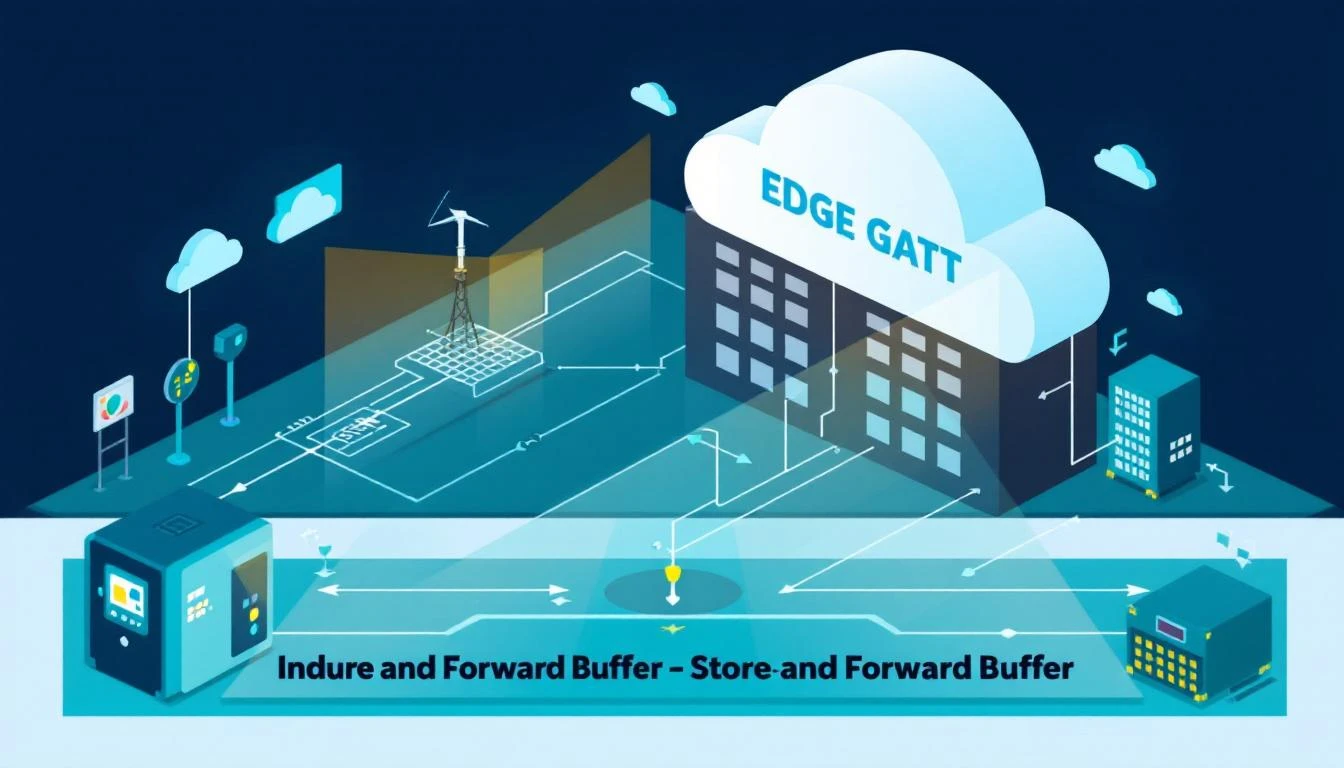
Store-and-Forward: Zero Data Loss During Outages
Network connectivity between the edge and cloud is never 100% reliable. Cellular connections drop, VPN tunnels time out, and cloud brokers occasionally go down for maintenance.
A production-grade edge gateway must buffer data locally during outages and deliver it in order when connectivity returns. This is the store-and-forward pattern.
Memory-Based Page Buffering
The most robust approach for resource-constrained edge devices is a pre-allocated, page-based memory buffer:
┌────────────────────────────────────────────────────┐
│                Pre-allocated Buffer Memory          │
│                   (e.g., 512KB)                     │
├──────────┬──────────┬──────────┬──────────┬────────┤
│  Page 0  │  Page 1  │  Page 2  │  Page 3  │  ...   │
│ (16KB)   │ (16KB)   │ (16KB)   │ (16KB)   │        │
└──────────┴──────────┴──────────┴──────────┴────────┘
     │
     ▼
  ┌──────────────────────────────────────────────┐
  │              Page Structure                   │
  │  ┌─────────┬─────────┬───────────────────┐   │
  │  │ Msg ID  │ Msg Size│   Message Body    │   │
  │  │ (4 bytes)│(4 bytes)│   (variable)     │   │
  │  ├─────────┼─────────┼───────────────────┤   │
  │  │ Msg ID  │ Msg Size│   Message Body    │   │
  │  ├─────────┼─────────┼───────────────────┤   │
  │  │  ...    │  ...    │      ...          │   │
  │  └─────────┴─────────┴───────────────────┘   │
  └──────────────────────────────────────────────┘
Here's how the buffer operates:
Normal operation (MQTT connected):
- Data arrives from the tag reading loop
- Data is written to the current "work page"
- When the page fills, it moves to the "used pages" queue
- The send routine pulls the oldest used page, transmits via MQTT
- On PUBACK confirmation, the page moves to the "free pages" pool
Disconnected operation:
- Data continues arriving from tag reading (PLC reading never stops)
- Data fills work pages, which queue into used pages
- When all pages are used and a new one is needed, the oldest undelivered page is recycled
- On reconnection, the used pages queue is drained in order
Why pre-allocate?
Dynamic memory allocation (malloc/free) during runtime is dangerous on embedded edge devices:
- Memory fragmentation over weeks of operation can cause allocation failures
- Allocation failures during high-load periods (many tags changing simultaneously) cause data loss
- Pre-allocation guarantees a known memory footprint that never grows
Why pages instead of a circular byte buffer?
Pages align with MQTT publishes. Each page becomes one MQTT message. The broker acknowledges pages by message ID, and the buffer can confirm delivery at page granularity. With a circular buffer, you'd need separate tracking for which byte ranges have been acknowledged — significantly more complex.
Sizing the Buffer
Buffer sizing depends on two factors: data rate and maximum expected outage duration.
Formula: Buffer Size = Data Rate (bytes/sec) × Maximum Outage (seconds)
Example for a 100-tag device:
- Average batch: ~500 bytes
- Batch interval: 5 seconds
- Data rate: 100 bytes/sec
- Target coverage: 1 hour outage
Buffer size: 100 × 3600 = 360KB → round up to 512KB
On a device with 32MB of RAM (common for industrial Linux gateways), dedicating 512KB to buffering is trivial. For longer outage coverage or higher-frequency data, scale to 2-8MB.
The Disk vs. RAM Tradeoff
Some edge platforms use disk-based buffering (writing to SD card or eMMC). This provides virtually unlimited buffer capacity but introduces two problems:
-
Write endurance: Industrial flash storage has limited write cycles. At 100 writes/second, a consumer-grade SD card will wear out in months. Industrial-grade eMMC is better but still a concern over multi-year deployments.
-
I/O latency: Disk writes can stall during wear-leveling or garbage collection, causing backpressure into the data collection pipeline. Memory-based buffering has consistent, sub-microsecond latency.
The pragmatic approach: use RAM-based buffering for primary store-and-forward and only fall back to disk for extended outages (>1 hour) where RAM capacity is exceeded.
Local Processing: What to Do at the Edge
Beyond simply forwarding data, the edge layer can perform processing that adds value:
Some tag values aren't directly readable from a PLC — they're derived from other tags through bitwise or arithmetic operations. For example, a 16-bit status register might encode 16 individual boolean states. The edge gateway can:
- Read the raw uint16 register value
- Extract individual bits using shift-and-mask operations
- Publish each bit as a separate boolean tag
This transforms an opaque register value (0x3A04) into human-readable states ("Compressor A running: true," "Pump fault: false," "Fan overload: false").
Dependent Tag Chains
Some tags only matter when a parent tag changes. For example, detailed diagnostic registers on a chiller might only be relevant when the alarm status changes. The edge gateway can define dependency chains:
Alarm Status (parent) ─── changes ──► Read Diagnostic Tags (dependents)
                                      - Error Code
                                      - Last Fault Time
                                      - Fault Counter
When the parent tag changes value, the edge gateway immediately reads all dependent tags and publishes them together. When the parent is stable, the dependent tags aren't read at all — saving bus bandwidth and PLC CPU.
Local Alarming
For safety-critical applications, don't rely on the cloud roundtrip for alarms. The edge gateway can evaluate alarm conditions locally:
- Compare tag values against configured thresholds
- Trigger local outputs (relay contacts, Modbus writes)
- Send alarm notifications via local protocols (SNMP traps, syslog)
The cloud still gets the alarm data for logging and analytics, but the local alarm fires in under 100ms regardless of cloud connectivity.
Real-World Deployment Patterns
Pattern 1: Single-Protocol, Single-Device
The simplest deployment: one edge gateway connected to one PLC.
[PLC] ──── Modbus TCP ────► [Edge Gateway] ──── MQTT ────► [Cloud]
Configuration: Define tags in a JSON config file. The gateway reads the config, creates the Modbus connection, and starts polling. Typical tag counts: 50-200. Data rate: 1-10KB/sec. A Raspberry Pi-class device handles this easily.
Pattern 2: Multi-Protocol, Multi-Device
A production line with mixed equipment:
[AB PLC] ── EtherNet/IP ──┐
[Chiller] ── Modbus TCP ──┤── [Edge Gateway] ── MQTT ──► [Cloud]
[TCU] ── Modbus RTU ──────┘
The edge gateway manages three separate communication channels, each with its own thread, error handling, and reconnection logic. Tags from all devices are batched into a unified payload format for cloud delivery.
Key engineering decisions:
- Thread isolation: Each protocol handler runs in its own thread. A Modbus RTU timeout on the serial bus shouldn't block EtherNet/IP reads on the Ethernet port.
- Unified batching: Despite different source protocols, all tag values feed into the same batching and buffering pipeline. The batch includes a device type identifier and serial number so the cloud can route data correctly.
- Independent health tracking: Each device connection has its own link state. A chiller going offline doesn't affect PLC data collection.
Pattern 3: Hierarchical Edge (Site Gateway)
Large facilities with hundreds of devices need a second tier:
[PLCs] ──► [Edge Gateway 1] ──┐
[PLCs] ──► [Edge Gateway 2] ──┤── [Site Gateway] ── MQTT ──► [Cloud]
[PLCs] ──► [Edge Gateway 3] ──┘        │
                                   Local Dashboard
                                   Local Historian
The site gateway aggregates data from multiple edge gateways, provides local storage and visualization, and manages the WAN connection to the cloud. This pattern is common in large manufacturing plants with 500+ controlled devices.
Monitoring Your Edge Infrastructure
An edge device that silently fails is worse than one that was never deployed. Every edge gateway should publish its own health metrics:
Daemon Status Heartbeat
Publish a status message every 60 seconds containing:
- Software version (gateway firmware/application version and revision hash)
- System uptime (time since last boot — catches unexpected reboots)
- Daemon uptime (time since application start — catches crashes and restarts)
- Device connection states (link up/down for each connected PLC)
- Token/certificate expiry (for cloud authentication)
- Buffer utilization (how full the store-and-forward buffer is)
This telemetry lets you monitor your monitoring infrastructure — you can alert on edge gateways that are down, running old firmware, or approaching buffer capacity before they start losing data.
Link State Tracking
Every protocol connection should track its link state and publish changes immediately:
- Link up → publish immediately (not batched) so dashboards update in real time
- Link down → publish immediately (via MQTT LWT if the gateway itself disconnects)
Link state is the most fundamental health indicator. If the edge gateway shows "link down" for a device, no amount of cloud-side troubleshooting will help — someone needs to check the physical connection.
How machineCDN Approaches Edge Computing
machineCDN's edge gateway architecture implements all of the patterns described above. The gateway supports simultaneous EtherNet/IP, Modbus TCP, and Modbus RTU connections with per-protocol thread isolation. Tag batching with COV detection reduces bandwidth by 85-95%, and a pre-allocated page-based buffer provides store-and-forward resilience during connectivity outages.
Each connected device is treated as an independent entity with its own configuration, health tracking, and data pipeline. When a new device is connected, the gateway auto-detects the protocol and device type, loads the appropriate tag configuration, and begins data collection — typically within 30 seconds of physical connection.
For plant engineers and controls integrators, this means deploying edge computing infrastructure that handles the hard engineering problems — protocol translation, data buffering, connection resilience — so they can focus on the process data that actually drives operational improvement.
Summary: Edge Computing Design Checklist
Before deploying an IIoT edge architecture, verify you've addressed each of these:
| Concern | Requirement |
|---|
| Protocol support | Cover all PLC types on site (Modbus TCP/RTU, EtherNet/IP, BACnet) |
| COV detection | Suppress unchanged values to reduce bandwidth 85-95% |
| Periodic refresh | Force full-state publish hourly to catch stuck states |
| Batch optimization | Group tag values into single publishes (500KB max batch size) |
| Critical alarm bypass | Safety tags skip the batch queue for under 100ms delivery |
| Store-and-forward | RAM-based page buffer sized for 1-hour outage minimum |
| Buffer overflow | Recycle oldest pages, not newest, during extended outages |
| Connection resilience | Auto-reconnect with backoff, async connect (don't block reads) |
| Contiguous reads | Group Modbus registers into bulk reads to minimize transactions |
| Serial bus timing | 50ms inter-transaction delay for Modbus RTU stability |
| Health telemetry | Publish gateway status (uptime, link states, versions) every 60s |
| TLS encryption | MQTT over TLS (port 8883) with per-device certificates |
| Token management | Monitor SAS/cert expiry, alert 7 days before expiration |
| Thread isolation | Separate threads per protocol — one stall doesn't block others |
Edge computing for IIoT isn't glamorous work. It's careful engineering of data pipelines, buffer management, and protocol handling. But when done right, it provides the reliable data foundation that every higher-level application — dashboards, analytics, predictive maintenance, AI — depends on.