Factory Floor Analytics: Turning Machine Data Into Manufacturing Intelligence

Every factory floor generates thousands of data points every second — cycle counts, temperatures, pressures, alarm states, energy consumption, material flow, machine status. The vast majority of this data is thrown away. Factory floor analytics is the discipline of capturing that data, extracting intelligence from it, and using that intelligence to make better manufacturing decisions. Here's how it works in practice.
The Factory Floor Data Problem
Modern manufacturing equipment is remarkably data-rich. A single CNC machine generates data on spindle speed, feed rates, tool position, coolant temperature, axis loads, alarm states, cycle completion, and power consumption. A PLC controlling a production line tracks every sensor input, every actuator output, every timer, and every counter.
The problem isn't data availability — it's data accessibility.
Where Factory Data Lives (and Why You Can't See It)
In the PLCs: Your machine controllers contain the richest operational data — every tag, every register, every coil. But this data is trapped inside proprietary control networks that IT can't access and operations can't visualize without specialized tools.
In SCADA systems: Some plants have SCADA infrastructure that captures PLC data. But traditional SCADA systems are designed for real-time control visualization, not historical analytics. They show you what's happening now but make it difficult to ask "what happened last Tuesday" or "how has performance trended over 90 days."
In operator logs: Production counts, quality notes, shift handover information — captured in spreadsheets, whiteboards, or paper logs. Manual, inconsistent, and nearly impossible to analyze at scale.
In ERP systems: Material consumption, work orders, quality records — captured but disconnected from real-time machine data. The ERP knows you consumed 500 kg of material yesterday but doesn't know which machine used it or at what rate.
The result: Most manufacturers operate with fragmented, delayed, and incomplete visibility into their own factory floor. Decisions are made on gut feel, experience, and lagging indicators rather than real-time intelligence.
The Analytics Stack: From Sensor to Insight
Factory floor analytics requires four layers working together:
Layer 1: Data Collection
Getting data off the factory floor and into an analytics-ready format.
Protocol-native collection connects directly to PLCs through industrial protocols (Ethernet/IP, Modbus TCP/RTU) and reads every tag the controller exposes. This is the most efficient approach because:
- PLCs already collect comprehensive operational data
- No additional sensors required
- Sub-second data resolution available
- Complete data — not just vibration or temperature, but everything
Edge devices sit between PLCs and the cloud, collecting, compressing, and transmitting data. Modern edge devices handle protocol translation, local buffering (for connectivity interruptions), and intelligent data filtering (send only meaningful changes to reduce bandwidth).
Cellular connectivity is increasingly the preferred path from edge to cloud. It bypasses plant IT networks entirely — no firewall rules, no VPN tunnels, no security reviews. For plants where IT and OT convergence is contentious (most plants), cellular is the path of least resistance.
Layer 2: Data Processing
Raw PLC data needs context before it becomes useful.
Tag mapping associates raw PLC addresses with meaningful names and machine context. "Machine_4/Spindle/Temperature" is actionable; "PLC3:N7:24" is not.
Contextualization adds metadata: which machine, which zone, which location, which shift, which product. Without context, data is just numbers.
Aggregation compresses high-frequency data into analyzable summaries: average temperature per hour, total cycles per shift, energy consumption per job. Raw data at 1-second resolution generates 86,400 data points per day per tag — aggregation makes this manageable.
Anomaly detection applies AI models to identify data points that deviate from normal patterns. This is where analytics transitions from "seeing what happened" to "identifying what matters."
Layer 3: Visualization and Dashboards
Making processed data accessible to the people who need it.
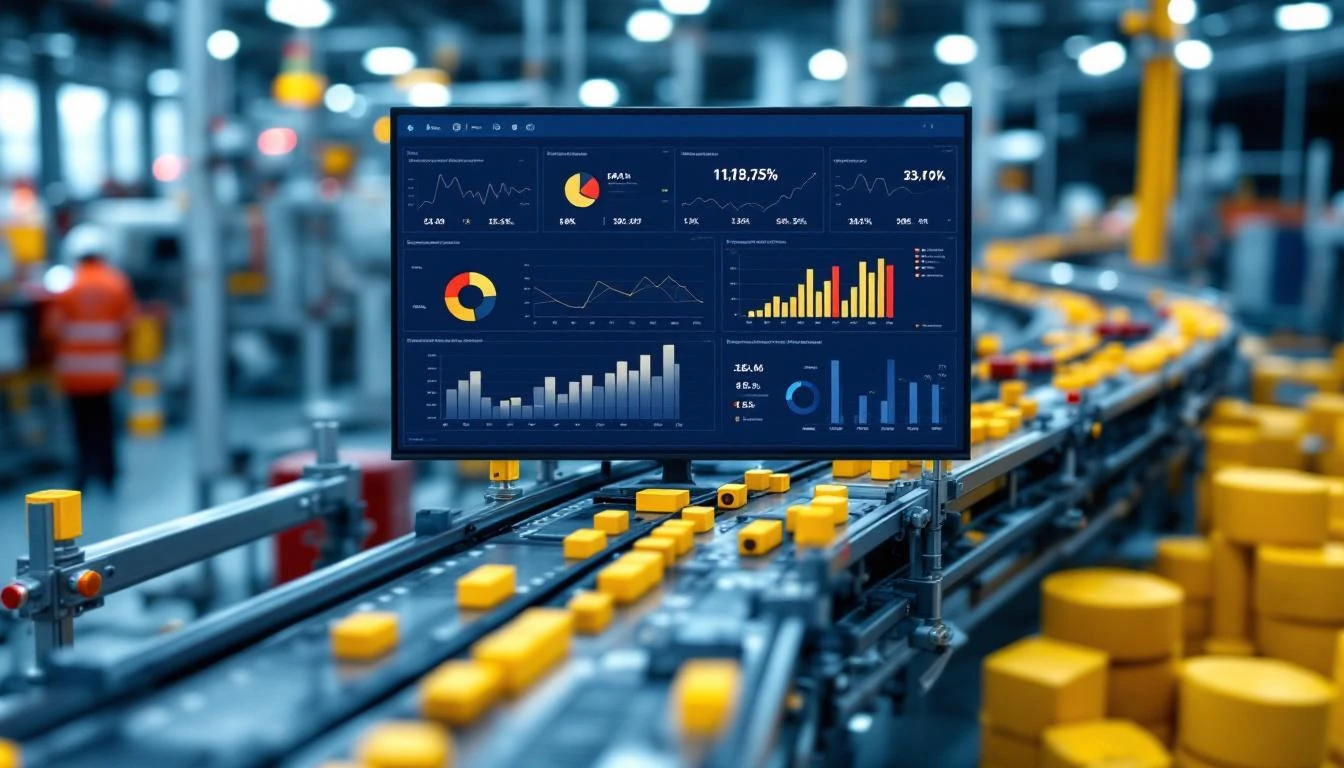
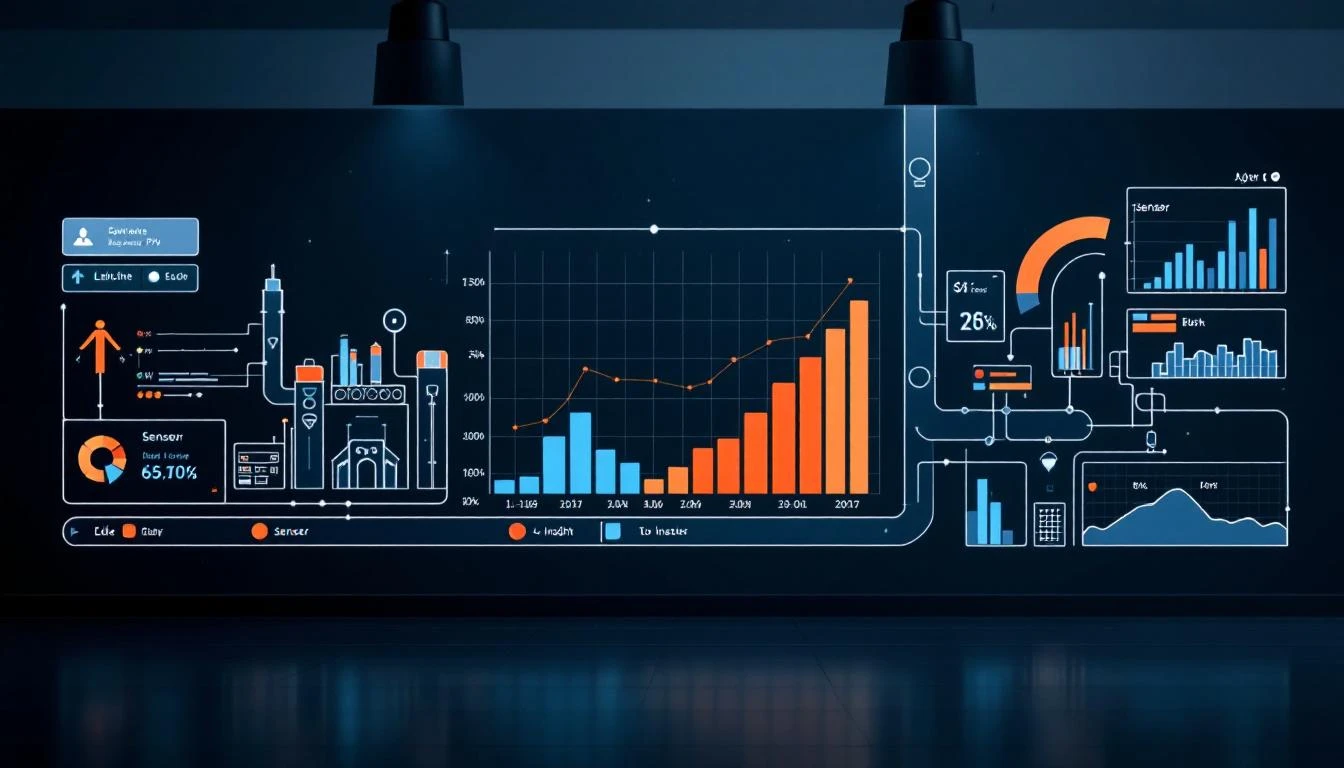
Real-time dashboards show live factory status — which machines are running, idle, in alarm, or offline. This is the fundamental visibility layer that most manufacturers lack. A plant manager should be able to glance at a screen and know the state of every machine in the facility.
Historical trending enables performance analysis over time: How has OEE trended this quarter? Is Machine 7's cycle time gradually increasing? Is energy consumption per unit improving or degrading?
Comparative analytics compares performance across machines, shifts, locations, or time periods. Which shift consistently produces higher quality? Which location has the lowest equipment availability? Which machine type has the highest failure rate?
Fleet views aggregate data across multiple facilities for manufacturers with distributed operations. Fleet-level dashboards reveal cross-site patterns invisible at the single-plant level.
Layer 4: Action and Integration
Analytics that don't drive action are expensive wallpaper.
Threshold alerting triggers notifications when parameters exceed defined limits. Critical: platforms should show both active alerts (threshold breached) AND approaching alerts (trending toward threshold) to enable proactive response.
Maintenance integration connects equipment analytics to maintenance scheduling. When analytics identify a developing problem, a maintenance task should be created automatically — including spare parts availability check.
Production planning integration feeds equipment health and performance data into production scheduling. Don't schedule critical orders on a machine showing early signs of bearing wear.
Continuous improvement uses analytics to identify systematic waste: Why does Line 3 always have a 12-minute changeover while Line 4 does it in 8? What's different about Tuesday night shift's reject rate?
Key Factory Floor Analytics Use Cases
1. OEE Optimization
OEE (Overall Equipment Effectiveness) = Availability × Performance × Quality
Each component is analytically rich:
Availability analytics:
- Downtime reason Pareto analysis — Which root causes drive the most downtime?
- Planned vs. unplanned downtime trending
- MTBF and MTTR tracking per machine
- Changeover time analysis and optimization
Performance analytics:
- Actual cycle time vs. ideal cycle time by product and machine
- Speed loss identification — Are machines running below rated speed? Why?
- Minor stop frequency and duration tracking
- Feed rate and speed optimization opportunities
Quality analytics:
- Defect rate by machine, shift, operator, and material lot
- Process parameter correlation with quality outcomes
- First-pass yield trending
- Scrap cost tracking per machine and product
MachineCDN provides OEE and capacity utilization analytics natively — connecting directly to PLCs to capture the availability, performance, and quality data needed for genuine OEE calculation without manual data entry.
2. Downtime Root Cause Analysis
Downtime is the most expensive factory floor problem, and analytics transforms how you address it:
Categorized downtime tracking — Every downtime event classified by type (mechanical, electrical, material, changeover, quality, operator) and specific reason. Over weeks and months, patterns emerge that gut feel misses.
Duration analysis — It's not just frequency that matters but duration. A fault that occurs 50 times but clears in 30 seconds may be less costly than a fault that occurs twice but takes 4 hours to resolve.
Cross-machine correlation — If Machines 3, 7, and 12 all experience similar faults within the same week, is there a common cause? Material batch issue? Environmental factor? Shared utility system?
3. Energy Management
Energy consumption analytics per machine reveals optimization opportunities:
- Baseline energy per unit produced — Normalize consumption to production volume
- Efficiency degradation detection — Increasing energy per unit indicates mechanical issues
- Idle energy identification — Machines consuming significant power while not producing
- Peak demand management — Shift start-up patterns that create expensive demand peaks
- Machine-level energy benchmarking — Compare similar machines to identify outliers
4. Materials Intelligence
For manufacturers in blending, mixing, extrusion, or batch processing:
- Material consumption per machine — Which machines use material most efficiently?
- Hopper and bin level monitoring — Automated material replenishment triggers
- Material waste analysis — Scrap and waste tracking by machine, product, and operator
- Inventory accuracy — Automated consumption tracking vs. inventory records
- Lot traceability — Connect material lots to specific machines and production runs
5. Predictive Quality
Combining machine data with quality outcomes enables predictive quality:
- Process-quality correlation — Identify which process parameters predict quality defects
- SPC (Statistical Process Control) — Monitor critical parameters for drift before defects occur
- Recipe optimization — Identify optimal process parameter combinations for each product
- Early warning — Alert operators when process conditions indicate developing quality issues
Common Mistakes in Factory Floor Analytics
Mistake 1: Boiling the Ocean
Starting with a plant-wide analytics deployment covering every machine and every data point. This overwhelms teams with data and delays time to value.
Better approach: Start with 5-10 critical machines. Prove value with specific, measurable outcomes (downtime reduced, energy saved, maintenance costs lowered). Expand based on demonstrated ROI.
Mistake 2: Collecting Data Without Context
Raw data without context is noise. "Temperature: 87°C" is meaningless without knowing which machine, which component, what the normal range is, and what the trend looks like.
Better approach: Use platforms that provide tag mapping, machine context, and automated baseline establishment. MachineCDN handles this natively — every data point is contextualzied to machine, zone, location, and operating condition.
Mistake 3: Dashboards Without Actions
Beautiful dashboards that no one acts on are expensive entertainment. Analytics must connect to operational workflows — maintenance scheduling, production planning, quality management.
Better approach: Choose platforms with integrated action capabilities. Threshold alerting that creates maintenance tasks. Anomaly detection that triggers investigation workflows. Analytics that drive decisions, not just decorate control rooms.
Mistake 4: Ignoring the "Last Mile"
Data flows from PLC → edge → cloud → dashboard → ... and stops. The "last mile" — from insight to action by a human — is often the weakest link.
Better approach: Mobile alerts to maintenance techs. Shift-start briefings generated from overnight analytics. Automated reporting to plant leadership. Make insights impossible to ignore.
Mistake 5: Treating Analytics as an IT Project
Factory floor analytics is an operations project with technology components. When IT leads the implementation, the result is often technically sophisticated but operationally disconnected.
Better approach: Operations leadership defines what questions need answering. Technology supports those questions. Start with the manufacturing problem ("We don't know why Line 3 has 15% more downtime than Line 4"), not the technology ("We need a data lake").
Getting Started with Factory Floor Analytics
Step 1: Define Your Questions
What would you do differently if you had perfect information? Common starting questions:
- Which machines have the most unplanned downtime?
- What's our actual OEE vs. what we think it is?
- Are any machines degrading that we don't know about?
- Where is energy being wasted?
- Which products cause the most quality issues on which machines?
Step 2: Connect Your Critical Equipment
Deploy a protocol-native IIoT platform on your top critical machines. MachineCDN connects to PLCs in 3 minutes per device with cellular connectivity — no IT involvement, no network changes, no sensor installation.
Step 3: Establish Baselines
Allow 2-4 weeks of data collection to establish normal operating patterns. During this period, document known issues, maintenance events, and production conditions to create annotated baselines.
Step 4: Configure Alerts and Thresholds
Set initial thresholds on critical parameters. Start conservative (wider bands) to avoid alert fatigue. Tighten based on experience. Use approaching-threshold alerts for early warning.
Step 5: Act on Insights
The first time analytics identifies a developing issue before it causes unplanned downtime, you have your proof point. Document the save, calculate the avoided cost, and use it to justify expansion.
Step 6: Scale and Deepen
Expand monitoring to additional machines. Add materials tracking, energy monitoring, and fleet-level analytics. Deepen from threshold-based alerting to AI-powered predictive analytics.
The Outcome
Manufacturers who implement factory floor analytics systematically report:
- 15-25% reduction in unplanned downtime (Deloitte, McKinsey)
- 5-15% energy cost reduction through equipment optimization
- 10-20% maintenance cost reduction through condition-based scheduling
- 3-8% OEE improvement through visibility-driven optimization
These aren't theoretical numbers — they're what happens when you stop guessing and start knowing what your factory floor is actually doing.
Book a MachineCDN demo and start seeing your factory floor in high definition.
Related reading: