Downtime Tracking for Plastics: From Mold Changes to Machine Failures

Every plastics manufacturer knows downtime. What most don't know is exactly how much it's costing them — or where those hours are actually going. A mold change that should take 45 minutes stretches to 90. A hydraulic seal failure on a 500-ton press takes out three shifts. A purging procedure that was supposed to be "quick" turns into a four-hour color change nightmare.
The difference between plastics shops running at 75% OEE and those hitting 85%+ isn't better machines — it's better downtime visibility. When you can categorize, measure, and analyze every minute of lost production, you stop guessing and start systematically eliminating waste.
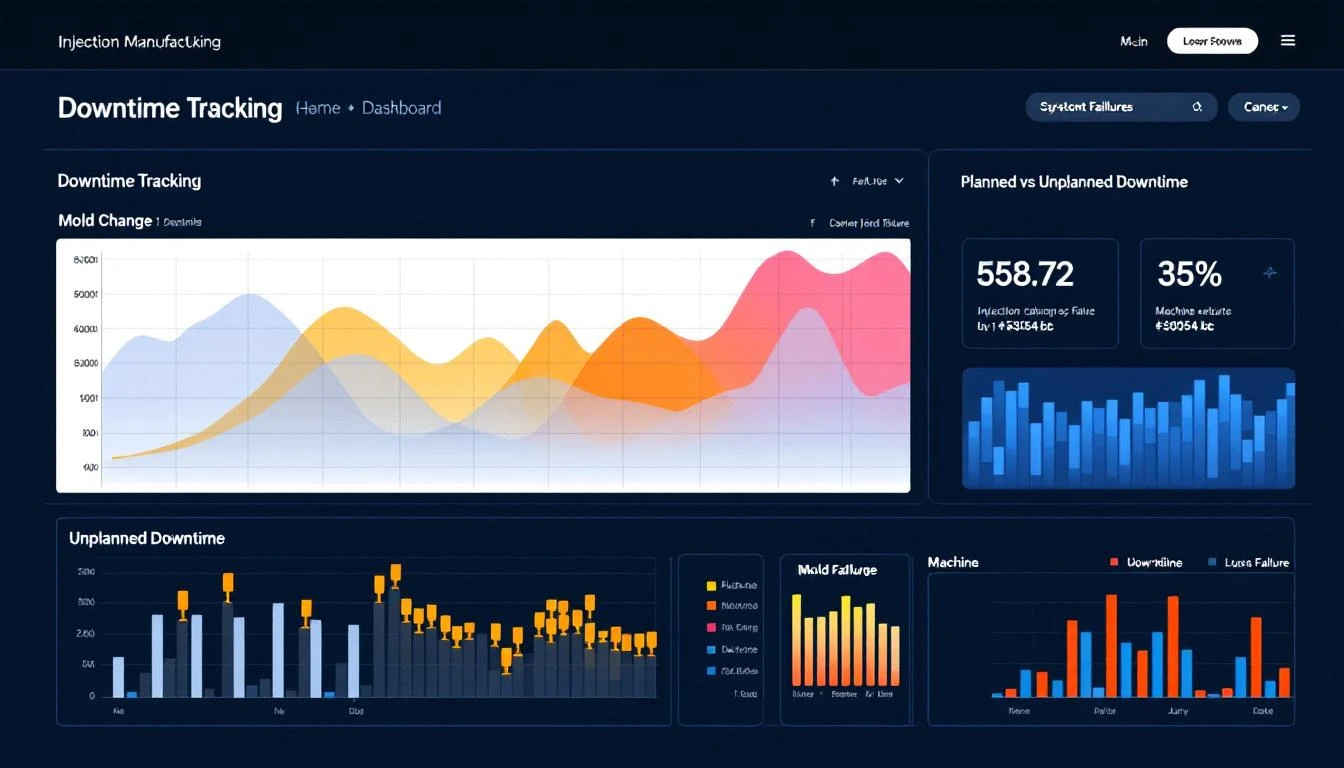
The True Cost of Downtime in Plastics Manufacturing
Industry data from the Plastics Industry Association consistently shows that unplanned downtime costs plastics manufacturers between $5,000 and $20,000 per hour depending on press tonnage, cavitation, and material costs. For a mid-sized injection molding shop running 20 presses, even 2% unplanned downtime represents over $400,000 in annual lost revenue.
But here's what makes plastics unique: a significant portion of your downtime is planned — and it's still too long.
Mold changes, color changes, material purges, preventive maintenance windows, and startup/shutdown procedures are all expected events. They're on the schedule. And yet, most shops have no idea whether their 60-minute mold change is actually taking 60 minutes or creeping toward 90.
The three categories every plastics operation needs to track:
- Planned downtime — Mold changes, PM tasks, scheduled purges, shift breaks
- Unplanned downtime — Machine failures, material shortages, quality holds
- Performance losses — Short stops, reduced cycle speeds, micro-stoppages that don't register as "downtime" but eat into throughput
Without a system that captures all three in real time, you're flying blind on your biggest cost driver.
Mold Change Optimization: Where SMED Meets Real-Time Data
Single-Minute Exchange of Die (SMED) has been a lean manufacturing principle for decades. In plastics, it translates directly to mold changes — the most frequent planned downtime event on any injection molding floor.
A typical mold change involves:
- Cooling down the mold and machine barrel
- Disconnecting water lines, hydraulic cores, and electrical connections
- Removing the existing mold with crane or quick-change system
- Installing the new mold and making mechanical connections
- Heating the mold to operating temperature
- Reconnecting water, hydraulic, and electrical systems
- Running first shots to establish process parameters
- Quality check on initial parts before production release
Most shops estimate mold changes take "about an hour." But when you actually timestamp each phase, you discover massive variation. Machine A's crew does it in 42 minutes. Machine B's night shift takes 95 minutes on the same mold. The difference isn't the equipment — it's the process discipline, and you can't fix what you can't see.
Real-Time Tracking of Mold Change Phases
When your injection molding machines are connected to an IIoT platform, mold change tracking becomes automatic. The system detects when a press goes into manual mode, when barrel temperatures drop below production range, and when they come back up to setpoint. It timestamps every transition.
This gives you:
- Actual vs. target duration for every mold change on every machine
- Phase-by-phase breakdown — how long for mechanical, thermal, and qualification phases
- Shift-by-shift comparison — which crews are fastest, and what they're doing differently
- Trend analysis — are mold changes getting slower over time (indicating tooling issues)?
Platforms like MachineCDN track downtime plans with specific reason codes, letting you differentiate between a mold change, a color change, a PM event, and a quality hold. Each event captures start time, end time, machine, zone, and operator — giving you the granularity to actually improve.
This kind of visibility is what separates operators tracking OEE for plastics manufacturing as a meaningful metric from those who treat it as a number on a whiteboard.
Purging Procedures: The Hidden Time Thief
Color changes and material transitions are routine in custom molding shops. A job running black ABS needs to switch to white nylon. The purging procedure between those runs can take anywhere from 15 minutes to 3+ hours depending on:
- Color contrast — Dark to light transitions require significantly more purging
- Material compatibility — Switching between amorphous and semi-crystalline resins adds barrel soak time
- Machine size — A 1,500-ton press with a 60 oz shot size takes exponentially longer to purge than a 100-ton machine
- Screw and barrel condition — Worn check rings and scratched barrel walls trap material in dead spots
- Purging compound choice — Mechanical vs. chemical purge compounds have vastly different effectiveness
Why Tracking Purge Time Matters
Without data, purging is treated as "part of the job." Operators purge until the parts look clean, with no standard for how long it should take or how much purge material is acceptable to use.
When you track purge events as a distinct downtime category, patterns emerge:
- Machine 12 consistently takes 2x longer to purge than Machine 14 — turns out the screw has excessive wear creating dead spots
- Night shift uses 40% more purge compound than day shift — a training opportunity
- Dark-to-light color changes on Material X always exceed 90 minutes — time to schedule those transitions as end-of-run rather than mid-shift
These insights connect directly to reducing scrap rates in plastics manufacturing, since extended purging generates pounds of scrap material and eats into productive time.
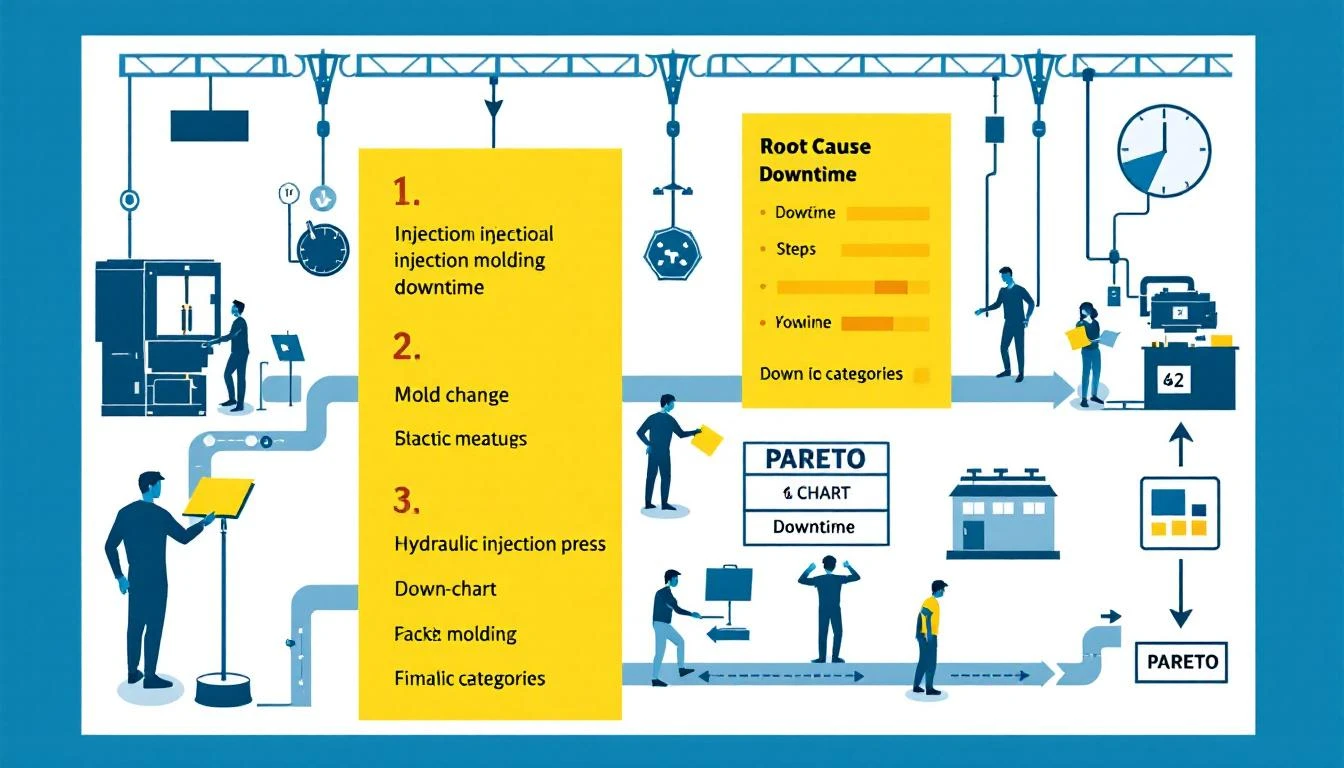
Categorizing Unplanned Downtime: Root Cause Analysis for Injection Molding
Unplanned downtime is where the real money leaks. In injection molding, the most common failure categories are:
Hydraulic System Failures
- Seal failures — O-rings, piston seals, and rod seals degrade under heat and pressure cycles
- Pump wear — Vane pumps and piston pumps lose volumetric efficiency over time, resulting in slow clamp movements before complete failure
- Oil contamination — Water intrusion, particulate contamination, and thermal breakdown of hydraulic fluid
- Proportional valve failures — Solenoid valves that control injection speed, hold pressure, and clamp tonnage
Hydraulic failures are particularly devastating because they often cascade. A leaking seal contaminates the oil, which accelerates pump wear, which causes inconsistent clamp pressure, which produces flash defects before the machine finally faults out.
Heating System Failures
- Heater band burnout — Barrel heater bands have finite lifespans (typically 18-36 months in continuous operation)
- Thermocouple drift — J-type and K-type thermocouples lose accuracy over time, causing barrel zones to run hotter or colder than displayed
- Hot runner failures — Manifold heater burnout, tip heater failures, thermocouple breaks in hot runner systems
- Controller faults — Temperature controller PID loop failures causing temperature oscillation
When barrel temperatures are monitored through an IIoT platform, you can detect thermocouple drift and heater degradation weeks before failure. A zone that's taking progressively longer to reach setpoint is a heater on its way out. Catching it during a scheduled PM window vs. during a production run is the difference between a 30-minute swap and an 8-hour emergency.
Mechanical Failures
- Toggle mechanism wear — On toggle-clamp machines, bushing and pin wear causes clamp force variation
- Tie bar stretch — Excessive clamp tonnage causes permanent tie bar elongation
- Check ring wear — Worn check rings cause shot-to-shot inconsistency (cushion variation)
- Screw wear — Flight wear reduces plasticating capacity and mixing efficiency
- Ejector system failures — Broken ejector pins, worn leader pins, seized ejector plates
Mold Failures
- Parting line damage — Flash due to mold parting line compression or contamination
- Cooling line blockage — Scale buildup or debris restricting water flow through mold cooling channels
- Core pin breakage — Fatigue failure in thin core pins
- Slide and lifter wear — Action components wearing beyond tolerance
Each of these failure categories should be a selectable downtime reason in your tracking system. When an operator tags a downtime event as "Hydraulic — Seal Failure — Clamp Cylinder," you can run Pareto analysis across your entire fleet to identify systemic issues.
Root Cause Analysis for Extrusion Lines
Extrusion downtime follows different patterns than injection molding but is equally costly. The continuous nature of extrusion means that unplanned stoppages often result in significant material waste — the line needs to be purged, restarted, and brought back to steady-state conditions.
Common extrusion downtime categories:
Screw and Barrel Wear
Unlike injection molding where screw wear causes shot inconsistency, extrusion screw wear reduces throughput and melt quality. Monitoring drive motor amps relative to output rate reveals wear trends months before they become critical. A detailed guide to monitoring these indicators is in our article on predictive maintenance for extrusion lines.
Die Buildup and Screen Pack Changes
Screen packs in the breaker plate filter contaminants from the melt stream. As they clog, back pressure rises, throughput drops, and eventually the pressure differential triggers a shutdown. Tracking the frequency and duration of screen changes reveals:
- Whether your incoming material quality is consistent (sudden increase in screen changes = raw material issue)
- Whether your screen mesh selection is optimal for the application
- Whether continuous screen changers would provide ROI vs. manual change-outs
Downstream Equipment Failures
Cooling tanks, pullers, cutters, and coilers all represent potential downtime sources for the entire extrusion line. A failed puller motor stops production just as effectively as an extruder barrel failure, but operators often don't categorize downstream failures with the same rigor as extruder issues.
Building a Downtime Reason Code Structure for Plastics
The effectiveness of your downtime tracking system depends entirely on the quality of your reason code hierarchy. Too few categories and everything becomes "Machine — Other." Too many and operators skip the classification entirely.
Here's a proven structure for plastics operations:
Level 1 — Equipment Type:
- Injection Molding Press
- Extruder
- Auxiliary Equipment (dryer, loader, granulator, chiller)
- Mold/Die
- Downstream Equipment
Level 2 — System:
- Hydraulic, Electrical, Mechanical, Heating/Cooling, Control System, Tooling
Level 3 — Component:
- Specific component (e.g., Hydraulic → Pump, Seal, Valve, Oil, Accumulator)
Level 4 — Failure Mode:
- What happened (e.g., Pump → Worn, Seized, Cavitation, Overheated)
This four-level hierarchy gives maintenance teams enough specificity for root cause analysis while keeping operator data entry manageable. Modern IIoT platforms present these as cascading dropdowns — the operator picks the machine (auto-detected), selects the system, and drills down to the specific failure.
When downtime reasons feed into a platform with built-in reporting, you get automatic Pareto charts showing your top 5 downtime drivers across the entire fleet. No more spreadsheet aggregation. No more monthly maintenance meetings where everyone argues about what the biggest problem is — the data speaks.
The Planned vs. Unplanned Downtime Ratio
World-class plastics manufacturers target a planned-to-unplanned downtime ratio of at least 4:1 — meaning 80% of all downtime is scheduled and controlled. The industry average is closer to 2:1.
Why does this ratio matter? Because planned downtime is:
- Predictable — you can schedule production around it
- Optimizable — you can SMED your mold changes and streamline your purges
- Productive — PM during planned windows prevents unplanned failures
Tracking this ratio over time is one of the most powerful leading indicators for maintenance health. If your ratio is declining (more unplanned events), your PM program needs attention. If it's improving, your predictive and preventive strategies are working.
This connects directly to how to reduce unplanned downtime — the systemic approaches that shift events from reactive to planned.
From Tracking to Action: Closing the Loop
Downtime tracking is only valuable if it drives action. Here's the closed-loop process that top-performing plastics shops follow:
- Capture — Every downtime event is automatically detected and tagged with reason codes
- Analyze — Weekly Pareto review identifies the top 3-5 downtime drivers
- Investigate — Root cause analysis (5-Why, Fishbone) on top drivers
- Act — Corrective actions assigned with owners and deadlines
- Verify — Track whether the specific downtime category decreases after intervention
- Standardize — Successful fixes become standard procedures and PM tasks
Without step 5 — verification — you're doing root cause analysis as a ritual rather than a process improvement method. The IIoT platform becomes the verification engine: did the downtime hours for "Hydraulic — Seal Failure" actually decrease after you switched to a better seal material?
Getting Started: Practical Implementation for Plastics Shops
If your plastics operation currently tracks downtime on whiteboards, spreadsheets, or not at all, here's the progression:
Phase 1 — Connect your critical assets. Start with your highest-tonnage presses or your bottleneck extrusion lines. Get machine status data flowing in real time. Platforms like MachineCDN can have a machine connected and reporting in as little as 3 minutes — no IT infrastructure required, no plant network disruption.
Phase 2 — Establish reason codes. Build your downtime reason hierarchy (use the structure above as a starting point). Keep it simple enough that operators will actually use it.
Phase 3 — Baseline your performance. Run for 30 days to establish your current downtime profile. Don't try to fix anything yet — just capture the reality.
Phase 4 — Attack the top drivers. Your Pareto chart will show you where to focus. Usually it's mold change time, a specific failure mode on aging equipment, or material-related issues.
Phase 5 — Expand and refine. Add more machines to monitoring, refine your reason codes based on what you've learned, and begin setting threshold alerts for approaching failure conditions.
The plastics manufacturers who commit to this process consistently see 15-25% reductions in total downtime within the first year. Not because the technology is magic — but because you can't optimize what you can't measure.
Ready to transform downtime tracking in your plastics operation? MachineCDN connects to your injection molding presses and extrusion lines in minutes — no IT involvement, no plant network disruption. Start seeing every minute of downtime, categorized and analyzed.