The Future of SCADA: Why Legacy Systems Are Losing Ground to Cloud-Native IIoT Platforms

SCADA (Supervisory Control and Data Acquisition) has been the backbone of industrial operations for four decades. From water treatment plants to oil refineries to discrete manufacturing lines, SCADA systems have provided the real-time monitoring and control that keeps industrial processes running. Every manufacturing engineer over 30 learned SCADA. Every plant over 20 years old runs on it.
And SCADA is being replaced.
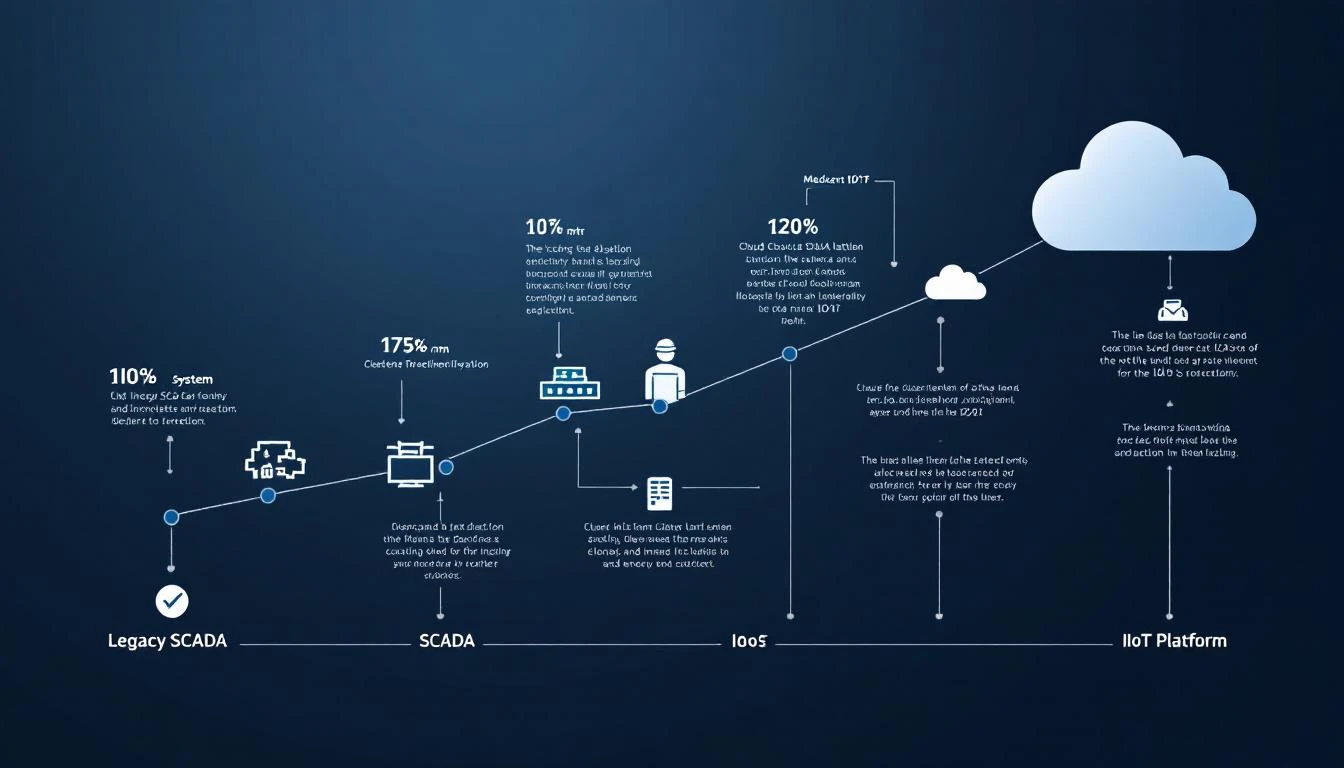
Not overnight. Not universally. And not without resistance from the controls engineers who've built careers on it. But the trajectory is clear: cloud-native IIoT platforms are absorbing SCADA's monitoring and analytics functions while the control function moves to modern distributed control systems, edge controllers, and smart devices.
ARC Advisory Group projects that the traditional SCADA market will decline 3-5% annually through 2030, while the cloud-native IIoT platform market grows at 25%+ annually. Gartner moved SCADA out of their "mainstream" category in 2024, replacing it with "operational technology platforms" — a tacit acknowledgment that SCADA as an architectural concept is being superseded.
This isn't obituary. SCADA will run critical infrastructure for decades to come. But if you're a plant engineer evaluating your monitoring and analytics architecture for the next 10 years, understanding where SCADA is heading — and what's replacing it — is essential.
What SCADA Got Right (and Why It Lasted 40 Years)
Before discussing SCADA's decline, it's worth understanding why it dominated for so long:
Reliability at scale. SCADA systems run for years without rebooting. They don't crash because of Windows updates. They don't slow down because someone opened too many browser tabs. When your process requires 99.99% uptime, this reliability matters.
Real-time determinism. SCADA systems guarantee response times in milliseconds. When a pressure reading exceeds a setpoint, the system responds within a defined time window — every time. This determinism is essential for safety-critical processes.
Vendor-maintained lifecycle. Rockwell, Siemens, GE, AVEVA, and other SCADA vendors provide 15-20 year product lifecycles with backward compatibility. A system installed in 2010 can still get support, patches, and parts.
Regulatory acceptance. SCADA systems have decades of regulatory track record in pharmaceutical (FDA), food and beverage (FSMA), and energy (NERC CIP) industries. Regulators understand SCADA. They've validated SCADA architectures. Switching to something new means re-validation.
These aren't trivial advantages. They explain why SCADA is being complemented more than outright replaced, and why the transition will take years, not months.
Five Reasons SCADA Is Losing Ground
1. The Architecture Doesn't Scale Economically
A traditional SCADA deployment requires:
- SCADA server hardware at each site ($10K-$50K)
- Software licenses per site ($5K-$50K+ depending on tag count)
- Historian server for time-series data storage ($15K-$100K)
- VPN or WAN infrastructure for remote access ($5K-$20K per site)
- IT infrastructure for server hosting, backup, and maintenance
- Controls engineer for initial configuration and ongoing changes ($100K+/year)
For a single site, this is manageable. For 10 sites, you're looking at $500K-$2M in SCADA infrastructure. For 50 sites, it's $2.5M-$10M — plus the IT and engineering staff to maintain it all.
Cloud-native IIoT platforms eliminate the per-site infrastructure. There's no server to buy, no historian to manage, no VPN to configure. The edge device connects to the cloud platform, and you access everything through a browser. Adding a new site costs a fraction of deploying a new SCADA instance.
2. Analytics Beyond What SCADA Was Built For
SCADA was built for real-time monitoring and basic alarming. Display current values. Log history. Alert when a value exceeds a setpoint. It does these things well.
But modern manufacturing needs more:
- Predictive analytics: When will this bearing fail? SCADA can tell you the bearing temperature is high. An AI-powered IIoT platform can tell you the bearing will fail in 72 hours based on the temperature trend, vibration signature, and historical failure patterns of similar equipment.
- Cross-site analytics: How does OEE on Line 3 in Dallas compare to Line 7 in Detroit? SCADA is site-centric. Comparing across sites requires manual data export and analysis.
- Machine learning: Pattern recognition across millions of data points to identify failure signatures that humans can't see. SCADA doesn't have the compute architecture for ML workloads.
- Natural language querying: "Show me every machine that ran above normal vibration levels in the past week." Modern IIoT platforms with AI can process natural language queries. SCADA requires pre-built screens for every view.
You can add analytics to SCADA through third-party tools (OSIsoft PI, Seeq, TrendMiner). But at that point, you're building a Frankenstein architecture — SCADA for data collection, a historian for storage, a third-party tool for analytics — with integration complexity and cost that exceeds a purpose-built IIoT platform.
3. The Talent Pipeline Is Drying Up
Here's the demographic reality: the engineers who configure and maintain SCADA systems are retiring. Universities aren't producing replacements at the same rate because the curriculum has shifted toward cloud computing, data science, and software engineering.
A controls engineer who can program Allen-Bradley RSLogix, configure an Ignition SCADA gateway, and troubleshoot a FactoryTalk historian is increasingly rare — and increasingly expensive. The Bureau of Labor Statistics projects a 7% decline in industrial controls engineering positions through 2030, even as the number of connected devices grows 25% annually.
Cloud-native IIoT platforms are accessible to a broader talent pool. A mechanical engineer or maintenance technician can configure a dashboard and set up alerts without programming a SCADA server. The system doesn't require specialized controls engineering knowledge to operate — it requires domain knowledge about the equipment and processes being monitored, which the maintenance team already has.
4. Remote Access Was an Afterthought
SCADA was designed when remote access meant dialing in via modem. The architecture assumes that operators are on-site, sitting in front of HMI screens. Remote access was added later through VPN connections to SCADA servers — a solution that's functional but far from elegant.
COVID accelerated the demand for remote monitoring. Plant managers working from home discovered that accessing SCADA remotely was either impossible (no VPN configured), painful (slow VPN through corporate network), or a security nightmare (SCADA servers exposed to the internet).
Cloud-native IIoT platforms are remote-first. The dashboard is a web application. Access from any device, anywhere, with proper authentication. No VPN required. No latency from routing through corporate networks. Real-time alerts on mobile devices, not just desktop HMIs.
5. Vendor Lock-In Is Becoming Unacceptable
Traditional SCADA creates deep vendor lock-in. Once you've invested in a Rockwell FactoryTalk environment — the historian, the SCADA server, the HMI licenses, the programming tools, the training — switching to a different vendor means starting from zero. The migration cost often exceeds the original investment.
This lock-in extends to integrations. A FactoryTalk SCADA server talks natively to Allen-Bradley PLCs. Connecting Siemens PLCs requires middleware. Connecting non-standard devices requires custom drivers. Every integration beyond the vendor's ecosystem adds cost and complexity.
Modern IIoT platforms are protocol-agnostic by design. They connect to any PLC that speaks standard protocols (Ethernet/IP, Modbus, OPC UA) regardless of manufacturer. This multi-vendor support is essential for manufacturing operations that have accumulated equipment from multiple vendors over decades.
The Hybrid Period: SCADA + IIoT Coexistence
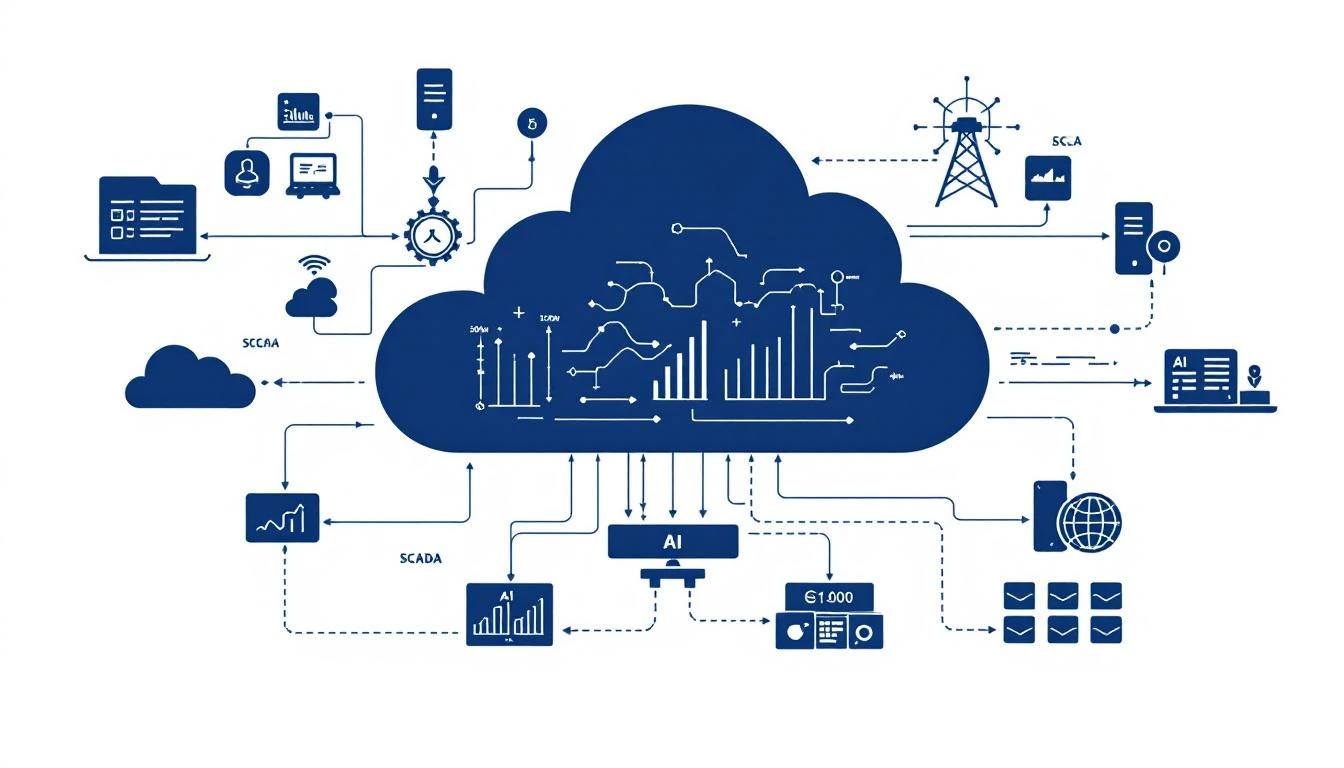
The realistic near-term architecture for most manufacturing operations isn't "rip out SCADA." It's "complement SCADA with IIoT."
SCADA retains control. Safety-critical control loops, emergency shutdowns, and real-time process control remain in the SCADA/PLC domain. This is where deterministic response times matter, and SCADA's reliability is proven.
IIoT handles analytics and monitoring. Predictive maintenance, cross-site fleet management, AI-powered anomaly detection, mobile alerts, and cloud-based dashboards move to the IIoT platform. This is where cloud-native architectures excel.
The edge device bridges both worlds. IIoT edge devices read data from the same PLCs that SCADA monitors, creating a parallel data path. SCADA continues its control function; IIoT provides the analytics and accessibility that SCADA can't.
This coexistence model is how most organizations will transition over the next 5-10 years. The SCADA system stays in place for control and safety. The IIoT platform runs alongside it for monitoring, analytics, and maintenance optimization. Over time, as SCADA hardware reaches end-of-life, the IIoT platform absorbs more of its monitoring function.
What Replaces SCADA: The Three Architectures
Architecture 1: Cloud-Native IIoT Platform (MachineCDN Approach)
Edge devices at each machine connect directly to a cloud platform via cellular. No on-site servers. No per-site infrastructure. AI-powered analytics, fleet management, and predictive maintenance in the cloud.
Best for: Discrete manufacturing, multi-site operations, organizations without dedicated controls engineering staff. See our best SCADA alternatives guide for a detailed comparison.
Advantages: Fastest deployment (minutes, not months), lowest infrastructure cost, no IT dependency, AI and ML capabilities native
Limitations: Not suitable for closed-loop control (millisecond response requirements), requires reliable cellular connectivity
Architecture 2: Edge-Heavy Platform (Ignition Approach)
A flexible edge platform (typically Ignition from Inductive Automation) that runs SCADA-like functionality on edge servers with optional cloud connectivity. Bridges the gap between traditional SCADA and cloud-native IIoT.
Best for: Process manufacturing, organizations with existing controls engineering teams, scenarios requiring local control logic
Advantages: Can replace SCADA entirely (including control), flexible architecture, strong OPC UA support
Limitations: Requires on-site servers, needs controls engineering expertise, cloud analytics are add-on rather than native
Architecture 3: Hyperscaler IoT (AWS/Azure Approach)
Building an IIoT solution on cloud infrastructure (AWS IoT SiteWise, Azure IoT Hub). Maximum flexibility but maximum complexity.
Best for: Large enterprises with cloud engineering teams, organizations building custom IoT applications
Advantages: Infinite scalability, full customization, integration with broader cloud ecosystem
Limitations: Requires significant cloud engineering expertise, long implementation timelines, ongoing development cost. See our AWS IoT SiteWise and Azure IoT comparisons.
Planning Your SCADA Transition
Step 1: Audit Your Current SCADA Estate
Document every SCADA system across every site: vendor, version, hardware age, tag count, license expiration. Identify systems approaching end-of-life (EOL) — these are your natural transition points.
Step 2: Separate Control from Monitoring
Map which SCADA functions are control (require real-time deterministic response) and which are monitoring (visualization, trending, alarming, analytics). Control functions stay in PLC/safety systems. Monitoring functions are candidates for IIoT migration.
Step 3: Run a Parallel IIoT Deployment
Deploy an IIoT platform alongside your SCADA system on 5-10 machines. Run both systems simultaneously for 3-6 months. Compare data accuracy, alert effectiveness, and user experience. This parallel period de-risks the transition.
Step 4: Migrate Monitoring to IIoT
Once validated, transition monitoring functions from SCADA to the IIoT platform. Users access the IIoT dashboard for visualization, trending, and alerts. SCADA continues for control.
Step 5: Sunset SCADA at End-of-Life
When SCADA hardware reaches end-of-life, evaluate whether replacement is needed. If control functions are handled by modern PLCs and monitoring/analytics are handled by the IIoT platform, the SCADA layer may be redundant.
The Bottom Line
SCADA served manufacturing faithfully for 40 years. It deserves respect, not contempt. But the world it was built for — isolated plants, on-site operators, basic alarming — is giving way to a world of connected operations, remote monitoring, AI analytics, and multi-site fleet management.
The future doesn't require abandoning everything SCADA represents (reliability, real-time performance, safety). It requires complementing those strengths with capabilities that SCADA can't provide (cloud analytics, AI, mobile access, rapid deployment).
MachineCDN represents the next generation — a cloud-native IIoT platform that delivers what SCADA can't (AI-powered predictive maintenance, 3-minute device setup, cellular connectivity, cross-site fleet management) while coexisting with what SCADA does well (real-time control).
Book a demo and see what monitoring looks like when it's designed for 2026, not 1986.