Vibration Monitoring Systems for Manufacturing: Complete Guide to Protecting Rotating Equipment

Every rotating machine in your factory is telling you about its health right now. The question is whether you're listening.
Vibration monitoring is the foundation of condition-based maintenance for rotating equipment — motors, pumps, compressors, fans, gearboxes, spindles, and turbines. According to the Vibration Institute, over 90% of mechanical failures in rotating equipment produce detectable vibration changes before catastrophic failure occurs. The warning signs are there — often weeks or months before the breakdown.
Yet a 2025 Plant Engineering survey found that 67% of manufacturing facilities still rely primarily on time-based or run-to-failure maintenance strategies for rotating equipment. The result: an average of 800 hours of unplanned downtime per year per facility, costing the global manufacturing industry an estimated $50 billion annually.
This guide covers how vibration monitoring systems work, what techniques and technologies are available, how to choose the right approach for your operation, and how modern IIoT platforms like MachineCDN integrate vibration data into a broader predictive maintenance strategy.

Why Vibration Monitoring Matters
Rotating equipment failures follow a predictable degradation curve. The P-F curve (Potential failure to Functional failure) shows that vibration anomalies typically appear 6-12 months before a bearing failure, 3-6 months before a misalignment becomes critical, and 1-3 months before a balance issue causes a shutdown.
This lead time is the value proposition of vibration monitoring: you can detect, diagnose, and schedule repairs during planned maintenance windows instead of reacting to catastrophic failures at 2 AM on a Saturday.
The Cost of Not Monitoring
Consider a single unplanned bearing failure on a critical production motor:
- Parts cost: $500-$5,000 (bearing replacement)
- Emergency labor: $2,000-$10,000 (overtime, expedited parts)
- Production loss: $10,000-$100,000+ per hour of downtime
- Collateral damage: $5,000-$50,000 (shaft damage, seal failure, motor rewind)
- Quality impact: Off-spec product, rework, scrap
Total cost of one unplanned failure: $20,000-$200,000+
Compare that to the cost of detecting the same bearing degradation 3 months early during routine vibration monitoring: a planned $2,000 bearing replacement during a scheduled maintenance window with zero production impact.
The math isn't subtle. Vibration monitoring programs typically deliver 10-25x ROI within the first year.
How Vibration Monitoring Works
The Physics
All rotating machines generate vibration. A perfectly balanced, perfectly aligned, perfectly lubricated machine produces minimal vibration at predictable frequencies. As conditions change — bearings wear, shafts misalign, rotors become unbalanced, gears develop defects — the vibration signature changes in measurable ways.
The key insight: different faults produce different vibration patterns. A trained analyst (or AI model) can identify not just that a problem exists, but what the problem is and how severe it's become.
Common Fault Signatures
Imbalance: Vibration at 1x rotational speed (1x RPM), proportional to speed squared. The most common fault in rotating machinery. Causes: material buildup, erosion, broken impeller vanes, loose components.
Misalignment: Vibration at 1x and 2x RPM, often with elevated axial vibration. Angular misalignment shows primarily at 1x; offset misalignment shows at 2x. Causes: thermal growth, foundation settling, improper installation.
Bearing defects: Frequencies determined by bearing geometry — BPFI (inner race), BPFO (outer race), BSF (rolling element), FTF (cage). Early-stage bearing faults appear as very high-frequency impacts that are often invisible in standard velocity measurements but clear in acceleration enveloping analysis.
Gear mesh: Vibration at gear mesh frequency (number of teeth × RPM) and harmonics. Gear wear, tooth cracking, and eccentricity produce sidebands around the mesh frequency.
Looseness: Elevated vibration at 1x, 2x, and multiple harmonics of running speed. Mechanical looseness generates a "noisy" spectrum with many peaks. Causes: loose bolts, bearing clearance, cracked foundation.
Cavitation: Broad-band, random vibration with elevated high-frequency content. Common in pumps operating outside their design envelope.
Types of Vibration Monitoring Systems
Route-Based (Periodic) Monitoring
The traditional approach: a vibration analyst walks the plant with a handheld data collector (CSI, SKF, Fluke, etc.), takes measurements at each machine, and analyzes the data on desktop software.
Advantages:
- Low hardware cost (one collector serves the entire plant)
- Expert analyst provides diagnosis
- Established technology with decades of proven results
Disadvantages:
- Measurements only during collection routes (monthly or quarterly typical)
- Faults that develop between routes may cause failures before detection
- Requires trained analysts ($80K-$120K salary or contractor costs)
- Manual process doesn't scale well
- Critical machines need more frequent monitoring than routes provide
Online (Continuous) Monitoring
Permanently installed sensors continuously measure vibration and transmit data for analysis. This approach eliminates the gaps between route measurements.
Types of online sensors:
- Wired accelerometers — highest fidelity, most expensive, permanent installation with cabling
- Wireless vibration sensors — battery-powered (1-5 year life), Wi-Fi or proprietary wireless
- MEMS sensors — lower cost, lower fidelity, suitable for many fault types
- Edge-processed sensors — onboard FFT processing, transmit spectral data instead of raw waveforms
Advantages:
- Continuous monitoring catches fast-developing faults
- Automated alerts without analyst involvement
- Historical trend data for every measurement point
- Scales to hundreds or thousands of points
Disadvantages:
- Higher hardware cost per measurement point ($200-$2,000 per sensor)
- Installation labor for wired systems
- Wireless sensors require battery management
- Data infrastructure needed (gateways, servers, cloud)
IIoT-Integrated Monitoring
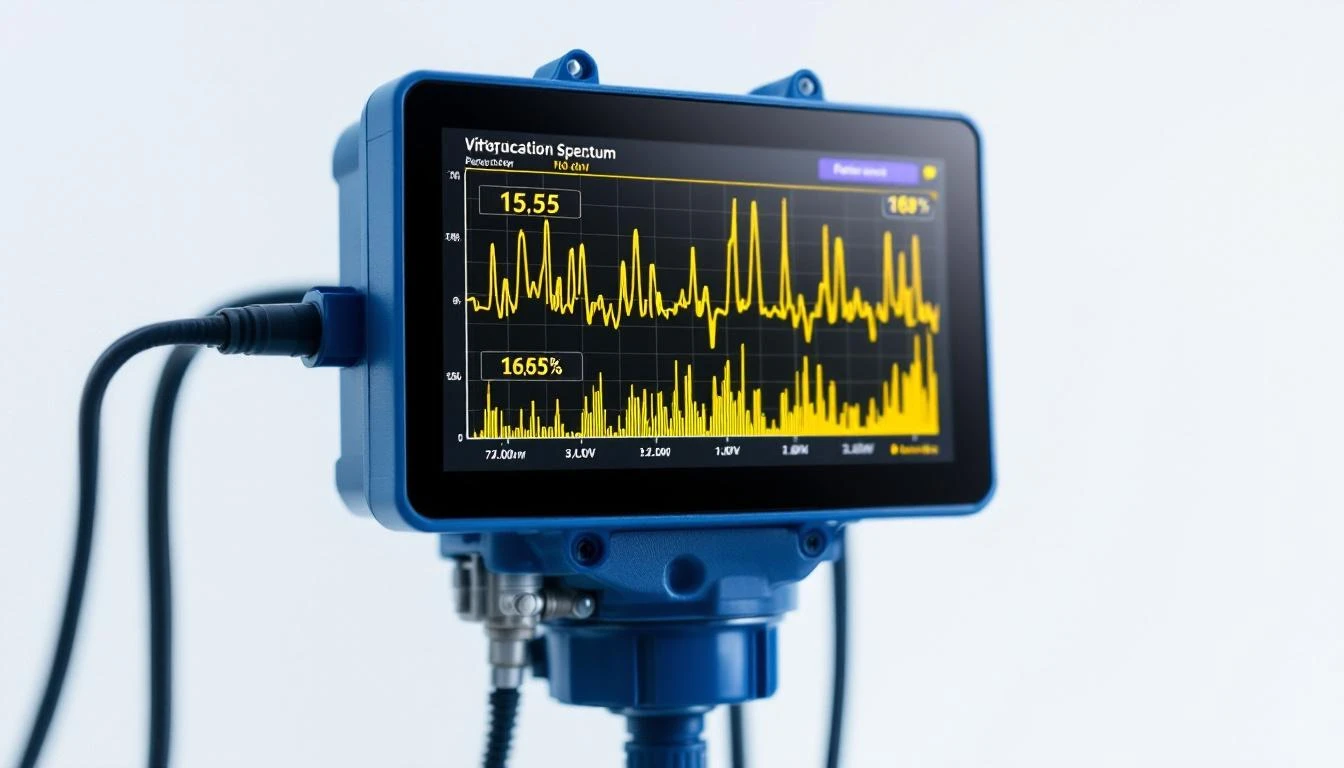
Modern IIoT platforms like MachineCDN integrate vibration data alongside other machine parameters — temperature, pressure, current, speed, position — to provide a holistic view of equipment health.
How MachineCDN approaches vibration monitoring:
Rather than deploying a standalone vibration monitoring system, MachineCDN reads vibration data from PLCs and sensors as part of its broader machine monitoring. Many modern PLCs already capture vibration signals from built-in sensor modules or analog input cards. MachineCDN reads these values alongside all other machine data through its direct PLC connectivity.
This approach provides:
- Vibration trends correlated with operating conditions (load, speed, temperature)
- Threshold alerting with approaching-alarm warnings
- AI-powered anomaly detection that considers vibration in the context of overall machine behavior
- No separate vibration monitoring infrastructure required
For machines where PLC-captured vibration isn't available, MachineCDN's platform can ingest data from standalone vibration sensors through edge integration.
Vibration Analysis Techniques
Overall Vibration Level
The simplest measurement: total vibration amplitude (velocity in mm/s or in/s). ISO 10816 provides severity criteria for different machine classes. Trending overall level catches significant changes but doesn't diagnose fault type.
Best for: Quick health assessment, alarm thresholds, screening for machines that need detailed analysis.
Frequency (Spectral) Analysis
FFT (Fast Fourier Transform) converts time-domain vibration into the frequency domain, revealing which specific frequencies contribute to the overall vibration. Since each fault type produces vibration at specific frequencies, spectral analysis enables diagnosis.
Best for: Fault identification, root cause analysis, distinguishing between imbalance, misalignment, bearing, and gear faults.
Envelope (Demodulation) Analysis
High-frequency bearing impacts are often hidden in the noise floor of standard velocity measurements. Envelope analysis band-pass filters the signal to isolate the high-frequency resonance band, then demodulates it to extract the repetitive impact pattern. This technique detects bearing faults months before they appear in velocity spectra.
Best for: Early-stage bearing fault detection, particularly for large, slow-speed machines where traditional spectral analysis is less effective.
Time Waveform Analysis
The raw vibration signal over time reveals patterns that frequency analysis may obscure — impacts, rubs, truncation, and intermittent events. Experienced analysts use waveform shape, crest factor, and kurtosis to assess machine condition.
Best for: Gearbox analysis, impact detection, looseness characterization.
Order Analysis
For variable-speed machines, traditional FFT produces smeared spectra because frequency components shift with speed. Order analysis normalizes vibration data to shaft speed, producing clean spectra regardless of speed variation.
Best for: Variable frequency drive (VFD) controlled motors, wind turbines, variable-speed compressors.
Choosing the Right Vibration Monitoring Approach
Criticality-Based Strategy
Not every machine deserves continuous monitoring. Use a criticality assessment to allocate monitoring resources:
Critical machines (continuous monitoring):
- Single-point-of-failure equipment
- Equipment where failure causes safety risk
- Machines with replacement lead times > 2 weeks
- Equipment running 24/7 with no backup
Important machines (monthly route monitoring):
- Redundant equipment (backup available)
- Machines with moderate downtime impact
- Equipment with readily available spare parts
Non-critical machines (quarterly or run-to-failure):
- Equipment with minimal production impact
- Low-cost, easily replaced machines
- Non-essential support equipment
Integration with Overall Machine Monitoring
Vibration monitoring delivers maximum value when combined with other condition indicators. A bearing that shows elevated vibration, rising temperature, and increasing motor current is a much more confident diagnosis than vibration alone.
This is where IIoT platforms like MachineCDN provide an advantage over standalone vibration monitoring systems. By monitoring vibration alongside process variables, operating conditions, and maintenance history in a single platform, you get:
- Correlated fault detection — multiple symptoms confirm diagnosis
- Operating context — vibration that increases under load vs. at idle tells different stories
- Automated severity assessment — AI models weigh multiple indicators
- Unified alerting — one alert system for all machine health parameters
Building a Vibration Monitoring Program
Phase 1: Baseline (Month 1)
- Identify critical rotating equipment (motors > 25 HP, production-critical pumps, fans, compressors)
- Install monitoring on top 10-20 critical machines
- Collect baseline data under normal operating conditions
- Document operating speeds, bearing specifications, coupling types
Phase 2: Threshold Setting (Month 2)
- Establish alert and alarm thresholds based on baseline data and ISO 10816
- Configure automated notifications for threshold exceedances
- Begin trending vibration levels over time
- Validate sensor placement and data quality
Phase 3: Analysis and Response (Months 3-6)
- Review trends monthly, investigate anomalies
- Correlate vibration changes with maintenance events and process changes
- Build fault library from confirmed diagnoses
- Optimize monitoring intervals based on equipment condition
Phase 4: Predictive Expansion (Months 6-12)
- Expand monitoring to next tier of equipment
- Implement AI-based anomaly detection for pattern recognition
- Integrate vibration data with CMMS work order system
- Calculate and report maintenance savings
ROI of Vibration Monitoring
A manufacturing facility with 200 rotating machines implementing a comprehensive vibration monitoring program can expect:
| Metric | Before | After | Improvement |
|---|---|---|---|
| Unplanned failures/year | 24 | 4 | -83% |
| Average downtime per failure | 8 hours | 2 hours | -75% |
| Emergency maintenance spend | $480,000 | $80,000 | -83% |
| Production loss from downtime | $1.2M | $100,000 | -92% |
| Monitoring system cost | $0 | $50,000-$100,000 | — |
| Net annual savings | — | $1.5M+ | 15-30x ROI |
These figures are consistent with data from the Vibration Institute and the Society for Maintenance and Reliability Professionals (SMRP). Real-world results vary, but 10x+ ROI in the first year is common for facilities starting from a run-to-failure baseline.
The Bottom Line
Vibration monitoring isn't new technology — it's been practiced for decades. What's new is the ability to integrate vibration data into comprehensive machine health platforms that combine multiple sensor types, AI-powered analysis, and automated alerting without requiring dedicated vibration analysts.
Modern IIoT platforms like MachineCDN are making vibration monitoring accessible to manufacturing operations that previously lacked the expertise or infrastructure for condition-based maintenance. By reading vibration data alongside all other machine parameters through direct PLC connectivity, these platforms provide contextual fault detection that standalone vibration systems cannot match.
Your rotating equipment is talking. The question is whether your monitoring system can hear it, understand it, and tell you what to do about it — before the 2 AM phone call.
Related Reading:
- How to Implement Predictive Maintenance
- How to Reduce Unplanned Downtime
- Predictive Maintenance Software Comparison 2026
- Best Machine Monitoring Software 2026
- Best Predictive Maintenance Software 2026
Ready to integrate vibration monitoring into a complete machine intelligence platform? Book a demo with MachineCDN and see how edge-to-cloud connectivity delivers predictive maintenance in minutes.