Hardware Sensors vs Protocol-Native IIoT: Why IoTFlows SenseAi and MachineCDN Take Opposite Approaches

The industrial IoT market is splitting into two camps, and the choice between them has long-term implications for your maintenance strategy, your budget, and your data quality. On one side: platforms like IoTFlows that deploy proprietary sensors to collect machine data from the outside. On the other: platforms like MachineCDN that connect directly to the controllers already running your equipment.
This isn't just a technology debate. It's a fundamental question about where manufacturing data should come from — and who owns the measurement infrastructure.
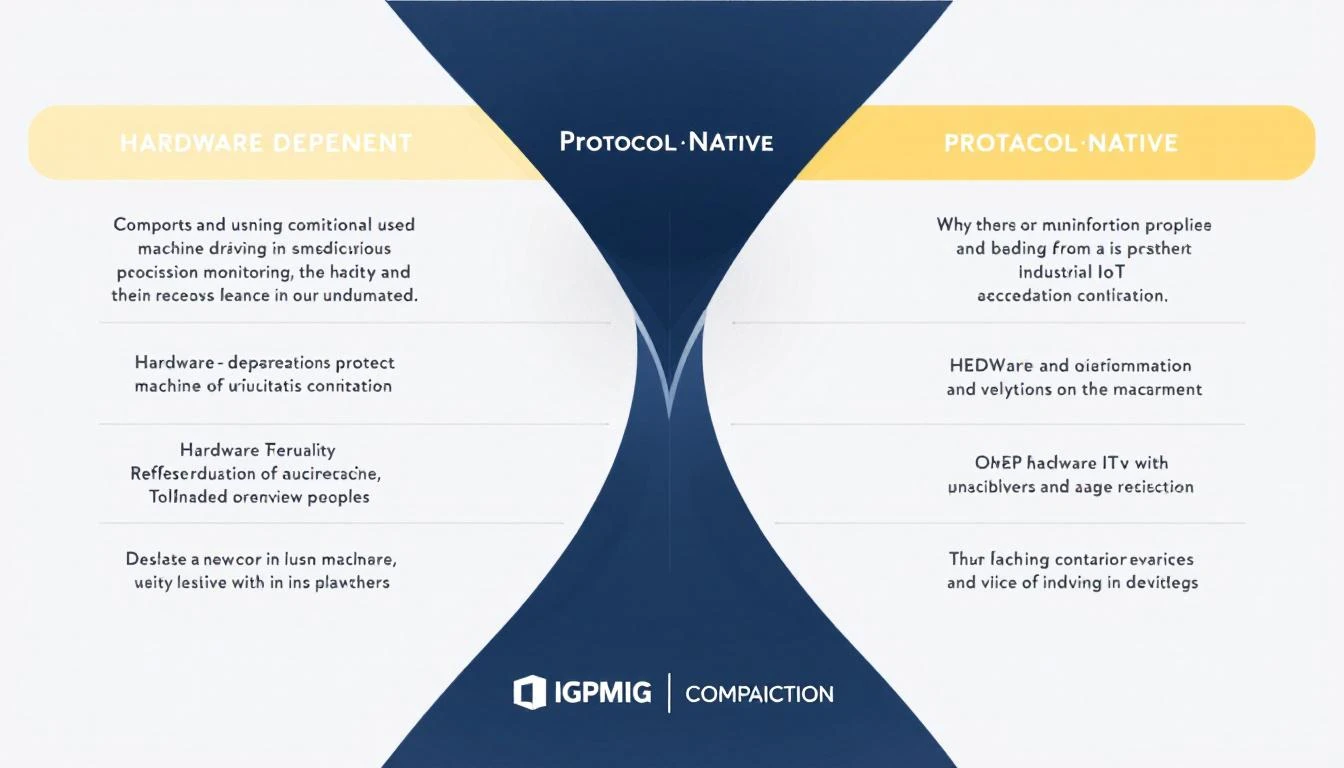
The Hardware-Dependent Approach: IoTFlows SenseAi
IoTFlows' core product line is the SenseAi sensor family — purpose-built devices designed to mount on industrial equipment and measure vibration, acoustics, and temperature. The flagship SenseAi Embedded is an IP67-rated sensor that can withstand harsh industrial environments. They also offer the BeamTracker, a laser-based tracking device for specific measurement applications.
Here's how the SenseAi approach works:
- Physical installation — Sensors are mounted on machine housings, motor casings, bearing pedestals, or equipment frames using adhesive, magnetic mounts, or bolted connections
- Data collection — Each sensor measures vibration spectra (acceleration, velocity, displacement), acoustic patterns, and surface temperature
- Wireless transmission — Sensor data transmits wirelessly to a gateway or directly to the cloud
- AI analysis — IoTFlows' platform processes the vibration and acoustic data through machine learning models trained on failure mode signatures
- Health scoring — Each machine receives a health score based on seven metrics: cavitation, looseness, imbalance, lubrication quality, alignment, bearing condition, and temperature
This approach has genuine merit. Vibration analysis is a proven predictive maintenance technique with decades of engineering history behind it. The ISO 10816 standard for vibration severity evaluation dates back to the 1990s. Route-based vibration analysis has been a cornerstone of reliability engineering programs at major manufacturers for years.
IoTFlows modernizes this practice by making vibration monitoring continuous (instead of periodic route-based collection) and applying AI to automate the analysis that traditionally required a certified vibration analyst.
The Protocol-Native Approach: MachineCDN
MachineCDN takes the opposite approach entirely: don't add new measurement hardware — read the data that already exists inside the machine.
Every PLC-controlled machine already contains a sophisticated sensor suite. A typical CNC machining center might have 30-50 sensors connected to its PLC: axis position encoders, spindle load transducers, coolant temperature and flow sensors, hydraulic pressure transducers, servo motor current feedback, tool length probes, and door/guard interlock switches. A packaging line might monitor servo positions, tension sensors, temperature zones, photoeyes, vacuum levels, and product detection sensors.
All of this data flows through the PLC on every scan cycle — typically every 5-20 milliseconds. The PLC uses this data to control the machine. But traditionally, this data has been locked inside the control system, accessible only through the HMI panel on the machine itself.
MachineCDN's edge gateway connects to the PLC using standard industrial communication protocols — the same protocols the PLC already speaks. It reads configured tags (data points) at configurable intervals and streams them to the cloud for analysis, visualization, and AI processing.
No additional sensors. No additional wiring. No additional hardware to mount, power, maintain, calibrate, or replace.
The Seven Critical Differences
1. Data Breadth
IoTFlows SenseAi measures three data types per sensor: vibration, acoustics, and temperature. Even with multiple sensors per machine, you're capturing a narrow slice of the machine's operating state.
MachineCDN reads any tag the PLC exposes — potentially hundreds per machine. Motor currents, hydraulic pressures, pneumatic states, servo positions, cycle times, fault codes, energy consumption, material levels, operating modes, and every other parameter the machine's own sensors measure.
Why this matters: A vibration sensor might detect that a bearing is degrading. PLC data tells you that bearing temperature is rising, the associated motor current is increasing, the lubrication system pressure dropped two days ago, and the last PM task for that bearing was overdue by 200 operating hours. Context transforms data into action.
2. Failure Mode Coverage
IoTFlows SenseAi excels at detecting mechanical degradation patterns: bearing wear, shaft imbalance, structural looseness, misalignment, and cavitation in pumps. These are important failure modes, but they represent maybe 30-40% of total unplanned downtime causes in discrete manufacturing.
MachineCDN sees every failure mode that produces a PLC fault code or alarm state — which is essentially every failure mode the machine was designed to detect. Electrical faults, control system errors, safety interlocks, material jams, quality parameter excursions, pneumatic failures, hydraulic issues, thermal overloads, and communication errors are all captured alongside mechanical degradation.
Why this matters: If 60% of your downtime comes from non-mechanical causes, a vibration-only monitoring system is blind to your biggest problems.
3. Hardware Lifecycle Costs
IoTFlows SenseAi sensors are physical devices that require:
- Initial purchase — sensor hardware cost per machine point
- Installation labor — mounting, wiring, pairing
- Battery replacement — for battery-powered variants (every 1-3 years typically)
- Sensor replacement — industrial environments are harsh, and external sensors take abuse from coolant spray, chips, dust, vibration, and thermal cycling
- Calibration — periodic verification that sensors are reading accurately
- Scaling costs — adding monitoring to a new machine means buying and installing new sensors
MachineCDN edge gateways are shared infrastructure — one gateway can monitor multiple machines on the same network segment. The gateway itself is the only hardware, and it sits in a protected location (electrical panel or network cabinet), not on the machine surface exposed to the production environment.
- No per-machine sensor costs — you're reading data that's already being collected
- No battery replacement — the gateway is powered from the electrical panel
- No calibration — you're reading the PLC's calibrated sensor data, not maintaining your own sensors
- Minimal scaling costs — adding a new machine means configuring new tags, not installing new hardware
4. Installation Impact
IoTFlows SenseAi installation requires physical access to machines, potentially during production downtime for optimal sensor placement on bearing housings and motor casings. In regulated environments (pharmaceutical, food & beverage), any physical modification to production equipment may trigger a change control process with validation requirements.
MachineCDN installation requires a network connection to the PLC — typically plugging an Ethernet cable into the same switch. The machine doesn't need to stop. No physical modification to production equipment. In regulated environments, reading data from a PLC through a standard protocol is typically categorized as a monitoring-only change, which carries much lighter validation requirements.
5. Data Latency and Resolution
IoTFlows SenseAi sensors typically sample at fixed intervals determined by battery life constraints and wireless bandwidth. Higher sampling rates drain batteries faster and consume more wireless bandwidth. This creates a trade-off between data resolution and sensor lifespan.
MachineCDN reads PLC data at configurable intervals — from sub-second to minutes, depending on the parameter. Critical parameters like alarm states and running status can be monitored at 1-second intervals. Slower-moving parameters like temperatures can be polled less frequently. The edge gateway supports both continuous streaming and change-based reporting (only send data when values change), optimizing bandwidth without sacrificing responsiveness.
6. IT and Network Impact
IoTFlows SenseAi wireless sensors need a communication path to the cloud — either through a dedicated gateway on the plant network or through the sensors' own cellular connectivity. Either approach introduces new wireless traffic on the factory floor, which some IT departments and OT security teams view with concern.
MachineCDN edge gateways use cellular connectivity — completely bypassing the plant network. The gateway has its own SIM card and communicates directly with the cloud. Zero IT involvement. Zero network changes. Zero risk of interference with existing OT networks. This is a massive practical advantage in plants where getting IT approval for a new device on the network takes weeks or months.
7. Vendor Lock-In
IoTFlows SenseAi sensors are proprietary hardware tied to the IoTFlows platform. If you decide to switch IIoT platforms in the future, the sensors may not work with a different analytics system. Your investment in hardware is locked to one vendor.
MachineCDN reads data using industry-standard protocols. The PLC data exists regardless of which IIoT platform reads it. If you ever switch platforms, your machines, sensors, and PLCs remain unchanged — only the edge gateway and cloud platform change. Your data source is the machine itself, not a vendor's proprietary sensor.
When Hardware Sensors Make Sense
To be fair, there are legitimate scenarios where adding external sensors provides value that PLC data cannot:
- Legacy equipment with no PLC — Older machines with relay logic or manual controls don't have digital data to read. External sensors are the only option for monitoring these assets.
- Machines without relevant sensors — Some equipment lacks built-in sensors for parameters you care about. If a motor doesn't have a current transducer and the PLC doesn't monitor motor load, a vibration sensor on the motor housing fills a genuine gap.
- Ultra-high-frequency vibration analysis — Some specialized bearing analysis techniques require vibration sampling at 20+ kHz, which exceeds what most PLCs capture. If your reliability program depends on envelope analysis or high-frequency demodulation, dedicated vibration sensors are appropriate.
For these cases, IoTFlows SenseAi or similar vibration monitoring hardware is the right tool. But these scenarios represent the exception, not the rule, in modern manufacturing.
The Manufacturing Reality Check
Walk onto any manufacturing floor built or retrofitted in the last 20 years. Count the PLCs. Count the sensors already connected to those PLCs. You'll find that 90%+ of the measurement infrastructure you need for comprehensive machine monitoring already exists — installed by the machine OEM, calibrated during commissioning, and maintained as part of normal machine operation.
The question isn't whether you need more sensors. The question is whether you're reading the sensors you already have.
IoTFlows answers: "Add our sensors, and we'll analyze what they measure."
MachineCDN answers: "Connect to your PLCs, and we'll analyze everything they already know."
For most modern manufacturing operations, the MachineCDN approach delivers broader visibility, faster deployment, lower total cost of ownership, and better data quality — because you're reading the machine's own calibrated sensors instead of adding approximations from the outside.
Ready to see what your PLCs already know? Book a demo and we'll connect to your equipment in minutes — not weeks.