IoTFlows vs MachineCDN for Downtime Root Cause Analysis: Which Platform Finds Problems Faster?

When a $40,000-per-hour stamping press goes down, the last thing your maintenance team needs is ambiguity. They need to know exactly what failed, exactly when, and exactly why — not a vibration score that says "something might be wrong."
That's where the fundamental difference between IoTFlows and MachineCDN becomes crystal clear. Both platforms promise downtime root cause analysis, but they approach the problem from opposite directions — and the approach determines how fast your team gets answers.
How IoTFlows Approaches Downtime Analysis
IoTFlows, a YC-backed industrial IoT company, built its downtime analysis capabilities around proprietary hardware — specifically the SenseAi sensor family. These vibration and acoustic sensors attach to your equipment and monitor seven health metrics: cavitation, looseness, imbalance, lubrication quality, alignment, bearing condition, and temperature.
When IoTFlows detects anomalous patterns in vibration or acoustic signatures, it flags the machine and provides a health score. The platform then correlates these scores with production data to identify when and why machines experienced downtime.
This approach works well for a specific use case: rotating equipment like motors, pumps, fans, and compressors where vibration patterns directly indicate failure modes. IoTFlows claims a 35% average downtime reduction for customers using this approach.
But here's the limitation that manufacturing engineers quickly discover: vibration sensors only tell you part of the story.
A CNC machine might stop because of a hydraulic pressure drop, a servo drive fault, a coolant temperature excursion, or a tool breakage alarm — none of which produce meaningful vibration signatures before the event. A packaging line might halt due to a sensor misread, a product jam, or a recipe parameter out of tolerance. An injection molding machine might cycle down because barrel temperature drifted, clamp pressure fell below threshold, or the material hopper ran empty.
These failures live inside the PLC — not on the outside of the machine casing where a vibration sensor sits.
How MachineCDN Approaches Downtime Analysis
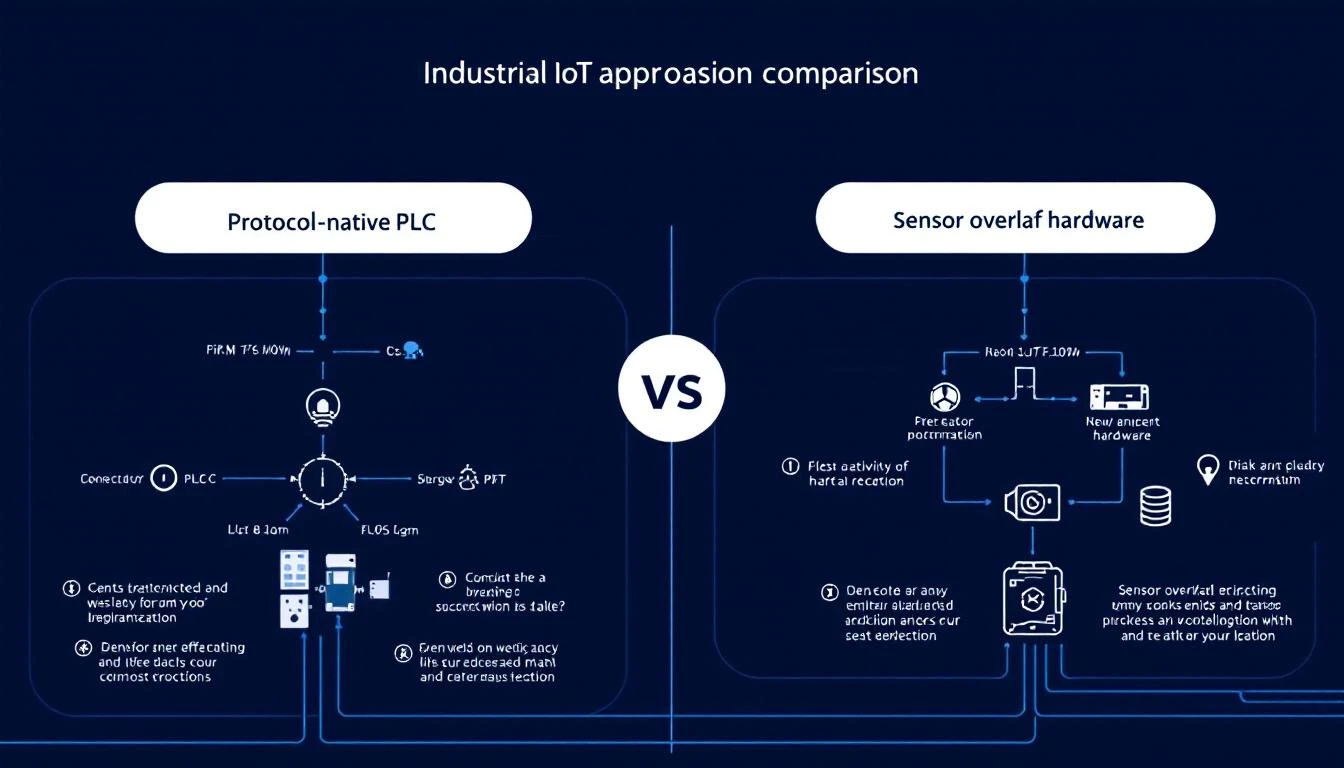
MachineCDN takes a fundamentally different approach. Instead of adding hardware to the outside of your machines, MachineCDN connects directly to the data source that already knows everything: the PLC itself.
Every modern PLC — whether it's a Siemens S7, Allen-Bradley ControlLogix, Mitsubishi, or ABB — already monitors dozens or hundreds of operating parameters in real time. Motor currents. Hydraulic pressures. Temperatures. Cycle times. Fault codes. Alarm states. Material levels. All of this data exists inside the controller, updated every scan cycle.
MachineCDN reads this data natively using industrial communication protocols — the same protocols your PLC already speaks. No additional sensors required. No wiring. No calibration. No maintenance of external hardware.
The result is a complete picture of every downtime event:
- What alarm triggered the stop — not an inferred vibration anomaly, but the actual fault code from the PLC
- What parameters were trending before the fault — hydraulic pressure dropping over 48 hours, coolant flow decreasing gradually, motor current climbing
- How long the machine was down — precise to the second, based on the actual running/idle/alarm state from the controller
- What the operator did to resolve it — captured through state transitions in the PLC data
- Categorized downtime reasons — with configurable reason codes that match your plant's maintenance taxonomy
Downtime Categorization: Where the Real Analysis Happens
Finding that a machine stopped is easy. Understanding why it stopped — and whether that reason is becoming more frequent — is where real downtime reduction happens.
IoTFlows provides machine health scores and OEE metrics that show you when equipment operated and when it didn't. But the categorization of downtime events is limited to what vibration and acoustic data can infer: bearing degradation, imbalance, looseness, and similar mechanical conditions.
MachineCDN provides a full downtime management system built for how maintenance teams actually work:
Downtime plans let you define expected downtime windows (scheduled maintenance, changeovers, shift breaks) so the system can distinguish planned downtime from unplanned events. This is critical for accurate OEE calculation — a 30-minute planned changeover shouldn't count against your availability metric the same way a 30-minute unexpected fault does.
Downtime reason codes are fully configurable. You create categories that match your plant's vocabulary — mechanical failure, electrical fault, quality hold, material shortage, operator error, changeover — and your team assigns reasons to every unplanned event. Over time, this builds a Pareto analysis that shows your top 5 downtime drivers.
Downtime type classification separates events by nature: equipment failure vs. process issue vs. external factor. This matters because each type requires a different response — equipment failures need maintenance, process issues need engineering, and external factors need supply chain coordination.
Fleet-Wide Failure Analysis
If you operate multiple machines of the same type — say 12 CNC lathes across two shifts — individual machine downtime data is useful but incomplete. What you really need is fleet-level failure analysis that answers questions like:
- Which machine type has the highest unplanned downtime rate?
- Which spare parts are consumed most frequently across the fleet?
- Are failures clustered by shift, operator, or material batch?
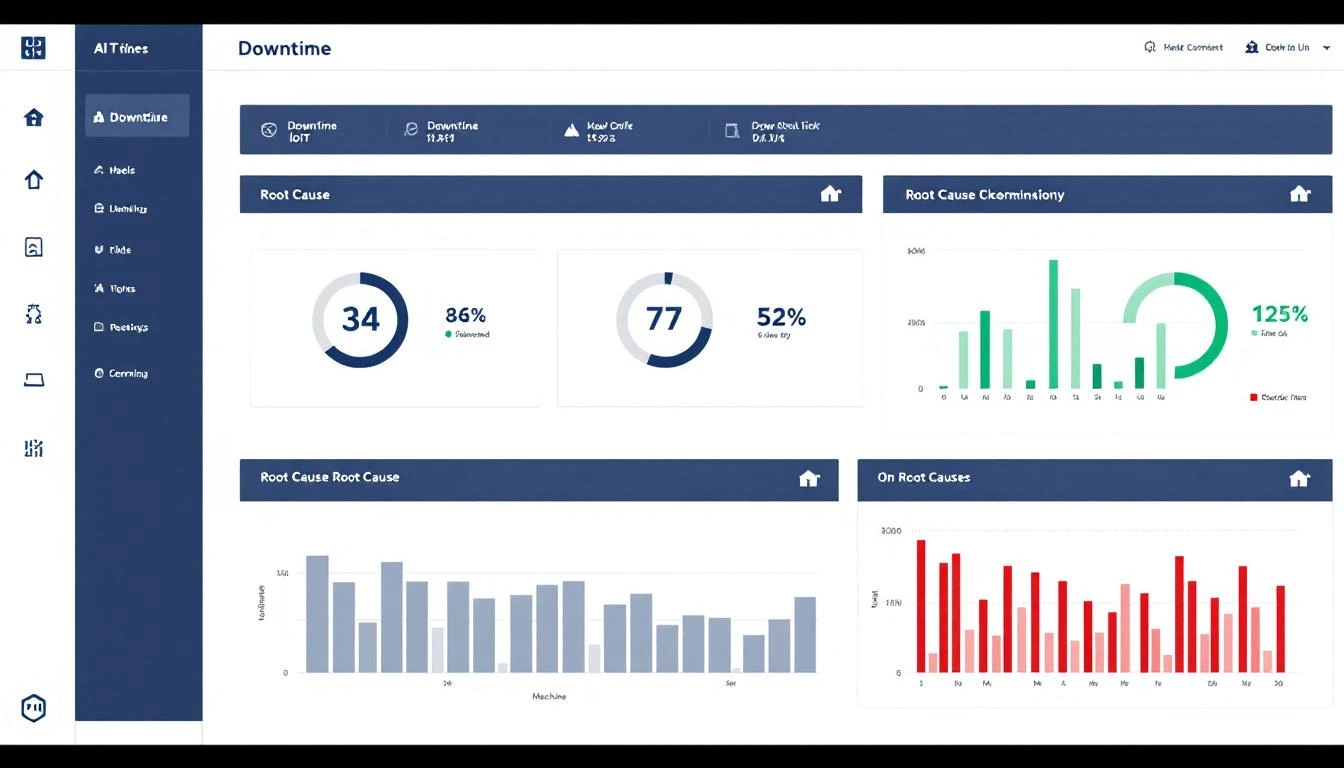
MachineCDN's fleet management module provides exactly this view. The failure analysis dashboard shows spare parts consumption by machine type, failure frequency by equipment category, and downtime patterns across your entire operation. You can drill from a fleet-wide Pareto chart down to a specific machine's alarm history in three clicks.
IoTFlows provides production tracking and shift-based reporting, which covers some of this territory. But because its data collection is limited to what the SenseAi sensors can measure, the failure analysis picture is inherently narrower — focused on mechanical degradation rather than the full spectrum of reasons machines stop.
Setup Speed and Total Cost of Downtime Tracking
Here's where the practical differences become financially significant.
IoTFlows setup requires:
- Ordering SenseAi sensors for each machine you want to monitor
- Physically mounting sensors on equipment (drilling, adhesive, or magnetic mounting)
- Powering sensors (battery or wired)
- Configuring wireless connectivity for each sensor
- Calibrating baseline vibration/acoustic profiles per machine
- Validating sensor placement and signal quality
For a 50-machine plant, this is a multi-week installation project that requires maintenance team involvement and potentially brief machine shutdowns for sensor mounting.
MachineCDN setup requires:
- Connecting an edge gateway to the same network switch as your PLCs
- Configuring which PLC tags to read (alarm states, running status, operating parameters)
- Defining your downtime categories and reason codes
The edge gateway uses cellular connectivity, so it doesn't require any involvement from your IT department or any changes to your plant network. MachineCDN advertises a 3-minute device setup — and from an engineering perspective, that's accurate because you're configuring a network connection to an existing data source, not deploying new measurement hardware.
Total time to first downtime analysis data: IoTFlows requires days to weeks of sensor installation plus baseline learning. MachineCDN delivers data within minutes of gateway connection because the PLCs already have the data — you're just reading it.
Which Platform Should You Choose?
Choose IoTFlows if:
- Your primary concern is mechanical degradation in rotating equipment (motors, pumps, fans, compressors)
- You want vibration-based condition monitoring as your main predictive maintenance approach
- Your machines don't have modern PLCs with accessible communication protocols
- You're monitoring legacy equipment with no digital controls
Choose MachineCDN if:
- You need complete downtime root cause analysis across all failure modes (not just mechanical)
- You operate diverse equipment types (CNC, injection molding, stamping, packaging, assembly)
- Your machines have PLCs and you want to leverage the data they already collect
- You need fleet-wide failure analysis across multiple machines, lines, or locations
- You want downtime tracking operational in days, not weeks
- Zero IT involvement is important (cellular connectivity bypasses plant networks)
- You need integrated materials tracking and spare parts management alongside downtime data
The Bottom Line
Both platforms reduce downtime — IoTFlows claims 35% average reduction, and MachineCDN customers routinely see similar or better results within 5 weeks of deployment.
The difference is in what kind of downtime each platform catches. IoTFlows excels at detecting mechanical degradation before it causes a failure. MachineCDN captures every reason a machine stops — mechanical, electrical, process-related, material-related, or operator-related — and gives your team the categorization tools to drive systematic improvement.
For most discrete manufacturers, the PLC already knows why the machine stopped. The question is whether your IIoT platform is reading that data — or trying to infer it from the outside.
Ready to see your actual downtime data? Book a demo and we'll show you what your PLCs already know.