Top 8 MachineMetrics Alternatives for Manufacturing in 2026

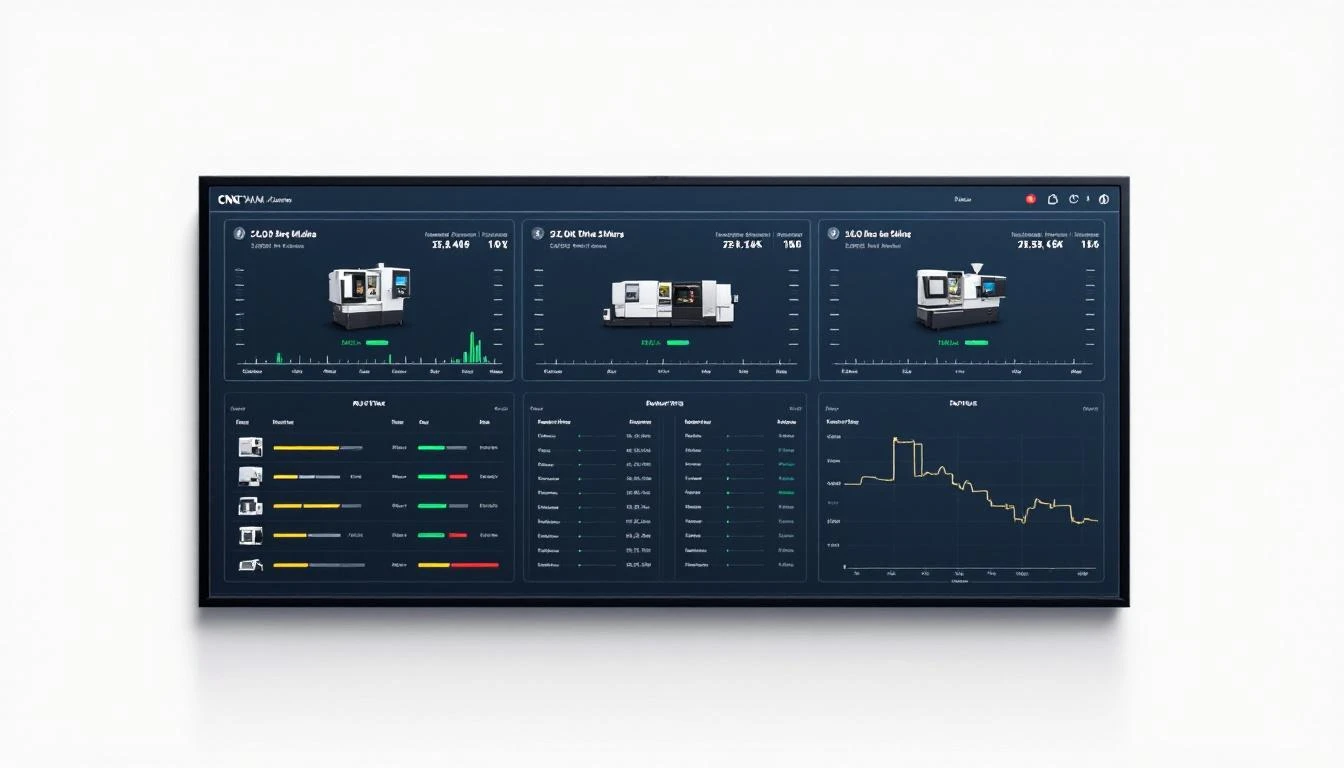
MachineMetrics has built a solid reputation in CNC machine monitoring. If you're running a job shop full of Haas, Mazak, and DMG MORI mills, their platform delivers real-time visibility into spindle utilization, cycle times, and part counts.
But MachineMetrics has limitations that become obvious as your monitoring needs expand. Their strength — deep CNC integration via MTConnect and FANUC FOCAS — is also their constraint. If you need to monitor injection molding machines, packaging lines, compressors, furnaces, or any non-CNC equipment, you'll quickly hit the edges of what MachineMetrics can do.
Here are 8 alternatives worth evaluating in 2026, ranked by how well they solve the problems MachineMetrics doesn't.
Why Manufacturers Look Beyond MachineMetrics
Before diving into alternatives, let's be specific about where MachineMetrics falls short for certain use cases:
- CNC-centric: Deep integration with CNC controllers, but limited coverage for non-CNC equipment (presses, ovens, packaging, assembly)
- Protocol limitations: Strong on MTConnect and FOCAS, but weaker on Ethernet/IP and Modbus — the protocols most non-CNC industrial equipment speaks
- Pricing: Per-machine pricing that gets expensive quickly when you want full factory coverage
- Edge computing: Cloud-first architecture that requires solid internet connectivity
- Setup complexity: While easier than legacy SCADA, still requires networking configuration and IT involvement
If any of these resonate, here are your options.
1. MachineCDN — Best for Full-Factory Monitoring with Zero IT Overhead
Best for: Manufacturers who need to monitor ALL equipment types — not just CNC machines
MachineCDN takes a fundamentally different approach from MachineMetrics. Instead of building deep integrations with specific controller brands, MachineCDN connects directly to any PLC using standard industrial protocols — Ethernet/IP and Modbus (TCP and RTU).
What makes it different:
- 3-minute device setup — plug in an edge gateway, configure tags, and you're reading live data
- Zero IT involvement — cellular connectivity bypasses your plant network entirely
- 5-week ROI — not a marketing claim, a measurable deployment timeline
- Full maintenance suite — preventive maintenance scheduling, spare parts tracking, alarm management, materials and inventory
- Multi-plant fleet management — see every machine across every location on one dashboard
- AI-powered predictive maintenance — not just monitoring, actually predicting failures
Where it wins over MachineMetrics: MachineMetrics monitors your CNC machines. MachineCDN monitors your CNC machines AND your presses, conveyors, compressors, ovens, packaging lines, and everything else with a PLC. One platform, one edge device, complete factory visibility.
Pricing: Transparent, per-device pricing without mandatory hardware purchases. Book a demo to see specific numbers.
2. Samsara — Best for Combined Fleet + Factory Monitoring
Best for: Companies that need to monitor both mobile assets (trucks, vehicles) AND factory equipment
Samsara started in fleet management and expanded into industrial monitoring. Their strength is breadth — they offer IoT sensors for temperature, humidity, door open/close, and basic machine monitoring alongside their GPS tracking platform.
Strengths:
- Unified platform for fleet and factory
- Good sensor catalog for environmental monitoring
- Strong mobile app experience
- Established brand with extensive support
Weaknesses vs. MachineMetrics:
- Less depth in machine-level analytics (no CNC-specific features)
- Sensor-based approach means per-point hardware costs
- Limited PLC integration
- OEE calculations are basic compared to dedicated platforms
- Pricing can escalate quickly with large sensor deployments
Pricing: Per-sensor/per-device subscriptions. Expect $30–$50/month per sensor point.
3. Litmus Edge — Best for Edge-First Data Integration
Best for: Plants that need an edge data layer to feed multiple upstream systems (historians, data lakes, BI tools)
Litmus positions itself as the edge computing layer for manufacturing. Rather than being a full application platform, Litmus Edge acts as a data broker — collecting data from multiple protocols and routing it to wherever it needs to go.
Strengths:
- Broad protocol support (250+ industrial drivers)
- Strong edge computing capabilities
- Good integration with cloud platforms (AWS, Azure, Google Cloud)
- Gartner-recognized in IIoT platforms
Weaknesses:
- Not a complete application — you still need analytics, dashboards, and maintenance management on top
- Complex pricing with multiple components (Edge, Edge Manager, marketplace)
- Requires significant IT resources to deploy and maintain
- No built-in maintenance management, inventory tracking, or work order management
Pricing: Enterprise pricing; see our detailed breakdown.
4. Sight Machine — Best for AI-Driven Manufacturing Analytics
Best for: Large enterprises that want AI/ML-driven insights across complex manufacturing processes
Sight Machine focuses on using machine learning to find patterns in manufacturing data that humans miss. Their "Manufacturing Data Platform" ingests data from multiple sources and applies AI models to identify quality issues, process deviations, and optimization opportunities.
Strengths:
- Advanced AI/ML capabilities for process optimization
- Strong data model for manufacturing (their "digital twin" approach)
- Good for complex, multi-variable processes (chemicals, pharma, automotive)
- Enterprise-grade security and compliance
Weaknesses:
- Enterprise-only pricing ($200K+ annual contracts are common)
- Long deployment timelines (3–6 months typical)
- Requires data science resources to get full value
- Overkill for straightforward monitoring and maintenance use cases
- Limited out-of-the-box maintenance management features
Pricing: Enterprise custom quotes only. Budget $200K–$500K+/year.
5. Tulip — Best for Frontline Operations and Digital Work Instructions
Best for: Manufacturers focused on human-machine interaction, quality workflows, and digital work instructions
Tulip comes at manufacturing from a different angle — they started with digital work instructions and expanded into machine monitoring. Their strength is connecting human processes with machine data.
Strengths:
- Excellent digital work instruction builder (no-code)
- Good for quality management and compliance workflows
- Easy to prototype and iterate on production apps
- IoT gateway for basic machine connectivity
- Strong community and app library
Weaknesses:
- Machine monitoring is secondary to their work instruction platform
- Limited predictive maintenance capabilities
- Edge data collection is basic compared to dedicated IIoT platforms
- OEE and downtime tracking are functional but not as deep as purpose-built solutions
- Not designed for large-scale fleet management across multiple plants
Pricing: Per-operator pricing starting around $500/month for basic plans. Enterprise pricing varies.
6. UpKeep — Best for CMMS-First Organizations
Best for: Maintenance teams that need work order management first, with some machine monitoring
UpKeep is fundamentally a CMMS (Computerized Maintenance Management System) with IoT add-ons. If your primary need is managing work orders, tracking maintenance history, and organizing spare parts, UpKeep delivers.
Strengths:
- Strong mobile-first CMMS platform
- Good work order management and asset tracking
- Inventory and spare parts management
- QR code-based asset identification
- Sensor integrations for basic condition monitoring
Weaknesses:
- Machine monitoring is an add-on, not core competency
- Limited real-time data collection from PLCs and controllers
- Basic analytics compared to dedicated IIoT platforms
- No protocol-native connectivity (Ethernet/IP, Modbus)
- OEE calculations require manual data entry or basic sensor inputs
- Can't replace MachineMetrics for CNC-specific monitoring
Pricing: Starts at $45/user/month for basic CMMS. IoT add-ons are additional.
7. PTC ThingWorx — Best for Enterprise IoT Development
Best for: Large enterprises with development teams that want to build custom IIoT applications
PTC ThingWorx is an IoT application development platform — not a finished product. It provides the building blocks (connectivity, data modeling, analytics, visualization) for building custom manufacturing applications.
Strengths:
- Extremely flexible — build anything you need
- Strong augmented reality integration (via PTC's Vuforia)
- Good Kepware integration for industrial protocol connectivity
- Enterprise-grade security and scalability
- Part of PTC's broader PLM/CAD ecosystem
Weaknesses:
- You're building a custom application, not deploying one
- Requires significant development resources (Java developers)
- Expensive: $50K+ in platform licensing before development costs
- 6–12+ month deployment timelines
- Ongoing maintenance of custom applications
- No built-in maintenance management or standard manufacturing workflows
Pricing: Platform licensing starts at $50K+/year. Total project costs including development commonly reach $200K–$500K+.
8. Ignition (Inductive Automation) — Best for SCADA Replacement
Best for: Plants replacing legacy SCADA systems that want a modern, licensable platform
Ignition is the modern SCADA platform that's captured significant market share from legacy players like Wonderware and FactoryTalk. Its unlimited licensing model (pay per server, not per client/tag) makes it economically attractive for large installations.
Strengths:
- Unlimited tags, clients, and connections per server license
- Powerful HMI/SCADA designer
- Strong OPC UA support
- Active community and marketplace (Exchange)
- One-time licensing plus annual maintenance (not SaaS)
- Runs on-premises with full data ownership
Weaknesses:
- Requires significant configuration and development
- SCADA-first, not IIoT-first — cloud connectivity is possible but not native
- Needs IT infrastructure (servers, networking, databases)
- No built-in AI/ML for predictive maintenance
- Deployment timeline: weeks to months
- You're building dashboards, not getting them out of the box
Pricing: ~$32,000 for standard license + $5,500/year maintenance. Development and integration costs are additional.
How to Choose: Decision Framework
The right MachineMetrics alternative depends on your primary use case:
| If your priority is... | Consider... |
|---|---|
| Full factory monitoring (all equipment types) | MachineCDN |
| Combined fleet + factory | Samsara |
| Edge data integration layer | Litmus Edge |
| AI-driven process optimization | Sight Machine |
| Digital work instructions + monitoring | Tulip |
| CMMS with IoT add-ons | UpKeep |
| Custom IIoT application development | PTC ThingWorx |
| SCADA replacement | Ignition |
The Protocol-Native Advantage
The biggest limitation shared by sensor-based platforms (Augury, Samsara, MachineMetrics with external sensors) is that they require dedicated hardware on every machine. This means:
- Higher upfront costs per machine
- Longer deployment timelines
- Limited data points (you only get what the sensor measures)
- Coverage gaps on equipment that doesn't fit the sensor model
Protocol-native platforms like MachineCDN connect to the controllers you already have. Your PLC is already reading dozens or hundreds of tags — temperature, pressure, vibration, cycle times, motor current, position. A protocol-native platform reads ALL of that data without adding a single sensor.
The result: Complete factory visibility in days, not months. At a fraction of the cost. With zero IT involvement thanks to cellular connectivity.
Making the Switch
If you're currently on MachineMetrics and considering a switch, here's a practical migration path:
- Audit your equipment: List every machine, its controller type, and available protocols
- Identify coverage gaps: Which machines can MachineMetrics NOT monitor today?
- Calculate total cost: Include hardware, software, and the cost of monitoring gaps
- Run a parallel pilot: Deploy an alternative on your non-CNC equipment first
- Compare TCO: Full-factory monitoring cost vs. CNC-only monitoring cost
Most manufacturers find that a protocol-native platform can monitor their ENTIRE factory for less than what they're paying to monitor just their CNC machines.
Ready to see what complete factory monitoring looks like? Book a demo with MachineCDN — we'll show you how to connect every machine on your floor in minutes, not months.