Planned Production Time vs Actual: How IIoT Closes the Capacity Gap in Manufacturing

Every production manager has been asked the same question by their VP of Operations: "How much more capacity do we have?" And every production manager has given the same answer with varying degrees of confidence: "We think we have about 15-20% more capacity, but it depends."
It depends on downtime. It depends on changeovers. It depends on which products are running. It depends on whether the Tuesday night shift actually gets 7.5 hours of production out of their 8-hour shift or whether they lose 90 minutes to startup, cleanup, and that recurring alarm on Press 4.
The gap between planned production time and actual productive time is the single largest source of hidden capacity in manufacturing. According to a study by the Aberdeen Group, the average manufacturer operates at 65-72% capacity utilization — meaning 28-35% of available production time is consumed by downtime, changeovers, slow cycles, and other losses that are rarely measured accurately.
IIoT platforms close this gap by measuring exactly what happens during every minute of planned production time. Not what is supposed to happen. Not what operators report happened. What actually happened, based on real-time machine data.
Understanding the Capacity Gap
The capacity gap is the difference between the time your machines are supposed to be producing and the time they are actually producing good parts at full speed. It sounds simple, but it is one of the most poorly understood metrics in manufacturing because it is composed of multiple layers of losses, each of which is invisible without granular data.
The Six Losses That Create the Gap
The Total Productive Maintenance (TPM) framework identifies six major losses that erode planned production time:
1. Equipment Breakdowns (Unplanned Downtime) The most visible loss. A machine stops running due to a fault, and production halts until it is repaired. Most manufacturers track this — but often inaccurately, relying on operator logs that undercount short stoppages and overcount repair times.
2. Setup and Changeovers (Planned Downtime) The time to switch from one product or tool to another. Often accepted as fixed — "changeovers take 45 minutes" — but in reality, changeover times vary enormously. Without measurement, there is no baseline and no improvement.
3. Minor Stoppages (Micro-Stoppages) Brief interruptions — 30 seconds to 5 minutes — caused by jams, misfeeds, sensor trips, or material issues. Individually trivial, collectively devastating. A machine that micro-stops for 2 minutes every 20 minutes loses 48 minutes per shift, but operators rarely log these because each one feels insignificant.
4. Reduced Speed The machine is running, but slower than its design speed. Maybe it was slowed down after a maintenance issue and never returned to full speed. Maybe the operator reduced speed to improve quality. Maybe nobody remembers what full speed is. Without a baseline measurement, reduced speed losses are invisible.
5. Startup Rejects Defective parts produced during startup, warmup, or after a changeover. These are expected but often unmeasured. How many startup rejects is normal? Without data, the answer is whatever feels right.
6. Production Rejects Defective parts produced during stable running. Quality systems catch these, but linking them to specific production conditions — machine temperature, cycle time variation, raw material lot — requires real-time process data that most manufacturers do not capture.
Why Manual Tracking Fails
Most manufacturers attempt to track these losses manually — operator log sheets, shift reports, end-of-day summaries. Manual tracking fails for three predictable reasons:
Time granularity. Operators log events in 5-15 minute increments at best. A 2-minute micro-stoppage does not get recorded. A 7-minute changeover gets rounded to 10. Over a shift, these rounding errors compound into 30-60 minutes of unmeasured time.
Human bias. Operators underreport their own downtime (not maliciously — they genuinely do not notice some stoppages) and overreport downtime that was not their fault (material shortages, upstream delays). The data reflects perception, not reality.
Delayed recording. Operators fill in log sheets at the end of the shift, reconstructing what happened from memory. Events get merged, timings get estimated, and root causes get simplified. The result is a narrative, not data.
How IIoT Captures Actual Production Time
IIoT platforms solve the measurement problem by reading data directly from the machine — cycle counts, running/idle status, alarm states, speeds, and temperatures — every few seconds. This creates a continuous, objective record of exactly what happened during every shift.
Real-Time Machine Status
At the most basic level, an IIoT platform knows whether each machine is:
- Running — producing parts at speed
- Idle — powered on but not producing (waiting for material, operator, or instructions)
- In Alarm — stopped due to a fault condition
- In Setup — being changed over or adjusted
This four-state view, updated every few seconds, creates a complete timeline of every shift. You can see exactly when Machine 12 stopped, how long it was idle before someone addressed it, how long the repair took, and when it returned to production.
Automatic Loss Categorization
Modern IIoT platforms automatically categorize losses based on duration and machine state:
- Stoppages under 5 minutes → categorized as micro-stoppages
- Stoppages over 5 minutes → categorized as breakdowns (requiring reason code assignment)
- Speed below target → categorized as reduced speed loss
- Time between jobs → categorized as changeover time
This automatic categorization eliminates the manual effort of logging losses and ensures that every minute of lost production time is captured — including the micro-stoppages that manual systems miss.
Planned Production Time Tracking
To calculate capacity utilization accurately, you need to know both what happened (actual) and what was planned. IIoT platforms with production planning features track:
- Scheduled production hours — when was this machine supposed to be running?
- Planned downtime — scheduled maintenance, planned changeovers, shift breaks
- Planned production rate — how many parts per hour should this machine produce?
By comparing planned versus actual across every dimension — time, speed, quality — the platform calculates true capacity utilization with accuracy that manual systems cannot approach.
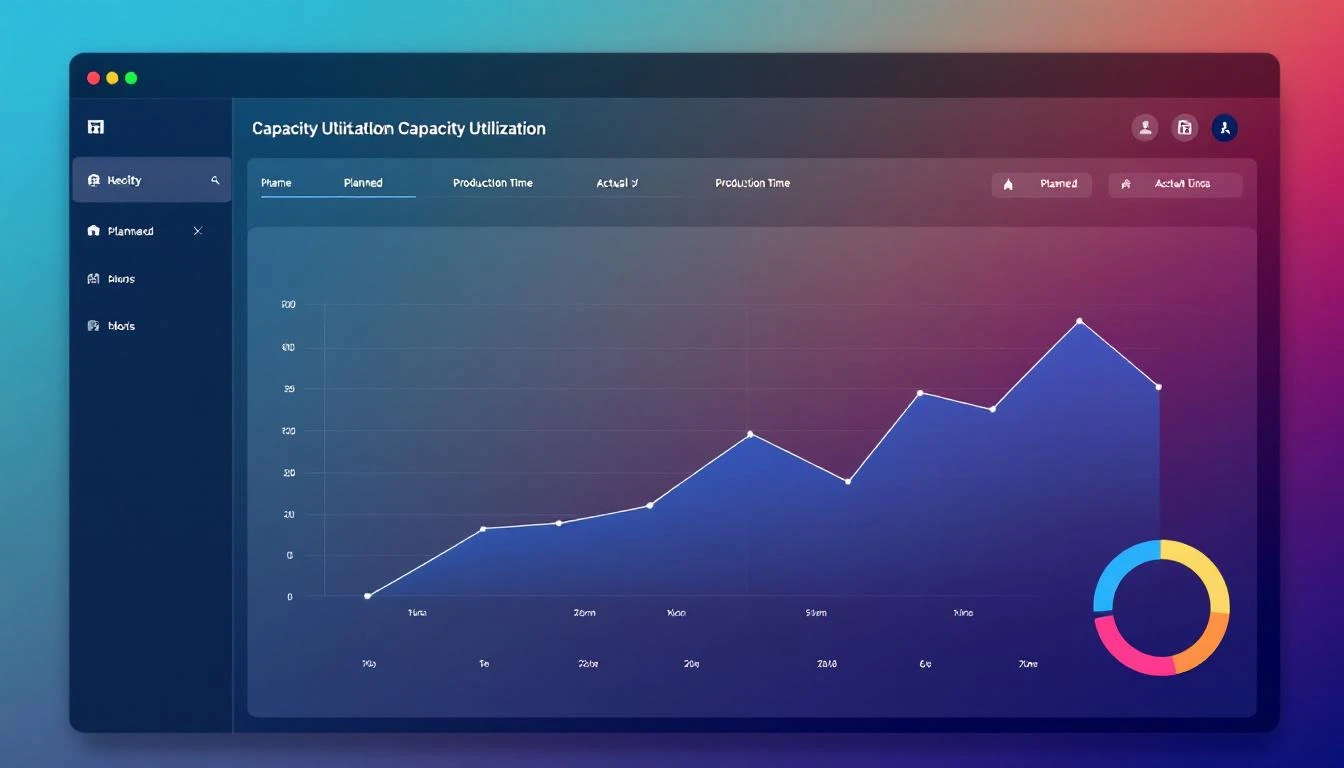
Capacity Utilization Views That Drive Action
Raw data is not useful. Capacity utilization data becomes actionable when it is organized into views that different roles in the organization can act on:
For Production Supervisors: Shift Comparison
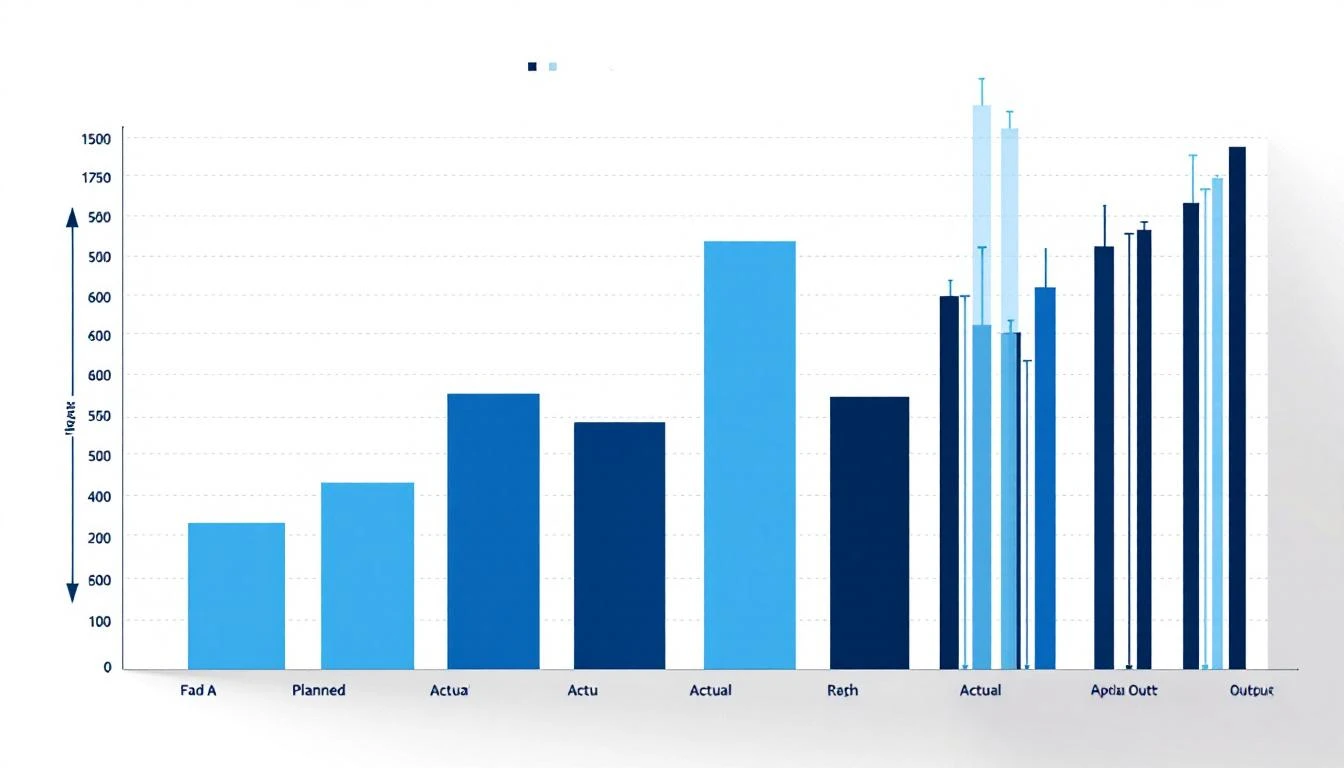
Side-by-side comparison of planned versus actual production time for each shift:
- First shift planned 7.5 hours, achieved 6.8 hours (90.7% utilization)
- Second shift planned 7.5 hours, achieved 5.9 hours (78.7% utilization)
- Third shift planned 7.5 hours, achieved 6.2 hours (82.7% utilization)
The 12-point gap between first and second shift immediately triggers a question: what is happening on second shift that is not happening on first? The data shows three micro-stoppages per hour on second shift versus one on first shift, pointing to a material handling issue during the second shift material changeover.
For Maintenance Managers: Equipment Availability Overview
Availability by machine across a time period — which machines are meeting their uptime targets and which are dragging down plant capacity:
- Press 1: 96% availability (target 95%) ✅
- Press 2: 91% availability (target 95%) ❌ — recurring hydraulic alarm
- Press 3: 94% availability (target 95%) ⚠️ — approaching target
- Press 4: 87% availability (target 95%) ❌ — bearing replacement overdue
The equipment availability overview turns abstract downtime into specific machines with specific problems. Press 4's bearing replacement has been deferred three times — each deferral costing 8% of that machine's capacity.
For Plant Managers: Daily Capacity Utilization
A single metric that captures the plant's actual output versus its theoretical maximum:
- Monday: 82% capacity utilization
- Tuesday: 79% capacity utilization (unplanned maintenance on CNC 3)
- Wednesday: 84% capacity utilization
- Thursday: 76% capacity utilization (material shortage + changeover delays)
- Friday: 81% capacity utilization
The weekly trend reveals that Thursday is consistently the lowest-utilization day. Investigation shows that Thursday is when most material changeovers occur, and the changeover process takes 35% longer than planned because raw material staging is not completed before the changeover window.
For Executives: Monthly Capacity Trend
A rolling 12-month view of capacity utilization shows whether the plant is improving, stable, or declining:
- Q4 2025: 74% average capacity utilization
- Q1 2026: 78% average capacity utilization
- Q2 2026: 81% average capacity utilization (after IIoT-driven improvements)
Each percentage point of capacity utilization improvement, for a plant running 00K/month in throughput value, is worth ,000-0,000 per month in additional output — without adding a single machine, a single shift, or a single employee.
Closing the Gap: Practical Steps
Once you can see the capacity gap accurately, closing it follows a systematic process:
Step 1: Establish Baselines
Before trying to improve anything, measure for 2-4 weeks without making changes. Understand your actual utilization, your real downtime patterns, and your true micro-stoppage frequency. The baseline will almost certainly be worse than you expected — that is normal and is the whole point of measuring.
Step 2: Attack the Biggest Loss Category
The Pareto principle applies aggressively here. In most plants, one loss category accounts for 40-60% of the total capacity gap. Attack that one first:
- If breakdowns dominate → focus on predictive maintenance and spare parts availability
- If changeovers dominate → apply SMED (Single-Minute Exchange of Die) principles
- If micro-stoppages dominate → investigate root causes by machine and shift
- If speed losses dominate → review whether speed reductions are still justified
Step 3: Use Threshold Alerts for Drift Detection
Configure your IIoT platform to alert when capacity utilization drops below target:
- Machine-level alert: utilization below 80% for more than 2 hours
- Zone-level alert: zone utilization below 85% during planned production
- Plant-level alert: overall utilization below 75%
These alerts catch capacity degradation in real time, rather than discovering it in a weekly report when the production window has already been lost.
Step 4: Review and Repeat
Capacity improvement is iterative. Each round of improvements shifts the Pareto — the biggest loss category changes as you fix problems. Continue measuring, identifying the new biggest loss, and applying targeted improvements.
The Revenue Impact of 5% More Capacity
To put concrete numbers on the capacity gap: a plant with 50 machines running two shifts at 75% utilization that improves to 80% utilization gains the equivalent of:
- 4 additional machine-hours per machine per day (across 50 machines = 200 machine-hours)
- At 00/hour throughput value = 0,000 per day in additional output capacity
- Annually = roughly million in capacity that was always there but invisible
This capacity does not require new equipment, new employees, or overtime. It already exists — it is just being consumed by losses that were previously unmeasured.
Bottom Line
The gap between planned and actual production time is the largest untapped capacity reserve in most manufacturing plants. Manual tracking methods miss 20-40% of actual losses, creating a false picture of capacity that leads to premature capital expenditure, unnecessary overtime, and missed delivery dates.
IIoT monitoring captures every minute of production time objectively — breakdowns, micro-stoppages, speed losses, changeover delays — and organizes it into views that supervisors, maintenance managers, and executives can act on. The result is not just better data, but better decisions about where to invest time and resources to unlock capacity that is already on your factory floor.
Book a demo to see how MachineCDN tracks capacity utilization, equipment availability, and planned versus actual production time — giving you the data to find and reclaim your hidden capacity.