IoTFlows Pricing vs MachineCDN Pricing: Total Cost of Ownership for Manufacturing IIoT

Choosing an IIoT platform isn't just about monthly subscription fees. The real cost includes hardware, installation, network infrastructure, ongoing maintenance, and the time your team spends managing the system. When manufacturing engineers compare IoTFlows pricing against MachineCDN pricing, the total cost of ownership (TCO) picture tells a very different story than sticker price alone.
The Hidden Cost Problem in Manufacturing IIoT
Most IIoT vendors advertise a clean monthly fee. But manufacturing leaders who've deployed these systems know the real cost breakdown looks something like this:
- Hardware costs: Sensors, gateways, edge devices
- Installation labor: Electricians, integrators, production downtime
- Network infrastructure: Wi-Fi upgrades, ethernet runs, cellular modems
- Software subscription: The actual platform fee
- Ongoing maintenance: Sensor battery replacements, calibrations, firmware updates
- IT overhead: Security reviews, network management, firewall rules
According to a 2024 IoT Analytics report, hardware and installation represent 40-60% of total IIoT project costs in manufacturing — yet most vendor pricing pages only show the software subscription.
IoTFlows Pricing: What to Expect
IoTFlows takes a hardware-plus-software approach. Their pricing model typically includes:
Hardware Costs
IoTFlows requires their proprietary SenseAi sensors for machine monitoring. These vibration and acoustic sensors are purpose-built devices that attach to your equipment. While IoTFlows doesn't publish exact pricing on their website (you'll need to request a quote), the typical cost structure for sensor-based systems includes:
- Per-sensor hardware: Industrial-grade vibration sensors typically range from $200-$800 per unit depending on capability and IP rating
- Gateways: Each monitoring zone needs a gateway to aggregate sensor data — typically $500-$1,500 per gateway
- IP67-rated sensors (SenseAi Embedded): Higher-cost option for harsh environments
For a typical 20-machine deployment, you're looking at multiple sensors per machine (vibration, temperature, acoustics) plus gateways for each production area.
Software Subscription
IoTFlows offers cloud-based analytics including OEE monitoring, AI job scheduling, and machine health scoring. Their subscription fees cover:
- Cloud data storage and processing
- AI-powered health scoring (7 metrics: cavitation, looseness, imbalance, lubrication, alignment, bearing, temperature)
- Dashboard access and reporting
- Downtime root cause analysis tools
Installation and Integration
Sensor-based systems require physical installation on every machine:
- Mounting sensors in the correct positions for accurate vibration/acoustic readings
- Running power and/or replacing batteries
- Configuring wireless connectivity for each sensor
- Calibrating baseline readings per machine
For a mid-size plant, installation typically takes 1-3 weeks with specialized technicians.
MachineCDN Pricing: A Different Model
MachineCDN takes a fundamentally different approach that changes the entire cost equation. Instead of adding new sensors to your machines, MachineCDN connects directly to the PLCs and controllers already running your equipment.
No Proprietary Hardware
Your PLCs are already collecting the data. Temperature, pressure, cycle times, motor current, vibration (if your PLC has those inputs) — it's all there. MachineCDN reads this data using standard industrial protocols that your equipment already speaks.
This eliminates:
- Sensor hardware costs: $0 (your PLC inputs are the sensors)
- Battery replacements: $0 (PLCs are already powered)
- Sensor calibration: $0 (PLC inputs are already calibrated for process control)
Edge Gateway
MachineCDN uses a compact industrial router as the edge device. One device per network segment typically covers all PLCs in that area. The cost is a fraction of sensor deployments — and the device handles all communication to the cloud.
Software Platform
The MachineCDN subscription covers the full platform:
- Real-time machine monitoring and dashboards
- Predictive maintenance with AI-powered analytics
- OEE and capacity utilization tracking
- Fleet management across all locations
- Materials and inventory management
- Spare parts tracking and PM scheduling
- Custom report builder
- Threshold alerting (active and approaching)
- Energy consumption monitoring
Installation
This is where the cost difference becomes dramatic. MachineCDN's 3-minute device setup means:
- Plug the edge device into your plant network (or use cellular — no IT involvement needed)
- The system auto-detects connected PLCs
- Configure which data points you want to monitor
- Done
No mounting sensors. No running cables. No sensor calibration. No production downtime for installation.
Total Cost of Ownership: 20-Machine Deployment
Let's model a realistic 20-machine deployment over 3 years:
IoTFlows (Estimated TCO)
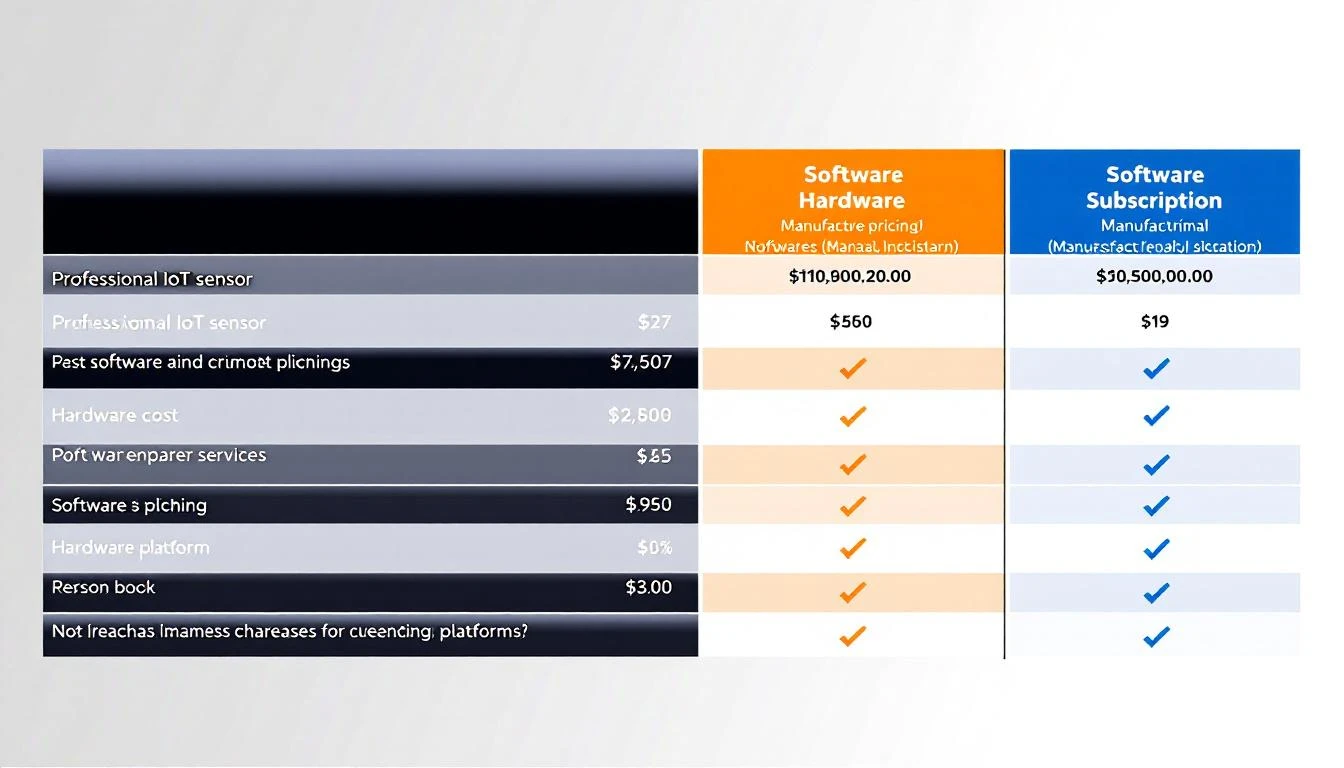
| Cost Category | Year 1 | Year 2 | Year 3 |
|---|---|---|---|
| Sensors (3 per machine × 20) | $12,000-$48,000 | $0 | $0 |
| Gateways (4 zones) | $2,000-$6,000 | $0 | $0 |
| Installation labor | $5,000-$15,000 | $0 | $0 |
| Software subscription | $12,000-$36,000 | $12,000-$36,000 | $12,000-$36,000 |
| Sensor maintenance/batteries | $1,000-$3,000 | $1,000-$3,000 | $1,000-$3,000 |
| Wi-Fi infrastructure upgrades | $2,000-$8,000 | $0 | $0 |
| Subtotal | $34,000-$116,000 | $13,000-$39,000 | $13,000-$39,000 |
| 3-Year TCO | $60,000-$194,000 |
MachineCDN (Estimated TCO)
| Cost Category | Year 1 | Year 2 | Year 3 |
|---|---|---|---|
| Edge devices (2-4 units) | $1,000-$3,000 | $0 | $0 |
| Installation labor | $500-$1,500 | $0 | $0 |
| Software subscription | $12,000-$36,000 | $12,000-$36,000 | $12,000-$36,000 |
| Hardware maintenance | $0-$200 | $0-$200 | $0-$200 |
| Network costs (cellular) | $600-$1,200 | $600-$1,200 | $600-$1,200 |
| Subtotal | $14,100-$41,900 | $12,600-$37,400 | $12,600-$37,400 |
| 3-Year TCO | $39,300-$116,700 |
The difference: MachineCDN's protocol-native approach can save 30-50% on total cost of ownership, primarily by eliminating hardware procurement, installation labor, and ongoing sensor maintenance.
Where IoTFlows Makes Sense
IoTFlows has advantages in specific scenarios:
- Equipment without PLCs: If your machines are purely mechanical with no controllers, you need external sensors. IoTFlows' SenseAi sensors fill this gap.
- Vibration-specific monitoring: IoTFlows specializes in vibration and acoustic analysis with dedicated AI models. If vibration is your primary concern and your PLCs don't have vibration inputs, their approach adds genuine value.
- Brownfield with legacy equipment: Very old machines that predate PLC control may need sensor-based monitoring.
Where MachineCDN Wins on Cost
MachineCDN's cost advantages are strongest when:
- Your machines already have PLCs (most modern manufacturing equipment does)
- You want comprehensive monitoring beyond vibration — including materials tracking, energy, spare parts, and fleet management
- You have multiple plants — the fleet management cost scales better with protocol-native connectivity
- IT involvement is a bottleneck — cellular connectivity eliminates network infrastructure costs entirely
- Speed matters — 3-minute setup vs. weeks of sensor installation means faster time to value
The ROI Timeline
MachineCDN's 5-week ROI claim is rooted in the deployment model. When you eliminate weeks of sensor installation and IT coordination, your first data-driven maintenance decision can happen within days of deployment — not months.
IoTFlows claims less than 3 months to ROI, which is still respectable for a sensor-based system. But that timeline includes hardware procurement, physical installation, and baseline calibration before the AI models can start generating insights.
Making the Right Choice
The pricing decision ultimately depends on your plant's infrastructure:
- Audit your PLC coverage. If 80%+ of your critical machines have PLCs, the protocol-native approach saves significant money.
- Calculate total installation time. Every day of installation labor and production disruption has a cost.
- Factor in ongoing maintenance. Sensors need batteries, calibration, and replacement. Protocol-native connections don't.
- Consider scope. If you need materials tracking, spare parts management, and energy monitoring alongside machine health, MachineCDN includes these in one platform.
Get a Real Quote
Ready to see actual pricing for your specific deployment? Book a demo with MachineCDN and get a detailed TCO analysis for your plant configuration — including a side-by-side comparison against your current spend.