Industrial Video Surveillance Meets IIoT: How Smart Cameras and Machine Data Create Complete Factory Visibility

Manufacturing plants have had security cameras for decades. And they've had machine data — PLC readings, SCADA screens, operator logs — for just as long. But these two data streams have lived in completely separate worlds: cameras watched by the security team, machine data watched by maintenance and operations.
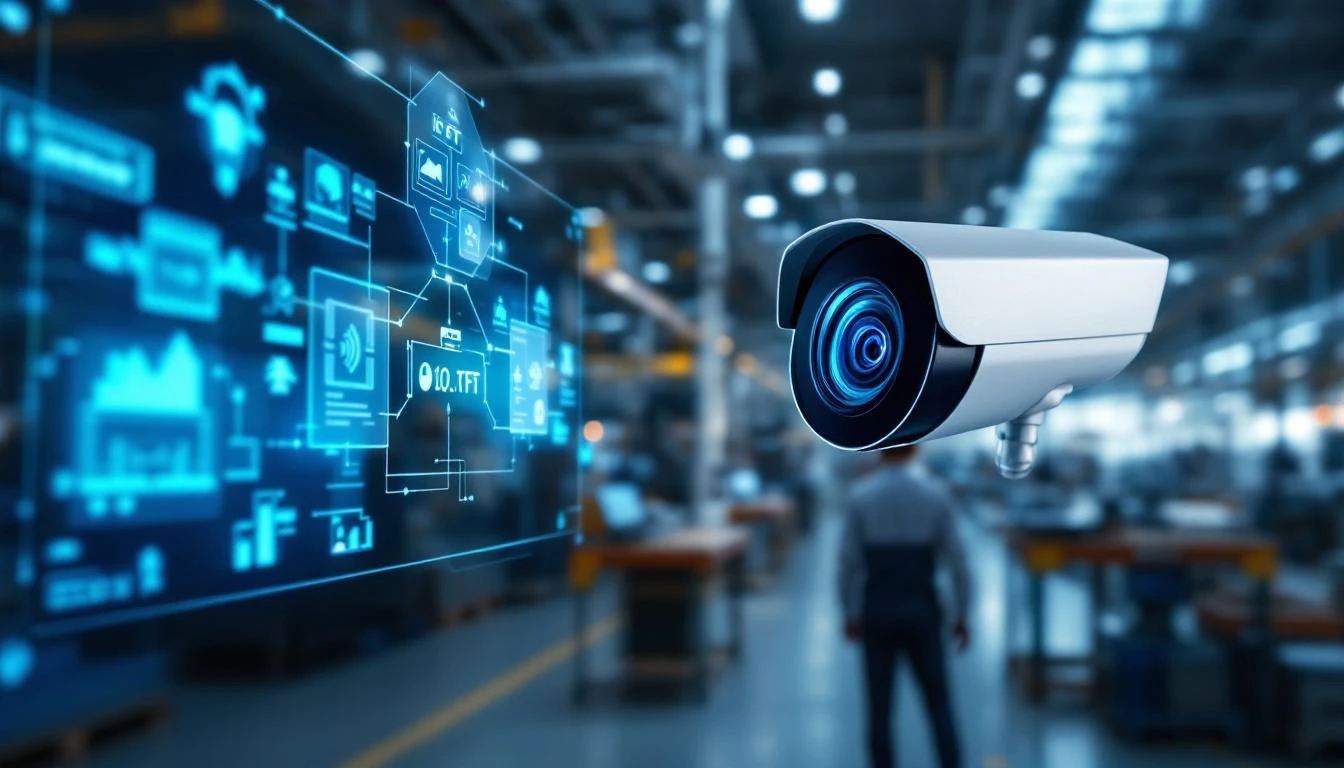
That separation is ending. The convergence of industrial video surveillance and IIoT platforms is creating something neither system could deliver alone: complete factory visibility that connects what happened on the machine with what happened on the floor.
When a press throws an alarm at 2:47 AM, you don't just see the alarm code — you see the camera footage from that exact moment. When quality rejects spike on Line 3, you don't just see the data trend — you see the operator actions (or inactions) that correlated with the defect. This isn't futuristic. It's happening now.
Why Manufacturers Are Merging Video and Machine Data
The business case for integrating video surveillance with IIoT goes beyond security. Here's what manufacturers are using it for:
1. Root Cause Analysis That Actually Works
Traditional root cause analysis relies on data logs and operator interviews. The problem? Operators don't always remember exactly what happened, and data logs don't capture physical context — was the material loaded correctly? Did someone bump the safety guard? Was there a spill on the floor near the sensor?
When you can correlate a machine event timestamp with synchronized video footage, root cause analysis goes from detective work to instant replay. A maintenance engineer reviewing a bearing failure can:
- See the exact moment vibration readings spiked
- Watch the video to see if there was a visible cause (collision, misalignment, material jamming)
- Correlate with production schedule data to identify if the machine was running outside normal parameters
According to McKinsey research, manufacturers using integrated video and sensor data reduce mean time to root cause (MTTRC) by 40-60% compared to data-only analysis.
2. Quality Assurance and Defect Tracing
For manufacturers producing critical components — automotive, aerospace, medical devices — traceability isn't optional. When a defective part is discovered, you need to answer:
- What machine produced it?
- What were the operating conditions at that moment?
- Who was the operator?
- What happened immediately before the defect?
Integrating video with IIoT data creates an auditable timeline for every part produced. Camera footage becomes part of the quality record, timestamped and synchronized with machine parameters. When a customer reports a defective batch, you can reconstruct exactly what happened during production.
3. Safety and Compliance
OSHA reports that manufacturing accounts for the second-highest number of workplace injuries in the US. Video surveillance combined with IIoT data can:
- Detect unsafe conditions — cameras with AI can identify PPE violations, zone intrusions, or unsafe operator behavior
- Correlate injuries with machine events — if someone gets hurt near a machine, you instantly know what the machine was doing at that moment
- Automate compliance documentation — video evidence of safety procedures being followed (or not) becomes part of your compliance record
- Trigger machine stops — advanced systems can shut down equipment when a person enters a danger zone during operation
4. Productivity and Operator Behavior
This one is sensitive but important. Video data correlated with machine utilization reveals patterns that production managers can't see from spreadsheets alone:
- Why does Machine 5 consistently underperform during second shift?
- What's different about the top-producing operator's technique?
- Where are the bottlenecks in material flow between stations?
- Are changeovers actually taking 20 minutes, or 45?
The goal isn't surveillance in the Big Brother sense — it's understanding why some shifts, lines, and operators consistently outperform others, and using that knowledge to level up the whole team.
Architecture: How Video + IIoT Integration Works
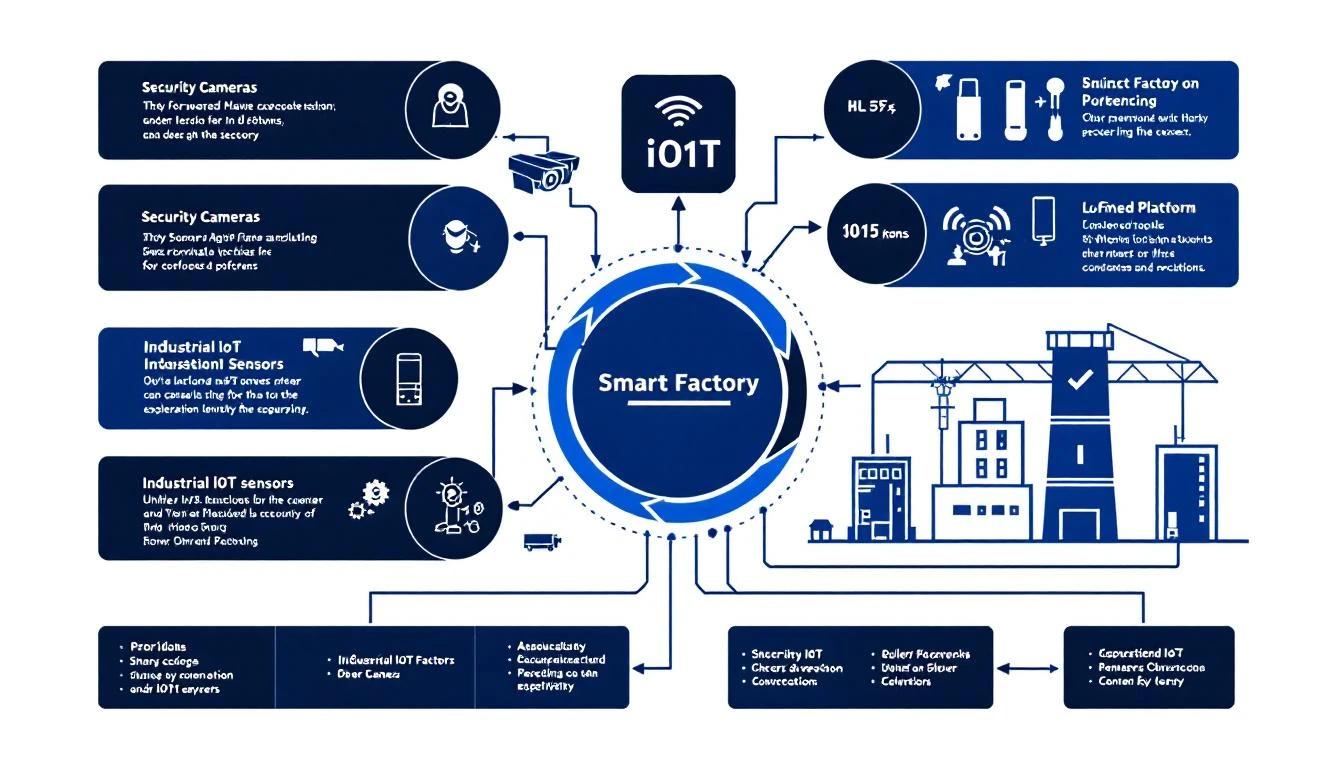
There are three common architectures for merging video surveillance with industrial IoT:
Architecture 1: Timestamp Correlation (Basic)
The simplest approach: video and IIoT data remain in separate systems, but they share a synchronized clock. When an event occurs in the IIoT platform, operators can manually pull the corresponding video footage.
Pros: Low cost, no system integration required Cons: Manual process, slow for investigations, no automated correlation
Architecture 2: Event-Triggered Video (Intermediate)
The IIoT platform triggers video recording or snapshot capture when specific events occur — alarms, threshold breaches, quality rejects, downtime events. Video clips are automatically tagged with machine event metadata.
Pros: Automated capture reduces storage costs, events are pre-correlated Cons: Only captures events you anticipate, may miss context before/after events
Architecture 3: Unified Data Platform (Advanced)
Video streams and IIoT sensor data flow into a single analytics platform. AI processes both data streams simultaneously, identifying correlations that neither system would catch alone.
Pros: Maximum insight, AI-powered anomaly detection across data types Cons: Higher infrastructure cost, more complex deployment, bandwidth requirements
Most manufacturers start with Architecture 1 or 2 and evolve toward Architecture 3 as they prove value.
Camera Technology for Manufacturing
Not all cameras work in industrial environments. Here's what to consider:
Industrial-Grade Requirements
Factory cameras face challenges that office security cameras don't:
- Temperature extremes — near furnaces, ovens, cold storage
- Vibration — mounted on or near heavy machinery
- Dust and particulate — machining, grinding, sanding, powder handling
- Chemical exposure — cleaning agents, process chemicals, solvents
- Lighting variability — welding flash, high-bay shadows, exterior exposure
- EMI/RFI interference — VFDs, welding equipment, high-power motors
Look for IP67/IP69K-rated cameras with IK10 impact resistance for production floor deployment. Thermal cameras add value for monitoring equipment temperature without contact sensors.
Camera Types for Manufacturing
| Camera Type | Best Use | Typical Cost |
|---|---|---|
| Fixed IP Camera | Machine monitoring, line surveillance | $500 – $2,000 |
| PTZ Camera | Large area coverage, incident investigation | $2,000 – $8,000 |
| Thermal Camera | Equipment temperature monitoring, hot spot detection | $3,000 – $15,000 |
| AI Vision Camera | Quality inspection, PPE detection, zone monitoring | $1,000 – $5,000 |
| High-Speed Camera | Process analysis, defect capture at production speed | $5,000 – $50,000 |
AI-Powered Video Analytics
The most impactful development in industrial video is edge AI processing — cameras with built-in neural network processors that analyze video locally without sending everything to the cloud:
- Object detection: Identify products, people, vehicles, forklifts in real time
- Anomaly detection: Flag unusual activity patterns (person in restricted zone, equipment operating without operator present)
- Quality inspection: Visual defect detection on production lines at full speed
- Counting and tracking: Count products, monitor WIP levels, track material movement
- Safety compliance: PPE detection (helmets, gloves, vests, safety glasses)
Integration with IIoT Platforms
The value of video surveillance multiplies when it's connected to your machine monitoring platform. Here's how integration typically works with a platform like MachineCDN:
Alarm-Triggered Video Clips
When MachineCDN detects a threshold breach or alarm on a machine, the system can automatically:
- Capture a video clip from nearby cameras (30 seconds before and after the event)
- Attach the clip to the alarm record in the platform
- Notify maintenance with both the machine data and the video context
- Store the clip as part of the machine's history for future reference
Downtime Documentation
When downtime events are logged, associated video footage provides context that data alone can't:
- Was the downtime caused by a mechanical failure or operator error?
- How long did the repair actually take (vs. how long the machine was down)?
- Were lockout/tagout procedures followed during the repair?
- What tools and parts did the technician use?
Production Verification
For manufacturers producing serialized or batch-tracked products, video synchronized with serial number tracking creates a visual production record:
- Timestamp-correlated video of each product being manufactured
- Visual evidence that correct materials were used
- Documentation of operator actions during critical process steps
- Proof of quality checks being performed
Privacy and Labor Considerations
Manufacturing video surveillance raises legitimate privacy and labor relations concerns. Address these proactively:
Legal Requirements
- Notify employees about camera locations and purposes (required in most US states and all EU countries)
- Avoid monitoring private spaces — break rooms, restrooms, changing areas are off-limits
- Follow GDPR/privacy regulations for data retention and access
- Negotiate with unions if applicable — camera deployment may be a bargaining subject
Best Practices
- Frame it as safety and quality — because it genuinely is, if implemented correctly
- Give operators access to their own footage for self-improvement (not just management)
- Set clear retention policies — 30-90 days for general footage, longer for incident records
- Limit access — only authorized personnel should view footage
- Use AI for aggregated insights — analyze patterns, not individuals
The goal is to create an environment where cameras are seen as tools that protect workers (safety), improve processes (quality), and help everyone do their jobs better — not as instruments of surveillance.
ROI of Integrated Video + IIoT
Manufacturers who implement integrated video and IIoT monitoring report measurable returns:
| Metric | Typical Improvement |
|---|---|
| Root cause analysis time | 40-60% faster |
| Quality defect escape rate | 25-40% reduction |
| Safety incident investigation | 70% faster resolution |
| Insurance premiums | 5-15% reduction |
| Downtime documentation accuracy | 90%+ vs. 60% (manual logs) |
| Operator training effectiveness | 30% improvement (using video review) |
The combined cost of industrial cameras ($500-5,000 per location) plus IIoT platform monitoring creates a monitoring infrastructure that costs a fraction of a single hour of unplanned downtime.
Getting Started
You don't need to deploy cameras and IIoT simultaneously. Most manufacturers follow this progression:
- Phase 1: Deploy IIoT monitoring on critical equipment — get machine data flowing (MachineCDN does this in 3 minutes per machine)
- Phase 2: Install cameras on highest-value production lines — start with timestamp correlation
- Phase 3: Integrate video triggers with IIoT events — automate clip capture for alarms and downtime
- Phase 4: Deploy AI video analytics — add quality inspection, safety compliance, and process optimization
Ready to start with Phase 1? Book a demo with MachineCDN and get your first machine connected in 3 minutes. Video integration builds on top of the foundation.