Best Remote Machine Monitoring Software 2026: Monitor Your Factory Floor From Anywhere

The maintenance manager who physically walks the plant floor checking gauges is going extinct. Not because the role is less important — but because manufacturers have figured out that real-time remote access to machine data catches problems faster, costs less, and scales better than clipboard rounds ever could.
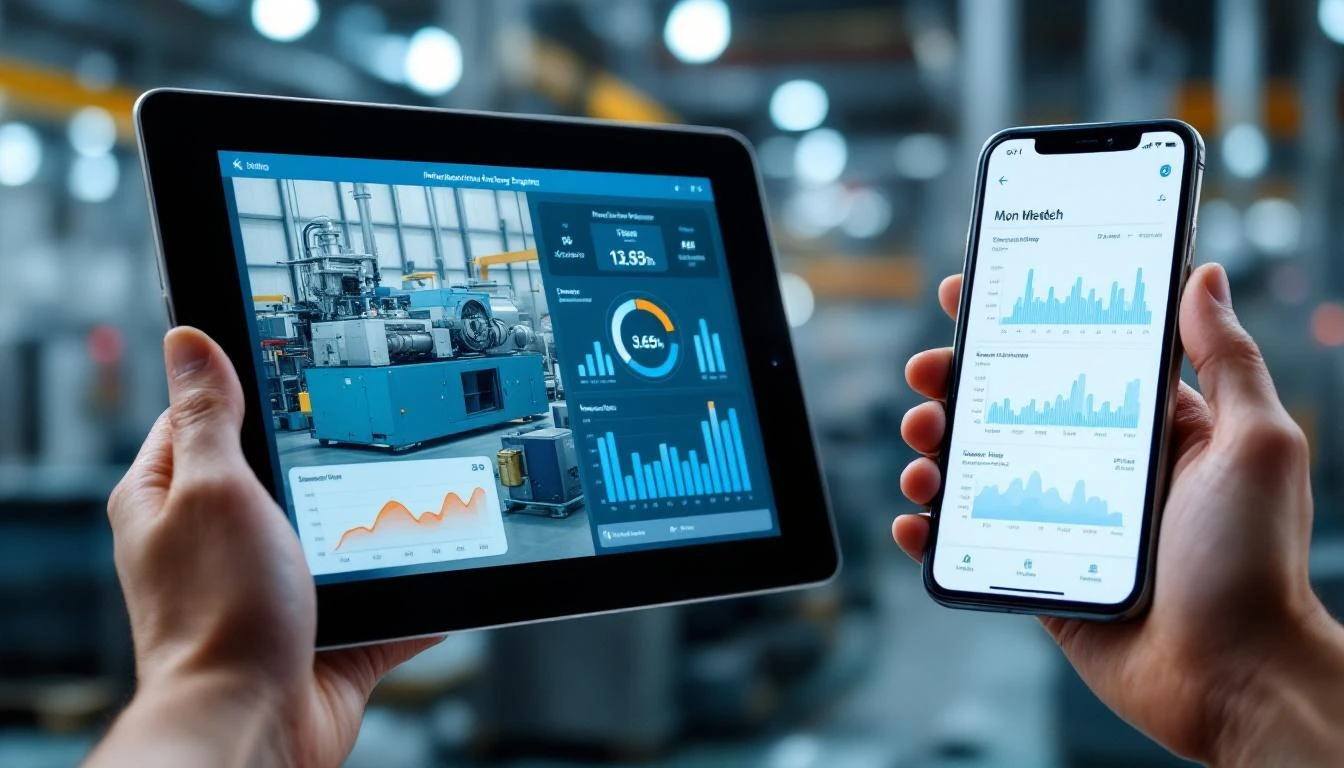
Remote machine monitoring software connects your factory equipment to the cloud, giving you live dashboards, instant alerts, and full production analytics on your laptop, tablet, or phone — whether you're on the plant floor, in a corner office, or at home on a Sunday night when the alarm goes off.
Here's what the best remote monitoring platforms deliver in 2026, and how to evaluate them for your operation.
What Remote Machine Monitoring Actually Means
Let's be precise. Remote machine monitoring isn't just "can I see a dashboard from my laptop." A complete remote monitoring solution includes:
- Real-time data collection — machine status, cycle times, temperatures, pressures, motor currents, vibration levels, all streaming continuously from the factory floor
- Cloud-accessible dashboards — web-based interfaces you can access from any device with a browser
- Mobile alerts — push notifications, SMS, or email when thresholds are breached or alarms fire
- Historical data — trend analysis, shift reports, and production summaries available remotely
- Multi-site visibility — a single pane of glass across multiple plants, locations, or production lines
- Secure access — role-based permissions so operators, managers, and executives see what's relevant
The platforms that deliver all six are the ones worth evaluating. Many claim "remote monitoring" but only deliver basic dashboard access without the alerting, historical analysis, or multi-site capabilities that make remote monitoring genuinely useful.
The 7 Best Remote Machine Monitoring Platforms in 2026
1. MachineCDN — Best for Full Remote Visibility with Zero IT Setup
MachineCDN was designed from day one for remote monitoring. The architecture tells you everything: an edge gateway on the factory floor connects directly to your PLCs and sends data to the cloud over cellular connectivity — no plant Wi-Fi, no VPN configurations, no IT involvement whatsoever.
Remote monitoring capabilities:
- Live dashboards with machine status, OEE, production counts, and alarm states
- Threshold alerting with configurable active and approaching alert levels — notifications go to your phone instantly
- Fleet management across unlimited locations — see every factory on one screen
- Historical trend analysis with custom report builder (tag selection, time ranges, zone filtering)
- Downtime tracking with root cause categorization — know why machines stopped, remotely
- Energy consumption monitoring per machine — track kWh and costs from anywhere
- Predictive maintenance — AI-powered fault prediction, not just reactive alerts
What sets it apart for remote monitoring: The cellular connectivity model means there's literally nothing between your machine and your cloud dashboard except a small edge gateway. No plant network dependencies. No VPN. No firewall exceptions. No IT tickets. You plug in the gateway, configure your tags, and within 3 minutes you have remote visibility into that machine from anywhere in the world.
Setup time: 3 minutes per device.
Time to ROI: 5 weeks.
Book a demo →
2. Samsara — Best for Mixed IoT + Machine Monitoring
Samsara's platform combines GPS tracking, environmental sensors, and basic machine monitoring in a single interface. For companies that need remote visibility into both mobile assets (trucks, forklifts) and fixed assets (machines, HVAC), it's an integrated option.
Remote monitoring strengths:
- Unified view of mobile and fixed assets
- Environmental sensors (temperature, humidity, door sensors)
- Good mobile app for field teams
- API for custom integrations
Limitations:
- Machine monitoring depth is limited compared to IIoT-native platforms
- No PLC-level data collection (sensor-only approach)
- OEE and production analytics are basic
- Per-sensor pricing scales unfavorably for large equipment counts
- No built-in maintenance management or PM scheduling
3. MachineMetrics — Best for Remote CNC Monitoring
If your fleet is predominantly CNC machines, MachineMetrics delivers strong remote monitoring for that specific use case. Their MTConnect and FOCAS integrations pull rich data from CNC controllers — spindle speed, feed rates, part counts, program names, and utilization metrics.
Remote monitoring strengths:
- Deep CNC-specific metrics (spindle utilization, cycle time efficiency)
- Real-time machine status with drill-down capabilities
- Production analytics with expected vs. actual cycle times
- Good alerting for CNC-specific conditions
Limitations:
- CNC-centric — limited support for non-CNC equipment
- Requires network connectivity (no cellular option)
- Per-machine pricing gets expensive at scale
- No maintenance management, inventory, or spare parts tracking
- Limited multi-protocol support for mixed equipment environments
4. Litmus Edge — Best for Edge-to-Cloud Data Pipeline
Litmus provides the data infrastructure for remote monitoring rather than the complete application. If you have a data engineering team and need a flexible edge-to-cloud pipeline, Litmus Edge can collect data from virtually any industrial protocol and forward it to your analytics platform of choice.
Remote monitoring strengths:
- 250+ protocol drivers for broad equipment connectivity
- Edge computing for local processing and filtering
- Flexible data routing to AWS, Azure, GCP, or on-premises historians
- Docker-based architecture for custom application deployment at the edge
Limitations:
- Not a finished application — you'll need to build or buy dashboards, alerting, and analytics separately
- Complex deployment requiring IT resources
- Enterprise pricing with multiple components
- No built-in maintenance management or operational features
- Steep learning curve for manufacturing teams without IT support
5. Siemens MindSphere (Insights Hub) — Best for Siemens-Heavy Plants
MindSphere, recently rebranded as Insights Hub, provides remote monitoring capabilities tightly integrated with Siemens equipment. If your factory runs predominantly on Siemens PLCs (S7-1200, S7-1500) and drives, the native connectivity is seamless.
Remote monitoring strengths:
- Deep Siemens PLC integration (native, not third-party)
- Industrial app ecosystem with pre-built analytics
- Good data visualization and trending tools
- Enterprise security and compliance (ISO 27001, SOC 2)
Limitations:
- Best suited for Siemens-heavy environments
- Complex licensing and pricing structure
- Requires Siemens-certified partners for deployment
- Multi-vendor environments require additional integration work
- Deployment timelines measured in months, not days
6. AVEVA (Wonderware Online) — Best for Process Industries
AVEVA's cloud platform (building on the Wonderware legacy) provides remote access to SCADA and historian data. For process manufacturing — chemicals, food & beverage, water treatment — where real-time process variables matter, AVEVA provides proven remote visibility.
Remote monitoring strengths:
- Strong process visualization and trending
- Historian integration for deep historical analysis
- Recipe and batch management for process industries
- Regulatory compliance reporting capabilities
Limitations:
- Legacy architecture with cloud added on top
- Complex licensing (per-tag, per-client, per-historian)
- Significant implementation effort
- Less suited for discrete manufacturing (machining, assembly, packaging)
- IT-heavy deployment and maintenance requirements
7. Ignition Perspective — Best for Custom Remote SCADA
Ignition's Perspective module provides web-based, mobile-responsive SCADA interfaces. If you're running Ignition on-premises and want remote access to your SCADA screens, Perspective is the natural extension.
Remote monitoring strengths:
- Full SCADA capability in a browser — responsive on any device
- Unlimited client licenses (Ignition's core pricing advantage)
- OPC UA and wide protocol support via Ignition's driver ecosystem
- Powerful scripting and customization capabilities
Limitations:
- You're building custom screens, not deploying pre-built dashboards
- Requires Ignition server infrastructure (on-premises or cloud-hosted)
- Development resources needed for initial setup
- Remote access requires VPN, reverse proxy, or cloud gateway configuration
- No built-in predictive maintenance or AI analytics
Key Features to Evaluate
When comparing remote monitoring platforms, these capabilities separate the useful from the frustrating:
1. Connectivity Model
Cellular (best for remote monitoring): The platform uses cellular data to connect the edge to the cloud. No plant network dependencies, no IT tickets, no VPN configuration. If your goal is true remote access with minimal setup, cellular wins.
Plant network: The platform connects through your existing plant network. Cheaper if you already have the infrastructure, but introduces dependencies on Wi-Fi, Ethernet, firewalls, and IT cooperation.
Hybrid: Some platforms support both — cellular for initial deployment, plant network for high-bandwidth applications once IT is ready.
2. Alert Quality
Not all alerts are created equal. The best remote monitoring platforms offer:
- Threshold alerting with configurable approaching and active levels
- Rate-of-change alerting (temperature rising faster than normal)
- AI-based anomaly detection (this pattern doesn't look right)
- Alert routing (send bearing alerts to maintenance, OEE alerts to production)
- Alert acknowledgment (so you know someone's on it)
3. Multi-Site Management
If you have more than one facility — or plan to — multi-site management isn't optional. Look for:
- Single login for all locations
- Role-based access per plant, zone, or machine
- Cross-plant comparison dashboards
- Centralized alert management
4. Offline Resilience
Connectivity drops happen. The best platforms handle this gracefully:
- Edge buffering: Data is stored locally and forwarded when connectivity returns
- Local alerting: Critical alarms still fire even without cloud connectivity
- Edge processing: Basic analytics continue at the edge during outages
5. Data Ownership and Export
Your machine data is valuable. Make sure you can:
- Export historical data in standard formats (CSV, JSON, API)
- Own your data (not locked into a vendor's proprietary format)
- Integrate with your existing BI, ERP, or historian systems
The Business Case for Remote Monitoring
The ROI on remote monitoring comes from three areas:
1. Faster response to problems. An alarm that reaches a maintenance engineer's phone 30 seconds after a temperature spike is worth infinitely more than one discovered during the next shift's walkthrough. Studies show that reducing response time to equipment anomalies can cut unplanned downtime by 30–50%.
2. Reduced travel and on-site labor. For multi-plant operations, remote monitoring eliminates unnecessary site visits. Engineers can diagnose issues remotely, dispatching on-site support only when physically needed.
3. Better capacity utilization. When you can see OEE, cycle times, and downtime reasons in real time, you make better scheduling decisions. A 5% improvement in utilization on a $10M production line is $500K per year.
Getting Started
If you're evaluating remote machine monitoring for the first time, start here:
- Inventory your equipment: List every machine, its controller type, and available communication protocols
- Identify your critical machines: Which equipment causes the most downtime or quality issues?
- Define your monitoring scope: Do you need vibration data, process variables, OEE, energy consumption, or all of the above?
- Evaluate connectivity: Does your plant have reliable network infrastructure, or would cellular be more practical?
- Pilot first: Deploy on 5–10 machines before committing to a full rollout
The fastest way to see what's possible: Book a MachineCDN demo and connect your first machine in 3 minutes. No hardware purchases, no IT involvement, no multi-month implementation projects.
Ready to monitor your factory from anywhere? Book a demo with MachineCDN — see your machine data in real time before the call ends.