How to Standardize Machine Data Across Multiple Manufacturing Plants

You acquire a second plant. The first plant runs Allen-Bradley PLCs with Ethernet/IP. The new plant has Siemens S7-1500s on PROFINET and a handful of legacy Mitsubishi FX units on Modbus RTU. Both plants make the same products on similar (but not identical) equipment.
Now the VP of Operations asks a simple question: "What's our OEE across both plants?"
And you realize you can't answer it. Not because the data doesn't exist, but because "Motor Temperature" in Plant A is tag N7:15 in degrees Fahrenheit, polled every 2 seconds, while the equivalent reading in Plant B is DB10.DBD4 in degrees Celsius, polled every 10 seconds. They're measuring the same thing, but the data is completely incompatible.
This is the machine data standardization problem, and it kills multi-plant visibility for manufacturers every day.
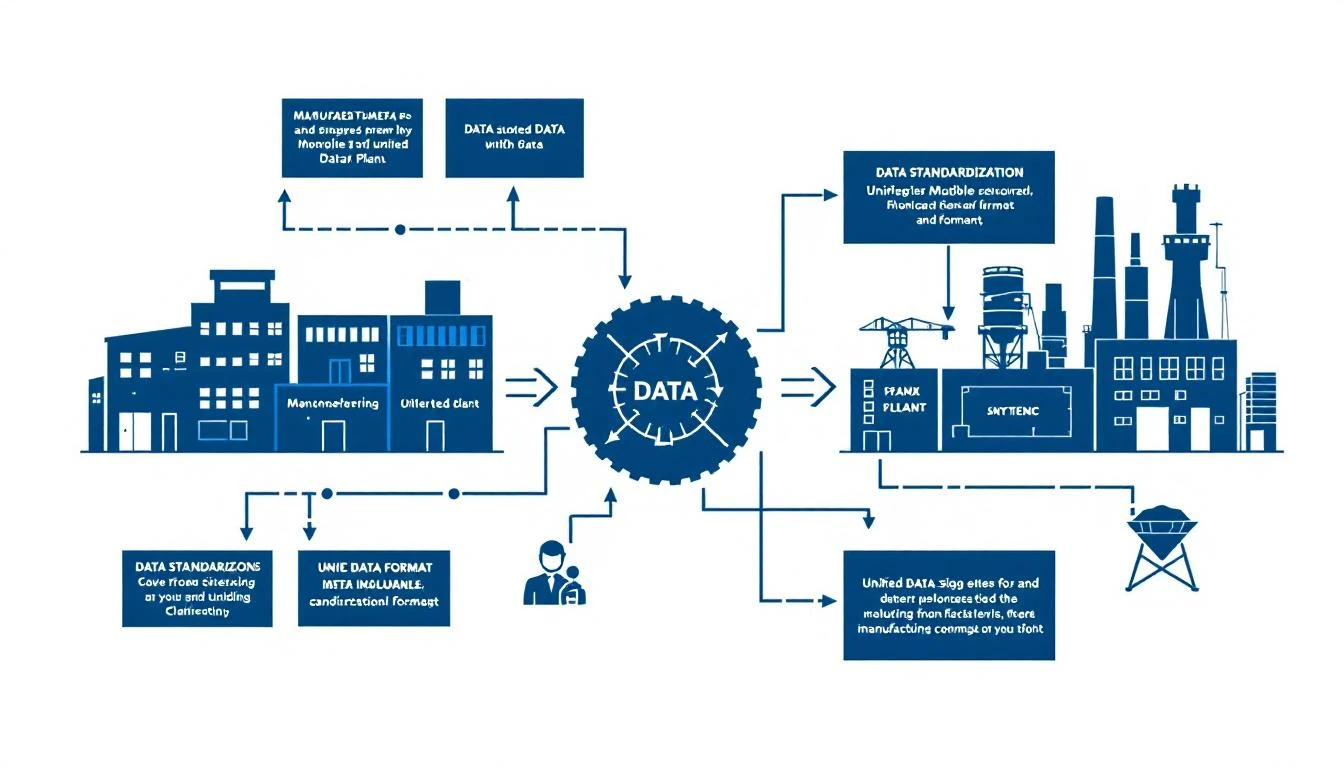
Why Machine Data Is Unstandardized (And Why It Matters)
Machine data heterogeneity isn't a failure of planning — it's the natural result of how manufacturing plants evolve:
- Different PLCs from different vendors. Each acquisition brings its own PLC ecosystem with vendor-specific tag naming, data types, and addressing schemes.
- Different integrators at different times. The engineer who programmed Plant A's PLCs in 2008 used a different naming convention than the contractor who set up Plant B in 2015.
- Different equipment from different OEMs. Even when running the same process, a Mazak CNC uses different variable names than a DMG MORI.
- Organic growth. Tags get added over years without governance. By 2026, Plant A has 4,000 tags with naming conventions that evolved (devolved) over a decade.
Why standardization matters now:
- Cross-plant comparison is impossible without it. You can't compare OEE between plants if they define availability, performance, and quality differently.
- Predictive models don't transfer. A machine learning model trained on Plant A's data format won't work on Plant B's data without standardization.
- Executive reporting is manual. Someone spends hours each week building spreadsheets that normalize data across plants. That's not sustainable at 5+ plants.
- AI and analytics require clean, consistent data. Every industrial AI platform will underperform on messy, inconsistent data.
The Standardization Framework
Standardizing machine data across plants requires addressing five layers, from the bottom up:
Layer 1: Connectivity Normalization
Before you can standardize data, you need to actually collect it from heterogeneous PLCs. This is the protocol translation layer.
The challenge: Plant A speaks Ethernet/IP, Plant B speaks PROFINET, legacy machines speak Modbus RTU. Your IIoT platform needs to speak all of them.
The solution: Use edge gateways that support multiple industrial protocols and normalize the data before it leaves the plant. MachineCDN's cellular edge gateways support Ethernet/IP and Modbus (TCP and RTU), translating PLC-specific register addresses into a common data format at the edge. This means the cloud platform never sees vendor-specific addressing — just standardized data points.
Why this matters: If you normalize at the cloud layer instead of the edge, you're shipping raw PLC data across the network and hoping your cloud platform can parse 15 different PLC dialects. Edge normalization is simpler, more reliable, and reduces bandwidth.
Layer 2: Naming Convention (The Taxonomy)
This is the hardest layer because it requires cross-plant agreement. You need a single naming convention that uniquely identifies every data point across every plant.
Recommended naming structure:
{Site}.{Area}.{Equipment}.{Component}.{Measurement}.{Unit}
Examples:
PLT01.PRESS.HYDR07.PUMP.PRESSURE.PSI— Plant 1, Press Area, Hydraulic Press 7, Pump, Pressure in PSIPLT02.WELD.ROB03.SERVO_J2.TEMP.C— Plant 2, Welding Area, Robot 3, Servo Joint 2, Temperature in CelsiusPLT01.PACK.LINE02.MOTOR_CONV.CURRENT.A— Plant 1, Packaging, Line 2, Conveyor Motor, Current in Amps
Naming convention rules:
- Hierarchical. Site → Area → Equipment → Component → Measurement → Unit. Every level narrows the scope.
- Equipment names are globally unique.
HYDR07at Plant 1 is different fromHYDR07at Plant 2 because the site prefix distinguishes them. - Measurement names are standardized vocabulary. Create a controlled vocabulary: TEMP (temperature), PRESS (pressure), VIB (vibration), CURRENT, SPEED, FLOW, LEVEL, COUNT, STATUS. No synonyms — "TEMPERATURE" and "TEMP" are not both allowed.
- Units are explicit. Don't assume. Include the unit in the tag name or metadata. Celsius and Fahrenheit are both valid, but they must be labeled.

Layer 3: Unit Normalization
Even with standardized names, you'll have plants using different units for the same measurement. Plant A reports temperature in Fahrenheit; Plant B uses Celsius. Plant A measures pressure in PSI; Plant B uses bar.
Options:
Option A: Convert everything at the edge. Configure each edge gateway to output data in the standard unit set. Pro: cloud data is always consistent. Con: local operators see unfamiliar units if you convert away from what they're used to.
Option B: Store native units, display in context. Store the raw value with its unit. Convert on display based on the viewer's preference. Pro: no data loss, flexible display. Con: more complex platform requirements.
Option C: Store both. Store the native value AND the normalized value. Pro: audit trail preserved, analytics use normalized values. Con: doubles your storage.
Our recommendation: Option A with metadata preservation. Convert to a standard unit set (SI units are the international standard, but many U.S. plants prefer imperial) at the edge. Store the conversion factor in metadata so the original value can always be reconstructed.
Standard unit set (pick one and stick with it across all plants):
| Measurement | SI Standard | Imperial Alternative |
|---|---|---|
| Temperature | °C | °F |
| Pressure | kPa | PSI |
| Flow | L/min | GPM |
| Current | A | A |
| Vibration | mm/s | in/s |
| Speed | RPM | RPM |
| Length | mm | in |
| Weight | kg | lb |
Layer 4: Data Model Standardization
Beyond naming and units, you need a consistent data model — the structure that defines how data points relate to each other.
Equipment type templates:
Create templates for each equipment type that define the expected data points. A "Hydraulic Press" template might include:
- Clamp pressure (PSI)
- Hydraulic fluid temperature (°F)
- Cycle count (integer)
- Motor current (A)
- Status (enum: RUNNING, IDLE, FAULT, MAINTENANCE)
- Fault code (integer)
- Cycle time (seconds)
When commissioning a new hydraulic press at any plant, the integrator maps PLC tags to the template. The platform knows what data to expect, can validate completeness, and can immediately apply cross-plant analytics because every hydraulic press reports the same data structure.
Benefits of equipment templates:
- New plant onboarding is faster. Instead of inventing a new tag structure, map existing PLC tags to proven templates.
- Predictive models transfer. A predictive maintenance model trained on 50 hydraulic presses at Plant A can immediately apply to 20 presses at Plant B — same data structure, same feature set.
- Benchmarking is automatic. Compare cycle times, energy consumption, or failure rates across every hydraulic press in the fleet, regardless of which plant or PLC brand.
Layer 5: Temporal Alignment
Different PLCs poll at different rates. Different gateways buffer and transmit at different intervals. To compare data across plants, you need temporal alignment.
Approaches:
- Resample to a common interval. If Plant A polls at 2 seconds and Plant B at 10 seconds, resample both to 10 seconds for cross-plant comparison. Use appropriate aggregation (average for continuous variables, max for alarms, last for status).
- Event-based alignment. For comparing production events (cycle start, fault trigger, batch completion), align on events rather than timestamps. This is more meaningful for production analytics.
- Timezone normalization. Plants in different time zones need timestamps in UTC with timezone metadata. Display in local time for operators, store in UTC for analytics.
Practical Implementation Steps
Step 1: Audit Current State
Before standardizing anything, document what exists:
- Export the tag list from every PLC/SCADA system at every plant.
- Catalog the naming conventions currently in use.
- Map which tags at different plants measure the same physical quantity.
- Identify equipment types that exist across multiple plants.
This audit typically takes 1-2 weeks for a 3-5 plant organization. It's unglamorous work, but it's the foundation.
Step 2: Define Standards (Committee Approach)
Form a small team — one reliability/maintenance engineer from each plant plus one data/analytics person. Together, define:
- The naming convention (Layer 2)
- The standard unit set (Layer 3)
- Equipment type templates for your top 10-15 equipment types (Layer 4)
This takes 2-4 weeks of part-time work. The key is getting buy-in from each plant. If Plant B's engineers feel the standard was imposed by Plant A, adoption will fail.
Step 3: Configure Edge Translation
Set up the mapping between existing PLC tags and standardized names at each edge gateway. This is where platforms like MachineCDN excel — the edge gateway configuration maps vendor-specific PLC register addresses to your standardized taxonomy, converts units, and handles protocol translation before data ever reaches the cloud.
Example mapping:
| Plant | PLC Tag | Standard Name | Conversion |
|---|---|---|---|
| PLT01 | N7:15 | PLT01.PRESS.HYDR07.PUMP.TEMP.F | Raw × 0.1 |
| PLT02 | DB10.DBD4 | PLT02.PRESS.HYDR12.PUMP.TEMP.F | (Raw × 0.1 × 9/5) + 32 |
Step 4: Validate With Cross-Plant Dashboards
Build a multi-plant dashboard that shows equivalent machines side by side. If the data doesn't make sense — Plant B's hydraulic press running at 10x the pressure of Plant A's — there's a mapping error. Validation catches conversion mistakes, wrong register addresses, and mismatched equipment types.
Step 5: Deploy Predictive Models Cross-Plant
Once data is standardized, predictive maintenance models trained at one plant can be applied to others. Start with simple threshold-based models (which transfer trivially), then evolve to ML-based models that leverage the larger, standardized dataset.
Common Pitfalls
-
Boiling the ocean. Don't try to standardize every tag from every PLC. Start with the 50-100 most critical tags per equipment type. Expand later.
-
Ignoring the operators. If Plant B's operators have called the hydraulic press "Big Blue" for 20 years, your taxonomy needs to accommodate that (as a display alias, not the standard name).
-
One-time standardization. Standardization isn't a project — it's a process. New equipment, new plants, and new tags will need to be mapped continuously. Assign ownership.
-
Forgetting metadata. Store not just the standardized value but the original PLC tag, the conversion applied, the timestamp precision, and the polling interval. You'll need this for debugging and auditing.
-
Assuming identical equipment IS identical. Two Mazak Quick Turn 250s from different years may have different PLC firmware, different options, and different tag structures. Validate equipment templates against actual PLC configurations, not just nameplate data.
The Payoff: What Cross-Plant Standardization Enables
Once your data is standardized across plants, previously impossible analyses become routine:
- Fleet-wide OEE benchmarking — Instantly compare performance across 200 presses at 5 plants. Identify the top and bottom performers and investigate why.
- Transferable predictive models — A vibration monitoring model trained on 1,000 motors across 4 plants is far more accurate than one trained on 50 motors at a single plant.
- Centralized maintenance intelligence — One reliability team monitors all plants from a single dashboard. Staff one expert team instead of one per plant.
- Supply chain optimization — Standardized production data feeds capacity planning. Know exactly how much slack exists across the fleet.
- M&A integration — When you acquire Plant 6, you have a proven playbook for integrating its data within weeks, not months.
Conclusion
Machine data standardization is the unsexy foundation that makes every exciting IIoT use case possible. Without it, you have isolated islands of data at each plant. With it, you have a connected manufacturing intelligence network.
The fastest path to standardized multi-plant data is an IIoT platform that handles protocol translation, naming normalization, and unit conversion at the edge. MachineCDN does exactly this — connect to any PLC, normalize data at the gateway, and deliver standardized, ready-to-compare data to a unified dashboard in minutes per device.
Managing multiple plants? Ready to see them all in one view? Book a demo and we'll show you what standardized machine data looks like on your equipment.