IIoT for Water and Wastewater Treatment: How to Monitor Pumps, Aeration, and Chemical Dosing in Real Time

Water and wastewater treatment plants run 24/7/365 with zero tolerance for failure. When a lift station pump fails at 2 AM during a storm, raw sewage backs up into neighborhoods. When a chemical dosing system malfunctions, treated water can violate EPA discharge limits. When a blower in the aeration basin trips offline, the biological treatment process degrades within hours.
Yet most treatment plants still operate with decades-old SCADA systems that show what's happening right now but can't tell you what's about to go wrong. The industry is ripe for IIoT — and the ROI is enormous when downtime means environmental violations and public health emergencies.

Why Water and Wastewater Needs IIoT — Now
The water industry faces a convergence of challenges that make IIoT adoption not just useful but critical:
Aging infrastructure. The American Society of Civil Engineers gives U.S. water infrastructure a C- grade. The average water main is over 45 years old. Treatment plants built in the 1970s and 1980s are running equipment well past its design life. Without continuous monitoring, these aging assets fail without warning.
Workforce crisis. The water sector faces a 30-50% workforce retirement in the next decade, according to the American Water Works Association. Experienced operators who can diagnose problems by sound and feel are retiring. Their replacements need data — not decades of institutional knowledge locked in someone's head.
Regulatory tightening. EPA discharge limits are getting stricter, and state regulators are increasingly requiring continuous monitoring and real-time reporting. Manual grab samples taken once per shift won't satisfy the next generation of compliance requirements.
Energy costs. Water treatment is one of the most energy-intensive municipal services, consuming 2-4% of total U.S. electricity. Aeration alone can account for 50-65% of a treatment plant's energy budget. IIoT-driven optimization can cut energy consumption by 15-30%.
Critical Monitoring Points in Water Treatment
Pump Stations and Lift Stations
Pumps are the heartbeat of water and wastewater systems. A typical wastewater utility operates dozens of lift stations spread across a service area, each with 2-4 pumps running in lead/lag configuration.
What to monitor:
- Motor current draw — Increasing current indicates impeller wear, bearing degradation, or partial blockage (rag buildup is the bane of wastewater pumps)
- Vibration — Rising vibration patterns indicate bearing wear, impeller imbalance, or cavitation
- Discharge pressure — Declining discharge pressure at constant speed suggests impeller wear or check valve issues
- Runtime hours — Track actual runtime against PM schedules. Most pump failures correlate with overdue maintenance
- Wet well levels — Rising wet well levels despite pumps running indicates reduced pump capacity or inflow exceeding design
- Pump cycling frequency — Rapid on/off cycling destroys contactors, stresses mechanical seals, and wastes energy
Predictive maintenance impact: A sewage pump failure costs $15,000-$50,000 in emergency repairs plus potential regulatory fines. Detecting bearing degradation 2-3 weeks early allows scheduled replacement during a planned outage at a fraction of the cost.
Aeration Systems
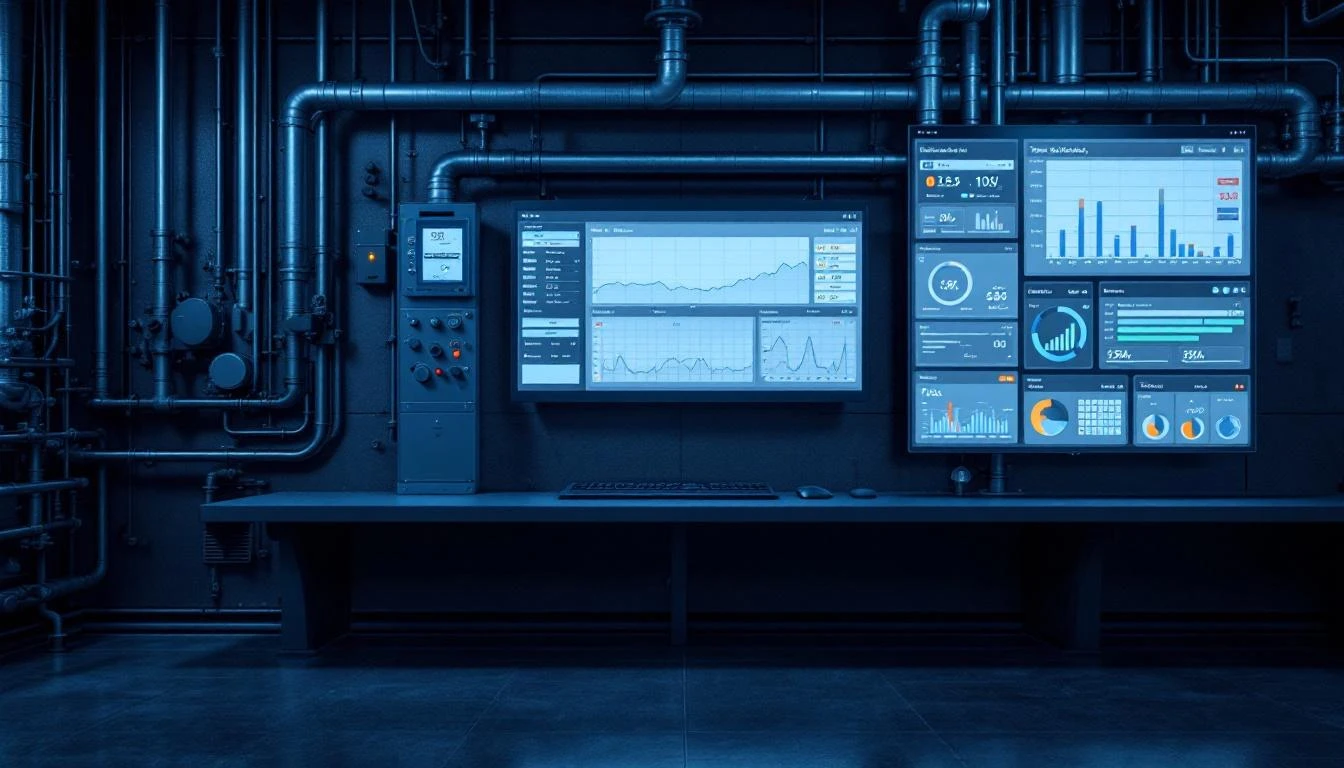
Aeration is where the biological magic happens — dissolved oxygen levels in the aeration basin determine whether the activated sludge process actually removes biological oxygen demand (BOD) and nutrients.
What to monitor:
- Dissolved oxygen (DO) — The critical process variable. Too low (< 1.0 mg/L) and the biology dies. Too high (> 3.0 mg/L) and you're wasting energy blowing air that's not being consumed.
- Blower motor current and vibration — These are expensive rotating assets. A turbo blower costs $200,000-$500,000 to replace.
- Airflow rates — Actual vs. setpoint. Declining airflow at constant blower output indicates diffuser fouling.
- Mixed liquor suspended solids (MLSS) — Process variable that determines how much oxygen the biology needs. IIoT sensors can measure MLSS continuously instead of daily grab samples.
- Ammonia and nitrate — Real-time nutrient analyzers enable closed-loop control of aeration for nutrient removal. Manual testing catches violations after they've happened.
Energy optimization opportunity: Most plants over-aerate by 20-40% because operators set conservative DO targets to avoid permit violations. Real-time DO monitoring with automated blower control can maintain target DO at 2.0 mg/L instead of 3.0+ mg/L — saving 25-30% of aeration energy costs.
Chemical Dosing Systems
Chemical feed systems handle coagulants (alum, ferric chloride), polymers, disinfectants (chlorine, UV), and pH adjustment (lime, caustic soda). Dosing accuracy directly impacts treatment quality, chemical costs, and regulatory compliance.
What to monitor:
- Feed pump stroke rate and output — Verify actual chemical delivery matches the setpoint
- Chemical tank levels — Prevent dry-run damage and ensure you never run out of disinfectant
- pH at dosing points — Continuous monitoring downstream of chemical injection confirms dosing is achieving target pH
- Chlorine residual — Must maintain minimum residual throughout the distribution system
- Turbidity — Real-time turbidity monitoring after coagulation/flocculation provides immediate feedback on dosing effectiveness
Cost savings: Many plants overdose chemicals by 15-25% as a safety margin. Real-time process monitoring enables precise dosing, saving $50,000-$200,000 annually on chemical costs for a mid-size plant.
Filtration Systems
Whether gravity sand filters, pressure filters, or membrane systems, filtration is where the final polishing happens.
What to monitor:
- Differential pressure across filters — Rising DP indicates filter loading (normal) or media degradation (problem)
- Backwash frequency and duration — Track filter run times between backwashes. Decreasing run times indicate media issues
- Filtered water turbidity — Real-time monitoring catches filter breakthrough immediately instead of at the next grab sample
- Membrane flux and transmembrane pressure — For MBR or UF/RO systems, these are the critical performance indicators
Architecture for Water/Wastewater IIoT
Water and wastewater presents unique IIoT challenges that manufacturing doesn't:
Geographic distribution. A wastewater utility might operate 50+ lift stations spread across a 200-square-mile service area. Each site needs independent connectivity — you can't run fiber to every lift station.
Harsh environments. Wastewater lift stations are corrosive, humid, and occasionally submerged. Equipment must be rated for the environment (IP67/NEMA 4X enclosures minimum).
Power availability. Some remote sites have only single-phase power or rely on solar. Edge devices need to be low-power.
Intermittent connectivity. Rural lift stations may have weak cellular coverage. The edge device must buffer data and retry transmission.
Recommended architecture:
-
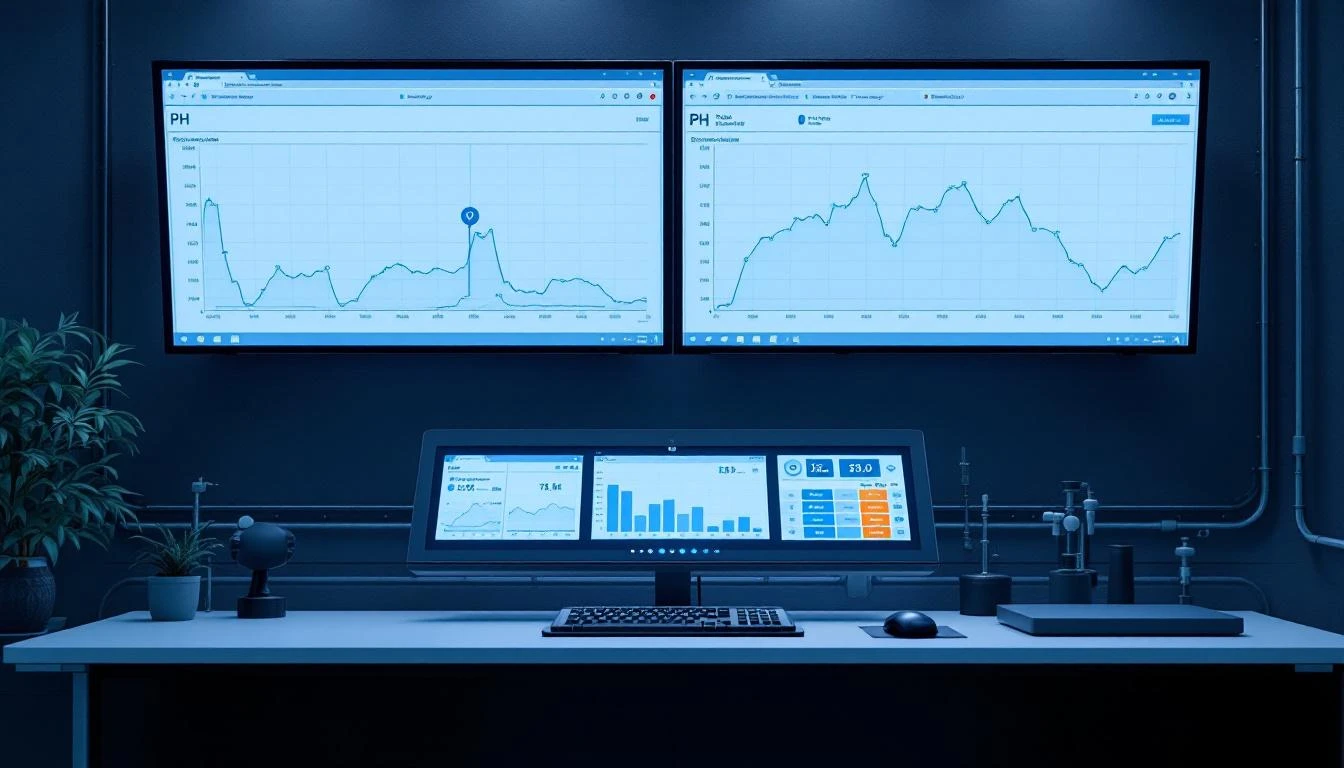
Cellular edge gateways at each site — Connects to existing PLCs via Ethernet/IP or Modbus. Cellular connectivity bypasses the need for wide-area networking between sites. This is exactly the approach MachineCDN takes — each gateway connects independently over cellular, creating a unified view without complex network infrastructure.
-
Local data buffering — Edge devices must store data locally during connectivity outages and forward when connection is restored. For storm events (when you need data most), cellular networks can be stressed.
-
Cloud platform with multi-site dashboard — All sites report to a single platform. Operators see every lift station, every treatment process, every alarm — from one screen. Fleet management across 50+ distributed sites is where cloud IIoT shines.
-
SCADA integration, not replacement — Don't rip out working SCADA. Layer IIoT on top. Read the same PLC data SCADA reads, but send it to the cloud for trending, analytics, and remote access. SCADA remains the real-time control system; IIoT becomes the intelligence layer.
Regulatory Compliance and Reporting
Water utilities operate under discharge permits (NPDES in the U.S.) that specify allowable levels for BOD, TSS, pH, ammonia, phosphorus, and other parameters. Violations trigger enforcement actions, fines, and consent decrees.
How IIoT supports compliance:
- Continuous monitoring reduces violation risk. Grab samples taken once per shift can miss a 2-hour excursion. Continuous IIoT monitoring catches it in real time.
- Automated compliance reporting. Instead of manually compiling monthly DMR (Discharge Monitoring Report) data, IIoT platforms can auto-generate compliance reports from continuous data.
- Audit trail. Regulators increasingly want data showing process stability, not just end-of-pipe results. Trending data demonstrates due diligence.
- Predictive alerts for permit limits. If pH is trending toward the permit limit, the operator gets an alert with time to intervene — not a violation notice from the state.
Case Study: Rural Wastewater Utility
A rural wastewater utility operating 12 lift stations and a 2 MGD treatment plant faced recurring pump failures that resulted in SSOs (sanitary sewer overflows) — reportable events that drew regulatory scrutiny.
Before IIoT:
- Average 4-6 pump failures per year at lift stations
- Mean time to discover failure: 3-8 hours (relied on high-level alarms only)
- 2-3 SSO events annually
- Annual emergency pump repair costs: $85,000
After IIoT deployment (cellular edge gateways on all 12 lift stations + treatment plant):
- Pump failures detected within minutes via current and vibration trending
- Predictive alerts flagged 80% of pump failures 2-4 weeks before failure
- SSO events reduced to zero in 12 months
- Emergency repair costs reduced to $22,000 annually (74% reduction)
- Chemical dosing optimization saved $38,000 in Year 1
- ROI achieved in under 5 weeks
Getting Started: Priority Order
If you're a water or wastewater utility evaluating IIoT, here's the prioritized rollout path:
- Lift station pumps — Highest failure risk, most distributed, most expensive when they fail. Start here.
- Aeration blowers — Highest energy cost, biggest optimization opportunity.
- Chemical feed systems — Chemical cost savings and compliance risk reduction.
- Filtration — Lower risk but valuable for optimization and compliance trending.
- Distribution system — Pressure monitoring, leak detection, water quality trending.
For each phase, a platform like MachineCDN can have devices connected and data flowing within 3 minutes per site — zero IT involvement, zero impact on existing SCADA operations.
The Future: Digital Water Utilities
The water industry is behind manufacturing in IIoT adoption, but it's catching up fast. The convergence of aging infrastructure, workforce shortages, and regulatory pressure makes the business case undeniable.
Leading utilities are already moving beyond monitoring to closed-loop optimization — AI-controlled aeration, predictive chemical dosing, and autonomous pump scheduling. But that future is built on a foundation of continuous, reliable data collection. You can't optimize what you can't see.
Start with visibility. Build to prediction. Evolve to optimization.
Ready to modernize your water or wastewater operations? Book a demo to see how MachineCDN connects to your existing PLCs and delivers real-time plant intelligence in minutes, not months.