Manufacturing Data Lakes vs Time-Series Databases: Where Should Your Machine Data Live?

Your IIoT platform is collecting 50 million data points per day from 200 machines across 3 plants. Temperature readings every 5 seconds. Vibration samples at 1 kHz. Cycle counts, fault codes, pressure values, motor currents — all timestamped, all streaming continuously.
Where does this data go? And more importantly, how do you query it? The answer shapes the cost, performance, and analytical capability of your entire IIoT stack.
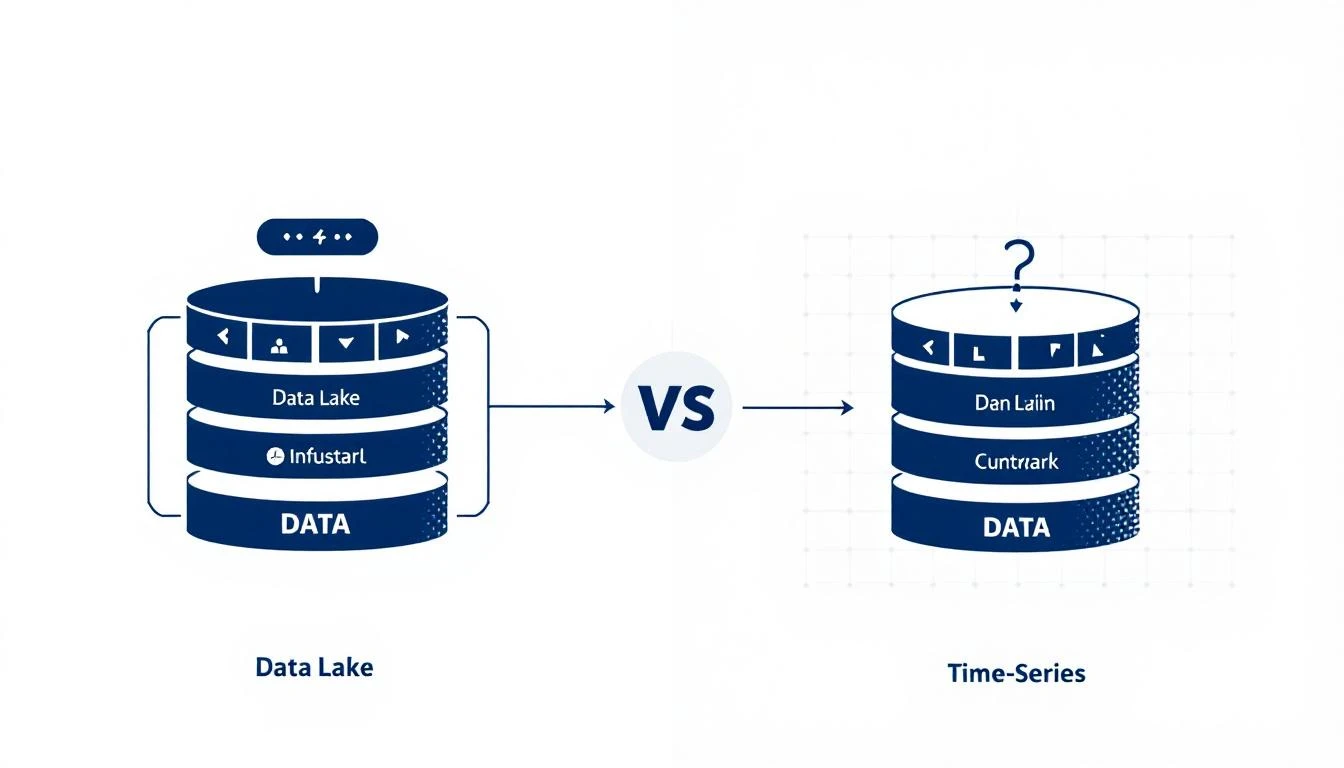
Two architectures dominate the conversation: time-series databases (TSDB) designed specifically for timestamped machine data, and data lakes that store everything in cheap object storage for batch analytics. Each has fierce advocates. Both have legitimate strengths. And most manufacturers end up needing elements of both.
Let's break it down without the vendor-driven religious wars.
What Time-Series Databases Do Well
A time-series database (TSDB) is purpose-built for data that arrives with a timestamp — which describes virtually all machine data. The major options: InfluxDB, TimescaleDB (Postgres-based), QuestDB, ClickHouse, Amazon Timestream, and Azure Data Explorer.
Strengths:
Blazing Fast Temporal Queries
"Show me the temperature of Motor 7 for the last 24 hours" returns in milliseconds from a TSDB, even across billions of data points. TSDBs organize data by time on disk, making range queries (the most common query pattern for machine data) extremely efficient.
This matters because the primary use of machine data is temporal analysis — trends, anomalies, correlations over time. When a maintenance engineer is diagnosing a failure, they need to see the last 48 hours of data for a specific machine instantly. A 30-second query response kills the diagnostic workflow.
Efficient Compression
Machine data is highly compressible. A temperature reading that changes by 0.1°C over 1,000 samples can be delta-encoded to a fraction of the raw size. TSDBs exploit this aggressively. InfluxDB achieves 10-20x compression on typical industrial data. TimescaleDB with compression enabled achieves 5-15x.
Real-world impact: 50 million data points per day, averaging 16 bytes each, is ~800 MB/day raw. With TSDB compression, that's 50-100 MB/day stored. Over a year, that's 18-36 GB instead of 290 GB.
Built-in Downsampling and Retention
TSDBs understand that you need second-level granularity for the last 24 hours, minute-level for the last month, and hourly for the last year. Automatic downsampling policies handle this without custom ETL pipelines.
Typical retention policy:
- Raw data (5-second intervals): 30 days
- 1-minute averages: 6 months
- 15-minute averages: 2 years
- 1-hour averages: indefinitely
This tiered retention dramatically reduces storage costs while preserving historical trend data.
Real-Time Dashboards
TSDBs are designed for the read pattern of predictive maintenance dashboards: "give me the current value and the last N hours of history for these 20 tags." Grafana, which is the standard visualization layer for TSDBs, handles this natively.
What Data Lakes Do Well
A data lake stores data in cheap object storage (S3, Azure Blob, GCS) in open formats (Parquet, ORC, Avro, JSON). Analytics run via query engines like Apache Spark, Databricks, Snowflake, or Amazon Athena that scan the stored files.
Strengths:
Infinite Scalability at Minimal Cost
Object storage costs $0.02-$0.03 per GB/month. Storing 290 GB/year of raw machine data costs about $7/month in S3. Ten years of data costs $70/month. This is orders of magnitude cheaper than a TSDB instance sized to hold the same volume.
For manufacturers with regulatory retention requirements (automotive, pharma, aerospace — often 7-15 years), data lake storage economics are unbeatable.
Schema Flexibility
Data lakes don't enforce a schema at write time. You can ingest machine data, maintenance records, quality inspection results, ERP data, and environmental readings into the same lake without pre-defining how they relate. Analytical models that combine these datasets — correlating quality defects with machine parameters AND production schedule AND ambient temperature — run against the lake without complex ETL.
Advanced Analytics and ML Training
Training a predictive maintenance machine learning model requires large historical datasets — months or years of operating data across multiple machines. Data lakes excel at this batch analytics pattern. Spark or Databricks can process terabytes of historical machine data to train failure prediction models.
This is the use case where data lakes genuinely outperform TSDBs. You can't efficiently train a deep learning model by querying a TSDB millions of times. You need bulk access to historical data in a format that ML frameworks understand (Parquet, CSV, or directly via Spark DataFrames).

Cross-Domain Joins
"Show me every time OEE dropped below 75% at the same time ambient temperature exceeded 90°F AND we were running Product SKU 47B" requires joining machine data with environmental data and production schedule data. Data lakes handle these ad-hoc cross-domain queries naturally. TSDBs struggle with joins — they're optimized for single-metric temporal queries, not relational analytics.
The Trade-Offs
Latency
| Query Type | TSDB | Data Lake |
|---|---|---|
| Last 24h of one sensor | < 100ms | 5-30 seconds |
| Last 30 days, downsampled | < 500ms | 10-60 seconds |
| Complex cross-metric correlation | 1-5 seconds | 30-120 seconds |
| ML model training (6 months, all sensors) | Impractical | 5-30 minutes |
For real-time dashboards and operational monitoring, TSDB latency is non-negotiable. For weekly analytics and ML, data lake latency is perfectly acceptable.
Cost
| Component | TSDB (Self-Hosted) | TSDB (Managed) | Data Lake |
|---|---|---|---|
| Compute | $500-$2,000/mo | $1,000-$5,000/mo | $0 (pay per query) |
| Storage | $100-$500/mo | $200-$1,000/mo | $5-$50/mo |
| Operations | 0.5-1 FTE | Managed | 0.25-0.5 FTE |
For small deployments (< 100 machines), managed TSDB is cost-effective. For large deployments (1,000+ machines) with years of retention, data lake storage wins on unit economics.
Complexity
TSDBs are simpler to deploy and operate for their intended purpose. Stand up InfluxDB or TimescaleDB, point your edge gateways at it, build Grafana dashboards. Done.
Data lakes require more components: object storage, a catalog (Glue, Hive), a query engine (Athena, Spark), a processing pipeline (Kafka, Kinesis), and typically a data engineering team to manage it all.
For most manufacturers starting with IIoT, a TSDB is the right starting point. You can always add a data lake for long-term retention and advanced analytics later.
The Hybrid Architecture (What Actually Works)
In practice, the best IIoT data architectures use both:
PLCs → Edge Gateway → Streaming Pipeline → TSDB (hot data, 30-90 days)
                                         ↘ Data Lake (cold data, years)
                                             ↘ ML Training
                                             ↘ Long-term Analytics
Hot path (TSDB):
- Last 30-90 days of raw data
- Powers real-time dashboards, threshold alerts, and operational monitoring
- Sub-second query response for maintenance engineers
- Automatic downsampling for aging data
Cold path (Data Lake):
- All historical data in Parquet format
- Powers ML model training, compliance reporting, and long-term trend analysis
- Query-when-needed (not always running)
- Cross-domain analytics (machine + quality + production + environmental)
Warm path (optional):
- Downsampled data (15-minute or hourly) in the TSDB, retained for 1-2 years
- Enables historical trending in dashboards without querying the data lake
- Balances cost and query performance
Data Lifecycle
- Ingest: Machine data arrives from edge gateways. It's written to both the TSDB and a streaming pipeline (Kafka) simultaneously.
- Hot (0-30 days): TSDB serves real-time queries. Dashboards, alerts, and operational monitoring hit this layer.
- Warm (30 days - 2 years): Raw data in TSDB is downsampled. The streaming pipeline writes raw data to the data lake in Parquet format.
- Cold (2+ years): Only downsampled data exists in the TSDB (if retained at all). Full-resolution historical data lives in the data lake. Accessed only for ML training, compliance audits, and long-term trend analysis.
What MachineCDN Does (So You Don't Have To)
Most manufacturers don't want to architect a hybrid TSDB/data lake system. They want to see their machine data on a dashboard and get alerts when something goes wrong.
MachineCDN handles the entire data pipeline — from PLC register to real-time dashboard — without requiring you to choose between TSDBs and data lakes, configure retention policies, or manage infrastructure.
The platform:
- Collects PLC data via cellular edge gateways (3-minute setup)
- Stores and indexes machine data with appropriate retention and compression
- Provides real-time dashboards with sub-second response
- Enables historical trending for failure investigation
- Delivers threshold alerting and predictive maintenance analytics
You focus on maintenance and operations. The platform handles the data architecture.
Decision Guide: Quick Reference
Choose a TSDB when:
- You're monitoring < 500 machines
- Primary use is real-time dashboards and alerting
- You need sub-second query response for operational decisions
- Your team doesn't include data engineers
- Retention requirement is < 2 years
Choose a data lake when:
- You need 5+ years of data retention for compliance
- Primary use is ML model training and advanced analytics
- You're combining machine data with ERP, quality, and other domains
- You have data engineering capability
- Cost per GB matters more than query latency
Choose both (hybrid) when:
- You need real-time dashboards AND long-term analytics
- You're building predictive maintenance ML models from historical data
- You have 500+ machines across multiple plants
- Regulatory compliance requires long-term retention of raw data
Choose a managed platform when:
- You want to monitor machines, not manage databases
- Your team's expertise is manufacturing, not data engineering
- You want to be live in days, not months
- Your priority is reducing downtime, not building infrastructure
Conclusion
The TSDB vs. data lake debate misses the point. They serve different purposes, and framing them as competitors leads to bad architectural decisions. TSDBs power real-time operations. Data lakes power offline analytics and ML. Most mature IIoT deployments need both, connected by a streaming pipeline.
But here's the honest truth: most manufacturers starting their IIoT journey don't need to think about data architecture at all. They need to get data off their PLCs and onto a screen. A platform like MachineCDN does that in 3 minutes per device, handles all the storage and query optimization behind the scenes, and lets you focus on what the data tells you about your machines — not where the data lives.
Ready to skip the database debates and start seeing your machine data? Book a demo and we'll have your PLCs streaming data to a real-time dashboard before the next architectural review meeting.