5G Private Networks for Manufacturing: What They Mean for Industrial IoT in 2026

Every major IIoT conference in 2025 and 2026 has had at least one vendor breathlessly promoting 5G private networks as the future of manufacturing connectivity. "Ultra-reliable low-latency communication! Network slicing! Massive machine-type communication! One million devices per square kilometer!"
The hype is real. But so is the technology — when applied to the right use cases. The problem is that most manufacturers don't need a 5G private network. They need reliable, low-latency connectivity to their PLCs. And for the vast majority of factory IIoT deployments, existing cellular (4G LTE) and industrial Ethernet already deliver that.
Let's separate the genuine use cases from the marketing noise.

What a 5G Private Network Actually Is
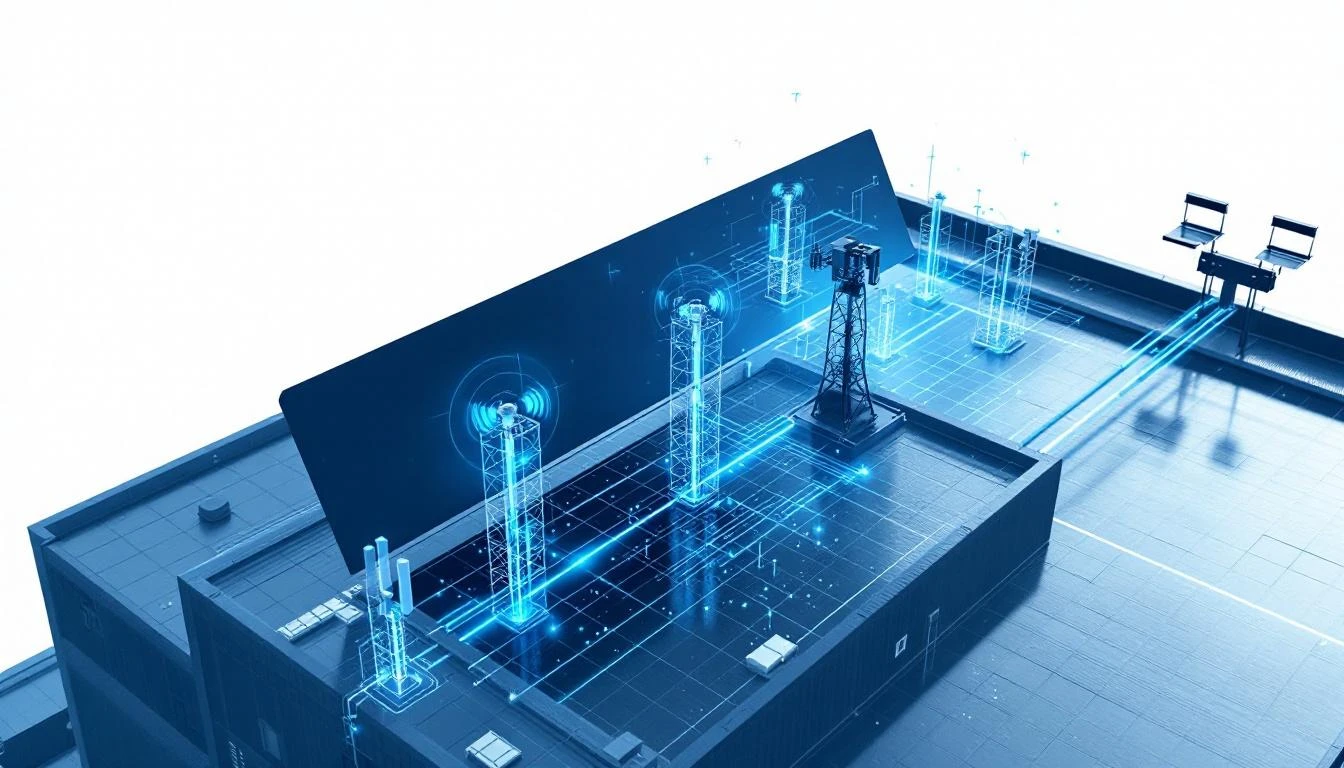
A 5G private network is a dedicated cellular network that operates within a defined area — your factory, campus, or industrial site — using spectrum you control. Unlike connecting to Verizon or AT&T's public network, you own and operate (or lease) the radio infrastructure, the core network, and the spectrum rights.
In the U.S., this is primarily enabled by CBRS (Citizens Broadband Radio Service) — 150 MHz of shared spectrum in the 3.5 GHz band that companies can access through a relatively simple licensing process. No need to spend billions at an FCC spectrum auction.
Components of a 5G private network:
- Small cells or gNB base stations — Radio access points deployed throughout the factory. Think of them as industrial-grade Wi-Fi access points, but for cellular.
- 5G core network — Software that manages device connections, authentication, and data routing. Can run on-premise or in a local edge cloud.
- SIM cards or eSIMs — Each device gets a SIM that authenticates to your private network, not a public carrier.
- Spectrum access — CBRS in the U.S., or licensed spectrum in other regions.
Cost: A basic 5G private network for a single factory (100,000 sq ft) starts at $200,000-$500,000 for infrastructure, plus $50,000-$100,000 annually for spectrum management, maintenance, and software licenses. Multi-building campuses can exceed $1M.
The Three 5G Features That Matter for Manufacturing
5G isn't a single technology — it's a collection of capabilities. Three are relevant for manufacturing IIoT:
1. URLLC (Ultra-Reliable Low-Latency Communication)
What it promises: Sub-1ms latency with 99.9999% reliability. This enables real-time closed-loop control over wireless — something Wi-Fi and 4G LTE can't guarantee.
Where it matters:
- Collaborative robotics — AGVs (Automated Guided Vehicles) and AMRs (Autonomous Mobile Robots) that need real-time coordination with each other and the central control system.
- Motion control — Synchronized multi-axis motion control over wireless. Currently, this requires hardwired EtherCAT or PROFINET connections.
- Safety-critical applications — Emergency stop commands that must arrive within guaranteed time windows.
Where it doesn't matter:
- Monitoring and diagnostics — Predictive maintenance data doesn't need sub-millisecond latency. A 5-second polling interval is fine for temperature, vibration, and current monitoring. Standard 4G LTE handles this easily.
- Production reporting — Cycle counts, OEE calculations, and downtime tracking are latency-insensitive.
Reality check: As of early 2026, URLLC is still in limited deployment. Most 5G private networks run on Release 15 or 16 specifications, which deliver improved latency over LTE but not the full URLLC promise of Release 17+. True sub-1ms URLLC at manufacturing scale is 2-3 years away for most deployments.
2. mMTC (Massive Machine-Type Communication)
What it promises: Support for up to 1 million devices per square kilometer. This enables sensor-dense deployments where thousands of low-power sensors report environmental and process data.

Where it matters:
- Dense sensor deployments — Thousands of vibration, temperature, humidity, and environmental sensors across a large facility or campus.
- Asset tracking — Real-time location of tools, WIP (work-in-progress), containers, and mobile equipment across a large site.
Where it doesn't matter:
- PLC connectivity — Most factories have dozens to low hundreds of PLCs, not thousands. Standard connectivity handles this volume easily.
- Existing instrumented equipment — If your machines already have PLCs with sensors, you don't need a parallel wireless sensor network. You need to connect the PLCs to the cloud.
3. Network Slicing
What it promises: Create multiple virtual networks on the same physical infrastructure, each with guaranteed performance characteristics. Slice 1 for real-time robot control (low latency, high reliability). Slice 2 for sensor data (high throughput, relaxed latency). Slice 3 for augmented reality maintenance (high bandwidth).
Where it matters:
- Converged networks — When you want a single wireless infrastructure to serve multiple use cases with different requirements, instead of operating separate networks for each.
- Security isolation — Different slices can have different security policies. Production data stays isolated from administrative traffic.
Where it doesn't matter:
- Single-use-case deployments — If you're only deploying IIoT monitoring (which is most early-stage deployments), you don't need network slicing. A single, well-configured cellular connection does the job.
When 5G Private Networks Make Sense for Manufacturing
Based on real deployments (not marketing demos), 5G private networks deliver clear ROI in these scenarios:
Scenario 1: Large Campus With Mobile Assets
A 500,000+ sq ft automotive assembly plant with 50+ AGVs, multiple buildings, and outdoor staging areas. Wi-Fi handoff between access points causes AGV navigation failures. Cellular coverage from public carriers is inconsistent inside metal-clad buildings.
A 5G private network provides seamless campus-wide coverage with reliable handoff for mobile assets. The AGVs stay connected whether they're inside the plant, in the connecting tunnel, or in the outdoor yard.
ROI driver: AGV downtime costs $3,000-$10,000 per hour when it blocks a production line. Eliminating connectivity-related AGV failures pays for the network.
Scenario 2: Greenfield Smart Factory
A new factory being built from scratch with Industry 4.0 principles. No legacy infrastructure constraints. The design calls for wireless-first connectivity to reduce cabling costs and enable flexible equipment reconfiguration.
ROI driver: Avoiding 500,000+ feet of industrial Ethernet cabling saves $500K-$1M in installation costs and eliminates cabling as a constraint on factory layout changes.
Scenario 3: Harsh RF Environments Where Wi-Fi Fails
Metal processing, automotive body shops, and other environments where metal surfaces create severe multipath interference that degrades Wi-Fi performance. 5G operates in different frequency bands with different propagation characteristics, often performing better in these environments.
ROI driver: Eliminating the cost and frustration of constantly troubleshooting Wi-Fi dead zones and interference issues.
When 5G Private Networks Don't Make Sense
Scenario: Standard IIoT Monitoring on Existing Equipment
You want to monitor machine data from 50-200 PLCs across 1-3 plants. You need temperature, vibration, pressure, and fault data for predictive maintenance and OEE tracking.
Why 5G is overkill: This use case requires modest bandwidth (kilobytes per second per machine), tolerates 5-15 second latency, and involves tens of devices, not thousands. Standard cellular gateways on public 4G/LTE networks handle this perfectly at 1/100th the cost of a private 5G network.
This is exactly the model MachineCDN uses — cellular edge gateways on existing carrier networks connect to PLCs and send data to the cloud. No private network infrastructure required. No spectrum licenses. No RF engineering. Just plug in, configure your PLC tags, and data flows.
The math:
- 5G private network for one factory: $200,000-$500,000 upfront + $50,000-$100,000/year
- 200 cellular edge gateways on public LTE: $30,000-$60,000 upfront + $36,000-$120,000/year in data
For standard IIoT monitoring, public cellular wins on cost by 3-5x and deploys in days instead of months.
Scenario: Retrofitting Brownfield Factories
Existing plants with mature SCADA and PLC infrastructure. The goal is to add cloud-based analytics and remote monitoring without disrupting operations.
Why 5G is overkill: Brownfield deployments need to be non-invasive. Installing small cells, running fiber backhaul, and deploying 5G core network software is a significant infrastructure project. A cellular gateway that sits next to the PLC and connects to the public cellular network is invisible to existing operations.
The 5G Decision Framework
Ask these four questions:
-
Do I need sub-10ms latency for closed-loop control? If yes, evaluate 5G private networks. If no (monitoring, diagnostics, analytics), public cellular is sufficient.
-
Do I have mobile assets (AGVs, AMRs) that need seamless campus-wide coverage? If yes, 5G private networks solve handoff problems Wi-Fi can't. If your assets are stationary (PLCs, machines), this doesn't apply.
-
Do I need to connect 1,000+ devices in a single facility? If yes, mMTC capabilities of 5G are relevant. If you have 50-200 PLCs, standard connectivity is fine.
-
Am I building a new facility from scratch? If yes, evaluate 5G as part of the overall design. If you're retrofitting existing plants, the disruption of deploying private 5G infrastructure usually isn't justified.
Most manufacturers will answer "no" to all four questions. And that's fine. Public cellular IIoT connectivity is a mature, proven technology that handles 95% of manufacturing monitoring and predictive maintenance use cases.
The Realistic Timeline
Available now (2026):
- Enhanced mobile broadband on private 5G (high bandwidth for video, AR)
- Basic mMTC for sensor deployments
- Improved latency vs. LTE (5-10ms range, not sub-1ms)
Expected 2027-2028:
- Full URLLC deployment for motion control and safety applications
- Advanced network slicing for converged factory networks
- TSN (Time-Sensitive Networking) integration over 5G
Expected 2029+:
- Closed-loop real-time control over wireless (replacing hardwired fieldbus in some applications)
- AI-optimized network management
- Full Industry 4.0 wireless-first factory architecture
Conclusion: Don't Wait for 5G to Start Your IIoT Journey
The biggest risk with 5G private networks for manufacturing is waiting. "We'll deploy IIoT monitoring when we build our 5G network" means waiting 2-3 years while your machines generate zero actionable data.
Start with what works today — cellular edge gateways that connect your PLCs to a cloud platform for monitoring, alerting, and predictive maintenance. When 5G private networks mature and your use case justifies the investment, the data models, analytics workflows, and maintenance processes you've built will transfer directly.
The platform matters more than the transport. MachineCDN works over any connectivity — public cellular today, private 5G tomorrow. The edge gateway handles protocol translation and data normalization regardless of how the data gets to the cloud.
Ready to start monitoring your machines today, not in 2028? Book a demo and see what 3-minute deployment looks like.