Machine Changeover Time Tracking with IIoT: How to Cut Setup Time and Boost OEE

Changeover time — the gap between the last good part of one run and the first good part of the next — is one of manufacturing's most persistent productivity killers. In most plants, changeovers consume 10-30% of available production time. Worse, most manufacturers don't actually measure changeover time accurately. They estimate. They round up. They accept "about two hours" when the actual time ranges from 45 minutes to four hours depending on the shift, the operator, and the product.
IIoT platforms eliminate this measurement problem entirely. When your machines are connected and streaming real-time data, changeover time isn't estimated — it's measured to the second. This guide shows you how to implement IIoT-based changeover tracking, apply SMED (Single-Minute Exchange of Dies) methodology with data-driven precision, and systematically reduce your setup times.

Why Changeover Time Matters More Than You Think
The OEE Impact
Changeover directly reduces your Availability component in OEE calculations. If your machine runs 16 hours per day and you do 3 changeovers averaging 90 minutes each, that's 4.5 hours — 28% of your available time — consumed by setup.
Reduce that to 45 minutes per changeover and you recover 2.25 hours of production time. On a machine generating $500/hour in throughput value, that's $1,125 per day, or $281,250 per year from a single machine.
The Hidden Costs
Direct production loss is only part of the story:
- Quality losses: The first 10-50 parts after a changeover often have higher defect rates as operators fine-tune parameters. Longer changeovers mean more adjustment time and more scrap.
- Batch size inflation: When changeovers are painful, planners increase batch sizes to reduce changeover frequency. Larger batches mean more WIP inventory, longer lead times, and less flexibility to respond to customer demand.
- Overtime costs: Long changeovers push production into overtime hours. You're paying 1.5x labor to make up for lost availability.
- Scheduling complexity: Unpredictable changeover times make production scheduling unreliable. Promise dates slip. Customers lose confidence.
The Measurement Problem
Most plants track changeover time one of three ways:
- Not at all — They know changeovers happen but don't measure duration
- Manual logging — Operators write down start and end times (subject to rounding, estimation, and forgotten entries)
- Standard times — Engineering sets a standard changeover time that rarely reflects reality
None of these give you accurate, consistent data. And without accurate data, SMED events produce temporary improvements that fade within weeks because there's no ongoing measurement to sustain them.
How IIoT Solves Changeover Measurement
Automatic Detection
When your machines are connected to an IIoT platform like MachineCDN, changeover detection becomes automatic. The platform knows when a machine stops producing parts (cycle counter stops incrementing), when parameters change (recipe changes, tool changes), and when production resumes with a new product.
What the PLC data shows during a changeover:
- Cycle counter stops → machine enters idle/setup state
- Multiple parameter changes (temperatures, pressures, speeds)
- Axis movements without production (die changes, fixture swaps)
- Quality sensors recalibrated (laser measurements, vision systems)
- First-article inspection period (slower cycle times, test shots)
- Cycle counter resumes → machine back in production
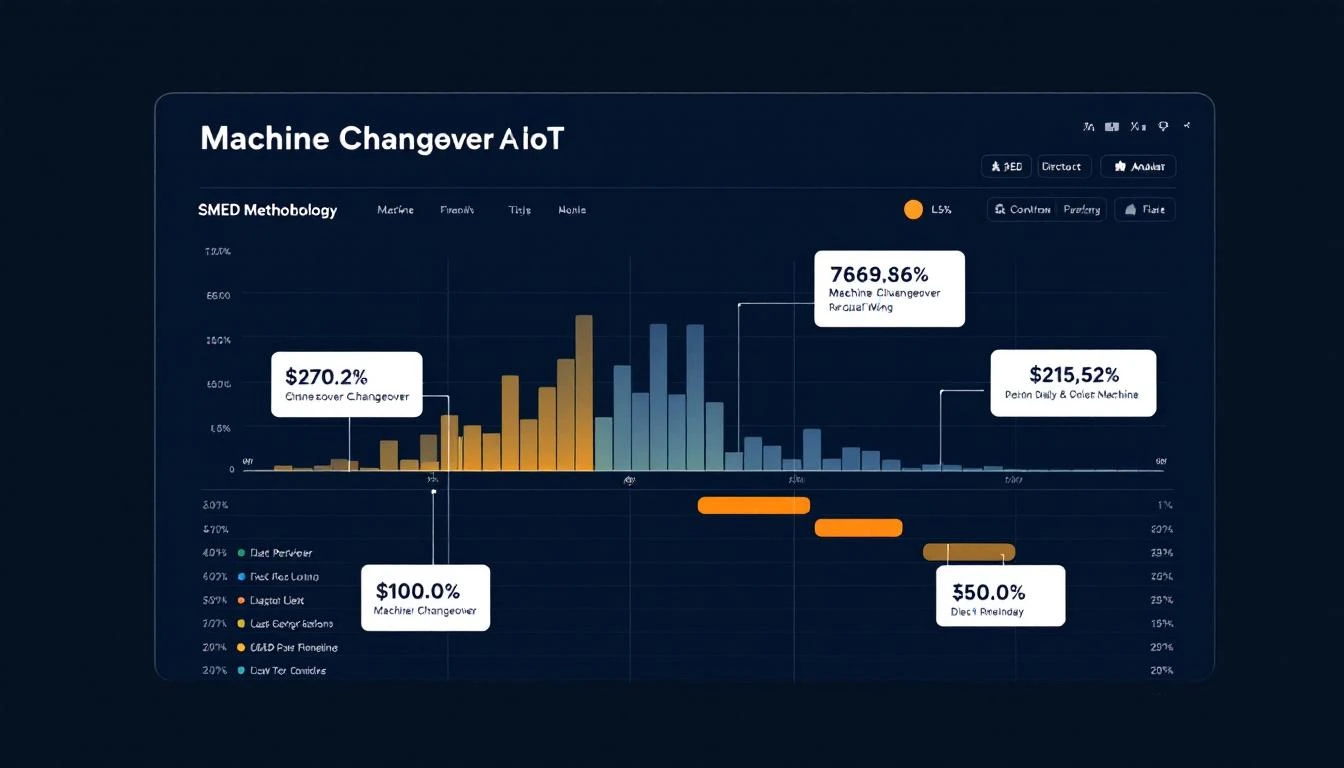
The IIoT platform timestamps each of these transitions automatically, giving you:
- Exact changeover duration (not estimated)
- Changeover phases (teardown, setup, adjustment, first-article)
- Operator performance (same changeover, different times by shift)
- Product-to-product matrix (some transitions are inherently longer)
Real-Time Visibility
During a changeover, maintenance managers and production supervisors can see exactly where the machine is in the process. Is it still in teardown? Has setup started? Is the operator waiting for a die from the tool room?
This real-time visibility replaces the "how long until that machine is back up?" question that echoes across every factory floor during every changeover.
Historical Analysis
With months of changeover data, patterns emerge:
- Which product transitions take longest? Maybe switching from Product A to Product C always takes 3x longer than A to B. Now you can sequence production to minimize difficult transitions.
- Which shift performs best? If the night shift consistently does 45-minute changeovers while the day shift averages 90 minutes, there's a training opportunity.
- Which machines have the most variability? High variability means the process isn't standardized. Low variability means your SOPs are working.
- Are changeover times improving or degrading? Post-SMED events, you can track whether improvements sustain or erode.
Implementing SMED with IIoT Data
SMED (Single-Minute Exchange of Dies) was developed by Shigeo Shingo at Toyota and remains the gold standard for changeover reduction. IIoT data makes every step of the SMED process more effective.
Step 1: Document the Current State (With Data, Not Guesswork)
Traditional SMED starts with videotaping changeovers and building spaghetti diagrams. IIoT data doesn't replace the video, but it adds precision:
- Exact timeline from PLC data: when did each phase start and end?
- Parameter changes: what adjustments took the longest?
- Waiting time: how long was the machine idle with no activity (waiting for tooling, materials, approvals)?
With MachineCDN's downtime tracking, you can categorize changeover time into productive setup work vs. waiting/wasted time.
Step 2: Separate Internal and External Activities
Internal activities require the machine to be stopped. External activities can be done while the machine is still running the previous product.
IIoT data reveals the true split:
- Die/fixture staging: Was the next die positioned next to the machine before the changeover started? (Check: was there a gap between production stop and first setup activity?)
- Material staging: Were the next product's materials pre-loaded? (Check: was there a delay between setup completion and production start?)
- Parameter pre-programming: Were the next product's recipe settings entered before the changeover? (Check: how long did parameter input take?)
Step 3: Convert Internal to External
The biggest SMED gains come from moving activities outside the changeover window. IIoT data quantifies the opportunity:
- If you spend 15 minutes entering parameters during every changeover, pre-loading recipes as external work saves 15 minutes × 3 changeovers/day = 45 minutes of recovered production daily
- If fixture staging adds 20 minutes, a pre-staging SOP eliminates it entirely
Step 4: Streamline Internal Activities
For activities that truly must happen while the machine is stopped, IIoT data helps you optimize:
- Parallel vs. sequential: Can two activities happen simultaneously? If parameter adjustment and fixture alignment are sequential but could be parallel (two operators), your data shows the exact time savings.
- Fastener standardization: How much time is spent on manual adjustments vs. repeatable, preset positions? Machines with preset stops and quick-release clamps show shorter adjustment phases in the data.
- First-article optimization: How many "trial" parts are you running before production quality is achieved? Tracking first-article scrap rates by changeover reveals whether better SOPs could reduce trial runs.
Step 5: Sustain the Improvements
This is where most SMED initiatives die. The event ends, the facilitator leaves, and within 6 months, changeover times creep back to pre-improvement levels.
IIoT kills this regression because every changeover is automatically measured, forever. There's no going back to estimation. If changeover times start increasing, the data shows it immediately — and you can investigate why before the gains are lost.
Set threshold alerts on changeover duration: if any changeover exceeds your target time by more than 20%, flag it for review.
Practical Implementation Guide
Phase 1: Baseline (Weeks 1-2)
- Connect your machines to MachineCDN or your IIoT platform
- Configure tags that indicate production state (running, idle, setup, alarm)
- Identify recipe/product change indicators (recipe numbers, die IDs, part numbers)
- Let the system collect 2 weeks of changeover data across all shifts
Phase 2: Analyze (Week 3)
- Export changeover data by machine, shift, product, and operator
- Calculate baseline metrics: average changeover time, standard deviation, range
- Identify your worst performers (longest, most variable, most frequent)
- Build a product-to-product transition matrix showing average time per transition
Phase 3: Improve (Weeks 4-6)
- Run SMED events on your worst-performing changeovers, using IIoT data instead of stopwatches
- Implement improvements: external staging, quick-release fixtures, recipe pre-loading
- Monitor changeover times in real time to verify improvements immediately
Phase 4: Sustain (Ongoing)
- Set changeover time targets by machine and product transition
- Configure automated alerts when changeovers exceed targets
- Include changeover time trends in your daily production meetings
- Re-run SMED events quarterly on the new worst performers
Expected Results
Based on industry data from manufacturers implementing IIoT-based changeover tracking:
- Average changeover reduction: 40-60% within the first 6 months
- Changeover variability reduction: 50-70% (consistency improves even more than average time)
- OEE improvement: 5-15 percentage points (primarily Availability gains)
- Batch size reduction: 30-50% (smaller batches become economical with shorter changeovers)
- Inventory reduction: 20-40% (smaller batches = less WIP)
The Bottom Line
You can't improve what you don't measure, and clipboard-based changeover tracking is barely measuring. IIoT gives you automatic, accurate, second-by-second changeover data that turns SMED from a one-time event into a continuous improvement engine.
Connect your machines. Measure your changeovers. Watch the data reveal opportunities you never knew existed.
Ready to see your real changeover times? Book a demo with MachineCDN and turn setup time into production time.