How to Implement Shift Handover Reporting with IIoT Data: Eliminate Information Gaps Between Shifts

Every manufacturing plant knows the problem: Shift A finishes at 3 PM, Shift B walks in at 3:15 PM, and somewhere in those 15 minutes, critical information evaporates. The injection molder on Line 4 has been running hot for the last two hours. The conveyor on Line 7 threw a fault code at 2:45 PM but was cleared manually. The quality team rejected a batch at 1 PM and nobody documented why.
This isn't a people problem — it's a systems problem. And IIoT data solves it completely.
The Real Cost of Bad Shift Handovers
According to research from the Abnormal Situation Management Consortium, poor shift handovers contribute to approximately 30% of industrial incidents. In manufacturing specifically, the consequences are less dramatic but financially devastating:
First-hour production losses are the most visible symptom. Plants that rely on verbal or paper handovers typically see 15-25% lower OEE during the first hour of each shift. Operators spend that time figuring out what happened, what's running, what needs attention — information that should be instantly available.
Repeated failures are the hidden cost. When Shift A encounters a problem and develops a workaround, that knowledge often dies with them. Shift B hits the same issue, spends 30 minutes troubleshooting, and develops their own workaround. Multiply this across three shifts and you're solving the same problem three times a day.
Quality escapes happen in the gaps. If a process parameter drifted during the last two hours of Shift A but nobody flagged it, Shift B inherits an out-of-spec process and may not catch it until they've produced hundreds of defective parts.
The Aberdeen Group estimates that poor communication between shifts costs the average discrete manufacturer $1.2 million annually in lost productivity, scrap, and rework.
Why Traditional Handover Methods Fail
Verbal Handovers
The most common approach — and the worst. Operators standing in a circle passing information verbally works when nothing important happened. But humans naturally filter for recency and drama. The alarm that fired at 10 AM and was cleared at 10:15 AM gets forgotten by 3 PM. The slow degradation in cycle time that started at noon doesn't register as noteworthy because it happened gradually.
Paper Logbooks
Better than verbal, but still fundamentally flawed. They capture what operators choose to write, not what actually happened. A study published in the Journal of Loss Prevention in the Process Industries found that paper shift logs capture less than 40% of operationally significant events. The rest — parameter drifts, intermittent faults, subtle trend changes — goes unrecorded.
Spreadsheet-Based Reports
An improvement over paper, but they require manual data entry, which means they're always incomplete, sometimes wrong, and never real-time. By the time the outgoing shift fills in the spreadsheet, they've already forgotten half of what mattered.
How IIoT Transforms Shift Handover Reporting
IIoT-based shift handover reporting flips the model entirely. Instead of relying on humans to remember and record, the system automatically captures everything and presents a curated summary.
Here's what a modern shift handover report should contain — all generated automatically from machine data:
1. Machine Status Summary
Every machine's current state — running, idle, alarmed, or down — at the moment of handover. Not what the outgoing shift says is happening. What's actually happening, verified by live PLC data.
This includes:
- Current operating mode (auto, semi-auto, manual, setup)
- Active cycle count versus planned production
- Time in current state (has this machine been idle for 5 minutes or 5 hours?)
2. Alarm History and Active Alerts
A complete record of every alarm that fired during the shift, organized by severity:
- Critical alarms that caused downtime
- Warning alarms that were acknowledged but may recur
- Approaching thresholds — parameters that haven't alarmed yet but are trending toward limits
This is where IIoT data shines. Traditional handovers might mention "Line 4 had some alarms." An IIoT handover report shows exactly which alarms, when they fired, how long they lasted, what parameters were at the time, and whether the root cause was addressed or just the symptom.
3. OEE and Production Metrics
Automatic OEE calculation for the shift, broken down by:
- Availability — actual run time vs. planned production time
- Performance — actual cycle time vs. ideal cycle time
- Quality — good parts vs. total parts (if quality data is captured)
The incoming shift should see at a glance whether the outgoing shift hit targets, fell short, or overperformed — and exactly where the losses occurred.
4. Parameter Trend Summary
This is the most valuable and most often missed element of shift handovers. IIoT platforms can automatically flag any process parameter that:
- Drifted more than X% from its setpoint during the shift
- Showed an unusual trend (increasing, decreasing, oscillating)
- Approached a threshold without actually crossing it
These slow drifts are invisible during a shift but glaringly obvious when plotted on a trend chart. An operator might not notice that hydraulic pressure dropped 3% over 6 hours, but the IIoT system does.
5. Maintenance Activities and Pending Tasks
What maintenance was performed during the shift? What was requested but not completed? Are there any pending work orders that the incoming shift needs to be aware of?
If your IIoT platform integrates with your CMMS (or has built-in preventive maintenance scheduling), this section auto-populates with actual work completed and work outstanding.

Building Your IIoT Shift Handover System: Step by Step
Step 1: Define Your Shift Schedule
Before the system can generate shift reports, it needs to know when shifts start and end. This sounds obvious, but many plants have variable schedules — 8-hour shifts Monday through Friday, 12-hour shifts on weekends, different schedules for different departments.
Your IIoT platform should support:
- Multiple shift definitions (Day, Swing, Night)
- Flexible start/end times
- Shift-specific production targets
- Break periods excluded from availability calculations
Step 2: Identify Critical Parameters per Machine
Not every PLC tag matters for handover purposes. Work with your operators and maintenance team to identify the 5-15 parameters per machine that actually matter:
- Process parameters: Temperature, pressure, speed, flow rate
- Quality indicators: Dimensions, weights, visual inspection results
- Machine health: Vibration, oil temperature, motor current draw
- Production counters: Parts produced, cycle count, reject count
These become your "shift handover watchlist." The IIoT system monitors all tags continuously but highlights only these for the handover summary.
Step 3: Configure Threshold-Based Alerting
Set thresholds for each critical parameter so the handover report can flag anything abnormal. Use a two-tier approach:
- Warning threshold (e.g., temperature above 185°C): Parameter is elevated but within operating range. Flag in handover report as "approaching limit."
- Alarm threshold (e.g., temperature above 200°C): Parameter exceeded safe operating range. Flag in handover report as "alarm event" with timestamp and duration.
With a platform like MachineCDN, you can configure threshold alerts with approaching and active views, giving the incoming shift a visual map of what's normal and what needs watching.
Step 4: Automate Report Generation
Configure your IIoT platform to automatically generate the handover report at the end of each shift (or continuously, updating in real-time). The report should be:
- Accessible on the plant floor — large screen in the control room, accessible on tablets
- Printable — some operators still prefer paper copies
- Archivable — every shift report should be stored for trending and compliance
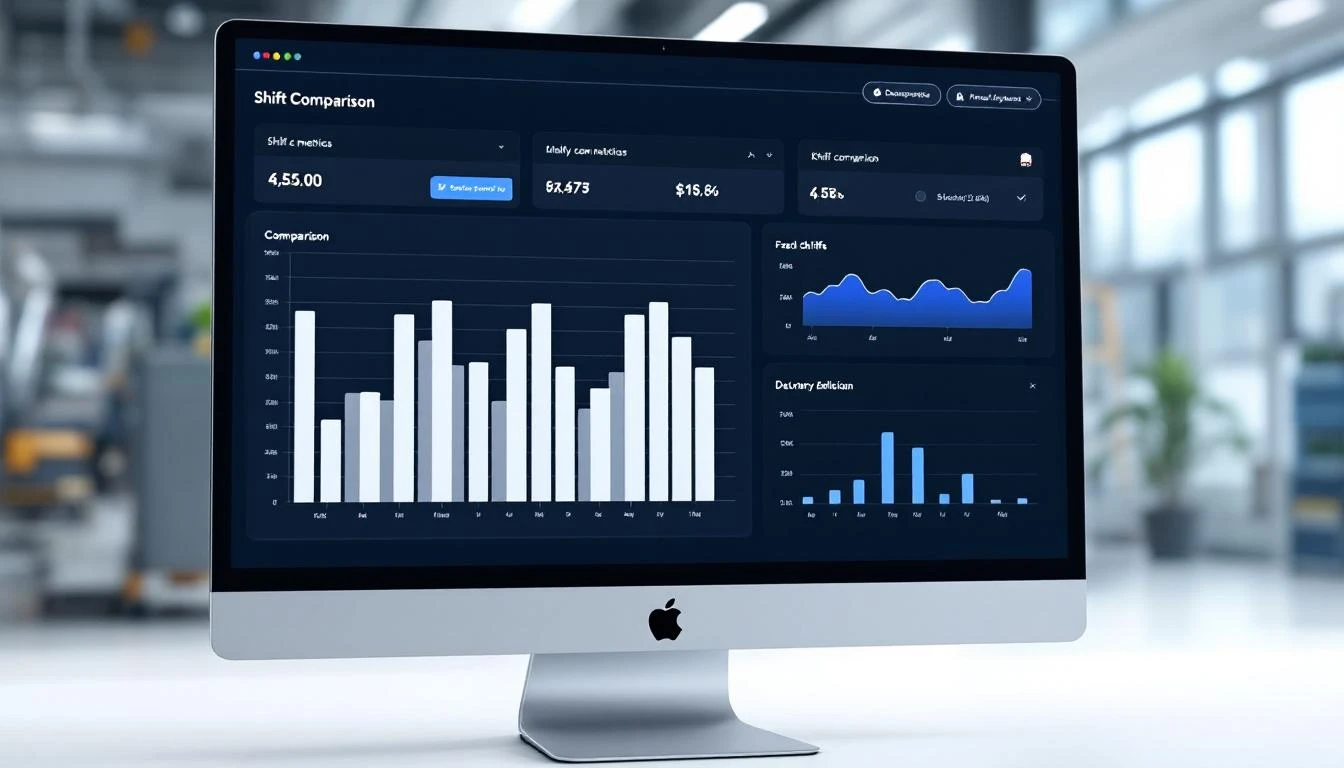
- Comparable — easy to compare today's Shift A report with yesterday's, or this week's vs. last week's
Step 5: Add Operator Notes
IIoT data captures what the machines did. But operators still have context that sensors don't: "The customer changed the spec at 1 PM," or "We switched to a new batch of raw material at 10 AM."
Build a simple interface for operators to add free-text notes to the automated report. This hybrid approach — automated data plus human context — is the gold standard.
Step 6: Implement Shift-Over-Shift Trending
Once you have shift-level data consistently captured, you can trend it over time:
- Is Shift A consistently outperforming Shift B? Why? Training gap? Staffing difference? Equipment condition at different times of day?
- Are Monday first shifts always worse? Weekend shutdown effects? Startup procedures?
- Is OEE declining shift over shift? Progressive equipment degradation? Material quality issues?
This kind of analysis is impossible with paper logbooks but trivial with IIoT data.
Real-World Implementation: What Changes
Plants that implement IIoT-based shift handovers typically see measurable improvements within the first month:
First-hour OEE improves 15-25%. Incoming operators no longer waste time figuring out what's happening — they know before they reach their stations. They can see machine states, active alarms, parameter trends, and pending maintenance on a dashboard as they walk through the door.
Repeat failures drop by 40-60%. When every alarm, fault, and anomaly is automatically recorded and carried forward, problems don't get "lost" between shifts. If Line 7's servo drive threw a fault three times on Shift A, Shift B sees that history and can escalate to maintenance before it fails completely.
Quality holds improve. Process parameter drifts are caught at handover instead of discovered through defective product. The incoming shift inherits a data-rich view of how every process has been behaving, not just a verbal "everything's fine."
Maintenance coordination improves. When maintenance activities and pending work orders are part of the automated handover, nothing slips through the cracks. The incoming shift knows exactly what was fixed, what was deferred, and what's scheduled.
Choosing the Right Platform
Not every IIoT platform handles shift-based reporting well. Look for:
- Built-in shift definitions with flexible scheduling
- Automatic report generation at shift boundaries
- Parameter trending with configurable watchlists
- Alarm history with severity classification
- OEE calculation at the shift level (not just daily or weekly)
- Operator note capability to supplement automated data
- Multi-plant support if you operate across locations
MachineCDN provides shift-based production reporting with automated data capture from PLCs via Ethernet/IP and Modbus protocols. With 3-minute device setup and zero IT involvement through cellular connectivity, you can have shift handover reporting running across your entire fleet within weeks — not the months typically required by enterprise IIoT deployments.
Getting Started
The best shift handover system is the one that's actually running. Start small:
- Pick one production line with a known handover problem
- Connect the machines to your IIoT platform
- Define 5-10 critical parameters per machine
- Configure automatic shift reports
- Run for 30 days and measure first-hour OEE improvement
Once you've proven the value on one line, expanding to the rest of the plant is straightforward — especially if your platform supports rapid device deployment without IT infrastructure changes.
Ready to eliminate shift handover gaps? Book a demo to see how MachineCDN's shift-based reporting gives every incoming shift a complete, data-driven picture of what happened, what's happening, and what needs attention.