5G Private Networks for Manufacturing: What They Mean for Industrial IoT in 2026

· 9 min read
MachineCDN Team
Industrial IoT Experts

Every major IIoT conference in 2025 and 2026 has had at least one vendor breathlessly promoting 5G private networks as the future of manufacturing connectivity. "Ultra-reliable low-latency communication! Network slicing! Massive machine-type communication! One million devices per square kilometer!"

The hype is real. But so is the technology — when applied to the right use cases. The problem is that most manufacturers don't need a 5G private network. They need reliable, low-latency connectivity to their PLCs. And for the vast majority of factory IIoT deployments, existing cellular (4G LTE) and industrial Ethernet already deliver that.

Let's separate the genuine use cases from the marketing noise.

Event-Driven Tag Delivery in IIoT: Why Polling Everything at Fixed Intervals Is Wasting Your Bandwidth [2026]

· 11 min read

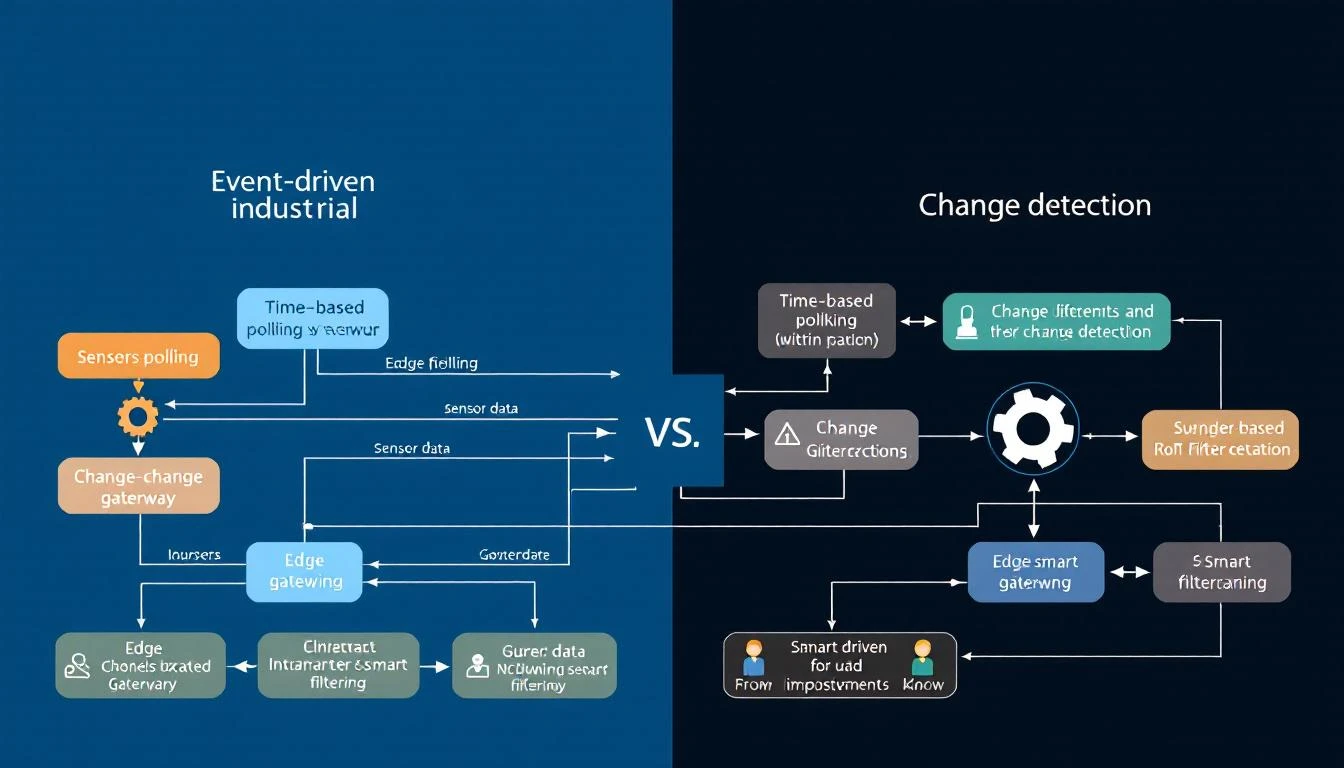
Event-Driven Tag Detection

Most IIoT deployments start the same way: poll every PLC register every second, serialize all values to JSON, and push everything to the cloud over MQTT. It works — until your cellular data bill arrives, or your broker starts choking on 500,000 messages per day from a single gateway, or you realize that 95% of those messages contain values that haven't changed since the last read.

The reality of industrial data is that most values don't change most of the time. A chiller's tank temperature drifts by a fraction of a degree per minute. A blender's motor state is "running" for 8 hours straight. A conveyor's alarm register reads zero all day — until the instant it doesn't, and that instant matters more than the previous 86,400 identical readings.

This guide covers a smarter approach: event-driven tag delivery, where the edge gateway reads at regular intervals but only transmits when something actually changes — and when something does change, it can trigger reads of related tags for complete context.

The Problem with Fixed-Interval Everything

Let's quantify the waste. Consider a typical industrial chiller with 10 compressor circuits, each exposing 16 process tags (temperatures, pressures, flow rates) and 3 alarm registers:

Tags per circuit:  16 process + 3 alarm = 19 tags
Total tags: 10 circuits × 19 = 190 tags
Poll interval: All at 1 second

At JSON format with timestamp, tag ID, and value, each data point is roughly 50 bytes. Per second, that's:

190 tags × 50 bytes = 9,500 bytes/second
= 570 KB/minute
= 34.2 MB/hour
= 821 MB/day

Over a cellular connection at $5/GB, that's $4.10/day per chiller — just for data that's overwhelmingly identical to what was sent one second ago.

Now let's separate the tags by their actual change frequency:

Tag TypeCountActual Change Frequency% of Total Data
Process temperatures100Every 30-60 seconds52.6%
Process pressures50Every 10-30 seconds26.3%
Flow rates10Every 5-15 seconds5.3%
Alarm bits30~1-5 times per day15.8%

Those 30 alarm registers — 15.8% of your data volume — change roughly 5 times per day. You're transmitting them 86,400 times. That's a 17,280x overhead on alarm data.

The Three Pillars of Event-Driven Delivery

A well-designed edge gateway implements three complementary strategies:

1. Compare-on-Read (Change Detection)

The simplest optimization: after reading a tag value from the PLC, compare it against the last transmitted value. If it hasn't changed, don't send it.

The implementation is straightforward:

# Pseudocode — NOT from any specific codebase
def should_deliver(tag, new_value, new_status):
# Always deliver the first reading
if not tag.has_been_read:
return True

# Always deliver on status change (device went offline/online)
if tag.last_status != new_status:
return True

# Compare values if compare flag is enabled
if tag.compare_enabled:
if tag.last_value != new_value:
return True
return False # Value unchanged, skip

# If compare disabled, always deliver
return True

Which tags should use change detection?

  • Alarm/status registers: Always. These are event-driven by nature — you need the transitions, not the steady state.
  • Digital I/O: Always. Binary values either changed or they didn't.
  • Configuration registers: Always. Software version numbers, setpoints, and device parameters change rarely.
  • Temperatures and pressures: Situational. If the process is stable, most readings are identical. But if you need trending data for analytics, you may want periodic delivery regardless.
  • Counter registers: Never. Counters increment continuously — every reading is "different" — and you need the raw values for accurate rate calculations.

The gotcha with floating-point comparison: Comparing IEEE 754 floats for exact equality is unreliable due to rounding. For float-typed tags, use a deadband:

# Apply deadband for float comparison
def float_changed(old_val, new_val, deadband=0.1):
return abs(new_val - old_val) > deadband

A temperature deadband of 0.1°F means you'll transmit when the temperature moves meaningfully, but ignore sensor noise.

2. Dependent Tags (Contextual Reads)

Here's where event-driven delivery gets powerful. Consider this scenario:

A chiller's compressor status word is a 16-bit register where each bit represents a different state: running, loaded, alarm, lockout, etc. You poll this register every second with change detection enabled. When bit 7 flips from 0 to 1 (alarm condition), you need more than just the status word — you need the discharge pressure, suction temperature, refrigerant level, and superheat at that exact moment to diagnose the alarm.

The solution: dependent tag chains. When a parent tag's value changes, the gateway immediately triggers a forced read of all dependent tags, delivering the complete snapshot:

Parent Tag:    Compressor Status Word (polled every 1s, compare=true)
Dependent Tags:
├── Discharge Pressure (read only when status changes)
├── Suction Temperature (read only when status changes)
├── Refrigerant Liquid Temp (read only when status changes)
├── Superheat (read only when status changes)
└── Subcool (read only when status changes)

In normal operation, the gateway reads only the status word — one register per second per compressor. When the status word changes, it reads 6 registers total and delivers them as a single timestamped group. The result:

  • Steady state: 1 register/second → 50 bytes/second
  • Event triggered: 6 registers at once → 300 bytes (once, at the moment of change)
  • vs. polling everything: 6 registers/second → 300 bytes/second (continuously)

Bandwidth savings: 99.8% during steady state, with zero data loss at the moment that matters.

3. Calculated Tags (Bit-Level Decomposition)

Industrial PLCs often pack multiple boolean signals into a single 16-bit or 32-bit "status word" or "alarm word." Each bit has a specific meaning defined in the PLC program documentation:

Alarm Word (uint16):
Bit 0: High Temperature Alarm
Bit 1: Low Pressure Alarm
Bit 2: Flow Switch Fault
Bit 3: Motor Overload
Bit 4: Sensor Open Circuit
Bit 5: Communication Fault
Bits 6-15: Reserved

A naive approach reads the entire word and sends it to the cloud, leaving the bit-level parsing to the backend. A better approach: the edge gateway decomposes the word into individual boolean tags at read time.

The gateway reads the parent tag (the alarm word), and for each calculated tag, it applies a shift and mask operation to extract the individual bit:

Individual Alarm = (alarm_word >> bit_position) & mask

Each calculated tag gets its own change detection. So when Bit 2 (Flow Switch Fault) transitions from 0 to 1, the gateway transmits only that specific alarm — not the entire word, and not any unchanged bits.

Why this matters at scale: A 10-circuit chiller has 30 alarm registers (3 per circuit), each 16 bits wide. That's 480 individual alarm conditions. Without bit decomposition, a single bit flip in one register transmits all 30 registers (because the polling cycle doesn't know which register changed). With calculated tags, only the one changed boolean is transmitted.

Batching: Grouping Efficiency

Even with change detection, transmitting each changed tag as an individual MQTT message creates excessive overhead. MQTT headers, TLS framing, and TCP acknowledgments add 80-100 bytes of overhead per message. A 50-byte tag value in a 130-byte envelope is 62% overhead.

The solution: time-bounded batching. The gateway accumulates changed tag values into a batch, then transmits the batch when either:

  1. The batch reaches a size threshold (e.g., 4KB of accumulated data)
  2. A time limit expires (e.g., 10-30 seconds since the batch started collecting)

The batch structure groups values by timestamp:

{
"groups": [
{
"ts": 1709335200,
"device_type": 1018,
"serial_number": 2411001,
"values": [
{"id": 1, "values": [245]},
{"id": 6, "values": [187]},
{"id": 7, "values": [42]}
]
}
]
}

Critical exception: alarm tags bypass batching. When a status register changes, you don't want the alarm notification sitting in a batch buffer for 30 seconds. Alarm tags should be marked as do_not_batch — they're serialized and transmitted immediately as individual messages with QoS 1 delivery confirmation.

This creates a two-tier delivery system:

Data TypeDeliveryLatencyBatching
Process valuesChange-detected, batched10-30 secondsYes
Alarm/status bitsChange-detected, immediate<1 secondNo
Periodic valuesTime-based, batched10-60 secondsYes

Binary vs. JSON: The Encoding Decision

The batch payload format has a surprisingly large impact on bandwidth. Consider a batch with 50 tag values:

JSON format:

{"groups":[{"ts":1709335200,"device_type":1018,"serial_number":2411001,"values":[{"id":1,"values":[245]},{"id":2,"values":[187]},...]}]}

Typical size: 2,500-3,000 bytes for 50 values

Binary format:

Header:     1 byte  (magic byte 0xF7)
Group count: 4 bytes
Per group:
Timestamp: 4 bytes
Device type: 2 bytes
Serial number: 4 bytes
Value count: 4 bytes
Per value:
Tag ID: 2 bytes
Status: 1 byte
Value count: 1 byte
Value size: 1 byte (1=bool/int8, 2=int16, 4=int32/float)
Values: 1-4 bytes each

Typical size: 400-600 bytes for 50 values

That's a 5-7x reduction — from 3KB to ~500 bytes per batch. Over cellular, this is transformative. A device that transmits 34 MB/day in JSON drops to 5-7 MB/day in binary, before even accounting for change detection.

The trade-off: binary payloads require a schema-aware decoder on the cloud side. Both the gateway and the backend must agree on the encoding format. In practice, most production IIoT platforms use binary encoding for device-to-cloud telemetry and JSON for cloud-to-device commands (where human readability matters and message volume is low).

The Hourly Reset: Catching Drift

One subtle problem with pure change detection: if a value drifts by tiny increments — each below the comparison threshold — the cloud's cached value can slowly diverge from reality. After hours of accumulated micro-drift, the dashboard shows 72.3°F while the actual temperature is 74.1°F.

The solution: periodic forced reads. Every hour (or at another configurable interval), the gateway resets all "read once" flags and forces a complete read of every tag, delivering all current values regardless of change. This acts as a synchronization pulse that corrects any accumulated drift and confirms that all devices are still online.

The hourly reset typically generates one large batch — a snapshot of all 190 tags — adding roughly 10-15KB once per hour. That's negligible compared to the savings from change detection during the other 3,599 seconds.

Quantifying the Savings

Let's revisit our 10-circuit chiller example with event-driven delivery:

Before (fixed interval, everything at 1s):

190 tags × 86,400 seconds × 50 bytes = 821 MB/day

After (event-driven with change detection):

Process values: 160 tags × avg 2 changes/min × 1440 min × 50 bytes = 23 MB/day
Alarm bits: 30 tags × avg 5 changes/day × 50 bytes = 7.5 KB/day
Hourly resets: 190 tags × 24 resets × 50 bytes = 228 KB/day
Overhead (headers, keepalives): ≈ 2 MB/day
──────────────────────────────────────────────────────
Total: ≈ 25.2 MB/day

With binary encoding instead of JSON:

≈ 25.2 MB/day ÷ 5.5 (binary compression) ≈ 4.6 MB/day

Net reduction: 821 MB → 4.6 MB = 99.4% bandwidth savings.

On a $5/GB cellular plan, that's $4.10/day → $0.02/day per chiller.

Implementation Checklist

If you're building or evaluating an edge gateway for event-driven tag delivery, here's what to look for:

  • Per-tag compare flag — Can you enable/disable change detection per tag?
  • Per-tag polling interval — Can fast-changing and slow-changing tags have different read rates?
  • Dependent tag chains — Can a parent tag's change trigger reads of related tags?
  • Bit-level calculated tags — Can alarm words be decomposed into individual booleans?
  • Bypass batching for alarms — Are alarm tags delivered immediately, bypassing the batch buffer?
  • Binary encoding option — Can the gateway serialize in binary instead of JSON?
  • Periodic forced sync — Does the gateway do hourly (or configurable) full reads?
  • Link state tracking — Is device online/offline status treated as a first-class event?

How machineCDN Handles Event-Driven Delivery

machineCDN's edge gateway implements all of these strategies natively. Every tag in the device configuration carries its own polling interval, change detection flag, and batch/immediate delivery preference. Alarm registers are automatically configured for 1-second polling with change detection and immediate delivery. Process values use configurable intervals with batched transmission. The gateway supports both JSON and compact binary encoding, with automatic store-and-forward buffering that retains data through connectivity outages.

The result: plants running machineCDN gateways over cellular connections typically see 95-99% lower data volumes compared to naive fixed-interval polling — without losing a single alarm event or meaningful process change.


Tired of paying for the same unchanged data point 86,400 times a day? machineCDN delivers only the data that matters — alarms instantly, process values on change, with full periodic sync. See how much bandwidth you can save.

Generative AI in Manufacturing Operations: What's Real, What's Coming, and What's Just Marketing

· 12 min read
MachineCDN Team
Industrial IoT Experts

Every manufacturing software vendor in 2026 has slapped a "Powered by AI" badge on their product. Generative AI — the technology behind ChatGPT, Claude, and Gemini — has gone from Silicon Valley novelty to enterprise must-have in under three years. But what does generative AI actually do for a plant manager with 200 machines, 47 maintenance work orders, and a 6 AM standup in 20 minutes?

The answer is more nuanced than the marketing suggests but more substantial than skeptics admit. Generative AI isn't going to replace your maintenance engineers. But it might make the difference between your best engineer being effective for 4 hours a day (drowning in data) and 7 hours a day (supported by an AI that organizes, summarizes, and surfaces what matters).

Here's what's real, what's emerging, and what's still vaporware.

How to Build a Predictive Maintenance Dashboard That Your Team Will Actually Use

· 11 min read
MachineCDN Team
Industrial IoT Experts

Most predictive maintenance dashboards fail — not because the underlying technology doesn't work, but because nobody uses them. They get built by data scientists who understand algorithms but don't understand the 6 AM maintenance standup. They display impressive ML model outputs that nobody on the floor knows how to act on.

A great predictive maintenance dashboard isn't a data science project. It's a communication tool. It translates machine data into maintenance decisions.

How to Set Up Remote PLC Diagnostics: A Practical Guide for Manufacturing Engineers

· 12 min read
MachineCDN Team
Industrial IoT Experts

Your plant's PLCs hold the truth about every machine on the floor — cycle counts, fault codes, temperature readings, pressure levels, motor currents. The problem? That data is trapped. Getting to it requires a truck roll, a laptop, and an engineer standing next to the panel.

Remote PLC diagnostics changes that equation entirely. Instead of dispatching someone every time a machine throws a fault, you can see what's happening from anywhere — your office, your home, or a different plant 500 miles away.

How to Standardize Machine Data Across Multiple Manufacturing Plants

· 11 min read
MachineCDN Team
Industrial IoT Experts

You acquire a second plant. The first plant runs Allen-Bradley PLCs with Ethernet/IP. The new plant has Siemens S7-1500s on PROFINET and a handful of legacy Mitsubishi FX units on Modbus RTU. Both plants make the same products on similar (but not identical) equipment.

Now the VP of Operations asks a simple question: "What's our OEE across both plants?"

And you realize you can't answer it. Not because the data doesn't exist, but because "Motor Temperature" in Plant A is tag N7:15 in degrees Fahrenheit, polled every 2 seconds, while the equivalent reading in Plant B is DB10.DBD4 in degrees Celsius, polled every 10 seconds. They're measuring the same thing, but the data is completely incompatible.

This is the machine data standardization problem, and it kills multi-plant visibility for manufacturers every day.

IIoT for Water and Wastewater Treatment: How to Monitor Pumps, Aeration, and Chemical Dosing in Real Time

· 9 min read
MachineCDN Team
Industrial IoT Experts

Water and wastewater treatment plants run 24/7/365 with zero tolerance for failure. When a lift station pump fails at 2 AM during a storm, raw sewage backs up into neighborhoods. When a chemical dosing system malfunctions, treated water can violate EPA discharge limits. When a blower in the aeration basin trips offline, the biological treatment process degrades within hours.

Yet most treatment plants still operate with decades-old SCADA systems that show what's happening right now but can't tell you what's about to go wrong. The industry is ripe for IIoT — and the ROI is enormous when downtime means environmental violations and public health emergencies.

Manufacturing Data Lakes vs Time-Series Databases: Where Should Your Machine Data Live?

· 9 min read
MachineCDN Team
Industrial IoT Experts

Your IIoT platform is collecting 50 million data points per day from 200 machines across 3 plants. Temperature readings every 5 seconds. Vibration samples at 1 kHz. Cycle counts, fault codes, pressure values, motor currents — all timestamped, all streaming continuously.

Where does this data go? And more importantly, how do you query it? The answer shapes the cost, performance, and analytical capability of your entire IIoT stack.

Two architectures dominate the conversation: time-series databases (TSDB) designed specifically for timestamped machine data, and data lakes that store everything in cheap object storage for batch analytics. Each has fierce advocates. Both have legitimate strengths. And most manufacturers end up needing elements of both.

Let's break it down without the vendor-driven religious wars.

Modbus Address Conventions and Function Codes: The Practical Guide Every IIoT Engineer Needs [2026]

· 11 min read

If you've ever stared at a PLC register map wondering why address 300001 means something completely different from 400001, or why your edge gateway reads all zeros from a register that should contain temperature data — this guide is for you.

Modbus has been the lingua franca of industrial automation for nearly five decades. Its longevity comes from simplicity, but that simplicity hides a handful of conventions that trip up even experienced engineers. The addressing scheme and its relationship to function codes is the single most important concept to nail before you write a single line of polling logic.

Let's break it apart.

Modbus RTU Serial Link Tuning: Baud Rate, Parity, and Timeout Optimization for Reliable PLC Communication [2026]

· 11 min read

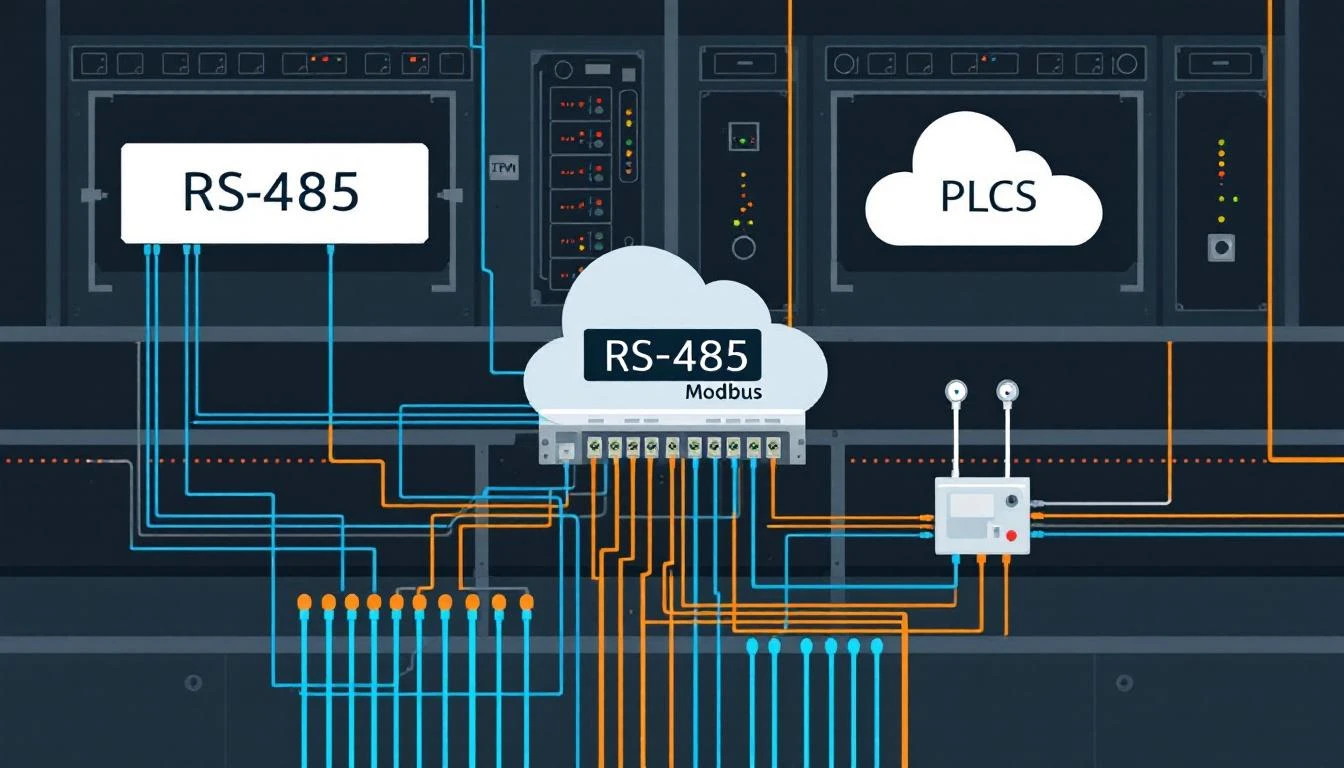
Modbus RTU Serial Communication

Modbus TCP gets all the attention in modern IIoT deployments, but Modbus RTU over RS-485 remains the workhorse of industrial communication. Millions of devices — temperature controllers, VFDs, power meters, PLCs, and process instruments — speak Modbus RTU natively. When you're building an edge gateway that bridges these devices to the cloud, getting the serial link parameters right is the difference between rock-solid telemetry and a frustrating stream of timeouts and CRC errors.

This guide covers the six critical parameters that govern Modbus RTU serial communication, the real-world trade-offs behind each one, and the tuning strategies that separate production-grade deployments from lab prototypes.

The Six Parameters That Control Everything

Every Modbus RTU serial connection is defined by six parameters that must match between the master (your gateway) and every slave device on the bus:

1. Baud Rate

The baud rate determines how many bits per second travel across the RS-485 bus. Common values:

Baud RateBits/secTypical Use Case
96009,600Legacy devices, long cable runs (>500m)
1920019,200Standard industrial default
3840038,400Mid-range, common in newer PLCs
5760057,600Higher-speed applications
115200115,200Short runs, high-frequency polling

The real-world constraint: Every device on the RS-485 bus must use the same baud rate. If you have a mix of legacy power meters at 9600 baud and newer VFDs at 38400, you need separate RS-485 segments — each with its own serial port on the gateway.

Practical recommendation: Start at 19200 baud. It's universally supported, tolerant of cable lengths up to 1000m, and fast enough for most 1-second polling cycles. Only go higher if your polling budget demands it and your cable runs are short.

2. Parity Bit

Parity provides basic error detection at the frame level:

  • Even parity (E): Most common in industrial settings. The parity bit is set so the total number of 1-bits (data + parity) is even.
  • Odd parity (O): Less common, but some older devices default to it.
  • No parity (N): Removes the parity bit entirely. When using no parity, you typically add a second stop bit to maintain frame timing.

The Modbus RTU specification recommends even parity with one stop bit as the default (8E1). However, many devices ship configured for 8N1 (no parity, one stop bit) or 8N2 (no parity, two stop bits).

Why it matters: A parity mismatch doesn't generate an error message — the slave device simply ignores the malformed frame. You'll see ETIMEDOUT errors on the master side, and the failure mode looks identical to a wiring problem or wrong slave address. This is the single most common misconfiguration in Modbus RTU deployments.

3. Data Bits

Almost universally 8 bits in modern Modbus RTU. Some ancient devices use 7-bit ASCII mode, but if you encounter one in 2026, it's time for a hardware upgrade. Don't waste time debugging 7-bit configurations — the Modbus RTU specification mandates 8 data bits.

4. Stop Bits

Stop bits mark the end of each byte frame:

  • 1 stop bit: Standard when using parity (8E1 or 8O1)
  • 2 stop bits: Standard when NOT using parity (8N2)

The total frame length should be 11 bits: 1 start + 8 data + 1 parity + 1 stop, OR 1 start + 8 data + 0 parity + 2 stop. This 11-bit frame length matters because the Modbus RTU inter-frame gap (the "silent interval" between messages) is defined as 3.5 character times — and a "character time" is 11 bits at the configured baud rate.

5. Byte Timeout

This is where things get interesting — and where most tuning guides fall short.

The byte timeout (also called "inter-character timeout" or "character timeout") defines how long the master waits between individual bytes within a single response frame. If the gap between any two consecutive bytes exceeds this timeout, the master treats it as a frame boundary.

The Modbus RTU specification says: The inter-character gap must not exceed 1.5 character times. At 9600 baud with 11-bit frames, one character time is 11/9600 = 1.146ms, so the maximum inter-character gap is 1.5 × 1.146ms ≈ 1.72ms.

What actually happens in practice:

At 9600 baud:  1 char = 1.146ms → byte timeout ≈ 2ms (safe margin)
At 19200 baud: 1 char = 0.573ms → byte timeout ≈ 1ms
At 38400 baud: 1 char = 0.286ms → byte timeout ≈ 500μs
At 115200 baud: 1 char = 0.095ms → byte timeout ≈ 200μs

The catch: At baud rates above 19200, the byte timeout drops below 1ms. Most operating systems can't guarantee sub-millisecond timer resolution, especially on embedded Linux or OpenWrt. This is why many Modbus RTU implementations clamp the byte timeout to a minimum of 500μs regardless of baud rate.

Practical recommendation: Set byte timeout to max(500μs, 2 × character_time). On embedded gateways running Linux, use 1000μs (1ms) as a safe floor.

6. Response Timeout

The response timeout defines how long the master waits after sending a request before declaring the slave unresponsive. This is the most impactful tuning parameter for overall system performance.

Factors that affect response time:

  1. Request transmission time: At 19200 baud, an 8-byte request takes ~4.6ms
  2. Slave processing time: Varies from 1ms (simple register read) to 50ms+ (complex calculations or EEPROM access)
  3. Response transmission time: At 19200 baud, a 40-register response (~85 bytes) takes ~48.7ms
  4. RS-485 transceiver turnaround: 10-50μs

The math for worst case:

Total = request_tx + slave_processing + turnaround + response_tx
= 4.6ms + 50ms + 0.05ms + 48.7ms
≈ 103ms

Practical recommendation: Set response timeout to 200-500ms for most applications. Some slow devices (energy meters doing power quality calculations) may need 1000ms. If you're polling temperature sensors that update once per second, there's no penalty to a generous 500ms timeout.

The retry question: When a timeout occurs, should you retry immediately? In production edge gateways, the answer is nuanced:

  • Retry 2-3 times before marking the device as offline
  • Insert a 50ms pause between retries to let the bus settle
  • Flush the serial buffer between retries to clear any partial frames
  • Track consecutive timeouts — if a device fails 3 reads in a row, something has changed (wiring, device failure, address conflict)

RS-485 Bus Topology: The Physical Foundation

No amount of parameter tuning can compensate for bad RS-485 wiring. The critical rules:

Daisy-chain only. RS-485 is a multi-drop bus, NOT a star topology. Every device must be wired in series — A to A, B to B — from the first device to the last.

Gateway ---[A/B]--- Device1 ---[A/B]--- Device2 ---[A/B]--- Device3
|
120Ω terminator

Termination resistors: Place a 120Ω resistor across A and B at both ends of the bus — at the gateway and at the last device. Without termination, reflections on long cable runs cause bit errors that look like random CRC failures.

Cable length limits:

Baud RateMax Cable Length
96001200m (3900 ft)
192001000m (3200 ft)
38400700m (2300 ft)
115200300m (1000 ft)

Maximum devices per segment: The RS-485 spec allows 32 unit loads per segment. Modern 1/4 unit-load transceivers can push this to 128, but in practice, keep it under 32 devices to maintain signal integrity.

Slave Address Configuration

Every device on a Modbus RTU bus needs a unique slave address (1-247). Address 0 is broadcast-only (no response expected), and addresses 248-255 are reserved.

The slave address is configured at the device level — typically through DIP switches, front-panel menus, or configuration software. The gateway needs to match.

Common mistake: Address 1 is the factory default for almost every Modbus device. If you connect two new devices without changing addresses, neither will respond reliably — they'll both try to drive the bus simultaneously, corrupting each other's responses.

Contiguous Register Grouping: The Bandwidth Multiplier

The most impactful optimization for Modbus RTU polling performance isn't a link parameter — it's how you structure your read requests.

Modbus function codes 03 (Read Holding Registers) and 04 (Read Input Registers) can read up to 125 contiguous registers in a single request. Instead of issuing separate requests for each tag, a well-designed gateway groups tags by:

  1. Function code — holding registers and input registers require different commands
  2. Address contiguity — registers must be adjacent (no gaps)
  3. Polling interval — tags polled at the same rate should be read together
  4. Maximum PDU size — cap at 50-100 registers per request to avoid overwhelming slow devices

Example: If you need registers 40001, 40002, 40003, 40010, 40011:

  • Naive approach: 5 separate read requests (5 × 12ms round-trip = 60ms)
  • Grouped approach: Read 40001-40003 in one request, 40010-40011 in another (2 × 12ms = 24ms)

The gap between 40003 and 40010 breaks contiguity, so two requests are optimal. But reading 40001-40011 as one block (11 registers) might be acceptable — the extra 7 "wasted" registers add only ~7ms of transmission time, which is less than the overhead of an additional request-response cycle.

Production-grade gateways build contiguous read groups at startup and maintain them throughout the polling cycle, only splitting groups when address gaps exceed a configurable threshold.

Error Handling: Beyond the CRC

Modbus RTU includes a 16-bit CRC at the end of every frame. If the CRC doesn't match, the frame is discarded. But there are several failure modes beyond CRC errors:

ETIMEDOUT — No response from slave:

  • Wrong slave address
  • Baud rate or parity mismatch
  • Wiring fault (A/B swapped, broken connection)
  • Device powered off or in bootloader mode
  • Bus contention (two devices with same address)

ECONNRESET — Connection reset:

  • On RS-485, this usually means the serial port driver detected a framing error
  • Often caused by electrical noise or ground loops
  • Add ferrite cores to cables near VFDs and motor drives

EBADF — Bad file descriptor:

  • The serial port was disconnected (USB-to-RS485 adapter unplugged)
  • Requires closing and reopening the serial connection

EPIPE — Broken pipe:

  • Rare on physical serial ports, more common on virtual serial ports or serial-over-TCP bridges
  • Indicates the underlying transport has failed

For each of these errors, a robust gateway should:

  1. Close the Modbus connection and flush all buffers
  2. Wait a brief cooldown (100-500ms) before attempting reconnection
  3. Update link state to notify the cloud that the device is offline
  4. Log the error type for remote diagnostics

Tuning for Specific Device Types

Different industrial devices have different Modbus RTU characteristics:

Temperature Controllers (TCUs)

  • Typically use function code 03 (holding registers)
  • Response times: 5-15ms
  • Recommended timeout: 200ms
  • Polling interval: 5-60 seconds (temperatures change slowly)

Variable Frequency Drives (VFDs)

  • Often have non-contiguous register maps
  • Response times: 10-30ms
  • Recommended timeout: 300ms
  • Polling interval: 1-5 seconds for speed/current, 60s for configuration

Power/Energy Meters

  • Large register blocks (power quality data)
  • Response times: 20-100ms (some meters buffer internally)
  • Recommended timeout: 500-1000ms
  • Polling interval: 1-15 seconds depending on resolution needed

Central Chillers (Multi-Circuit)

  • Dozens of input registers per compressor circuit
  • Deep register maps spanning 700+ addresses
  • Naturally contiguous register layouts within each circuit
  • Alarm bit registers should be polled at 1-second intervals with change detection
  • Process values (temperatures, pressures) can use 60-second intervals

Putting It All Together

A production Modbus RTU configuration for a typical industrial gateway looks like this:

# Example configuration (generic format)
serial_port: /dev/ttyUSB0
baud_rate: 19200
parity: even # 'E' — matches Modbus spec default
data_bits: 8
stop_bits: 1
slave_address: 1
byte_timeout_ms: 1
response_timeout_ms: 300

# Polling strategy
max_registers_per_read: 50
retry_count: 3
retry_delay_ms: 50
flush_between_retries: true

How machineCDN Handles Modbus RTU

machineCDN's edge gateway handles both Modbus TCP and Modbus RTU through a unified data acquisition layer. The gateway auto-configures serial link parameters from the device profile, groups contiguous registers for optimal bus utilization, implements intelligent retry logic with bus-level error recovery, and bridges Modbus RTU data to cloud-bound MQTT with store-and-forward buffering. Whether your devices speak Modbus RTU at 9600 baud or EtherNet/IP over Gigabit Ethernet, the data arrives in the same normalized format — ready for analytics, alerting, and operational dashboards.


Need to connect legacy Modbus RTU devices to a modern IIoT platform? machineCDN bridges serial protocols to the cloud without replacing your existing equipment. Talk to us about your multi-protocol deployment.