The Maintenance Maturity Model: From Reactive to Prescriptive — Where Does Your Plant Actually Stand?

Every manufacturing plant claims to be "doing predictive maintenance." In reality, most are somewhere between reactive and preventive, with a few vibration sensors they call "predictive" because a vendor told them to.
This isn't a criticism — it's a diagnostic. Understanding where you actually are on the maintenance maturity model is the first step to getting where you need to be. And more importantly, understanding which level makes sense for your plant, because not every operation needs to reach the peak.
The Five Levels of Maintenance Maturity
Level 1: Reactive (Run-to-Failure)
Description: Fix it when it breaks. No scheduled maintenance. No monitoring. Equipment runs until it fails, then the maintenance team scrambles to repair it.
What it looks like in practice:
- Maintenance team spends 80%+ of their time on emergency repairs
- Spare parts are either overstocked (just in case) or unavailable (didn't see it coming)
- Production schedule is dictated by equipment failures, not customer demand
- Maintenance costs are unpredictable — some months $50K, some months $200K
- Operators have workarounds for equipment quirks that maintenance doesn't know about
Who's still here: More plants than will admit it. According to a Plant Engineering survey, approximately 55% of maintenance activities in North American manufacturing are still reactive. Even plants that have a PM program often revert to reactive mode when they're short-staffed or behind on production.
The math: Reactive maintenance costs 3-5× more than planned maintenance per repair event, according to the Department of Energy. An emergency bearing replacement on a production-critical machine costs $15K-$25K when you factor in expedited parts, overtime labor, lost production, and the quality issues from an uncontrolled shutdown.
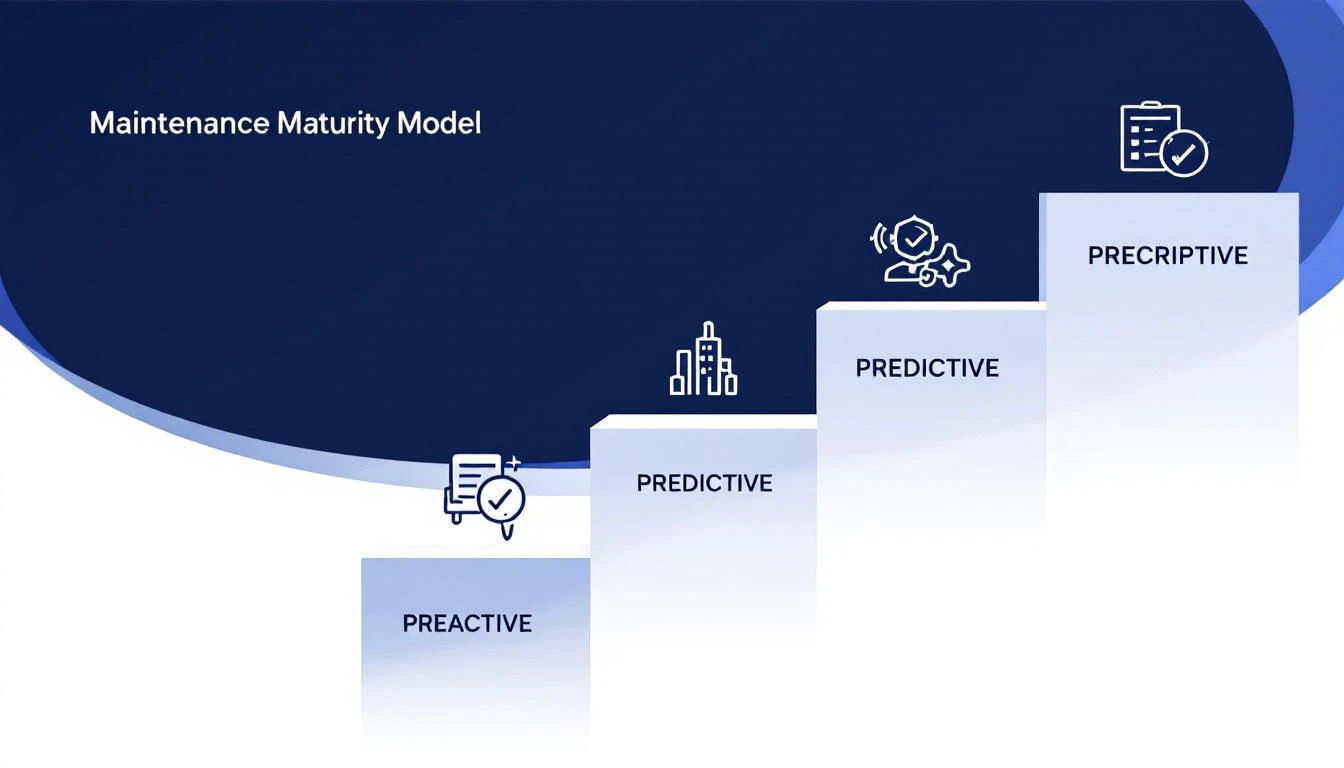
Level 2: Preventive (Time-Based)
Description: Service equipment on a fixed schedule — every 3 months, every 500 hours, every 10,000 cycles. Regardless of actual condition.
What it looks like in practice:
- Maintenance calendar drives activities: oil changes, filter replacements, belt inspections on schedule
- PM compliance is tracked (and often reported to management as a KPI)
- Unplanned downtime is lower than reactive mode but still significant
- Some over-maintenance occurs — replacing parts that still have 50% of their useful life remaining
- Work order system exists and is reasonably well-populated
The improvement over reactive: Preventive maintenance reduces unplanned downtime by 25-35% compared to reactive maintenance. That's significant. But it has a ceiling.
The limitation: Time-based maintenance assumes equipment degrades linearly, which it doesn't. A motor bearing might last 8,000 hours in one application and 3,000 hours in another, depending on load, alignment, lubrication, and environmental conditions. A fixed 6-month replacement schedule either replaces bearings too early (wasting money) or too late (causing failures).
The false comfort: Many plants reach Level 2 and stop, believing they've "done their maintenance transformation." PM compliance of 90%+ feels like victory. But if 40% of those PMs are unnecessary (parts replaced too early) and the remaining unplanned failures happen to critical equipment, you've reduced costs without reducing risk.
Level 3: Condition-Based (Monitor and React)
Description: Monitor equipment condition using sensors and measurements. Maintain based on actual condition rather than arbitrary schedules.
What it looks like in practice:
- Vibration analysis on rotating equipment (motors, pumps, fans, compressors)
- Oil analysis on lubricated systems (gearboxes, hydraulic systems)
- Thermography on electrical systems (switchgear, connections, motor windings)
- Ultrasonic testing for bearing defects and steam trap failures
- Maintenance decisions driven by measurement data, not calendar dates
The improvement over preventive: Condition-based maintenance (CBM) reduces maintenance costs by 25-30% compared to time-based PM, according to the US Department of Energy. More importantly, it reduces the right kind of failures — the ones that cause significant production losses.
The limitation: Traditional CBM is periodic. A vibration analyst visits each machine monthly, takes readings, analyzes spectra, writes a report. If a bearing develops a defect on Day 3 after the last reading, you won't know until Day 33. A lot can happen in 30 days.
The technology gap: This is where IIoT starts to change the game. Traditional CBM requires trained analysts walking the floor with portable instruments. IIoT enables continuous condition monitoring — every parameter, every second, automatically. What was monthly becomes real-time.
Level 4: Predictive (Forecast and Plan)
Description: Use historical data patterns and statistical models to predict when equipment will fail. Schedule maintenance based on predicted remaining useful life, not current condition.
What it looks like in practice:
- Continuous monitoring of equipment parameters via IIoT sensors and PLC data
- Machine learning models trained on historical failure data
- Remaining useful life (RUL) estimates for critical components
- Maintenance scheduled weeks or months in advance based on predictions
- Integration between monitoring system and CMMS for automatic work order generation
- Spare parts ordered based on predicted need, not safety stock
The improvement over condition-based: Predictive maintenance reduces maintenance costs by an additional 8-12% over CBM, according to McKinsey. But the bigger impact is on production: predictive maintenance enables maintenance to be scheduled during planned downtime (weekends, holidays, shift changes) rather than during production.
What makes it work:
-
Sufficient historical data — You need 6-12 months of continuous monitoring data to build meaningful predictions. This is why starting IIoT monitoring today pays off in 6 months even if you're not doing anything predictive yet.
-
Failure examples — ML models learn from failures. If a bearing has never failed in your dataset, the model can't predict bearing failures. This is the cold-start problem, and it's why many "AI-powered predictive maintenance" claims fall flat in the first year.
-
Domain expertise — The best predictive maintenance systems combine data science with engineering knowledge. A vibration signature that means "bearing outer race defect" on a pump means something entirely different on a spindle motor. Context matters.
-
Integration — Prediction without action is just an interesting chart. The prediction must trigger a work order, reserve spare parts, and schedule labor. This requires integration with your CMMS or maintenance management system.

Level 5: Prescriptive (Recommend and Optimize)
Description: Not just predict when equipment will fail, but recommend what to do about it — considering production schedule, spare parts availability, labor resources, and business priorities.
What it looks like in practice:
- System predicts: "Motor on Press #7 has 72% probability of bearing failure within 21 days"
- System recommends: "Replace bearing during scheduled Saturday shutdown on March 15. Parts: SKF 6308-2RS (in stock, bin 47B). Estimated labor: 3 hours, 2 technicians. Production impact: zero (Saturday shutdown)."
- Alternative recommendations when constraints exist: "If Saturday shutdown is cancelled, next best window is Tuesday night shift (7% utilization, minimum production impact)"
- Automatic optimization of maintenance scheduling across multiple assets
Who's actually here: Almost nobody. Prescriptive maintenance is the aspirational peak of the maturity model. A handful of organizations in aerospace, power generation, and semiconductor manufacturing have elements of prescriptive maintenance for their most critical assets. In general manufacturing, it's largely theoretical — and that's okay.
Why it matters anyway: Understanding Level 5 helps you build toward it incrementally. Even partial prescriptive capabilities — like automatically suggesting the best maintenance window based on production schedule and parts availability — deliver significant value without requiring full AI autonomy.
Assessing Your Current Level
Be honest with yourself. Here's a quick diagnostic:
| Question | Your Answer Reveals |
|---|---|
| What percentage of your maintenance is unplanned? | Over 60% = Level 1, 40-60% = Level 2, 20-40% = Level 3, Under 20% = Level 4 |
| Do you replace parts on a schedule or based on condition? | Schedule = Level 2, Condition = Level 3+ |
| Can you predict a failure more than 1 week before it happens? | No = Level 1-3, Sometimes = Level 3-4, Consistently = Level 4+ |
| Do you know the remaining useful life of critical components? | No idea = Level 1-2, Rough estimate = Level 3, Data-driven = Level 4 |
| Is your maintenance schedule optimized against production? | No = Level 1-3, Manually = Level 3-4, Automatically = Level 5 |
Most manufacturing plants land between Level 2 and Level 3 — they have a PM program but limited or no condition monitoring. Some have pockets of Level 3 (vibration analysis on a few critical machines) but the rest of the plant is Level 2 at best.
The Realistic Advancement Roadmap
Level 1 → Level 2: Build the Foundation (3-6 months)
What to do:
- Implement a CMMS or work order system
- Create PM schedules for all production-critical equipment based on manufacturer recommendations
- Build a spare parts tracking system
- Train maintenance team on PM execution and documentation
- Target: 85% PM compliance
Investment: $50K-$150K (CMMS software, initial training, parts inventory) ROI timeline: 6-12 months (reduced emergency repairs, lower parts costs)
Level 2 → Level 3: Add Condition Monitoring (6-12 months)
What to do:
- Deploy IIoT monitoring on the top 20% of equipment (by criticality and failure cost)
- Configure threshold alerts for temperature, vibration, pressure, and current
- Begin trending equipment parameters over time
- Train maintenance team to interpret condition data
- Start replacing time-based PMs with condition-based decisions on monitored equipment
Investment: $100K-$300K (IIoT platform, connectivity, training) ROI timeline: 3-6 months (MachineCDN customers typically see ROI within 5 weeks)
Level 3 → Level 4: Develop Predictive Capability (12-24 months)
What to do:
- Accumulate 6-12 months of continuous monitoring data (you've been collecting since Level 3)
- Identify failure patterns in historical data
- Implement predictive models for top 10 failure modes
- Integrate monitoring system with CMMS for automatic work order generation
- Build predictive maintenance dashboards for the maintenance team
- Measure prediction accuracy and refine models quarterly
Investment: $200K-$500K (expanded monitoring, analytics platform, data science) ROI timeline: 12-18 months (reduced unplanned downtime on critical equipment)
Level 4 → Level 5: Optimize Holistically (24-36 months)
What to do:
- Integrate maintenance predictions with production scheduling
- Implement multi-asset optimization (which machine gets maintained first?)
- Add resource optimization (labor, parts, tools)
- Develop scenario modeling capability
- Continuous model improvement
Investment: $500K+ (advanced analytics, integration, organizational change) ROI timeline: 18-24 months (system-level optimization)
Where Should You Aim?
Not every plant needs to reach Level 5. Here's a framework:
Level 3 is sufficient for plants with:
- Moderate equipment criticality (no single machine shuts down the entire operation)
- Standard equipment types (pumps, motors, conveyors)
- Maintenance team with strong troubleshooting skills
- Limited data science resources
Level 4 is worth pursuing for plants with:
- High-value production assets ($500K+ per machine)
- Significant cost of unplanned downtime ($50K+/hour)
- Complex equipment with multiple failure modes
- Available historical failure data
- Organizational willingness to act on data-driven recommendations
Level 5 is justified for plants with:
- Continuous process operations (24/7, no natural maintenance windows)
- Extremely high consequence of failure (safety, environmental, regulatory)
- Large maintenance organization needing optimization
- Executive commitment to data-driven operations
The Practical Truth
The biggest mistake in maintenance maturity is trying to jump from Level 1 to Level 4. It doesn't work. You need the PM discipline of Level 2, the monitoring infrastructure of Level 3, and the data history of continuous monitoring before predictive capabilities become meaningful.
Start where you are. Move one level at a time. Each level delivers standalone value — you don't need to reach Level 4 to see significant improvements. A plant that moves from Level 1 to Level 3 reduces unplanned downtime by 50-70% and maintenance costs by 30-40%. That's transformative, and it's achievable within 12 months.
Ready to assess your maintenance maturity and build a practical advancement roadmap? Book a demo to see how MachineCDN's IIoT platform takes you from time-based maintenance to condition-based and predictive — with 5-week ROI and zero IT infrastructure requirements.