Total Cost of Ownership for IIoT Platforms: The Complete Guide to What You'll Actually Spend

When manufacturing leaders evaluate Industrial IoT platforms, the conversation usually starts with license cost. "What's it per device? Per user? Per data point?" These are the wrong first questions. License fees typically represent only 20-40% of your total IIoT investment over three years. The rest hides in implementation, infrastructure, engineering time, change management, and ongoing operations.
This guide breaks down every cost component of an IIoT deployment, compares TCO across different platform approaches, and gives you a framework to build a realistic budget that won't surprise your CFO in year two.
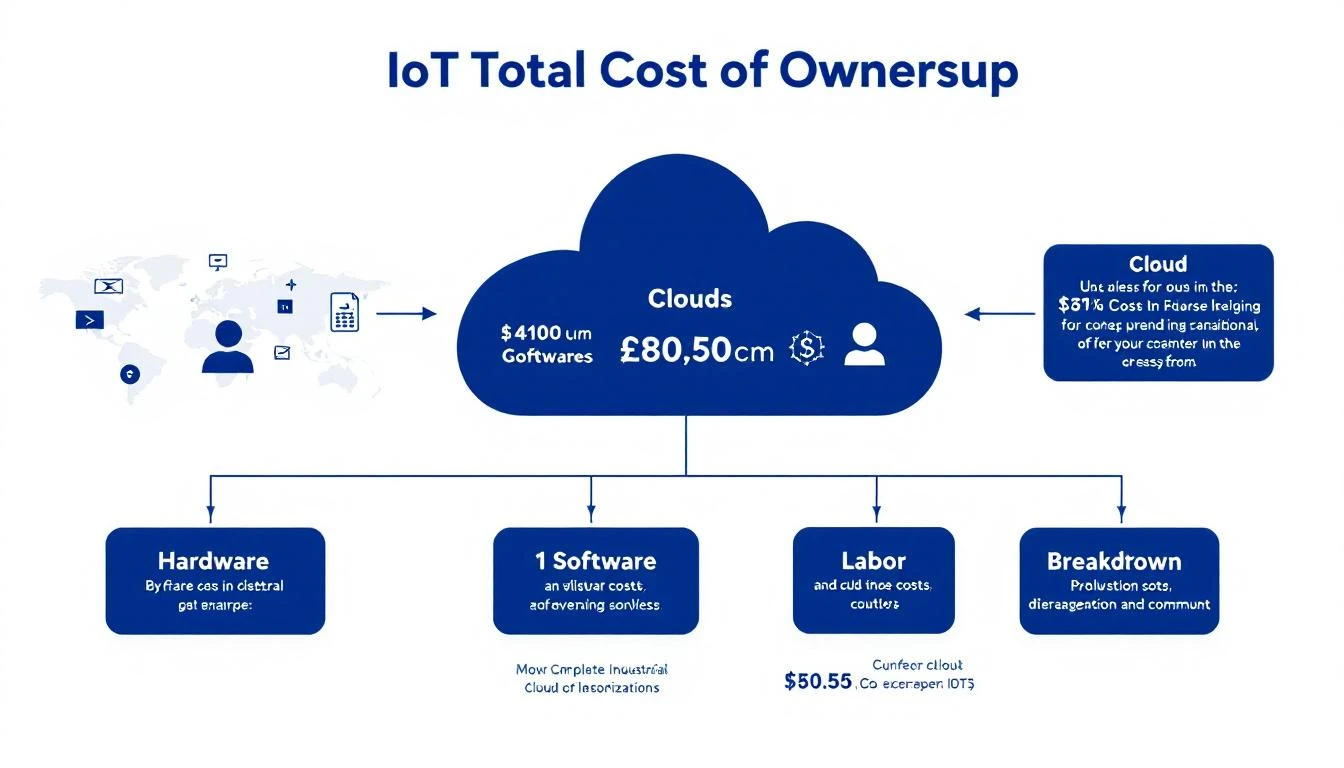
The Five Layers of IIoT Cost
Layer 1: Platform Licensing
This is the number everyone asks about first, and it varies dramatically by platform type:
Per-device/per-gateway pricing:
- Range: $50-$500/device/month
- Examples: MachineCDN, Litmus Edge, MachineMetrics
- Advantage: Predictable scaling — you know the cost of adding each machine
- Risk: Can get expensive at scale (100+ machines)
Per-user pricing:
- Range: $50-$200/user/month
- Examples: Tulip, some CMMS platforms
- Advantage: Low entry cost for small teams
- Risk: Penalizes broad data access — you end up limiting who can see dashboards
Platform/enterprise licensing:
- Range: $50,000-$500,000+ per year
- Examples: Siemens MindSphere, PTC ThingWorx, AVEVA, C3 AI
- Advantage: Unlimited scale within the license
- Risk: Massive upfront commitment, long procurement cycles
Usage-based pricing:
- Range: $0.001-$0.01 per data point ingested
- Examples: AWS IoT SiteWise, Azure IoT Hub
- Advantage: Pay only for what you use
- Risk: Unpredictable costs — data volumes are hard to forecast
Open-source (free license, pay for infrastructure):
- Range: $0 (license) + $10,000-$100,000/year (infrastructure + engineering)
- Examples: Node-RED, Apache Kafka, InfluxDB OSS
- Advantage: No vendor lock-in
- Risk: All engineering, security, and reliability costs fall on you
Layer 2: Hardware and Infrastructure
IIoT platforms need physical infrastructure to connect to your machines:
Edge devices/gateways:
- Industrial edge devices: $500-$5,000 each
- Industrial PCs for SCADA-class workloads: $3,000-$10,000 each
- Retrofit sensors (vibration, temperature, pressure): $100-$1,000 each
- I/O modules for legacy equipment: $200-$1,000 each
Network infrastructure:
- Industrial Ethernet switches: $500-$2,000 each
- WiFi access points (industrial): $1,000-$3,000 each
- Cellular modems/plans: $30-$100/month per device
- Network cabling (if new): $50-$200 per run
Cloud infrastructure (if not included in platform):
- Compute: $500-$5,000/month
- Storage: $100-$1,000/month (time-series data grows fast)
- Data egress: $50-$500/month (often overlooked)
- Database services: $200-$2,000/month
MachineCDN's approach eliminates most infrastructure costs: the edge device connects via cellular (no plant network needed), and cloud infrastructure is included in the subscription. No servers to provision, no database to manage, no network to build.
Layer 3: Implementation
This is where TCO models diverge most dramatically:
Traditional enterprise IIoT (ThingWorx, MindSphere, AVEVA):
- Solution architecture and design: $20,000-$50,000
- System integrator fees: $100-$300/hour, 500-2,000 hours typical
- Data modeling and configuration: $15,000-$50,000
- Dashboard/application development: $20,000-$100,000
- Integration with MES, ERP, CMMS: $25,000-$100,000 per system
- Testing and validation: $10,000-$30,000
- Total implementation: $100,000-$500,000+
- Timeline: 6-18 months
Mid-market IIoT (MachineMetrics, Litmus Edge):
- Solution design: $5,000-$15,000
- Configuration and deployment: $10,000-$30,000
- Dashboard customization: $5,000-$20,000
- Integration: $10,000-$30,000
- Total implementation: $30,000-$100,000
- Timeline: 2-6 months
Plug-and-play IIoT (MachineCDN):
- Device setup: 3 minutes per machine (internal labor only)
- Tag configuration: Hours, not weeks
- Dashboard: Built-in, no development needed
- Integration: API available if needed
- Total implementation: Minimal (internal labor)
- Timeline: Days to weeks
- ROI in 5 weeks
Layer 4: Ongoing Operations
Post-deployment costs that accumulate year after year:
Platform maintenance:
- Software updates and patches: Included in SaaS pricing; $10,000-$50,000/year for on-premise
- Edge device firmware updates: Typically OTA (included) or manual ($1,000-$5,000/year)
- Dashboard and report maintenance: $5,000-$20,000/year for custom-built
Engineering time:
- Adding new machines/tags: 1-8 hours per machine (depending on platform complexity)
- Troubleshooting connectivity issues: 2-10 hours/month average
- User training for new team members: $1,000-$5,000/year
- Data quality management: 2-5 hours/month
Infrastructure operations (self-hosted only):
- Server administration: $20,000-$50,000/year (internal or managed)
- Database management: $10,000-$30,000/year
- Backup and disaster recovery: $5,000-$15,000/year
- Security patching and compliance: $5,000-$20,000/year
Vendor support:
- Basic support: Usually included
- Premium/priority support: $5,000-$30,000/year
- Professional services retainer: $20,000-$100,000/year
Layer 5: Opportunity Cost and Risk
The hardest costs to quantify but often the largest:
Delayed value realization:
- A 12-month implementation means 12 months of unplanned downtime you could have prevented
- At $260,000/hour average downtime cost, even one prevented incident per quarter = $1M/year in avoided losses
- The difference between a 2-week deployment and a 12-month deployment is 11.5 months of lost preventive value
Vendor lock-in risk:
- Proprietary platforms increase switching costs over time
- Data portability limitations can trap you with a vendor even after needs change
- Platform sunset risk (Predix, MindSphere rebrandings) forces re-implementation
Scaling limitations:
- Platforms that require per-machine implementation projects scale slowly
- If expanding from pilot (10 machines) to full plant (200 machines) requires proportional implementation effort, scaling takes years
TCO Comparison: Three Scenarios
Scenario 1: Small Manufacturer (50 Machines, Single Plant)
| Cost Component | Enterprise Platform | Mid-Market Platform | MachineCDN |
|---|---|---|---|
| License (Year 1) | $150,000 | $48,000 | Subscription |
| Hardware/Infrastructure | $50,000 | $25,000 | Included (cellular) |
| Implementation | $200,000 | $60,000 | Minimal |
| Year 1 Operations | $30,000 | $15,000 | Included |
| Year 1 Total | $430,000 | $148,000 | Fraction |
| Time to First Value | 9-12 months | 3-5 months | Days |
| Time to Full Deployment | 12-18 months | 6-9 months | 2-4 weeks |
| 3-Year TCO | $700,000-$1M | $300,000-$400,000 | Significantly lower |
Scenario 2: Mid-Size Manufacturer (200 Machines, 3 Plants)
| Cost Component | Enterprise Platform | Mid-Market Platform | MachineCDN |
|---|---|---|---|
| License (Year 1) | $300,000 | $144,000 | Subscription |
| Hardware/Infrastructure | $150,000 | $75,000 | Included (cellular) |
| Implementation | $500,000 | $150,000 | Minimal |
| Year 1 Operations | $60,000 | $30,000 | Included |
| Year 1 Total | $1,010,000 | $399,000 | Fraction |
| Time to First Value | 12-18 months | 6-9 months | Days |
| 3-Year TCO | $1.5M-$2M | $700,000-$900,000 | Significantly lower |
Scenario 3: Large Enterprise (1,000+ Machines, 10+ Plants)
At this scale, enterprise platforms' unlimited licensing starts to show value — but implementation costs dominate:
- Enterprise platforms: $3M-$10M over 3 years (primarily implementation and integration)
- The implementation never truly "ends" — there's always the next plant, the next integration, the next dashboard request
- Many enterprises are 3+ years into their IIoT journey and still haven't connected all their machines
MachineCDN's approach — connect every machine in days, not months — changes the math entirely at enterprise scale. Instead of rolling out plant-by-plant over years, you can connect all 1,000 machines in weeks.
How to Build Your TCO Model
Step 1: Inventory Your Assets
- How many machines will you connect? (Start with critical assets, plan for expansion)
- What PLC protocols do they use? (Ethernet/IP, Modbus, OPC UA)
- How many plants/locations?
- What's your current network infrastructure?
Step 2: Define Your Use Cases
- Real-time monitoring only? Or full predictive maintenance?
- OEE tracking?
- Energy monitoring?
- Integration with existing systems (ERP, CMMS, MES)?
Step 3: Map Costs to Each Layer
Use the five-layer framework above. Get quotes from vendors that include ALL costs, not just licensing. Ask specifically:
- "What does implementation cost?"
- "What infrastructure do I need to provide?"
- "What's the ongoing support/operations cost?"
- "How long until I see value from the first connected machine?"
Step 4: Factor in Time-to-Value
The most overlooked TCO component. If Platform A costs $100,000/year but takes 12 months to deploy, and Platform B costs $120,000/year but deploys in 2 weeks, Platform B delivers 11 months more value in year one. If that value is preventing one downtime event, Platform B is cheaper by $140,000+.
Step 5: Build a 3-Year Model
IIoT is a long-term investment. Year 1 costs (heavy on implementation) look very different from Year 3 costs (mostly licensing and operations). Make sure your CFO sees the full picture, including the cost reduction curve as the platform matures.
Common TCO Mistakes
1. Ignoring Engineering Time
"We'll build it ourselves with open-source tools." The tools are free. The 2,000 engineering hours are not. A senior OT engineer costs $80-$120/hour fully loaded. That "free" platform costs $160,000-$240,000 in engineering time — and it's never done.
2. Under-Scoping Integration
Connecting your IIoT platform to ERP, CMMS, MES, and quality systems always costs more than planned. Every integration has edge cases, data mapping challenges, and ongoing maintenance. Budget 2x what the integrator quotes.
3. Forgetting About Training
People change roles. New maintenance techs join. The engineer who built your dashboards leaves. If your platform requires specialized knowledge to operate, budget for ongoing training — $5,000-$15,000/year.
4. Assuming Year 1 = Year 3
Year 1 includes implementation, Year 3 doesn't. But Year 3 includes: expanded scope (more machines), new use cases (analytics you didn't plan initially), and platform upgrades that may require re-configuration.
The Bottom Line
Total cost of ownership for IIoT is 2-5x the platform license cost. The platforms that appear cheapest on paper often have the highest total cost because of implementation complexity, infrastructure requirements, and engineering effort.
The platforms that minimize TCO share common traits: fast deployment, cloud-native (no infrastructure to manage), built-in analytics (no dashboard development), and cellular connectivity (no network to build). MachineCDN was designed around these principles — 3-minute setup, zero IT involvement, and ROI in 5 weeks.
Ready to see what an IIoT platform with minimal TCO looks like in practice? Book a demo and start monitoring machines without the six-figure implementation project.