IIoT for Woodworking and Lumber Manufacturing: How to Monitor Sawmills, CNC Routers, and Drying Kilns in Real Time

Woodworking and lumber manufacturing operate in a unique space: heavy industrial processes producing natural material products with inherent variability. Moisture content shifts between logs. Blade wear changes cut quality unpredictably. Kiln temperatures drift. Adhesive curing depends on ambient conditions. This variability makes real-time monitoring not just valuable — it's essential for consistent output.
Yet most wood products operations still rely on manual checks, periodic inspections, and operator experience to catch problems. A kiln running 2°C too hot for six hours ruins an entire charge of hardwood. A saw blade losing alignment produces a hundred boards with inconsistent thickness before anyone notices. An IIoT platform connected to your PLCs catches these deviations in seconds.
This guide covers how to implement Industrial IoT monitoring across every major process in woodworking and lumber manufacturing — from log breakdown through finishing.

The Unique Challenges of Woodworking and Lumber Operations
Material Variability
Unlike metals or plastics, wood is a biological material with inherent inconsistency. Moisture content varies between species, between logs, and even within a single board. Grain direction affects machining forces. Knots and defects change cutting dynamics unpredictably.
IIoT monitoring doesn't eliminate this variability, but it lets you respond to it in real time. When your CNC router hits a knot and spindle load spikes, the system can alert the operator, adjust feed rate, or flag the part for inspection — before the entire batch is compromised.
Dust and Harsh Environments
Sawdust, wood chips, and resin create challenging environments for electronics. Edge devices and sensors need appropriate enclosures (IP65+), and connectivity solutions must work in dusty, temperature-variable facilities.
Cellular IIoT connectivity solves the network challenge — no WiFi infrastructure competing with metallic dust particles, no Ethernet cables running through chip-filled environments. A cellular edge device in a sealed enclosure communicates directly to the cloud regardless of plant conditions.
Seasonal Demand Swings
Many wood products manufacturers face seasonal demand shifts — construction peaks in spring/summer, furniture demand spikes before holidays. OEE monitoring and changeover tracking help maximize output during peak seasons and optimize scheduling during slower periods.
Energy Intensity
Kiln drying is extraordinarily energy-intensive, often accounting for 50-70% of a lumber operation's total energy cost. Real-time energy monitoring per kiln lets you optimize drying schedules, detect heat loss, and reduce your largest cost driver.
Process-by-Process Monitoring Guide
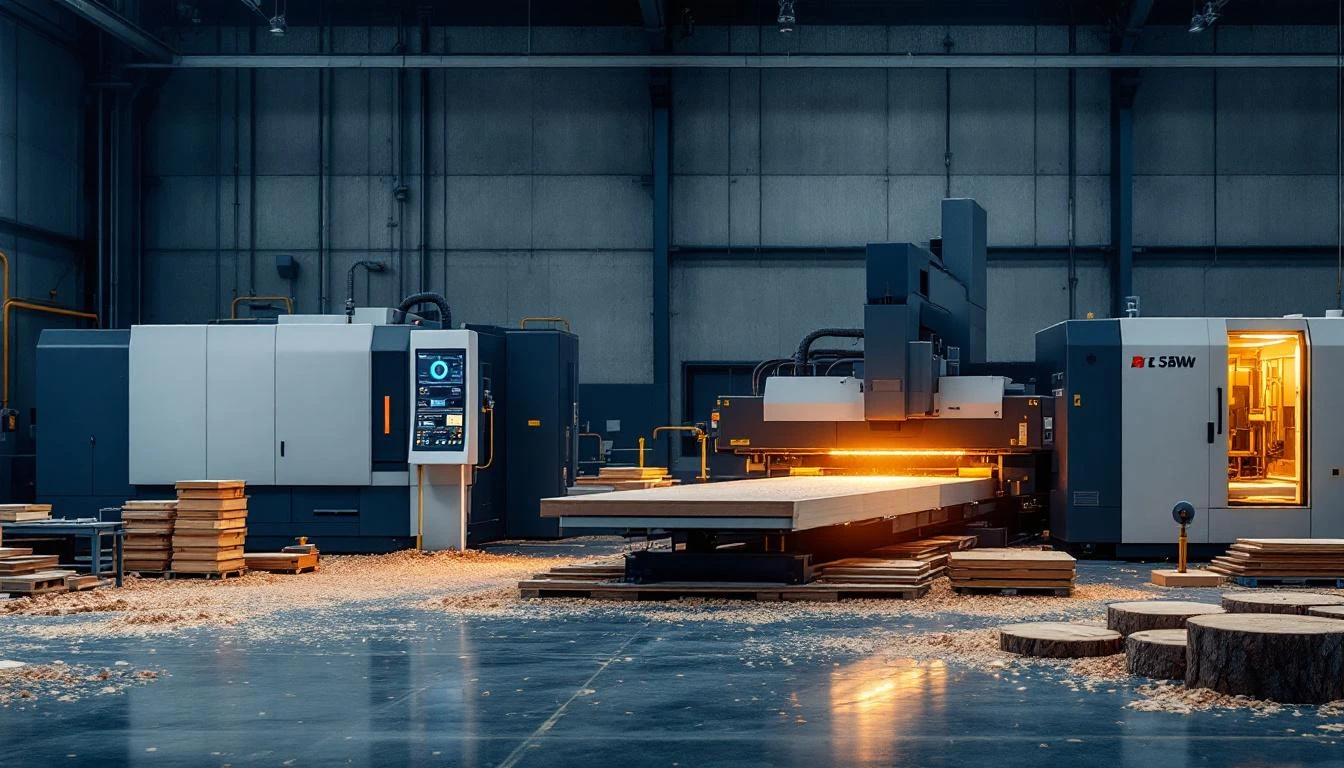
1. Log Breakdown and Primary Sawmilling
Equipment: Head rigs, band saws, circular saws, log carriage systems, debarkers, chippers
Critical PLC tags to monitor:
| Parameter | Why It Matters | Threshold Example |
|---|---|---|
| Blade motor current draw | Indicates blade sharpness, feed rate vs. capacity | above 85% rated load → blade approaching dull |
| Feed rate (carriage speed) | Affects cut quality and throughput | Deviation above 10% from setpoint |
| Blade tension | Prevents blade wander and breakage | Outside 15,000-20,000 PSI range |
| Blade guides temperature | Bearing wear indicator | above 150°F → inspect guides |
| Hydraulic pressure | Log carriage and positioning systems | below 1,500 PSI → check pump/valves |
| Kerf waste percentage | Blade thickness optimization | above 15% → evaluate thin-kerf blade |
| Board count per shift | Throughput tracking | Below target → investigate |
Predictive maintenance opportunities:
- Blade replacement prediction: As blades wear, motor current increases for the same feed rate. Track the current-to-feedrate ratio over time, and the platform predicts when blade performance will drop below acceptable quality — letting you schedule blade changes during planned downtime instead of discovering dull cuts on finished boards.
- Bearing failure prevention: Guide and wheel bearing temperatures trend upward weeks before failure. Threshold alerting catches the drift early.
- Hydraulic system health: Slow pressure decay indicates seal wear. Sudden drops indicate failure.
2. Kiln Drying
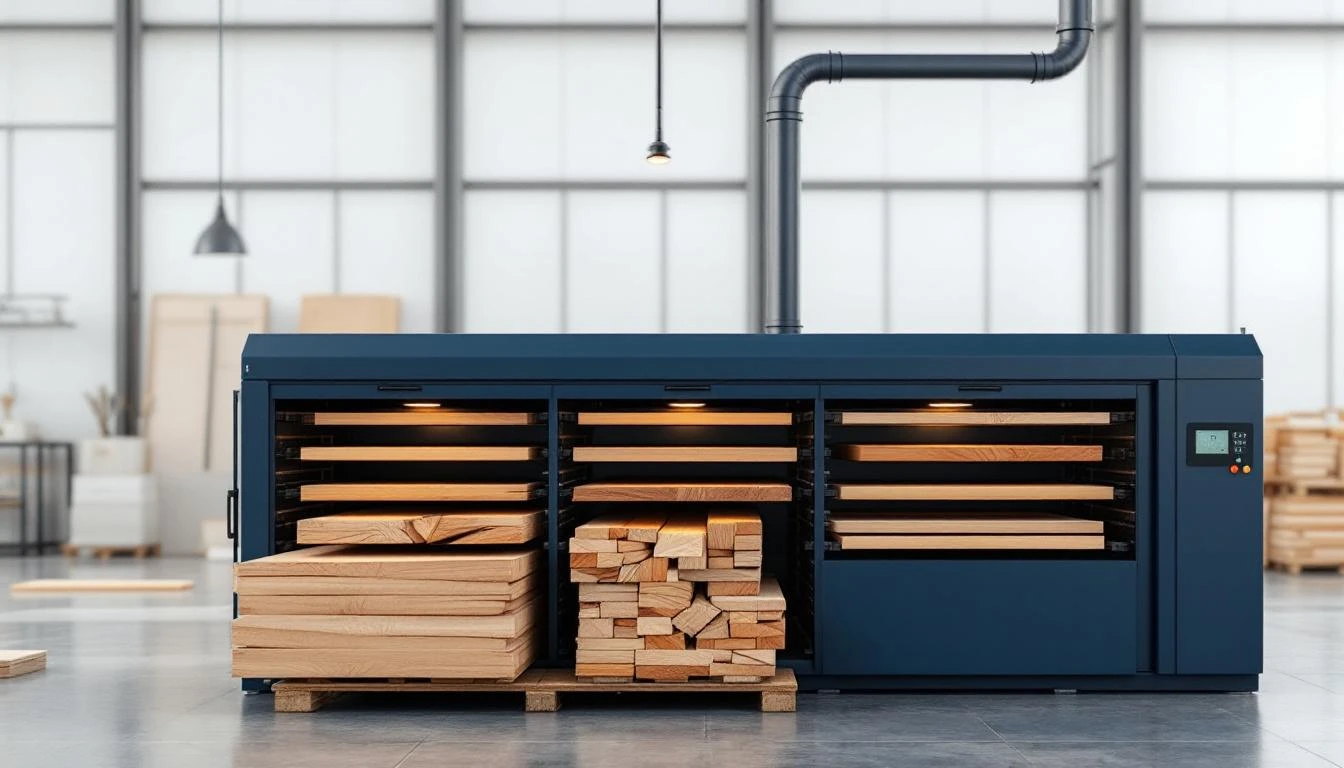
Equipment: Conventional kilns, dehumidification kilns, vacuum kilns, pre-dryers
Critical PLC tags to monitor:
| Parameter | Why It Matters | Threshold Example |
|---|---|---|
| Dry bulb temperature | Primary drying control | Deviation above 3°F from schedule |
| Wet bulb temperature | Controls humidity/EMC | Deviation above 2°F from schedule |
| Wood moisture content (probes) | Drying progress tracking | Target: 6-8% MC (species-dependent) |
| Fan motor current | Air circulation health | above 90% rated → motor/bearing issue |
| Vent position | Humidity control | Unexpected fully-open/closed |
| Steam valve position | Heat delivery control | Excessive cycling |
| Stack differential pressure | Airflow uniformity | above 0.5" WC → sticker issues |
| Kiln charge weight (if equipped) | Drying rate calculation | Plateau = possible stall |
Why kiln monitoring is critical:
Kiln drying is the highest-risk process in lumber manufacturing. Errors are devastating and slow to manifest:
- Over-drying: Surface checking, internal stress, case hardening. A 2% over-dry on premium hardwood can cost $10,000-$50,000 per charge in degrade.
- Under-drying: Products ship above target MC, warp in service, generate warranty claims
- Uneven drying: Temperature stratification means boards in different kiln positions dry at different rates. Hot spots create over-dried boards while cool zones produce wet boards — same charge, two different quality problems.
IIoT monitoring with probes throughout the kiln stack gives you real-time MC and temperature mapping. When one zone drifts, you catch it in minutes rather than discovering the damage after unloading.
Energy optimization: Real-time energy monitoring per kiln reveals:
- Which kilns are less efficient (heat loss through insulation degradation)
- Optimal venting schedules (balancing humidity removal vs. heat loss)
- Fan energy vs. drying rate (are you running fans at full speed when half-speed would produce the same drying rate?)
Manufacturers who implement IIoT kiln monitoring typically reduce energy costs by 15-25% while improving lumber quality consistency.
3. CNC Routing and Machining
Equipment: CNC routers (3-axis, 5-axis), CNC lathes, CNC boring machines, edge banders
Critical PLC tags to monitor:
| Parameter | Why It Matters | Threshold Example |
|---|---|---|
| Spindle load (%) | Tool wear, material hardness variation | above 80% → tool approaching end of life |
| Spindle temperature | Bearing health, coolant system | above 160°F → investigate |
| Feed rate actual vs. programmed | Controller override, material variation | Deviation above 15% |
| Vacuum hold-down pressure | Part security during machining | below 85% setpoint → check table/gaskets |
| Spindle vibration (if sensor) | Tool balance, bearing wear | Baseline +50% → tool check |
| Dust collection differential pressure | Fire prevention, air quality | above 6" WC → change filters |
| Cycle time per part | Production pace, quality correlation | above 120% standard → investigate |
| Tool change count | Tool life tracking | Approaching max life count |
CNC-specific insights from IIoT data:
- Tool life optimization: Most shops replace CNC router bits on a fixed schedule (every 5,000 cuts) or when an operator notices degraded cut quality. IIoT monitoring tracks spindle load progression over time, showing the actual wear curve. Many shops discover they're replacing tools 30-40% too early — wasting $5,000-$20,000/year in unnecessary tooling.
- Material-aware machining: When cutting MDF, spindle load is consistent. When cutting solid hardwood, load varies with grain direction, knots, and density. IIoT data helps you develop material-specific feed rate profiles that maximize throughput without sacrificing quality.
- Vacuum table maintenance: Vacuum hold-down degradation happens gradually. IIoT monitoring catches the trend before a part lifts during machining — a safety and quality issue.
4. Pressing and Laminating
Equipment: Hot presses, cold presses, membrane presses, edge banders, laminating lines
Critical PLC tags to monitor:
| Parameter | Why It Matters | Threshold Example |
|---|---|---|
| Platen temperature (multiple zones) | Bond quality, cure rate | Deviation above 5°F between zones |
| Press pressure | Bond strength | Outside ±10% of recipe |
| Press cycle time | Production pace, cure quality | Deviation above 10% from standard |
| Adhesive temperature | Application quality | Outside spec range |
| Adhesive pump pressure | Flow rate, nozzle condition | Variation above 15% |
| Daylight opening speed | Mechanical wear | Slower than baseline by above 20% |
5. Finishing and Coating
Equipment: Spray booths, UV cure lines, roller coaters, drying ovens
Critical PLC tags to monitor:
| Parameter | Why It Matters | Threshold Example |
|---|---|---|
| Spray booth temperature | Coating viscosity, flow | Outside 65-80°F |
| Spray booth humidity | Coating adhesion, drying | above 65% RH |
| UV lamp intensity | Cure quality | below 80% rated output → replace |
| Conveyor speed | Coating thickness, cure time | Deviation above 5% from recipe |
| Exhaust fan airflow | Overspray removal, safety | below 80% design CFM |
| Oven zone temperatures | Drying/curing quality | Deviation above 10°F between zones |
Implementing IIoT Across Your Wood Products Operation
Start Where the Money Is
For most wood products manufacturers, the highest-value starting points are:
- Kiln drying — Highest energy cost, highest risk of material loss, most impact on product quality
- Primary sawmilling — Highest throughput volume, blade optimization drives immediate savings
- CNC machining — Tool life optimization and downtime reduction have clear ROI
Equipment Connectivity
Most modern woodworking equipment (2010+) has PLCs with Ethernet ports. Older equipment often has Modbus RTU serial connections. MachineCDN's edge devices support both Ethernet/IP and Modbus protocols, covering the vast majority of wood products machinery.
For equipment without PLCs (older manual saws, legacy kilns), external sensors connected to a Modbus I/O module can add monitoring capability for a few hundred dollars per machine.
Network Considerations
Wood products plants are notoriously challenging for wireless networks. Metal buildings, dust, and large distances between buildings (sawmill, kiln yard, planer mill, finishing) make traditional WiFi unreliable.
Cellular IIoT connectivity eliminates this challenge entirely. Each edge device has its own cellular connection — no plant WiFi needed, no IT infrastructure to deploy in your kiln yard.
ROI Expectations
Based on industry benchmarks for wood products manufacturers implementing IIoT:
- Kiln energy reduction: 15-25% ($50,000-$200,000/year for medium operations)
- Lumber degrade reduction: 5-15% of current degrade losses
- Blade/tool life extension: 20-40% ($10,000-$50,000/year)
- Unplanned downtime reduction: 30-50% (varies by baseline)
- OEE improvement: 5-15 percentage points
- Typical payback period: 5 weeks on connected equipment
The Bottom Line
Woodworking and lumber manufacturing's natural material variability makes it one of the industries that benefits most from real-time monitoring. Every log is different. Every board is unique. The only way to maintain consistency is to monitor your processes continuously and respond to deviations before they become defects.
IIoT platforms like MachineCDN make this practical — even in dusty, distributed wood products environments where traditional networking fails.
Ready to bring real-time intelligence to your wood products operation? Book a demo and see your kiln temperatures, saw blade performance, and CNC efficiency in one dashboard.