Why Most Manufacturing AI Projects Stall After the Pilot Phase (And the 5 Fixes That Actually Work)

The pilot worked beautifully. Your AI model predicted bearing failures on Line 3 with 94% accuracy. The CEO saw the demo. The board heard about "digital transformation." Budget was approved for a plant-wide rollout.
That was eighteen months ago. The model still runs on Line 3. Maintenance still uses clipboards everywhere else. The data scientist who built the pilot left for a fintech startup. And nobody can explain why a model that worked perfectly on one line won't work on the other seven.
If this sounds familiar, you're not alone. According to a McKinsey survey on AI in manufacturing, 87% of manufacturing AI projects never make it past the pilot phase. Not because the AI doesn't work — but because the organizational, data, and infrastructure challenges of scaling from one line to a full plant were never addressed.
The AI isn't the problem. The pilot model is the problem.
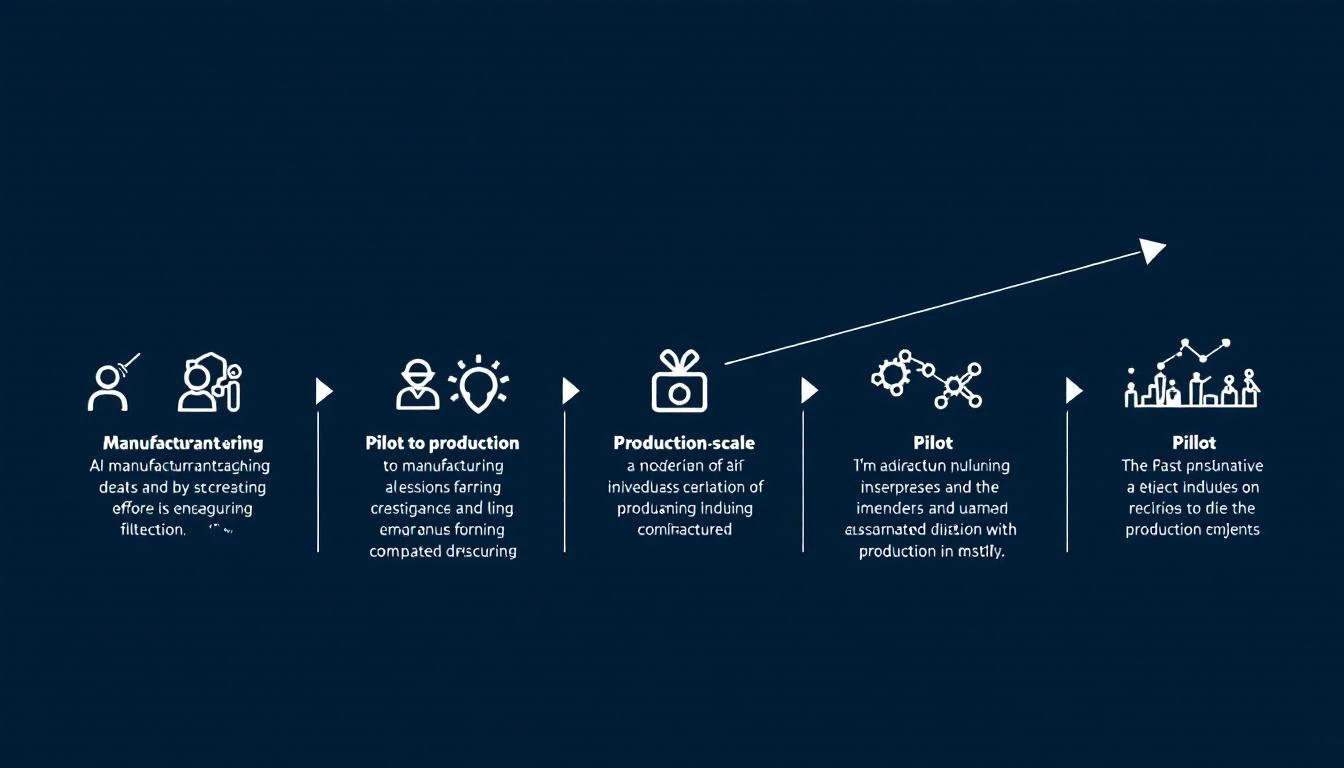
The Pilot-to-Production Gap
The pilot-to-production gap in manufacturing AI isn't a technology problem — it's a systems problem. A pilot proves that a specific AI technique can extract value from a specific dataset on a specific machine. Scaling it requires proving that the same approach works across different machines, different data quality levels, different operators, and different organizational priorities.
What a successful pilot proves:
- The physics of the problem is amenable to AI/ML
- Sufficient data exists on the pilot machine(s)
- The prediction or optimization delivers measurable value
What a successful pilot does NOT prove:
- Other machines have comparable data quality
- The model generalizes across equipment variations
- Operators will trust and act on AI recommendations
- IT/OT infrastructure can support plant-wide deployment
- The business case survives at scale economics
Understanding this distinction is the key to avoiding the "pilot purgatory" trap.
Reason #1: Data Infrastructure Was Never Built for Scale
Every pilot cheats on data. The data scientist manually cleaned the CSV export from the historian. They hand-labeled fault events using maintenance logs. They interpolated missing values and removed the two weeks when a sensor was miscalibrated.
None of this happens at scale.
The data reality at plant scale:
- Inconsistent tag naming — Line 1 calls it
HYD_PRESS_PSI, Line 2 calls itHydraulic_Pressure, Line 3 calls itP1_HYD. Same measurement, three names. - Missing data — Sensors fail. PLCs reboot. Networks drop. A typical manufacturing dataset has 3-12% missing values.
- Sensor calibration drift — The thermocouple on Machine 4 reads 8°F high. The pressure transducer on Machine 7 hasn't been calibrated since 2021.
- Irregular sampling rates — One PLC sends data every second. Another sends on-change-only. A third uses a 5-second polling cycle.
The fix: Build data infrastructure before building AI models.
This means deploying a standardized machine connectivity layer that normalizes tag names, handles missing data, and ensures consistent sampling rates across all equipment. Platforms like MachineCDN do this at the edge — standardizing data from different PLC brands into a common format before it ever reaches the cloud.
The boring truth: the manufacturing companies that succeed with AI at scale spend 70% of their effort on data infrastructure and 30% on models. Pilot-stage companies invert this ratio.
Reason #2: The Model Was Overfit to Pilot Conditions
Machine learning models are pattern matchers. A model trained on Line 3's bearing failure data learns the specific vibration signatures of Line 3's specific motor, running Line 3's specific product at Line 3's specific speed. It's not learning "how bearings fail" — it's learning "how this bearing on this machine fails."
Common overfitting traps in manufacturing AI:
- Equipment variation — Same model of machine, different age, different maintenance history, different wear patterns. The model expects a vibration signature that doesn't exist on the other machines.
- Operating condition variation — The pilot ran during stable production. At scale, machines run different products, at different speeds, with different materials. The model hasn't seen these variations.
- Seasonal effects — Pilot collected data during fall/winter. Plant performance in summer (ambient temperature 30°F higher) is fundamentally different.
- Small sample size — The pilot captured 3 bearing failures. That's not enough data to generalize. You need 20-50 failure events minimum for a robust classification model.
The fix: Design for generalization from day one.
- Train on data from multiple machines, not one
- Include operating condition variables (speed, load, ambient temperature, product SKU) as model features
- Collect at least 12 months of data to capture seasonal variation
- Use transfer learning techniques to adapt models across similar equipment
- Build a model validation framework that tests on unseen machines, not unseen time periods
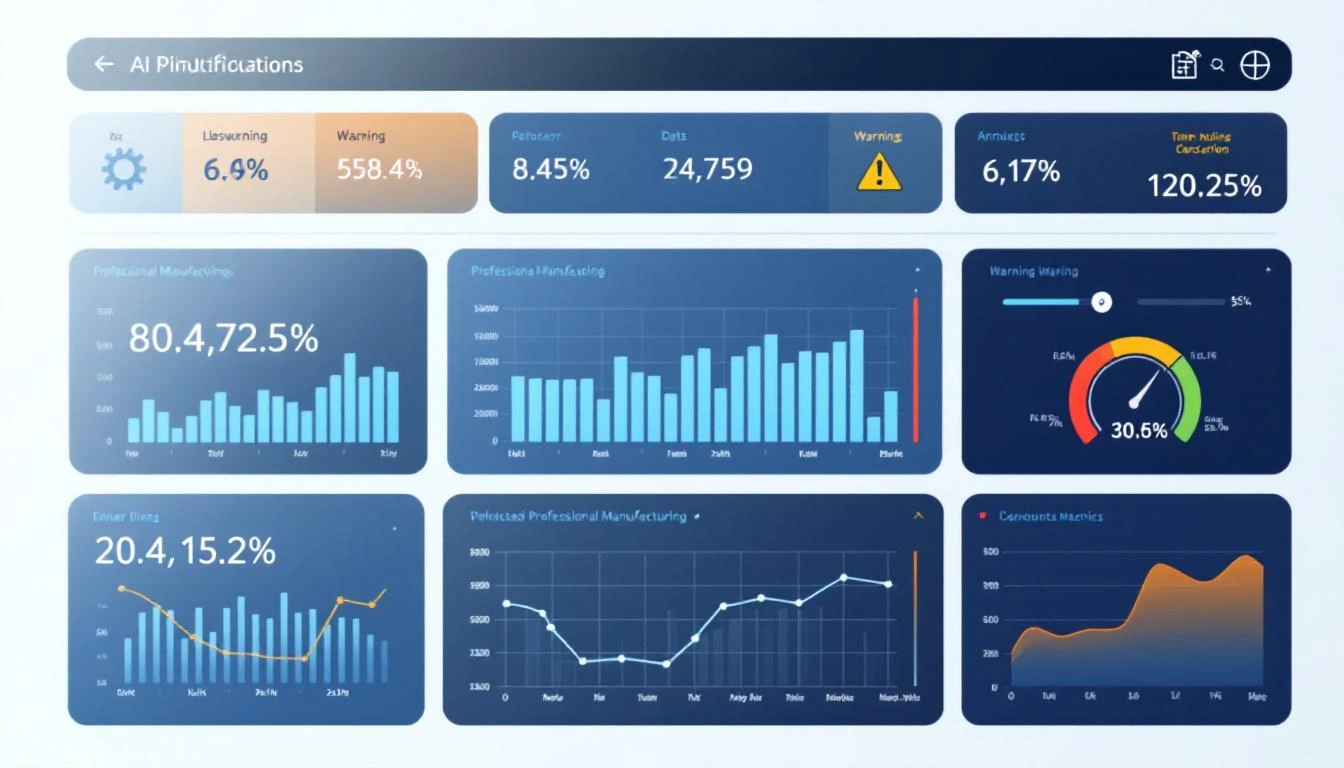
The best approach is often the simplest: instead of complex AI models, start with threshold-based alerting using your IIoT platform's built-in capabilities. MachineCDN's threshold alerts catch 80% of the problems that manufacturers try to solve with ML — without any model training, overfitting risk, or data science headcount.
Reason #3: Organizational Resistance Is More Powerful Than Algorithms
The maintenance supervisor who's been running this plant for 22 years doesn't need an AI to tell him Press #4 is about to fail. He can hear it. He can feel the vibration in the floor. And he deeply resents an algorithm that implies his expertise isn't sufficient.
This isn't a stereotype — it's the most commonly cited barrier to manufacturing AI adoption in every industry survey.
The organizational resistance stack:
- Operators resist because the AI changes their workflow and questions their judgment
- Maintenance technicians resist because predictive maintenance implies they weren't doing preventive maintenance well enough
- Floor supervisors resist because they lose autonomy when an algorithm dictates priorities
- IT resists because OT data on cloud infrastructure creates security and compliance concerns
- Finance resists because the scale-up costs weren't in the original pilot budget
The fix: Deploy AI as augmentation, not replacement.
The most successful manufacturing AI deployments position the technology as a tool that enhances human expertise — not a system that replaces it.
Specific tactics:
- Involve operators in model development — Let the 22-year veteran tell you which vibration frequencies matter. His domain knowledge improves the model and gives him ownership.
- Present AI output as recommendations, not commands — "The system suggests inspecting the bearing on Press #4 within 5 days" vs. "Replace the bearing on Press #4 by Tuesday."
- Celebrate catches, not corrections — When the AI catches something operators missed, frame it as "the AI caught what we all would have missed at 3am on Saturday" — not "see, we need this because humans aren't reliable."
- Start with pain points operators already have — Operators hate emergency callouts at 2am. If AI can predict those failures and move them to planned maintenance, operators become the biggest advocates.
Reason #4: The Scale-Up Economics Don't Pencil
Pilot economics are always favorable. You used free compute credits from your cloud provider. The data scientist worked on this as a "20% project." The edge hardware was a loaner from the vendor. The pilot cost $50K all-in and saved $200K in avoided downtime — a 4:1 ROI.
Now multiply by 8 lines. And 4 plants. And the real cost of data engineers, cloud compute, model retraining, and ongoing maintenance.
Real scale-up costs manufacturers underestimate:
| Cost Category | Pilot | Plant-Wide | Company-Wide |
|---|---|---|---|
| Data infrastructure | $10K | $150K | $500K+ |
| Model development | $30K | $80K | $200K+ |
| Edge hardware | $5K | $40K | $150K+ |
| Cloud compute | Free tier | $3K/mo | $15K/mo |
| Ongoing model maintenance | Included | $60K/yr | $200K/yr |
| Change management | Zero | $50K | $200K+ |
| Total Year 1 | $45K | $416K | $1.4M+ |
Those numbers sober up a lot of pilot celebrations.
The fix: Choose platforms where scale-up cost is linear, not exponential.
This is where purpose-built IIoT platforms for manufacturing have a massive advantage over custom AI builds. When you use a platform like MachineCDN, the cost of connecting machine #50 is the same as connecting machine #1. The edge devices, cloud infrastructure, dashboards, and alerting are all part of the platform — you don't build them from scratch for each scale-up phase.
The pricing model matters too. Per-device pricing (common in IIoT) scales linearly. Data scientist salaries for custom model development scale exponentially with complexity.
Reason #5: No One Owns It
The pilot was the data scientist's passion project. Or the innovation team's showcase. Or the plant manager's initiative. None of these create sustainable ownership for a production AI system.
When the data scientist leaves, who retrains the model? When the innovation team moves to the next shiny project, who maintains the data pipeline? When the plant manager retires, does the next one care?
The fix: Embed AI into operations, not alongside it.
- No dedicated AI team — The AI should be embedded in the maintenance and operations workflow, not managed by a separate team that can be cut
- Use platform capabilities — Built-in analytics from your IIoT platform require no data science maintenance. Predictive maintenance alerts built into the platform don't need a data scientist to retrain.
- Make it boring — The best sign of successful AI deployment is when nobody calls it "AI" anymore. It's just how the plant works. Operators check the dashboard like they check the gauges — it's part of the job.
- Measure business outcomes, not model accuracy — Track downtime reduction, OEE improvement, and maintenance cost savings — not F1 scores and confusion matrices. Business metrics survive leadership changes.
The Alternative: Skip the Pilot-to-Production Gap Entirely
Here's the most contrarian advice in this article: for most manufacturing AI use cases, you don't need a custom AI pilot at all.
Modern IIoT platforms have absorbed the most common "AI use cases" into standard product features:
- Predictive maintenance → Built-in threshold alerting with trend analysis
- Anomaly detection → Statistical process control on machine health data
- Downtime root cause analysis → Downtime tracking with reason code analytics
- Energy optimization → Real-time energy monitoring with benchmark comparison
- Quality prediction → SPC charts on process parameters with automatic alerting
MachineCDN delivers these capabilities out of the box — no custom models, no data scientists, no pilot-to-production gap. You connect machines, configure thresholds, and start catching problems immediately.
Is this as sophisticated as a custom deep learning model trained on 3 years of vibration data? No. Does it capture 80% of the value at 10% of the cost and risk? Absolutely.
When Custom AI Is Worth It
Custom AI models are worth the investment when:
- The problem is physics-specific — Predicting the remaining useful life of a specific component under specific operating conditions
- The value is enormous — Preventing a $5M catastrophic failure on a turbine or reactor
- You have abundant data — 50+ failure events, 12+ months of operating data, consistent instrumentation
- You have organizational readiness — Data infrastructure is in place, operators are data-literate, there's a clear owner
- Standard analytics don't solve it — Threshold alerting and SPC have already been tried and aren't sufficient
If you can check all five boxes, invest in custom AI. If you can't, start with a platform-based approach and graduate to custom models when the foundation is ready.
Conclusion
The 87% failure rate of manufacturing AI pilots isn't a technology indictment — it's an implementation indictment. The models work. The data science is sound. What fails is the infrastructure, the generalization, the organizational change, the economics, and the ownership.
The fix isn't better AI. It's better foundations: standardized data infrastructure, platform-based capabilities instead of custom builds, organizational change management, and realistic scale-up economics.
Start with connecting your machines to an IIoT platform. Get the data flowing. Use built-in analytics to deliver immediate value. Then — and only then — evaluate whether custom AI adds enough incremental value to justify the complexity.
Book a demo with MachineCDN to see how platform-based intelligence delivers 80% of AI's promise without the pilot-to-production gap.
Stuck in pilot purgatory? Book a demo to see how MachineCDN's built-in analytics deliver predictive maintenance results without custom AI development.