The Convergence of MES and IIoT: Why Traditional Manufacturing Execution Systems Are Being Disrupted

The manufacturing execution system (MES) market hit $16.7 billion in 2025. By 2030, analysts project $28.3 billion. And yet, the most interesting thing happening in manufacturing software isn't MES growing — it's MES being absorbed.
IIoT platforms are eating MES functionality from the bottom up. What started as simple machine monitoring (connect a sensor, see a dashboard) has expanded to include OEE tracking, downtime analysis, quality management, production scheduling, and work order management — the traditional domain of enterprise MES.
Meanwhile, MES vendors are adding IIoT features — edge connectivity, real-time machine data, predictive analytics — from the top down. The two categories are converging, and the result is a fundamental disruption of how manufacturers think about their factory software stack.
If your plant is running a 10-year-old MES — or worse, if you're about to sign a 7-figure MES contract — this convergence matters to you. Here's what's actually happening and what to do about it.
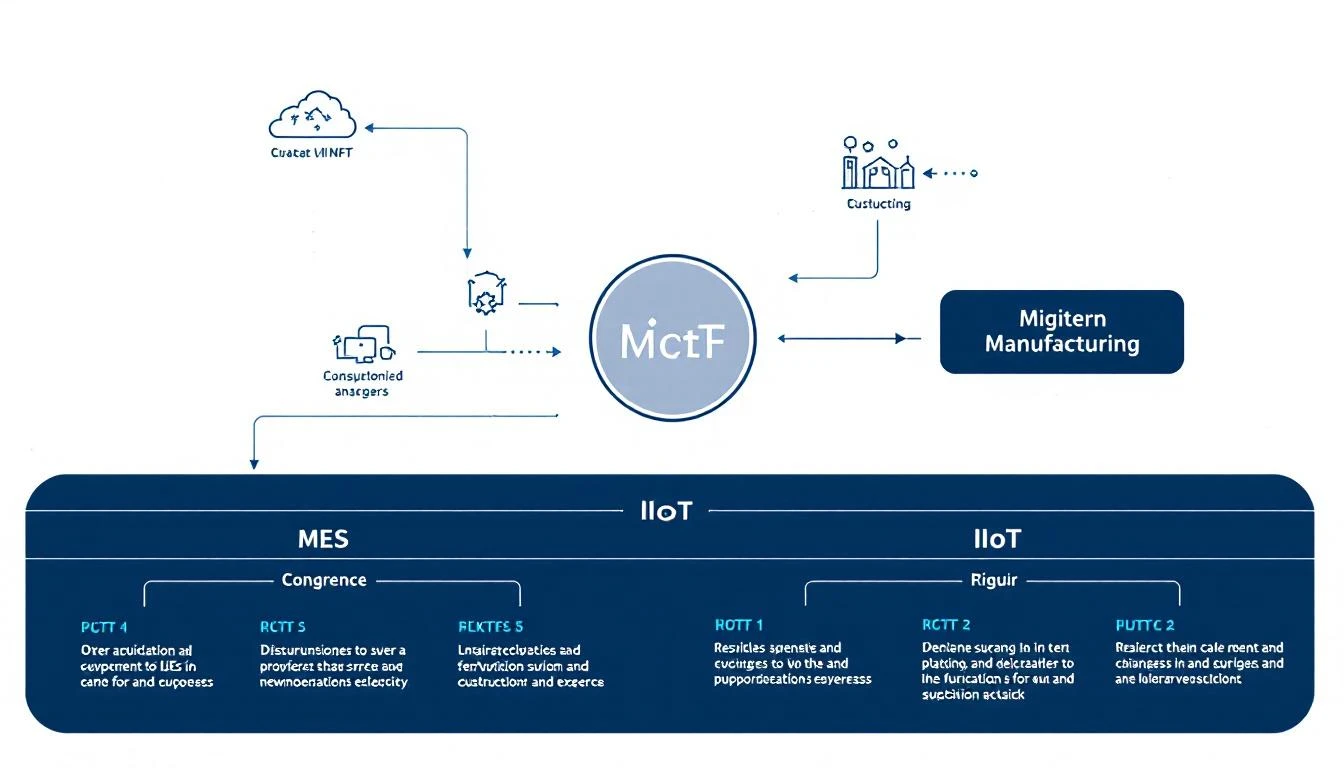
What MES Was Built to Do (and Where It Falls Short)
Traditional MES, defined by the ISA-95 standard, sits between the ERP layer (Level 4) and the control layer (Level 1-2). It manages production execution — work orders, routing, labor tracking, quality, and equipment utilization.
The classic MES function list (ISA-95 Activity Model):
- Production scheduling and sequencing
- Work order management and dispatching
- Data collection and acquisition
- Quality management (SPC, SQC)
- Process management
- Labor management
- Equipment management and maintenance
- Product tracking and genealogy
- Performance analysis (OEE, KPIs)
- Resource allocation
- Document management
MES has been the workhorse of pharmaceutical, automotive, and process manufacturing for 25+ years. Companies like Siemens (Opcenter), Rockwell (Plex), AVEVA, and Dassault (DELMIA) dominate the market.
But traditional MES has three fundamental problems:
Problem 1: Implementation Timelines
Enterprise MES implementations take 12-24 months for a single plant. Multi-site rollouts can stretch to 3-5 years. During this time, requirements change, stakeholders leave, and the original business case erodes.
A Gartner survey on MES projects found that 35% of MES implementations exceed their budget and timeline, and 15% are abandoned entirely.
Compare this to IIoT platforms like MachineCDN that deliver device-to-dashboard connectivity in minutes. When you can prove value in 5 weeks instead of 52 weeks, the ROI conversation is fundamentally different.
Problem 2: Data Architecture
Traditional MES was designed in the era of polling — it queries machines periodically (every 1-5 seconds) and stores the data in relational databases. This architecture assumes a manageable data volume.
Modern manufacturing generates data volumes that overwhelm this model. A single CNC machine with vibration monitoring produces 500MB per day. A pharmaceutical batch reactor with 200 process parameters at 1-second intervals produces 17 million data points per day.
IIoT platforms were born in the era of streaming data. They use time-series databases, edge computing for data reduction, and cloud-native architectures that scale horizontally. The data architecture is fundamentally different — and fundamentally more capable.
Problem 3: Connectivity
MES assumes that machines are already connected — that PLC data is available through OPC servers or other middleware. In reality, 60-70% of manufacturing equipment in brownfield plants isn't connected to anything.
IIoT platforms start from the opposite assumption: machines are disconnected, and the first job is to connect them. This connectivity-first approach — exemplified by MachineCDN's edge devices that connect directly to PLCs via Modbus and Ethernet/IP — means you get machine data flowing before you worry about execution workflows.
How IIoT Is Absorbing MES Functionality
The convergence isn't theoretical. It's happening in real product roadmaps and real customer deployments.
Phase 1: Machine Monitoring (2015-2020)
Early IIoT platforms focused on one thing: connecting machines and displaying data on dashboards. Simple, but revolutionary for plants that had zero visibility into equipment performance.
MES functions absorbed: Data collection and acquisition, basic performance analysis
Phase 2: Analytics and OEE (2020-2023)
IIoT platforms added calculated metrics — OEE, availability, performance, quality. They added downtime tracking with reason codes, shift-based reporting, and multi-plant visibility.
MES functions absorbed: Performance analysis, basic equipment management, process analysis
Phase 3: Predictive and Prescriptive (2023-2025)
AI and machine learning entered the picture. IIoT platforms began predicting failures, recommending actions, and optimizing processes. Predictive maintenance became table stakes. Prescriptive maintenance — telling operators what to do, not just what's wrong — became the differentiator.
MES functions absorbed: Equipment management, maintenance planning, advanced quality management
Phase 4: Execution and Orchestration (2025-Present)
Modern IIoT platforms now manage production workflows — scheduling, work orders, quality checkpoints, materials tracking, and serial number tracking. They're not just monitoring machines; they're orchestrating production.
MES functions absorbed: Production scheduling, work order management, product tracking, resource allocation

The Case Against Buying a Traditional MES in 2026
If you're evaluating a traditional MES in 2026, consider these realities:
1. You're Buying Connectivity Twice
A traditional MES requires connectivity infrastructure (OPC servers, data historians, middleware) before the MES itself does anything useful. Then you need the MES software, customization, and integration with ERP.
An IIoT-first approach bundles connectivity and analytics together. You skip the middleware layer entirely.
2. Time-to-Value Gap
MES: 12-24 months before operators see a dashboard. IIoT platform: 5-35 days before operators see a dashboard.
In the time it takes to configure a traditional MES, an IIoT platform has already delivered its first year of ROI.
3. Vendor Lock-In Risk
MES contracts are typically 5-7 year agreements with substantial customization. Switching costs are enormous. You're betting your factory software strategy on a single vendor for a decade.
Cloud-native IIoT platforms are generally more modular and less sticky. If a platform doesn't deliver, you switch the edge device configuration and redirect data — you don't rip and replace a 2-year implementation.
4. The Functionality Gap Is Closing
Five years ago, IIoT platforms couldn't handle production scheduling or quality management. Today, platforms like MachineCDN offer alarm management, preventive maintenance scheduling, spare parts tracking, materials management, and full fleet management across plants.
The remaining MES-unique capabilities (complex batch management, electronic batch records for regulated industries, detailed labor tracking) are being addressed by specialized cloud tools — not monolithic MES suites.
When You Still Need a Traditional MES
This convergence doesn't mean MES is dead. There are legitimate use cases where traditional MES remains the right choice:
Highly Regulated Industries
Pharmaceutical manufacturing under FDA 21 CFR Part 11 requires electronic batch records with full audit trails, electronic signatures, and validated systems. While IIoT platforms are gaining compliance capabilities, FDA-validated MES is still the safest choice for regulated production.
Complex Discrete Manufacturing
Aerospace or automotive manufacturing with hundreds of routing steps, complex bill-of-materials, and detailed work instruction delivery at each station still benefits from purpose-built MES. The production orchestration complexity exceeds what most IIoT platforms handle today.
Brownfield Plants with Existing MES Investment
If you've already invested $2M+ in an MES deployment, it makes more sense to augment it with IIoT for predictive maintenance and equipment monitoring than to replace it. Use the IIoT platform for what MES does poorly (real-time machine connectivity, edge computing, predictive analytics) and keep MES for what it does well (work order management, routing, compliance).
The Hybrid Architecture: Best of Both Worlds
For most manufacturers, the optimal architecture in 2026 is hybrid:
IIoT Platform (e.g., MachineCDN) handles:
- Machine connectivity and real-time data collection
- Edge computing and data preprocessing
- Equipment health monitoring and predictive maintenance
- OEE tracking and production monitoring
- Alarm management and threshold alerting
- Energy monitoring and sustainability tracking
MES/ERP handles:
- Production scheduling and sequencing
- Complex work order routing
- Regulatory compliance (21 CFR Part 11, IATF 16949)
- Labor management and time tracking
- Detailed product genealogy and traceability
The integration point: The IIoT platform feeds real-time machine data and production events to MES/ERP via APIs. MES sends work order context (what product is running, what quality spec applies) to the IIoT platform for contextualized monitoring.
This architecture preserves your MES investment while adding the real-time machine intelligence that traditional MES architectures can't deliver.
What This Means for Your Next Software Decision
If you're a manufacturing leader evaluating software in 2026, here's the practical framework:
Start with IIoT if:
- You have limited or no machine connectivity today
- Your primary pain is equipment visibility, downtime, and quality
- You need results in weeks, not years
- Your production processes are relatively straightforward
- You're in discrete manufacturing without heavy regulatory requirements
Start with MES if:
- You're in pharma, medical device, or aerospace with regulatory mandates
- You have complex routing with hundreds of production steps
- You need detailed labor tracking and work instruction delivery
- You already have machine connectivity infrastructure (OPC, SCADA)
Start with IIoT, plan for convergence if:
- You eventually need MES-level functionality but can't wait 18 months for value
- You want to prove ROI before committing to a 7-figure software investment
- You want machine data driving decisions while you evaluate MES options
The Five-Year Outlook
By 2030, the distinction between "IIoT platform" and "MES" will be largely academic. The surviving platforms will offer both machine connectivity (today's IIoT) and production orchestration (today's MES) in a single cloud-native architecture.
The winners will be platforms that started with connectivity and added orchestration — not the other way around. Why? Because you can't orchestrate production without machine data, but you can certainly monitor machines without work orders.
MachineCDN's trajectory — from machine monitoring to fleet management to maintenance planning to materials management — illustrates this bottom-up convergence path.
Conclusion
The MES market isn't dying — it's being absorbed. IIoT platforms are systematically adding MES capabilities while delivering something traditional MES never could: real-time machine connectivity that deploys in minutes instead of months.
For manufacturers evaluating their next factory software investment, the question isn't "MES or IIoT?" — it's "Where do I start, and how do I get to value fastest?"
If the answer is weeks instead of years, book a demo with MachineCDN and see the convergence in action.
Evaluating MES vs. IIoT? Book a demo to see how MachineCDN combines machine connectivity with production management — without the 18-month implementation.