MQTT Broker Architecture for Industrial Deployments: Clustering, Persistence, and High Availability [2026]
· 11 min read

MQTT Broker Architecture

Every IIoT tutorial makes MQTT look simple: connect, subscribe, publish. Three calls and you're streaming telemetry. What those tutorials don't tell you is what happens when your broker goes down at 2 AM, your edge gateway's cellular connection drops for 40 minutes, or your plant generates 50,000 messages per second and you need every single one to reach the historian.

Industrial MQTT isn't a protocol problem. It's an architecture problem. The protocol itself is elegant and well-specified. The hard part is designing the broker infrastructure — clustering, persistence, session management, and failover — so that zero messages are lost when (not if) something fails.

This article is for engineers who've gotten past "hello world" and need to build MQTT infrastructure that meets manufacturing reliability requirements. We'll cover the internal mechanics that matter, the failure modes you'll actually hit, and the architecture patterns that work at scale.

How MQTT Brokers Actually Handle Messages

Before discussing architecture, let's nail down what the broker is actually doing internally. This understanding is critical for sizing, troubleshooting, and making sensible design choices.

The Session State Machine

When a client connects with CleanSession=false (MQTT 3.1.1) or CleanStart=false with a non-zero SessionExpiryInterval (MQTT 5.0), the broker creates a persistent session bound to the client ID. This session maintains:

  • The set of subscriptions (topic filters + QoS levels)
  • QoS 1 and QoS 2 messages queued while the client is offline
  • In-flight QoS 2 message state (PUBLISH received, PUBREC sent, waiting for PUBREL)
  • The packet identifier namespace

This is the mechanism that makes MQTT suitable for unreliable networks — and it's the mechanism that will eat your broker's memory and disk if you don't manage it carefully.

Message Flow at QoS 1

Most industrial deployments use QoS 1 (at least once delivery). Here's what actually happens inside the broker:

  1. Publisher sends PUBLISH with QoS 1 and a packet identifier
  2. Broker receives the message and must:
    • Match the topic against all active subscription filters
    • For each matching subscription, enqueue the message
    • For connected subscribers with matching QoS, deliver immediately
    • For disconnected subscribers with persistent sessions, store in the session queue
    • Persist the message to disk (if persistence is enabled) before acknowledging
  3. Broker sends PUBACK to the publisher — only after all storage operations complete
  4. For each connected subscriber, broker sends PUBLISH and waits for PUBACK
  5. If PUBACK isn't received, broker retransmits on reconnection

The critical detail: step 3 is the durability guarantee. If the broker crashes between receiving the PUBLISH and sending the PUBACK, the publisher will retransmit. If the broker crashes after PUBACK but before delivering to all subscribers, the message must survive the crash — which means it must be on disk.

QoS 2: The Four-Phase Handshake

QoS 2 (exactly once) uses a four-message handshake: PUBLISH → PUBREC → PUBREL → PUBCOMP. The broker must maintain state for each in-flight QoS 2 transaction. In industrial settings, this is occasionally used for critical state changes (machine start/stop commands, recipe downloads) where duplicate delivery would cause real damage.

The operational cost: each QoS 2 message requires 4x the network round trips of QoS 0, and the broker must maintain per-message transaction state. For high-frequency telemetry, this is almost never worth the overhead. QoS 1 with application-level deduplication (using message timestamps or sequence numbers) is the standard industrial approach.

Broker Persistence: What Gets Stored and Where

In-Memory vs Disk-Backed

A broker with no persistence is a broker that loses messages on restart. Period. For development and testing, in-memory operation is fine. For production industrial deployments, you need disk-backed persistence.

What needs to be persisted:

DataPurposeStorage Impact
Retained messagesLast-known-good value per topicGrows with topic count
Session stateOffline subscriber queuesGrows with offline duration × message rate
Inflight messagesQoS 1/2 messages awaiting acknowledgmentUsually small, bounded by max_inflight
Will messagesLast-will-and-testament per clientOne per connected client

The session queue is where most storage problems originate. Consider: an edge gateway publishes 100 tags at 1-second intervals. Each message is ~200 bytes. If the cloud subscriber goes offline for 1 hour, that's 360,000 messages × 200 bytes = ~72 MB queued for that single client. Now multiply by 50 gateways across a plant.

Practical Queue Management

Every production broker deployment needs queue limits:

  • Maximum queue depth — Cap the number of messages per session queue. When the queue is full, either drop the oldest message (most common for telemetry) or reject new publishes (appropriate for control messages).
  • Maximum queue size in bytes — A secondary safeguard when message sizes vary.
  • Message expiry — MQTT 5.0 supports per-message expiry intervals. For telemetry data, 1-hour expiry is typical — a temperature reading from 3 hours ago has no operational value.

A well-configured broker with 4 GB of RAM can handle approximately:

  • 100,000 active sessions
  • 500,000 subscriptions
  • 10,000 messages/second throughput
  • 50 MB of retained messages

These are ballpark figures that vary enormously with message size, topic tree depth, and subscription overlap. Always benchmark with your actual traffic profile.

Clustering: Why and How

A single broker is a single point of failure. For industrial deployments where telemetry loss means blind spots in production monitoring, you need broker clustering.

Active-Active vs Active-Passive

Active-passive (warm standby): One broker handles all traffic. A secondary broker synchronizes state and takes over on failure. Failover time: typically 5-30 seconds depending on detection mechanism.

Active-active (load sharing): Multiple brokers share the client load. Messages published to any broker are replicated to subscribers on other brokers. This provides both high availability and horizontal scalability.

The Shared Subscription Problem

In a clustered setup, if three subscribers share a subscription (e.g., three historian instances for redundancy), each message should be delivered to exactly one of them — not all three. MQTT 5.0's shared subscriptions ($share/group/topic) handle this, distributing messages round-robin among group members.

Without shared subscriptions, each historian instance receives every message, tripling your write load. This is one of the strongest arguments for MQTT 5.0 over 3.1.1 in industrial architectures.

Message Ordering Guarantees

MQTT guarantees message ordering per publisher, per topic, per QoS level. In a clustered broker, maintaining this guarantee across brokers requires careful replication design. Most broker clusters provide:

  • Strong ordering for messages within a single broker node
  • Eventual ordering for messages replicated across nodes (typically < 100ms delay)

For industrial telemetry where timestamps are embedded in the payload, eventual ordering is almost always acceptable. For control messages where sequencing matters, route the publisher and subscriber to the same broker node.

Designing the Edge-to-Cloud Pipeline

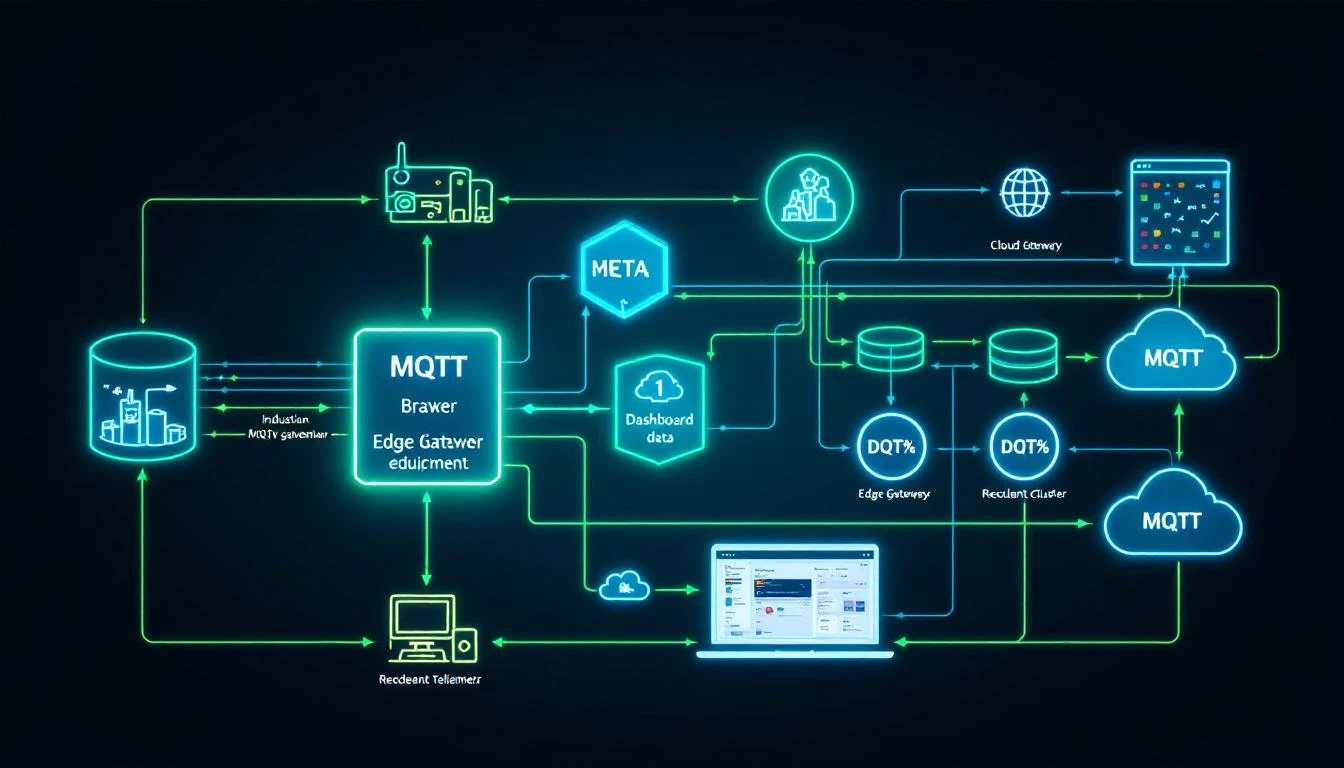
The most common industrial MQTT architecture has three layers:

Layer 1: Edge Broker (On-Premises)

Runs on the edge gateway or a local server within the plant network. Responsibilities:

  • Local subscribers — HMI panels, local alarm engines, historian
  • Store-and-forward buffer — Queues messages when cloud connectivity is lost
  • Protocol translation — Accepts data from Modbus/EtherNet/IP collectors and publishes to MQTT
  • Data reduction — Filters unchanged values, aggregates high-frequency data

The edge broker must run on reliable storage (SSD, not SD card) because it's your buffer against network outages. Size the storage for your worst-case outage duration:

Storage needed = (messages/sec) × (avg message size) × (max outage seconds)

Example: 500 msg/s × 200 bytes × 3600 sec = 360 MB per hour of outage

Layer 2: Bridge to Cloud

The edge broker bridges selected topics to a cloud-hosted broker or IoT hub. Key configuration decisions:

  • Bridge QoS — Use QoS 1 for the bridge connection. QoS 0 means any TCP reset loses messages in transit. QoS 2 adds overhead with minimal benefit since telemetry is naturally idempotent.
  • Topic remapping — Prefix bridged topics with a plant/location identifier. A local topic machines/chiller-01/temperature becomes plant-detroit/machines/chiller-01/temperature in the cloud.
  • Bandwidth throttling — Limit the bridge's publish rate to avoid saturating the WAN link. If local collection runs at 500 msg/s but your link can sustain 200 msg/s, the edge broker must buffer or aggregate the difference.

Layer 3: Cloud Broker Cluster

Receives bridged data from all plants. Serves cloud-hosted consumers: analytics pipelines, dashboards, ML training jobs. This layer typically uses a managed service (Azure IoT Hub, AWS IoT Core, HiveMQ Cloud) or a self-hosted cluster.

Key sizing for cloud brokers:

  • Concurrent connections — One per edge gateway, plus cloud consumers
  • Message throughput — Sum of all edge bridge rates
  • Retention — Typically short (minutes to hours). Long-term storage is the historian's job.

Connection Management: The Details That Bite You

Keep-Alive and Half-Open Connections

MQTT's keep-alive mechanism is your primary tool for detecting dead connections. When a client sets keepAlive=60, it must send a PINGREQ within 60 seconds if no other packets are sent. The broker will close the connection after 1.5× the keep-alive interval with no activity.

In industrial environments, be aware of:

  • NAT timeouts — Many firewalls and NAT devices close idle TCP connections after 30-120 seconds. Set keep-alive below your NAT timeout.
  • Cellular networks — 4G/5G connections can silently disconnect. A keep-alive of 30 seconds is aggressive but appropriate for cellular gateways.
  • Half-open connections — The TCP connection is dead but neither side has detected it. Until keep-alive expires, the broker maintains the session and queues messages that will never be delivered. This is why aggressive keep-alive matters.

Last Will and Testament for Device Health

Configure every edge gateway with a Last Will and Testament (LWT):

Topic: devices/{device-id}/status
Payload: {"status": "offline", "timestamp": 1709251200}
QoS: 1
Retain: true

On clean connection, publish a retained "online" message to the same topic. Now any subscriber can check device status by reading the retained message on the status topic. If the device disconnects uncleanly (network failure, power loss), the broker publishes the LWT automatically.

This pattern provides a real-time device health map across your entire fleet without any polling or heartbeat logic in your application.

Authentication and Authorization at Scale

Certificate-Based Authentication

For fleets of 100+ edge gateways, username/password authentication becomes an operational burden. Certificate-based TLS client authentication scales better:

  • Issue each gateway a unique X.509 certificate from your PKI
  • Configure the broker to extract the client identity from the certificate's Common Name (CN) or Subject Alternative Name (SAN)
  • Revoke compromised devices by updating the Certificate Revocation List (CRL) — no password rotation needed

Topic-Level Authorization

Not every device should publish to every topic. A well-designed ACL (Access Control List) restricts:

  • Each gateway can only publish to plants/{plant-id}/devices/{device-id}/#
  • Each gateway can only subscribe to plants/{plant-id}/devices/{device-id}/commands/#
  • Cloud services can subscribe to plants/+/devices/+/# (wildcard across all plants)
  • No device can subscribe to another device's command topics

This contains the blast radius of a compromised device. It can only pollute its own data stream, not inject false data into other devices' telemetry.

Monitoring Your Broker: The Metrics That Matter

$SYS Topics

Most MQTT brokers expose internal metrics via $SYS/ topics:

  • $SYS/broker/messages/received — Total messages received (track rate, not absolute)
  • $SYS/broker/clients/connected — Current connected client count
  • $SYS/broker/subscriptions/count — Active subscription count
  • $SYS/broker/retained/messages/count — Retained message store size
  • $SYS/broker/heap/current — Memory usage

Operational Alerts

Set alerts for:

  • Connected client count drops > 10% in 5 minutes → possible network issue
  • Message rate drops > 50% vs rolling average → possible edge gateway failure
  • Heap usage > 80% of available → approaching memory limit, check session queue sizes
  • Subscription count anomaly → possible subscription leak (client reconnecting without cleaning up)

Where machineCDN Fits

All of this broker infrastructure complexity is why industrial IIoT platforms exist. machineCDN's edge software handles the protocol collection layer (Modbus, EtherNet/IP, and more), implements the store-and-forward buffering that keeps data safe during connectivity gaps, and manages the secure delivery pipeline to cloud infrastructure. The goal is to let plant engineers focus on what the data means rather than how to transport it reliably.

Whether you build your own MQTT infrastructure or use a managed platform, the principles in this article apply. Understand your persistence requirements, size your queues for realistic outage durations, and test failover before you need it in production. The protocol is simple. The architecture is where the engineering happens.

Quick Reference: Broker Sizing Calculator

Plant SizeEdge GatewaysTags/GatewayMsgs/sec (total)Min Broker RAMStorage (1hr buffer)
Small10505001 GB360 MB
Medium501005,0004 GB3.6 GB
Large20020040,00016 GB28.8 GB
Enterprise500+500250,00064 GB+180 GB+

These assume 200-byte average message size, QoS 1, and 1-second publishing intervals per tag. Your mileage will vary — always benchmark with representative traffic.

MQTT Store-and-Forward for IIoT: Building Bulletproof Edge-to-Cloud Pipelines [2026]

· 12 min read

Factory networks go down. Cellular modems lose signal. Cloud endpoints hit capacity limits. VPN tunnels drop for seconds or hours. And through all of it, your PLCs keep generating data that cannot be lost.

Store-and-forward buffering is the difference between an IIoT platform that works in lab demos and one that survives a real factory. This guide covers the engineering patterns — memory buffer design, connection watchdogs, batch queuing, and delivery confirmation — that keep telemetry flowing even when the network doesn't.

MQTT store-and-forward buffering for industrial IoT

Multi-Plant Manufacturing Monitoring: How to Get Real-Time Visibility Across Every Location

· 9 min read
MachineCDN Team
Industrial IoT Experts

You have four plants. Three states. Two countries. 200 machines total. And your Monday morning report is a spreadsheet cobbled together from four different plant managers who each use slightly different metrics, slightly different definitions of "downtime," and slightly different opinions about what counts as an alarm.

This is the multi-plant visibility problem, and it's universal in manufacturing organizations that have grown through acquisition, geographic expansion, or capacity scaling. Each plant has its own SCADA system, its own HMI panels, its own maintenance practices, and its own way of reporting performance. Getting a unified view of your manufacturing operation feels like translating between four different languages — because it is.

Modern IIoT platforms solve this by creating a single data model across all locations — but only if the platform was designed for fleet management from the ground up.

Multi-Protocol PLC Auto-Detection: Building Intelligent Edge Gateway Discovery [2026]

· 14 min read

Multi-Protocol Auto-Detection Edge Gateway

You plug a new edge gateway into a plant floor network. It needs to figure out what PLCs are on the wire, what protocol each one speaks, and how to read their data — all without a configuration file.

This is the auto-detection problem, and getting it right is the difference between a 10-minute commissioning process and a 2-day integration project. In this guide, we'll walk through exactly how industrial edge gateways probe, detect, and configure communication with PLCs across EtherNet/IP and Modbus TCP, drawing from real-world patterns used in production IIoT deployments.

Multi-Protocol PLC Discovery: How to Automatically Identify Devices on Your Factory Network [2026]

· 12 min read
MachineCDN Team
Industrial IoT Experts

Commissioning a new IIoT gateway on a factory floor usually starts the same way: someone hands you an IP address, a spreadsheet of tag names, and the vague instruction "connect to the PLC." No documentation about which protocol the PLC speaks. No model number. Sometimes the IP address is wrong.

Manually probing devices is tedious and error-prone. Does this PLC speak EtherNet/IP or Modbus TCP? Is it a Micro800 or a CompactLogix? What registers hold the serial number? You can spend an entire day answering these questions for a single production cell.

Automated device discovery solves this by systematically probing known protocol endpoints, identifying the device type, extracting identification data (serial numbers, firmware versions), and determining the correct communication parameters — all without human intervention.

This guide covers the engineering details: protocol probe sequences, identification register maps, fallback logic, and the real-world edge cases that trip up naive implementations.

OPC-UA Pub/Sub vs Client/Server: Choosing the Right Pattern for Your Plant Floor [2026]

· 10 min read

OPC-UA Architecture

If you've spent any time connecting PLCs to cloud dashboards, you've run into OPC-UA. The protocol dominates industrial interoperability conversations — and for good reason. Its information model, security architecture, and cross-vendor compatibility make it the lingua franca of modern manufacturing IT.

But here's what trips up most engineers: OPC-UA isn't a single communication pattern. It's two fundamentally different paradigms sharing one information model. Client/server has been the workhorse since OPC-UA's inception. Pub/sub, ratified in Part 14 of the specification, is the newer pattern designed for one-to-many data distribution. Picking the wrong one can mean the difference between a system that scales to 500 machines and one that falls over at 50.

Let's break down when you need each, how they actually behave on the wire, and where the real-world performance boundaries lie.

The Client/Server Model: What You Already Know (and What You Don't)

OPC-UA client/server follows a familiar request-response paradigm. A client establishes a secure channel to a server, opens a session, creates one or more subscriptions, and receives notifications when monitored item values change.

How Subscriptions Actually Work

This is where many engineers have an incomplete mental model. A subscription isn't a simple "tell me when X changes." It's a multi-layered construct:

  1. Monitored Items — Each tag you want to observe becomes a monitored item with its own sampling interval (how often the server checks the underlying data source) and queue size (how many values to buffer between publish cycles).

  2. Publishing Interval — The subscription itself has a publishing interval that determines how frequently the server packages up change notifications and sends them to the client. This is independent of the sampling interval.

  3. Keep-alive — If no data changes occur within the publishing interval, the server sends a keep-alive message. After a configurable number of missed keep-alives, the subscription is considered dead.

The key insight: sampling and publishing are decoupled. You might sample a temperature sensor at 100ms but only publish aggregated notifications every 1 second. This reduces network traffic without losing fidelity at the source.

Real-World Performance Characteristics

In practice, a single OPC-UA server can typically handle:

  • 50-200 concurrent client sessions (depending on hardware)
  • 5,000-50,000 monitored items per server across all sessions
  • Publishing intervals down to ~50ms before CPU becomes the bottleneck
  • Secure channel negotiation takes 200-800ms depending on security policy

The bottleneck isn't usually bandwidth — it's the server's CPU. Every subscription requires the server to maintain state, evaluate sampling queues, and serialize notification messages for each connected client independently. This is the fan-out problem.

When Client/Server Breaks Down

Consider a plant with 200 machines, each exposing 100 tags. A central historian, a real-time dashboard, an analytics engine, and an alarm system all need access. That's four clients × 200 servers × 100 tags each.

Every server must maintain four independent subscription contexts. Every data change gets serialized and transmitted four times — once per client. The server doesn't know or care that all four clients want the same data. It can't share work between them.

At moderate scale, this works fine. At plant-wide scale with hundreds of devices and dozens of consumers, you're asking each embedded OPC-UA server on a PLC to handle work that grows linearly with the number of consumers. That's the architectural tension pub/sub was designed to resolve.

The Pub/Sub Model: How It Actually Differs

OPC-UA Pub/Sub fundamentally changes the relationship between data producers and consumers. Instead of maintaining per-client connections, a publisher emits data to a transport (typically UDP multicast or an MQTT broker) and subscribers independently consume from that transport.

The Wire Format: UADP vs JSON

Pub/sub messages can be encoded in two ways:

UADP (UA Data Protocol) — A compact binary encoding optimized for bandwidth-constrained networks. A typical dataset message with 50 variables fits in ~400 bytes. Headers contain security metadata, sequence numbers, and writer group identifiers. This is the format you want for real-time control loops.

JSON encoding — Human-readable, easier to debug, but 3-5x larger on the wire. Useful when messages need to traverse IT infrastructure (firewalls, API gateways, log aggregators) where binary inspection is impractical.

Publisher Configuration

A publisher organizes its output into a hierarchy:

Publisher
└── WriterGroup (publishing interval, transport settings)
└── DataSetWriter (maps to a PublishedDataSet)
└── PublishedDataSet (the actual variables)

Each WriterGroup controls the publishing cadence and encoding. A single publisher might have one WriterGroup at 100ms for critical process variables and another at 10 seconds for auxiliary measurements.

DataSetWriters bind the data model to the transport. They define which variables go into which messages and how they're sequenced.

Subscriber Discovery

One of pub/sub's elegant features is publisher-subscriber decoupling. A subscriber doesn't need to know the publisher's address. It subscribes to a multicast group or MQTT topic and discovers available datasets from the messages themselves. DataSet metadata (field names, types, engineering units) can be embedded in the message or discovered via a separate metadata channel.

In practice, this means you can add a new analytics consumer to a running plant network without touching a single PLC configuration. The publisher doesn't even know the new subscriber exists.

Head-to-Head: The Numbers That Matter

DimensionClient/ServerPub/Sub (UADP/UDP)Pub/Sub (JSON/MQTT)
Latency (typical)5-50ms1-5ms10-100ms
Connection setup200-800msNone (connectionless)Broker-dependent
Bandwidth per 100 tags~2-4 KB/s~0.5-1 KB/s~3-8 KB/s
Max consumers per dataset~50 practicalUnlimited (multicast)Broker-limited
SecuritySession-level encryptionMessage-level signing/encryptionTLS + message-level
Firewall traversalEasy (single TCP)Hard (multicast)Easy (TCP to broker)
Deterministic timingNoYes (with TSN)No

The Latency Story

Client/server latency is bounded by the publishing interval plus network round-trip plus serialization overhead. The server must evaluate all monitored items in the subscription, package the notification, encrypt it, and transmit it — for each client independently.

Pub/sub with UADP over UDP can achieve sub-millisecond delivery when combined with Time-Sensitive Networking (TSN). The publisher serializes the dataset once, and the network fabric handles delivery to all subscribers simultaneously. There's no per-subscriber work on the publisher side.

Security Trade-offs

Client/server has the more mature security story. Each session negotiates its own secure channel with certificate-based authentication, message signing, and encryption. The server knows exactly who's connected and can enforce fine-grained access control.

Pub/sub security is message-based. Publishers sign and optionally encrypt messages using security keys distributed through a Security Key Server (SKS). Subscribers must obtain the appropriate keys to decrypt and verify messages. This works, but key distribution and rotation add operational complexity that client/server doesn't have.

Practical Architecture Patterns

Pattern 1: Client/Server for Configuration, Pub/Sub for Telemetry

The most common hybrid approach uses client/server for interactive operations — reading configuration parameters, writing setpoints, browsing the address space, acknowledging alarms — while pub/sub handles the high-frequency telemetry stream.

This plays to each model's strengths. Configuration operations are infrequent, require acknowledgment, and benefit from the request/response guarantee. Telemetry is high-volume, one-directional, and needs to scale to many consumers.

Pattern 2: Edge Aggregation with Pub/Sub Fan-out

Deploy an edge gateway that connects to PLCs via client/server (or native protocols like Modbus or EtherNet/IP), normalizes the data, and re-publishes it via OPC-UA pub/sub. The gateway absorbs the per-device connection complexity while providing a clean, scalable distribution layer.

This is exactly the pattern that platforms like machineCDN implement — the edge software handles the messy reality of multi-protocol PLC communication while providing a unified data stream that any number of consumers can tap into.

Pattern 3: MQTT Broker as Pub/Sub Transport

If your plant network can't support UDP multicast (many can't, due to switch configurations or security policies), use an MQTT broker as the pub/sub transport. The publisher sends OPC-UA pub/sub messages (JSON-encoded) to MQTT topics. Subscribers consume from those topics.

You lose the latency advantage of raw UDP, but you gain:

  • Standard IT infrastructure compatibility
  • Built-in persistence (retained messages)
  • Existing monitoring and management tools
  • Firewall-friendly TCP connections

The overhead is measurable — expect 10-50ms additional latency per hop through the broker — but for most monitoring and analytics use cases, this is perfectly acceptable.

Migration Strategy: Moving from Pure Client/Server

If you're running a pure client/server architecture today and hitting scale limits, don't rip and replace. Migrate incrementally:

  1. Identify high-fan-out datasets — Which datasets have 3+ consumers? Those are your first pub/sub candidates.

  2. Deploy an edge pub/sub gateway — Stand up a gateway that subscribes to your existing OPC-UA servers (via client/server) and republishes via pub/sub. Existing consumers continue to work unchanged.

  3. Migrate consumers one at a time — Move each consumer from direct server connections to the pub/sub stream. Monitor for data quality and latency differences.

  4. Push pub/sub to the source — Once proven, configure PLCs and servers that support native pub/sub to publish directly, eliminating the gateway hop for those devices.

When to Use Which: The Decision Matrix

Choose Client/Server when:

  • You need request/response semantics (writes, method calls)
  • Consumer count is small and stable (< 10 per server)
  • You need to browse and discover the address space interactively
  • Security audit requirements demand per-session access control
  • Your network doesn't support multicast

Choose Pub/Sub when:

  • You have many consumers for the same dataset
  • You need deterministic, low-latency delivery (especially with TSN)
  • Publishers are resource-constrained (embedded PLCs)
  • You're distributing data across network boundaries (IT/OT convergence)
  • You want to decouple publisher lifecycle from consumer lifecycle

Choose both when:

  • You're building a plant-wide platform (this is most real deployments)
  • Configuration and telemetry have different reliability requirements
  • You need to scale consumers independently of device count

The Future: TSN + Pub/Sub

The convergence of OPC-UA Pub/Sub with IEEE 802.1 Time-Sensitive Networking is arguably the most significant development in industrial networking since Ethernet hit the plant floor. TSN provides guaranteed bandwidth allocation, bounded latency, and time synchronization at the network switch level. Combined with UADP encoding, this enables OPC-UA to replace proprietary fieldbus protocols in deterministic control applications.

We're not there yet for most brownfield deployments. TSN-capable switches are expensive, and PLC vendor support is still rolling out. But for greenfield installations making architecture decisions today, TSN-ready pub/sub infrastructure is worth designing for.

Getting Started

If you're evaluating OPC-UA patterns for your plant:

  1. Audit your current fan-out — Count how many consumers connect to each data source. If any source serves 5+ consumers, pub/sub will reduce its load.

  2. Test your network for multicast — Many industrial Ethernet switches support multicast, but it may not be configured. Work with your network team to test IGMP snooping and multicast routing.

  3. Start with MQTT transport — If multicast isn't viable, MQTT-based pub/sub is the lowest-friction path. You can always migrate to UADP/UDP later.

  4. Consider an edge platform — Platforms like machineCDN handle the protocol translation and data normalization layer, letting you focus on the analytics and business logic rather than wrestling with transport plumbing.

The choice between client/server and pub/sub isn't either/or. It's understanding which pattern serves which data flow — and designing your architecture accordingly.

OPC-UA Security Policies: Certificate Management for Industrial Networks [2026 Guide]

· 11 min read

OPC-UA Security Certificate Management

If you've ever deployed OPC-UA in a production environment, you've hit the certificate wall. Everything works beautifully in development with self-signed certs and None security — then the IT security team shows up, and suddenly your perfectly functioning SCADA bridge is a compliance nightmare.

This guide cuts through the confusion. We'll cover how OPC-UA security actually works at the protocol level, what the security policies mean in practice, and how to manage certificates across a fleet of industrial devices without losing your mind.

PLC Alarm Decoding in IIoT: Byte Masking, Bit Fields, and Building Reliable Alarm Pipelines [2026]

· 13 min read

PLC Alarm Decoding

Every machine on your plant floor generates alarms. Motor overtemp. Hopper empty. Pressure out of range. Conveyor jammed. These alarms exist as bits in PLC registers — compact, efficient, and completely opaque to anything outside the PLC unless you know how to decode them.

The challenge isn't reading the register. Any Modbus client can pull a 16-bit value from a holding register. The challenge is turning that 16-bit integer into meaningful alarm states — knowing that bit 3 means "high temperature warning" while bit 7 means "emergency stop active," and that some alarms span multiple registers using offset-and-byte-count encoding that doesn't map cleanly to simple bit flags.

This guide covers the real-world techniques for PLC alarm decoding in IIoT systems — the bit masking, the offset arithmetic, the edge detection, and the pipeline architecture that ensures no alarm gets lost between the PLC and your monitoring dashboard.

How PLCs Store Alarms

PLCs don't have alarm objects the way SCADA software does. They have registers — 16-bit integers that hold process data, configuration values, and yes, alarm states. The PLC programmer decides how alarms are encoded, and there are three common patterns.

Pattern 1: Single-Bit Alarms (One Bit Per Alarm)

The simplest and most common pattern. Each bit in a register represents one alarm:

Register 40100 (16-bit value: 0x0089 = 0000 0000 1000 1001)

Bit 0 (value 1): Motor Overload → ACTIVE ✓
Bit 1 (value 0): High Temperature → Clear
Bit 2 (value 0): Low Pressure → Clear
Bit 3 (value 1): Door Interlock Open → ACTIVE ✓
Bit 4 (value 0): Emergency Stop → Clear
Bit 5 (value 0): Communication Fault → Clear
Bit 6 (value 0): Vibration High → Clear
Bit 7 (value 1): Maintenance Due → ACTIVE ✓
Bits 8-15: (all 0) → Clear

To check if a specific alarm is active, you use bitwise AND with a mask:

is_active = (register_value >> bit_offset) & 1

For bit 3 (Door Interlock):

(0x0089 >> 3) & 1 = (0x0011) & 1 = 1 → ACTIVE

For bit 4 (Emergency Stop):

(0x0089 >> 4) & 1 = (0x0008) & 1 = 0 → Clear

This is clean and efficient. One register holds 16 alarms. Two registers hold 32. Most small PLCs can encode all their alarms in 2-4 registers.

Pattern 2: Multi-Bit Alarm Codes (Encoded Values)

Some PLCs use multiple bits to encode alarm severity or type. Instead of one bit per alarm, a group of bits represents an alarm code:

Register 40200 (value: 0x0034)

Bits 0-3: Feeder Status Code
0x0 = Normal
0x1 = Low material warning
0x2 = Empty hopper
0x3 = Jamming detected
0x4 = Motor fault

Bits 4-7: Dryer Status Code
0x0 = Normal
0x1 = Temperature deviation
0x2 = Dew point high
0x3 = Heater fault

To extract the feeder status:

feeder_code = register_value & 0x0F           // mask lower 4 bits
dryer_code = (register_value >> 4) & 0x0F // shift right 4, mask lower 4

For value 0x0034:

feeder_code = 0x0034 & 0x0F = 0x04 → Motor fault
dryer_code = (0x0034 >> 4) & 0x0F = 0x03 → Heater fault

This pattern is more compact but harder to decode — you need to know both the bit offset AND the mask width (how many bits represent this alarm).

Pattern 3: Offset-Array Alarms

For machines with many alarm types — blenders with multiple hoppers, granulators with different zones, chillers with multiple pump circuits — the PLC programmer often uses an array structure where a single tag (register) holds multiple alarm values at different offsets:

Tag ID 5, Register 40300: Alarm Word
Read as an array of values: [value0, value1, value2, value3, ...]

Offset 0: Master alarm (1 = any alarm active)
Offset 1: Hopper 1 high temp
Offset 2: Hopper 1 low level
Offset 3: Hopper 2 high temp
Offset 4: Hopper 2 low level
...

In this pattern, the PLC transmits the register value as a JSON-encoded array (common with modern IIoT gateways). To check a specific alarm:

values = [0, 1, 0, 0, 1, 0, 0, 0]
is_hopper1_high_temp = values[1] // → 1 (ACTIVE)
is_hopper2_low_level = values[4] // → 1 (ACTIVE)

When offset is 0 and the byte count is also 0, you're looking at a simple scalar — the entire first value is the alarm state. When offset is non-zero, you index into the array. When the byte count is non-zero, you're doing bit masking on the scalar value:

if (bytes == 0 && offset == 0):
active = values[0] // Simple: first value is the state
elif (bytes == 0 && offset != 0):
active = values[offset] != 0 // Array: index by offset
elif (bytes != 0):
active = (values[0] >> offset) & bytes // Bit masking: shift and mask

This three-way decode logic is the core of real-world alarm processing. Miss any branch and you'll have phantom alarms or blind spots.

Building the Alarm Decode Pipeline

A reliable alarm pipeline has four stages: poll, decode, deduplicate, and notify.

Stage 1: Polling Alarm Registers

Alarm registers must be polled at a higher frequency than general telemetry. Process temperatures can be sampled every 5-10 seconds, but alarms need sub-second detection for safety-critical states.

The practical approach:

  • Alarm registers: Poll every 1-2 seconds
  • Process data registers: Poll every 5-10 seconds
  • Configuration registers: Poll once at startup or on-demand

Group alarm-related tag IDs together so they're read in a single Modbus transaction. If your PLC stores alarm data across tags 5, 6, and 7, read all three in one poll cycle rather than three separate requests.

Stage 2: Decode Each Tag

For each alarm tag received, look up the alarm type definitions — a configuration that maps tag_id + offset + byte_count to an alarm name and decode method.

Example alarm type configuration:

Alarm NameMachine TypeTag IDOffsetBytesUnit
Motor OverloadGranulator500-
High TemperatureGranulator510°F
Vibration WarningGranulator504-
Jam DetectionGranulator620-

The decode logic for each row:

Motor Overload (tag 5, offset 0, bytes 0): active = values[0] — direct scalar

High Temperature (tag 5, offset 1, bytes 0): active = values[1] != 0 — array index

Vibration Warning (tag 5, offset 0, bytes 4): active = (values[0] >> 0) & 4 — bit mask at position 0 with mask width 4. This checks if the third bit (value 4 in decimal) is set in the raw alarm word.

Jam Detection (tag 6, offset 2, bytes 0): active = values[2] != 0 — array index on a different tag

Stage 3: Edge Detection and Deduplication

Raw alarm states are level-based — "the alarm IS active right now." But alarm notifications need to be edge-triggered — "the alarm JUST became active."

Without edge detection, every poll cycle generates a notification for every active alarm. A motor overload alarm that stays active for 30 minutes would generate 1,800 notifications at 1-second polling. Your operators will mute alerts within hours.

The edge detection approach:

previous_state = get_cached_state(device_id, alarm_type_id)
current_state = decode_alarm(tag_values, offset, bytes)

if current_state AND NOT previous_state:
trigger_alarm_activation(alarm)
elif NOT current_state AND previous_state:
trigger_alarm_clear(alarm)

cache_state(device_id, alarm_type_id, current_state)

Critical: The cached state must survive gateway restarts. Store it in persistent storage (file or embedded database), not just in memory. Otherwise, every reboot triggers a fresh wave of alarm notifications for all currently-active alarms.

Stage 4: Notification and Routing

Not all alarms are equal. A "maintenance due" flag shouldn't page the on-call engineer at 2 AM. A "motor overload on running machine" absolutely should.

Alarm routing rules:

SeverityResponseNotification
Critical (E-stop, fire, safety)Immediate shutdownSMS + phone call + dashboard
High (equipment damage risk)Operator attention neededPush notification + dashboard
Medium (process deviation)Investigate within shiftDashboard + email digest
Low (maintenance, informational)Schedule during downtimeDashboard only

The machine's running state matters for alarm priority. An active alarm on a stopped machine is informational. The same alarm on a running machine is critical. This context-aware prioritization requires correlating alarm data with the machine's operational state — the running tag, idle state, and whether the machine is in a planned downtime window.

Machine-Specific Alarm Patterns

Different machine types encode alarms differently. Here are patterns common across industrial equipment:

Blenders and Feeders

Blenders with multiple hoppers generate per-hopper alarms. A 6-hopper batch blender might have:

  • Tags 1-6: Per-hopper weight/level values
  • Tag 7: Alarm word with per-hopper fault bits
  • Tag 8: Master alarm rollup

The number of active hoppers varies by recipe. A machine configured for 4 ingredients only uses hoppers 1-4. Alarms on hoppers 5-6 should be suppressed — they're not connected, and their registers contain stale data.

Discovery pattern: Read the "number of hoppers" or "ingredients configured" register first. Only decode alarms for hoppers 1 through N.

Temperature Control Units (TCUs)

TCUs have a unique alarm pattern: the alert tag is a single scalar where a non-zero value indicates any active alert. This is the simplest pattern — no bit masking, no offset arrays:

alert_tag_value = read_tag(tag_id=23)
if alert_tag_value[0] != 0:
alarm_active = True

This works because TCUs typically have their own built-in alarm logic. The IIoT gateway doesn't need to decode individual fault codes — the TCU has already determined that something is wrong. The gateway just needs to surface that to the operator.

Granulators and Heavy Equipment

Granulators and similar heavy-rotating-equipment tend to use the full three-pattern decode. They have:

  • Simple scalar alarms (is the machine faulted? yes/no)
  • Array-offset alarms (which specific fault zone is affected?)
  • Bit-masked alarm words (which combination of faults is present?)

All three might exist simultaneously on the same machine, across different tags. Your decode logic must handle them all.

Common Pitfalls in Alarm Pipeline Design

1. Polling the Same Tag Multiple Times

If multiple alarm types reference the same tag_id, don't read the tag separately for each alarm. Read the tag once per poll cycle, then run all alarm type decoders against the cached value. This is especially important over Modbus RTU where every extra register read costs 40-50ms.

Group alarm types by their unique tag_ids:

unique_tags = distinct(tag_id for alarm_type in alarm_types)
for tag_id in unique_tags:
values = read_register(device, tag_id)
cache_values(device, tag_id, values)

for alarm_type in alarm_types:
values = get_cached_values(device, alarm_type.tag_id)
active = decode(values, alarm_type.offset, alarm_type.bytes)

2. Ignoring the Difference Between Alarm and Active Alarm

Many systems maintain two concepts:

  • Alarm: A historical record of what happened and when
  • Active Alarm: The current state, right now

Active alarms are tracked in real-time and cleared when the condition resolves. Historical alarms are never deleted — they form the audit trail.

A common mistake is treating the active alarm table as the alarm history. Active alarms should be a thin, frequently-updated state table. Historical alarms should be an append-only log with timestamps for activation, acknowledgment, and clearance.

3. Not Handling Stale Data

When a gateway loses communication with a PLC, the last-read register values persist in cache. If the alarm pipeline continues using these stale values, it won't detect new alarms or clear resolved ones.

Implement a staleness check:

  • Track the timestamp of the last successful read per device
  • If data is older than 2× the poll interval, mark all alarms for that device as "UNKNOWN" (not active, not clear — unknown)
  • Display UNKNOWN state visually distinct from both ACTIVE and CLEAR on the dashboard

4. Timestamp Confusion

PLC registers don't carry timestamps. The timestamp is assigned by whatever reads the register — the edge gateway, the cloud API, or the SCADA system.

For alarm accuracy:

  • Timestamp at the edge gateway, not in the cloud. Network latency can add seconds (or minutes during connectivity loss) between the actual alarm event and cloud receipt.
  • Use the gateway's NTP-synchronized clock. PLCs don't have accurate clocks — some don't have clocks at all.
  • Store timestamps in UTC. Convert to local time only at the display layer, using the machine's configured timezone.

5. Unit Conversion on Alarm Thresholds

If a PLC stores temperature in Fahrenheit and your alarm threshold logic operates in Celsius (or vice versa), every comparison is wrong. This happens more than you'd think in multi-vendor environments where some equipment uses imperial units and others use metric.

Normalize at the edge. Convert all values to SI units (Celsius, kilograms, meters, kPa) before applying alarm logic. This means your alarm thresholds are always in consistent units regardless of the source equipment.

Common conversions that trip people up:

  • Weight/throughput: Imperial (lbs/hr) vs. metric (kg/hr). 1 lb = 0.4536 kg.
  • Flow: GPM vs. LPM. 1 GPM = 3.785 LPM.
  • Length: ft/min vs. m/min. 1 ft = 0.3048 m.
  • Pressure delta: PSI to kPa — ÷0.145.
  • Temperature delta: A 10°F delta ≠ a 10°C delta. Delta conversion: ΔC = ΔF × 5/9.

Architecture: From PLC Register to Dashboard Alert

The end-to-end alarm pipeline in a well-designed IIoT system:

PLC Register (bit field)

Edge Gateway (poll + decode + edge detect)

Local Buffer (persist if cloud is unreachable)

Cloud Ingestion (batch upload with timestamps)

Alarm Service (route + prioritize + notify)

Dashboard / SMS / Email

The critical path: PLC → Gateway → Operator. Everything else (cloud storage, analytics, history) is important but secondary. If the cloud goes down, the gateway must still detect alarms, log them locally, and trigger local notifications (buzzer, light tower, SMS via cellular).

machineCDN implements this architecture with its edge gateway handling the decode and buffering layers, ensuring alarm data is never lost even during connectivity gaps. The gateway maintains PLC communication state, handles the three-pattern alarm decode natively, and batches alarm events for efficient cloud delivery.

Testing Your Alarm Pipeline

Before deploying to production, test every alarm path:

  1. Force each alarm in the PLC (using the PLC programming software) and verify it appears on the dashboard within your target latency
  2. Clear each alarm and verify the dashboard reflects the clear state
  3. Disconnect the PLC (pull the Ethernet cable or RS-485 connector) and verify alarms transition to UNKNOWN, not CLEAR
  4. Reconnect the PLC while alarms are active and verify they immediately show as ACTIVE without requiring a transition through CLEAR first
  5. Restart the gateway while alarms are active and verify no duplicate alarm notifications are generated
  6. Simulate cloud outage and verify alarms are buffered locally and delivered in order when connectivity returns

If any of these tests fail, your alarm pipeline has a gap. Fix it before your operators learn to ignore alerts.

Conclusion

PLC alarm decoding is unglamorous work — bit masking, offset arithmetic, edge detection. It's not the part of IIoT that makes it into the keynote slides. But it's the part that determines whether your monitoring system catches a motor overload at 2 AM or lets it burn out a $50,000 gearbox.

The three-pattern decode (scalar, array-offset, bit-mask) covers the vast majority of industrial equipment. Get this right at the edge gateway layer, add proper edge detection and staleness handling, and your alarm pipeline will be as reliable as the hardwired annunciators it's replacing.


machineCDN's edge gateway decodes alarm registers from any PLC — Modbus RTU or TCP — with configurable alarm type mappings, automatic edge detection, and store-and-forward buffering. No alarms lost, no false positives from stale data. See how it works →

Preventive Maintenance Scheduling Software for Manufacturing: Automate PM Tasks and Maximize Uptime

· 9 min read
MachineCDN Team
Industrial IoT Experts

Preventive maintenance is the most effective maintenance strategy that most manufacturers still execute poorly. Not because they don't understand PM — every maintenance manager knows that regularly scheduled maintenance prevents breakdowns. They execute it poorly because their PM scheduling tools are disconnected from reality.

The typical PM program lives in a spreadsheet, a standalone CMMS, or even a whiteboard in the maintenance office. Tasks are scheduled based on calendar intervals or runtime hours that someone estimated years ago. Technicians get a printed work order with instructions written for a generic machine, not the specific unit they're about to work on. Spare parts availability is checked by walking to the parts crib. Completion is documented on paper and entered into the CMMS days later — if at all.

Modern IIoT platforms are changing this by connecting PM scheduling directly to real-time machine data — so maintenance tasks are triggered by actual equipment condition, spare parts are tracked in the same system, and technicians have the information they need before they pick up a wrench.

PROFINET for IIoT Engineers: Real-Time Classes, IO Device Configuration, and GSD Files Explained [2026]

· 11 min read

If you've spent time integrating PLCs over Modbus TCP or EtherNet/IP, PROFINET can feel like stepping into a different world. Same Ethernet cable, radically different philosophy. Where Modbus gives you a polled register model and EtherNet/IP wraps everything in CIP objects, PROFINET delivers deterministic, real-time IO data exchange — with a configuration-driven architecture that eliminates most of the guesswork about data types, scaling, and addressing.

This guide covers how PROFINET actually works at the wire level, what distinguishes its real-time classes, how GSD files define device behavior, and where PROFINET fits (or doesn't fit) in modern IIoT architectures.

The Three Real-Time Classes: RT, IRT, and TSN

PROFINET doesn't have a single communication mode — it has three, each targeting a different performance tier. Understanding which one your application needs is the first design decision.

PROFINET RT (Real-Time) — The Workhorse

PROFINET RT is what 90% of PROFINET deployments use. It operates on standard Ethernet hardware — no special switches, no dedicated ASICs. Data frames are prioritized using IEEE 802.1Q VLAN tagging (priority 6), which gives them precedence over regular TCP/IP traffic but doesn't guarantee hard determinism.

Typical cycle times: 1–10 ms (achievable on uncongested networks)

What it looks like on the wire:

Ethernet Frame:
├── Dst MAC: Device MAC
├── Src MAC: Controller MAC
├── EtherType: 0x8892 (PROFINET)
├── Frame ID: 0x8000–0xBFFF (cyclic RT)
├── Cycle Counter
├── Data Status
├── Transfer Status
└── IO Data (provider data)

The key insight: PROFINET RT uses Layer 2 Ethernet frames directly — not TCP, not UDP. This skips the entire IP stack, which is how it achieves sub-millisecond latencies on standard hardware. When you compare this to Modbus TCP (which requires a full TCP handshake, connection management, and sequential polling), the difference in latency is 10–50x for equivalent data volumes.

However, PROFINET RT doesn't guarantee determinism. If you share the network with heavy TCP traffic (file transfers, HMI polling, video), your RT frames can be delayed. The 802.1Q priority helps, but it's not a hard guarantee.

PROFINET IRT (Isochronous Real-Time) — For Motion Control

IRT is where PROFINET enters territory that Modbus and standard EtherNet/IP simply cannot reach. IRT divides each communication cycle into two phases:

  1. Reserved phase — A time-sliced window at the beginning of each cycle exclusively for IRT traffic. No other frames are allowed during this window.
  2. Open phase — The remainder of the cycle, where RT traffic, TCP/IP, and other protocols can share the wire.

Cycle times: 250 µs – 1 ms, with jitter below 1 µs

This requires IRT-capable switches (often built into the IO devices themselves — PROFINET devices typically have 2-port switches integrated). The controller and all IRT devices must be time-synchronized, and the communication schedule must be pre-calculated during engineering.

When you need IRT:

  • Servo drive synchronization (multi-axis motion)
  • High-speed packaging lines with electronic cams
  • Printing press register control
  • Any application requiring synchronized motion across multiple drives

When RT is sufficient:

  • Process monitoring and data collection
  • Discrete I/O for conveyor control
  • Temperature/pressure regulation
  • General-purpose PLC IO

PROFINET over TSN — The Future

The newest evolution replaces the proprietary IRT scheduling with IEEE 802.1 Time-Sensitive Networking standards (802.1AS for time sync, 802.1Qbv for time-aware scheduling). This is significant because it means PROFINET determinism can coexist on the same infrastructure with OPC-UA Pub/Sub, EtherNet/IP, and other protocols — true convergence.

TSN-based PROFINET is still emerging in production deployments (as of 2026), but new controllers from Siemens and Phoenix Contact are shipping with TSN support.

The IO Device Model: Provider/Consumer

PROFINET uses a fundamentally different data exchange model than Modbus. Instead of a client polling registers, PROFINET uses a provider/consumer model:

  • IO Controller (typically a PLC) configures the IO device at startup and acts as provider of output data
  • IO Device (sensor module, drive, valve terminal) provides input data back to the controller
  • IO Supervisor (engineering tool) handles parameterization, diagnostics, and commissioning

Once a connection is established, data flows cyclically in both directions without explicit request/response transactions. This is fundamentally different from Modbus, where every data point requires a request frame and a response frame:

Modbus TCP approach (polling):

Controller → Device: Read Holding Registers (FC 03), Addr 0, Count 10
Device → Controller: Response with 20 bytes
Controller → Device: Read Input Registers (FC 04), Addr 0, Count 10
Device → Controller: Response with 20 bytes
(repeat every cycle)

PROFINET approach (cyclic provider/consumer):

Every cycle (automatic, no polling):
Controller → Device: Output data (all configured outputs in one frame)
Device → Controller: Input data (all configured inputs in one frame)

The PROFINET approach eliminates the overhead of request framing, function codes, and sequential polling. For a device with 100 data points, Modbus might need 5–10 separate transactions per cycle (limited by the 125-register maximum per read). PROFINET sends everything in a single frame per direction.

GSD Files: The Device DNA

Every PROFINET device ships with a GSD file (Generic Station Description) — an XML file that completely describes the device's capabilities, data structure, and configuration parameters. Think of it as a comprehensive device driver that the engineering tool uses to auto-configure the controller.

A GSD file contains:

Device Identity

<DeviceIdentity VendorID="0x002A" DeviceID="0x0001">
<InfoText TextId="DeviceInfoText"/>
<VendorName Value="ACME Industrial"/>
</DeviceIdentity>

Every PROFINET device has a globally unique VendorID + DeviceID combination, assigned by PI (PROFIBUS & PROFINET International). This eliminates the ambiguity you often face with Modbus devices where two different manufacturers might use the same register layout differently.

Module and Submodule Descriptions

This is where GSD files shine for IIoT integration. Each module explicitly defines:

  • Data type (UNSIGNED8, UNSIGNED16, SIGNED32, FLOAT32)
  • Byte length
  • Direction (input, output, or both)
  • Semantics (what the data actually means)
<Submodule ID="Temperature_Input" SubmoduleIdentNumber="0x0001">
<IOData>
<Input>
<DataItem DataType="Float32" TextId="ProcessTemperature"/>
</Input>
</IOData>
<RecordDataList>
<ParameterRecordDataItem Index="100" Length="4">
<!-- Measurement range configuration -->
</ParameterRecordDataItem>
</RecordDataList>
</Submodule>

Compare this to Modbus, where you get a register address and must consult a separate PDF manual to know whether register 30001 contains a temperature in tenths of degrees, hundredths of degrees, or raw ADC counts — and whether it's big-endian or little-endian. The GSD file eliminates an entire class of integration errors.

Parameterization Records

GSD files also define the device's configurable parameters — measurement ranges, filter constants, alarm thresholds — as structured records. The engineering tool reads these definitions and presents them to the user during commissioning. When the controller connects to the device, it automatically writes these parameters before starting cyclic data exchange.

This is a massive workflow improvement over Modbus, where parameterization typically requires a separate tool from the device manufacturer, a different communication channel (often Modbus writes to holding registers), and manual coordination.

Data Handling: Where PROFINET Eliminates Headaches

Anyone who's spent time wrangling Modbus register data knows the pain: Is this 32-bit value stored in two consecutive registers? Which word comes first? Is the float IEEE 754 or some vendor-specific format? Does this temperature need to be divided by 10 or by 100?

These problems stem from Modbus's minimalist design — it defines 16-bit registers and nothing more. The protocol has no concept of data types beyond "16-bit word." When a device needs to transmit a 32-bit float, it packs it into two consecutive registers, but the byte ordering is vendor-defined.

Common Modbus byte-ordering variants in practice:

  • Big-endian (ABCD): Honeywell, ABB, most European devices
  • Little-endian (DCBA): Some older Allen-Bradley devices
  • Mid-big-endian (BADC): Schneider Electric, Daniel flow meters
  • Mid-little-endian (CDAB): Various Asian manufacturers

PROFINET eliminates this entirely. The GSD file specifies exact data types (Float32 is always IEEE 754, in network byte order), exact byte positions within the IO data frame, and exact semantics. The engineering tool handles all marshaling.

For IIoT data collection platforms like machineCDN, this means PROFINET integration can be largely automated from the GSD file — unlike Modbus, where every device integration requires manual register mapping, byte-order configuration, and scaling factor discovery.

Network Topology and Device Naming

PROFINET devices use names, not IP addresses, for identification. During commissioning:

  1. The engineering tool assigns a device name (e.g., "conveyor-drive-01") via DCP (Discovery and Configuration Protocol)
  2. The controller resolves the device name to an IP address using DCP
  3. IP addresses can be assigned via DHCP or statically, but the name is the primary identifier

This has practical implications for IIoT:

  • Device replacement: If a motor drive fails, the replacement device gets the same name, and the controller reconnects automatically — no IP address reconfiguration
  • Network documentation: Device names are human-readable and meaningful, unlike Modbus slave addresses (1–247) or IP addresses
  • Multi-controller environments: Multiple controllers can discover and communicate with devices by name

Diagnostics: PROFINET's Hidden Strength

PROFINET includes standardized, structured diagnostics that go far beyond what Modbus or basic EtherNet/IP offer:

Channel Diagnostics

Every IO channel can report structured alarms with:

  • Channel number — which physical channel has the issue
  • Error type — standardized codes (short circuit, wire break, overrange, underrange)
  • Severity — maintenance required, maintenance demanded, or fault

Device-Level Diagnostics

  • Module insertion/removal
  • Power supply status
  • Internal device errors
  • Firmware version mismatches

Alarm Prioritization

PROFINET defines alarm types with priorities:

  • Process alarms: Application-level (e.g., limit switch triggered)
  • Diagnostic alarms: Device health changes
  • Pull/Plug alarms: Module hot-swap events

For IIoT systems focused on predictive maintenance and condition monitoring, this built-in diagnostic structure means less custom code and fewer vendor-specific workarounds.

When to Choose PROFINET vs. Alternatives

FactorPROFINET RTModbus TCPEtherNet/IP
Cycle time1–10 ms50–500 ms (polling)1–100 ms (implicit)
Data type clarityFull (GSD)None (manual)Partial (EDS)
Max devices256 per controller247 (slave addresses)Limited by scanner
DeterminismSoft (RT), Hard (IRT)NoneCIP Sync (optional)
Standard hardwareYes (RT)YesYes
Device replacementName-based (easy)Address-basedIP-based
Regional strengthEurope, AsiaGlobalAmericas
Motion controlIRT/TSNNot suitableCIP Motion

Integration Patterns for IIoT

For modern IIoT platforms, PROFINET networks are typically integrated at the controller level:

  1. PLC-to-cloud: The controller aggregates PROFINET IO data and publishes it via MQTT, OPC-UA, or a proprietary API. This is the most common pattern — the IIoT platform doesn't interact with PROFINET directly.

  2. Edge gateway tap: An edge gateway connects to the PROFINET controller via its secondary interface (often OPC-UA or Modbus TCP) and relays telemetry to the cloud. Platforms like machineCDN typically integrate at this level, pulling normalized data from the controller rather than sniffing PROFINET frames directly.

  3. PROFINET-to-MQTT bridge: Some modern IO devices support dual protocols — PROFINET for control and MQTT for telemetry. This allows direct-to-cloud data without routing through the controller, though it adds network complexity.

Practical Deployment Checklist

If you're adding PROFINET devices to an existing IIoT-monitored plant:

  • Obtain GSD files for all devices (check the PI Product Finder or manufacturer websites)
  • Import GSD files into your engineering tool (TIA Portal, CODESYS, etc.)
  • Plan your naming convention before commissioning (changing device names later requires re-commissioning)
  • Separate PROFINET RT traffic on its own VLAN if sharing infrastructure with IT networks
  • For IRT, ensure all switches in the path are IRT-capable — a single standard switch breaks the deterministic chain
  • Configure your edge gateway or IIoT platform to collect data from the controller's secondary interface, not directly from the PROFINET network
  • Set up diagnostic alarm forwarding — PROFINET's structured diagnostics are too valuable to ignore for predictive maintenance

Looking Forward

PROFINET's evolution toward TSN is the most significant development in industrial Ethernet convergence. By replacing proprietary IRT scheduling with IEEE standards, the dream of running PROFINET, OPC-UA Pub/Sub, and standard IT traffic on a single converged network is becoming reality.

For IIoT engineers, this means simpler network architectures, fewer protocol gateways, and more direct access to field-level data. Combined with PROFINET's rich device descriptions and structured diagnostics, it remains one of the most IIoT-friendly industrial protocols available — particularly when working with European automation vendors.

The protocol's self-describing nature via GSD files points toward a future where device integration is increasingly automated, reducing the manual configuration burden that has historically made industrial data collection such a time-intensive process.