Total Productive Maintenance (TPM) in the IIoT Era: Data-Driven Pillars for Modern Manufacturing

Total Productive Maintenance was developed by Seiichi Nakajima at Nippondenso (now Denso) in the 1970s. Fifty years later, the core philosophy remains sound: maximize equipment effectiveness by involving every employee in maintenance. But the implementation? That's where most TPM programs stall.
The traditional TPM toolkit — AM tags, one-point lessons, CILT sheets (Clean, Inspect, Lubricate, Tighten) — was designed for an era when machine data meant a gauge on the side of a press and a clipboard on the operator's desk. In 2026, your PLCs collect thousands of data points per second. Your operators carry smartphones. Your maintenance systems can talk to your production systems.
IIoT doesn't replace TPM. It supercharges it. Here's how each TPM pillar transforms when backed by real-time machine data.
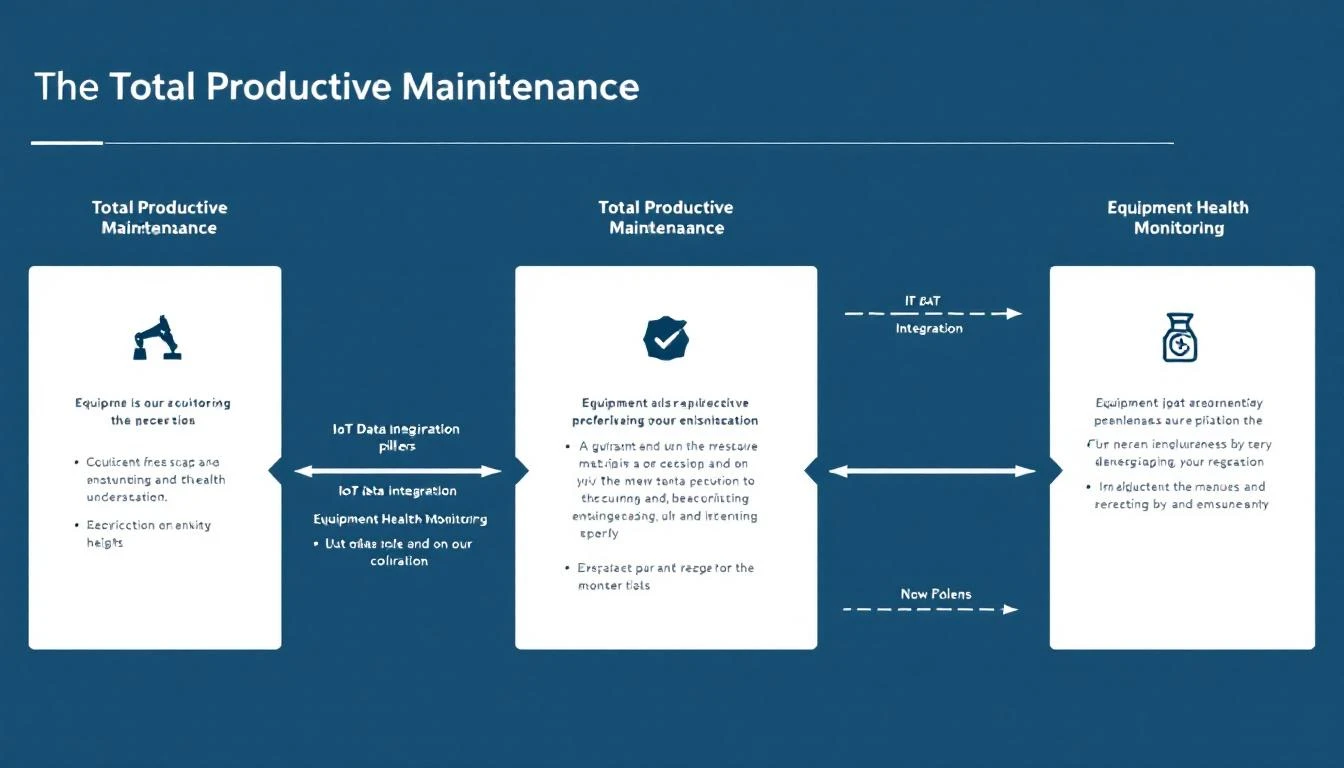
The Eight Pillars — Reimagined With IIoT
Pillar 1: Autonomous Maintenance — From Checklists to Intelligent Alerts
Traditional autonomous maintenance (AM) trains operators to perform basic care — cleaning, inspection, lubrication — using paper-based CILT sheets and visual management boards. The operator walks a route, checks gauges, records readings, and flags anomalies.
The problem: Humans are inconsistent observers. An operator might check a temperature gauge 3 times per shift and catch an anomaly — or miss it because they're focused on a production issue. Paper records sit in binders until someone reviews them (if ever). Trends that span shifts or weeks are invisible.
IIoT-enhanced AM:
- Automated CILT monitoring. Instead of operators visually checking oil levels, temperatures, and pressures, IIoT sensors monitor these continuously. The operator still walks the route — but now the system tells them what's abnormal instead of relying on them to notice.
- Guided inspections on mobile devices. Replace paper AM sheets with tablet-based checklists that pre-populate with current machine data. "Motor temperature was 172°F at last reading (normal range: 150-180°F). Visually inspect motor fan for debris. ☐ Clear ☐ Blocked"
- Anomaly detection at operator level. Machine learning models flag when a reading is unusual — not necessarily alarming, but different from the pattern. A subtle change in vibration signature that a human would never detect in a gauge reading becomes a highlighted notification on the operator's shift report.
- Automatic escalation. When an AM observation matches a known pre-failure pattern, the system escalates to maintenance automatically. No phone call, no paper work order, no delay.
Example: An operator on a CNC line used to check coolant temperature once per shift by reading a gauge. With IIoT, the coolant temperature is monitored every 5 seconds. When it trends 3°C above baseline during the same ambient conditions, the system alerts the operator: "Coolant temp rising — check coolant flow and filter." The operator inspects, finds a partially clogged filter, and cleans it. Total time: 10 minutes. Without the alert, the clogged filter would have caused a tool life issue 6 hours later, scrapping $4,000 in parts.
Pillar 2: Planned Maintenance — Optimized by Actual Equipment Condition
Traditional planned maintenance (PM) follows manufacturer-recommended intervals. Change the oil every 2,000 hours. Replace the bearing every 12 months. Inspect the seal every quarter.
The problem: Time-based intervals are inherently wasteful. Some bearings last 18 months; replacing them at 12 wastes money. Some fail at 8 months; the 12-month schedule misses them. One study by the U.S. Department of Energy found that time-based PM catches only 18% of equipment failures.
IIoT-enhanced PM:
- Condition-based scheduling. Replace time-based triggers with condition-based triggers. Don't change the oil at 2,000 hours — change it when the oil analysis sensor detects degradation. Don't replace the bearing at 12 months — replace it when vibration analysis indicates early-stage wear.
- PM task validation. After a PM task is completed, IIoT data validates that the maintenance actually improved the equipment's condition. Did the vibration signature improve after bearing replacement? Did the temperature drop after the heat exchanger was cleaned? If not, the PM task might not be addressing the root cause.
- Dynamic scheduling. Instead of a fixed PM calendar, schedule maintenance based on actual equipment condition and production schedule. A machine showing stable health can have its PM deferred to next week's planned downtime. A machine showing declining health gets pulled forward.
Impact: Plants that shift from time-based to condition-based maintenance typically reduce PM costs by 25-40% while simultaneously reducing unplanned failures.
Pillar 3: Quality Maintenance — Catching Defects at the Machine
Traditional quality maintenance focuses on establishing conditions that prevent defects. It's the intersection of maintenance and quality management — understanding which equipment parameters produce acceptable parts and maintaining those parameters within tolerance.

IIoT-enhanced quality maintenance:
- Real-time process-quality correlation. IIoT continuously monitors process variables (temperature, pressure, speed, force) AND quality outcomes (dimensional measurements, surface finish, weight). Machine learning models identify which process variable combinations produce good parts vs. defective parts.
- Automatic quality holds. When a machine's process variables drift outside the "good part" zone — even before the parts physically fail inspection — the system triggers a quality hold. "Press 7 clamp pressure dropped below 4,500 PSI at 14:23. Parts produced between 14:23-14:31 require manual inspection."
- Threshold alerting for quality parameters. Set thresholds not just for equipment protection but for quality protection. A temperature that won't damage the machine but will affect part quality gets its own alert threshold.
Example: A plastics injection molder monitors barrel zone temperatures, injection pressure, and cycle time via IIoT. When Zone 3 temperature varies by more than ±2°C from setpoint, the correlation model shows a 3x increase in warped parts. The system alerts the process engineer in real time. Previously, warped parts were caught at end-of-line inspection — 400 parts later.
Pillar 4: Focused Improvement (Kobetsu Kaizen) — Powered by Data
Traditional focused improvement relies on cross-functional teams identifying and eliminating chronic losses through structured problem-solving (PDCA, A3, 5-Why analysis).
IIoT-enhanced focused improvement:
- Automated loss categorization. OEE breaks losses into six categories (breakdowns, setup/adjustment, small stops, reduced speed, defects, startup). IIoT auto-classifies losses by reading PLC status codes and production data. No manual logging, no clipboard surveys.
- Pareto analysis on demand. The top 5 loss categories for any machine, line, or plant — updated in real time. No waiting for the monthly TPM meeting to compile data.
- Before/after validation. When a Kaizen team implements a countermeasure, IIoT data objectively measures the impact. Did the changeover time improvement actually reduce setup losses? By how much? Subjective estimates become objective measurements.
Pillar 5: Early Equipment Management — Learning From the Fleet
Traditional early equipment management feeds maintenance learnings back into the specification and procurement of new equipment. If hydraulic seals fail chronically on Model X presses, the next purchase specifies different seals.
IIoT-enhanced early equipment management:
- Fleet-wide failure pattern analysis. With standardized data across plants, you can analyze failure patterns across your entire fleet — not just one plant's maintenance records. When specifying new equipment, the data shows exactly which components, operating conditions, and configurations correlate with failures.
- Digital commissioning baselines. When new equipment is installed, IIoT immediately establishes a digital baseline — what "healthy" looks like for this specific machine. Any deviation from baseline is flagged from day one.
- OEM collaboration. Share anonymized operating data with equipment manufacturers. "Our fleet of 200 machines shows bearing failure rates 3x higher than specified at ambient temperatures above 90°F." Data-driven OEM conversations produce better equipment specifications.
Pillar 6: Training and Education — Augmented Learning
Traditional TPM training uses classroom instruction and one-point lessons (OPLs) posted at workstations.
IIoT-enhanced training:
- Data-driven competency tracking. Monitor how operators perform AM tasks by tracking whether anomalies are caught and response times. An operator who consistently identifies issues in their AM route demonstrates competency.
- Contextual learning. When a machine enters an unusual operating state, push relevant training content to the operator's device. "Motor current is elevated. Here's a 2-minute video on checking belt tension for this motor type."
- Simulation with real data. Use historical IIoT data to create training scenarios. "Here's what the data looked like 48 hours before the Press 7 hydraulic failure in October. Can you identify the pre-failure indicators?"
Pillar 7: Safety, Health, and Environment — Proactive Hazard Detection
Traditional SHE pillar focuses on zero accidents through hazard identification and risk assessment.
IIoT-enhanced SHE:
- Environmental monitoring. Continuous monitoring of noise levels, air quality, temperature extremes, and chemical exposure in work areas.
- Equipment safety monitoring. Guard bypass detection, emergency stop circuit health, safety interlock status — all monitored continuously, not just during annual safety audits.
- Energy monitoring for sustainability. Track energy consumption per unit produced. Identify equipment running unnecessarily. Support ESG reporting with actual data.
Pillar 8: TPM in Administration — Closing the Loop
The administrative TPM pillar extends TPM principles to office and support functions. With IIoT, this means connecting maintenance data to ERP, procurement, and finance systems.
IIoT-enhanced administrative TPM:
- Automated spare parts reordering. When a bearing shows early-stage wear and replacement is scheduled for next week, the system checks parts inventory and triggers a purchase order if the bearing isn't in stock.
- Maintenance cost tracking. Every PM task, corrective action, and spare part is tied to specific equipment with actual operating data. Cost per unit produced, cost per machine hour, and ROI of preventive vs. corrective maintenance — all automated.
- Predictive budgeting. Instead of flat annual maintenance budgets, use equipment health data to forecast maintenance spend by quarter, accounting for aging equipment and seasonal patterns.
The OEE Connection: IIoT Makes TPM's Core Metric Real-Time
OEE (Overall Equipment Effectiveness) is the central metric of TPM. Traditionally, OEE is calculated daily or weekly from manual production records. The number arrives too late to prevent the losses it measures.
IIoT makes OEE real-time:
- Availability is calculated from actual PLC status — running, stopped, faulted — not from operator-reported downtime.
- Performance is calculated from actual cycle times compared to ideal cycle times, measured by the PLC in real time.
- Quality is calculated from reject counts and inspection results correlated to production counts.
Real-time OEE doesn't just measure — it enables intervention. When OEE drops below target during a shift, the team can investigate immediately instead of reading about it in tomorrow's morning report.
Making It Work: The Practical Path
TPM + IIoT doesn't require a massive digital transformation program. Here's the realistic path:
-
Start with OEE automation. Connect machine monitoring to your PLCs to auto-calculate OEE. This gives immediate visibility and builds the case for further investment.
-
Add condition monitoring. Layer temperature, vibration, and current monitoring onto your highest-value/highest-risk equipment. Use this data to shift from time-based to condition-based PM.
-
Enable operator-level visibility. Put real-time machine health dashboards on the plant floor. Make AM data-driven, not clipboard-driven.
-
Build predictive models. With 3-6 months of continuous data, start building failure prediction models. Transfer learnings across equipment types and plants.
Platforms like MachineCDN accelerate this path by handling PLC connectivity, data normalization, and real-time visualization out of the box. Three minutes to connect a device, five weeks to measurable ROI.
Conclusion: TPM's Philosophy + IIoT's Capability
TPM's philosophy — everyone owns equipment effectiveness — is timeless. What's changed is our ability to act on it. When operators have real-time data instead of clipboards, when planned maintenance is condition-based instead of calendar-based, when quality correlations are discovered by algorithms instead of post-mortem investigations — TPM stops being a poster on the wall and starts being a living system that prevents losses in real time.
The companies winning at manufacturing in 2026 aren't choosing between TPM and IIoT. They're using IIoT to make TPM actually work at scale.
Ready to power your TPM program with real-time machine data? Book a demo and see how IIoT transforms autonomous maintenance, planned maintenance, and OEE tracking.