Unified Namespace (UNS) for Manufacturing: The Architecture That Replaces Point-to-Point Integration Chaos

If you've spent any time in manufacturing IT/OT, you've lived the integration nightmare. Your SCADA talks to the historian. Your historian feeds your MES. Your MES pushes data to your ERP. Your IIoT platform reads from the PLC independently. Your quality system has its own database. Your energy management system has another. And every one of these connections is a point-to-point integration that someone built years ago, nobody fully understands, and everyone is terrified to touch.
This is the spaghetti architecture that the Unified Namespace (UNS) is designed to replace. And in 2026, it's moved from conference-talk buzzword to production-deployed architecture in forward-thinking manufacturing plants.
Here's what UNS actually is, why it matters, and how to implement it without boiling the ocean.
The Problem UNS Solves
Point-to-Point Integration Hell
In a typical manufacturing plant with 8 software systems, the number of possible point-to-point integrations is:
n × (n-1) / 2 = 8 × 7 / 2 = 28 integrations
Each integration requires:
- Custom code or middleware configuration
- Understanding of both systems' data models
- Error handling for when either system is unavailable
- Security credentials management
- Maintenance when either system updates
At 28 integrations, you need a dedicated integration engineer. At 50+ (common in large plants), you need a team. And the system is fragile — changing one integration can break three others.
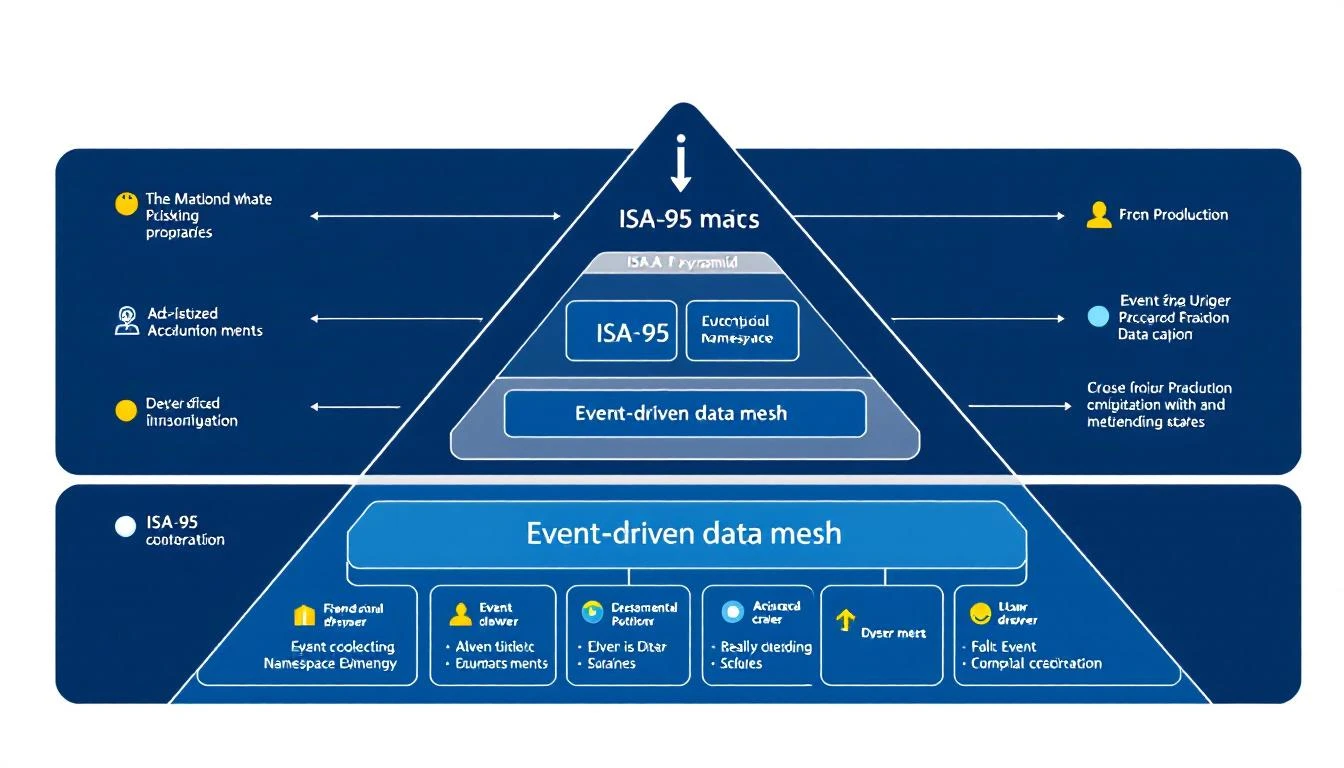
The ISA-95 Pyramid Trap
The ISA-95 model organizes manufacturing systems into layers:
- Level 0-1: Physical equipment and PLCs
- Level 2: SCADA and HMI
- Level 3: MES, batch management, quality
- Level 4: ERP, supply chain, business intelligence
Data flows up through these layers sequentially. PLC data goes to SCADA. SCADA data goes to MES. MES data goes to ERP. This was designed for a world where each layer had different time scales and different users.
The problem: modern manufacturing needs data to flow in every direction, not just up. Your AI predictive maintenance model needs raw PLC data (Level 0-1) and maintenance work order history (Level 3). Your quality system needs real-time process parameters (Level 1) and customer order specs (Level 4). Your energy optimization algorithm needs PLC power readings (Level 1) and utility rate schedules (Level 4).
The ISA-95 pyramid doesn't support this. Point-to-point integrations around the pyramid create the spaghetti.
What a Unified Namespace Actually Is
A Unified Namespace is a single, event-driven data hub where every system in your manufacturing environment publishes its data and subscribes to data it needs.
The Core Concept
Instead of 28 point-to-point integrations between 8 systems, every system connects to ONE central hub:
- PLCs publish machine data to the UNS
- SCADA subscribes to PLC data from the UNS (and publishes operator inputs)
- MES publishes production orders and subscribes to machine counts
- ERP publishes material data and subscribes to production completions
- IIoT platforms subscribe to everything and publish analytics results
- Quality systems publish inspection data and subscribe to process parameters
- Energy systems subscribe to power data and publish rate schedules
- Maintenance (CMMS) publishes work orders and subscribes to equipment health
Total connections: 8 (one per system). Not 28. Not spaghetti. One hub, many spokes.
The Technology: MQTT + Sparkplug B
Most UNS implementations use MQTT as the messaging protocol and Sparkplug B as the payload specification:
MQTT provides:
- Publish/subscribe messaging (decoupled producers and consumers)
- Topic-based routing (hierarchical topic structure maps naturally to manufacturing)
- Lightweight protocol (works on constrained edge devices)
- Quality of Service levels (guaranteed delivery when needed)
- Retained messages (new subscribers get the latest state immediately)
Sparkplug B provides:
- Standardized payload format for industrial data
- Birth/death certificates for device state management
- Metric definitions with data types and metadata
- Sequence numbers for message ordering
- State-aware publishing (report by exception, not polling)
Topic Structure
A well-designed UNS uses MQTT topics that mirror your manufacturing hierarchy:
spBv1.0/PlantChicago/
  Line1/
    InjectionMolder01/
      Temperature/BarrelZone1    → 415.2°F
      Temperature/BarrelZone2    → 420.1°F
      Pressure/Injection         → 1,847 psi
      Status/Running             → true
      Counts/TotalParts          → 14,523
      Counts/RejectParts         → 31
      OEE/Availability           → 91.3%
      OEE/Performance            → 87.1%
      OEE/Quality                → 99.8%
    InjectionMolder02/
      ...
  Line2/
    ...
  Maintenance/
    WorkOrders/WO-2026-0847     → { machine: "IM01", type: "PM", due: "2026-03-05" }
  Quality/
    Inspections/INS-2026-4521   → { machine: "IM01", result: "pass", timestamp: "..." }
  Energy/
    CurrentRate                  → $0.082/kWh
    Line1/Consumption            → 847 kW
Any system can subscribe to any topic. The MES subscribes to +/+/Counts/TotalParts to get production counts from every machine. The predictive maintenance system subscribes to +/+/Temperature/# to get all temperature readings. The energy system subscribes to +/+/Energy/# for power consumption.
No integration code required. Each system subscribes to the topics it cares about.
Why UNS Matters for IIoT
1. Context-Rich Data
Raw PLC data without context is nearly useless. A temperature reading of 415°F means nothing unless you know:
- What machine it's from
- What product is running
- What the setpoint is
- What the historical baseline is
- Whether a maintenance action was just performed
In a UNS, all of this context lives in the same namespace. The IIoT platform doesn't need to query three databases to understand a temperature reading — the production order, equipment profile, and sensor data all coexist.
2. Single Source of Truth
Without UNS, the same data exists in multiple systems with different values. The MES says Machine 7 produced 10,234 parts. The SCADA historian says 10,198. The quality system says 10,247. Which is right?
In a UNS, the PLC publishes the count once. Every system reads the same value. Discrepancies disappear.
3. Rapid System Onboarding
Adding a new system to a UNS is trivial compared to point-to-point integration:
Without UNS: New system needs custom integrations to SCADA, MES, ERP, quality system, and historian. Timeline: 2-6 months.
With UNS: New system connects to the MQTT broker and subscribes to relevant topics. Timeline: hours to days.
This is why IIoT platforms like MachineCDN are naturally aligned with UNS architecture. When MachineCDN's edge device publishes machine data, it becomes available to every other system in the namespace — CMMS for work orders, quality systems for SPC, energy systems for optimization.
How to Implement UNS
Phase 1: Start with the Edge (Month 1-2)
Don't try to connect everything at once. Start by getting PLC data into the UNS:
- Deploy an MQTT broker — HiveMQ, EMQX, or Mosquitto (for smaller deployments)
- Define your topic hierarchy — mirror your physical plant structure (site/area/line/machine/datapoint)
- Connect 3-5 machines via IIoT edge devices (like MachineCDN) that publish to the broker
- Validate data flow — ensure retained messages work, QoS is appropriate, and data types are correct
Why start with edge data? Because PLC data is the highest-value, highest-frequency data in your plant. It's also the hardest to get into traditional enterprise systems. Once it's in the UNS, everything else is easier.
Phase 2: Add Context Systems (Month 2-4)
Connect systems that add context to the raw machine data:
- MES → publishes production orders, recipes, product specs
- CMMS → publishes maintenance schedules, work orders, asset registries
- Quality → publishes inspection results, SPC data
Now your IIoT platform can correlate machine behavior with production context. "Vibration increased by 15% — and we just started running a new product recipe" is actionable. "Vibration increased by 15%" alone is less so.
Phase 3: Close the Business Loop (Month 4-6)
Connect business systems:
- ERP → publishes material master data, customer orders, costing
- Energy management → publishes utility rates, carbon factors
- Warehouse → publishes raw material lot information
Now you have a complete digital view of your manufacturing operation — from customer order to finished product to energy cost — in a single namespace.
UNS vs. Traditional Approaches
| Approach | Connections for 8 Systems | Time to Add New System | Data Latency | Maintenance |
|---|---|---|---|---|
| Point-to-Point | 28 integrations | 2-6 months | Varies | High (28 integrations to maintain) |
| Data Lake | 8 inbound + queries | 2-4 weeks | Minutes to hours (batch ETL) | Medium |
| UNS (MQTT) | 8 broker connections | Hours to days | Milliseconds | Low (one broker to manage) |
| API-based ESB | 8 adapters + bus | 2-8 weeks | Seconds | Medium-High |
Common UNS Pitfalls
Over-Engineering the Topic Structure
Start simple. You don't need 15 levels of hierarchy. Site/Area/Line/Machine/Metric is enough for most plants. You can refine later.
Ignoring Retained Messages
MQTT retained messages are critical for UNS. When a new subscriber connects, it should immediately receive the current state of every metric — not wait for the next publish cycle. Configure retained messages for all state data.
Treating UNS as a Historian
UNS is for real-time state and events. It's not a replacement for your time-series database or historian. Your IIoT platform (like MachineCDN) should subscribe to the UNS and store historical data in a proper time-series store for trending and analytics.
Ignoring Security
MQTT without TLS is an open door. Implement TLS encryption, certificate-based authentication, and topic-level ACLs from day one. Don't add security later — it's harder to retrofit than to build in.
Boiling the Ocean
The #1 reason UNS projects fail is trying to connect everything at once. Start with 5 machines and 2 enterprise systems. Prove value. Expand. The beauty of UNS is that each new connection is independent — you can add systems incrementally without affecting what's already running.
UNS and MachineCDN
MachineCDN's architecture aligns naturally with UNS principles:
- Edge devices collect PLC data and publish to MachineCDN's cloud — which can serve as UNS-compatible data source for other systems
- Cellular connectivity means edge data flows without touching the OT network
- Fleet management provides the multi-site, multi-machine namespace structure
- Real-time dashboards consume UNS data and present actionable views
- Predictive maintenance models subscribe to the full context (machine data + maintenance history + production orders)
Whether you're building a UNS from scratch or looking for an IIoT platform that plays well with an existing UNS, MachineCDN fits.
The Bottom Line
The Unified Namespace isn't a product you buy — it's an architecture you adopt. It replaces the integration spaghetti that makes manufacturing IT fragile, expensive, and slow. In 2026, the tools (MQTT brokers, Sparkplug B, IIoT platforms with native MQTT support) are mature, affordable, and proven in production.
The question isn't whether you should implement UNS. It's whether you can afford not to — as your competitors flatten their data architectures and move faster because of it.
Book a demo with MachineCDN to see how purpose-built IIoT integrates with modern manufacturing data architectures.