Industrial Video Surveillance Meets IIoT: How Smart Cameras and Machine Data Create Complete Factory Visibility

· 9 min read
MachineCDN Team
Industrial IoT Experts

Manufacturing plants have had security cameras for decades. And they've had machine data — PLC readings, SCADA screens, operator logs — for just as long. But these two data streams have lived in completely separate worlds: cameras watched by the security team, machine data watched by maintenance and operations.

That separation is ending. The convergence of industrial video surveillance and IIoT platforms is creating something neither system could deliver alone: complete factory visibility that connects what happened on the machine with what happened on the floor.

IoTFlows Pricing vs MachineCDN Pricing: Total Cost of Ownership for Manufacturing IIoT

· 7 min read
MachineCDN Team
Industrial IoT Experts

Choosing an IIoT platform isn't just about monthly subscription fees. The real cost includes hardware, installation, network infrastructure, ongoing maintenance, and the time your team spends managing the system. When manufacturing engineers compare IoTFlows pricing against MachineCDN pricing, the total cost of ownership (TCO) picture tells a very different story than sticker price alone.

IoTFlows vs MachineCDN for Fleet Management: Multi-Plant Monitoring Compared

· 7 min read
MachineCDN Team
Industrial IoT Experts

Managing machines across multiple manufacturing plants is one of the hardest operational challenges in industrial IoT. When your extruders in Ohio, injection molders in Mexico, and assembly lines in Texas all need real-time visibility, the fleet management capabilities of your IIoT platform become mission-critical. Here's how IoTFlows and MachineCDN approach multi-plant monitoring — and where the differences matter.

IoTFlows vs MachineCDN for Materials and Inventory Tracking: The Missing Feature in Most IIoT Platforms

· 7 min read
MachineCDN Team
Industrial IoT Experts

Most IIoT platforms obsess over machine health and OEE — and for good reason. Unplanned downtime costs manufacturers an average of $260,000 per hour according to Aberdeen Research. But there's a massive blind spot in the IIoT market: materials and inventory tracking. When your injection molder runs out of resin at 2am, perfect OEE scores don't matter. Here's how IoTFlows and MachineCDN handle materials — and why this gap could cost you more than you think.

MachineCDN vs Kepware (PTC KEPServerEX): Industrial Connectivity Showdown 2026

· 8 min read
MachineCDN Team
Industrial IoT Experts

Kepware's KEPServerEX has been the go-to industrial connectivity middleware for over two decades. If you've ever needed to get data out of a PLC and into a SCADA system, MES, or historian, chances are Kepware was on the shortlist. But in 2026, manufacturers aren't just looking to move data from point A to point B — they need real-time analytics, predictive maintenance, and cloud-based visibility across multiple plants.

That's where the comparison with MachineCDN gets interesting. One is a connectivity layer. The other is a complete IIoT analytics platform. Let's break down when each makes sense — and when one clearly wins.

MachineCDN vs Yokogawa: IIoT Platform Comparison for Process and Discrete Manufacturing

· 8 min read
MachineCDN Team
Industrial IoT Experts

Yokogawa Electric has been in industrial automation since 1915. They make DCS systems, analyzers, recorders, and process control equipment used in oil refineries, chemical plants, and power stations worldwide. With over $3.5 billion in annual revenue and operations in 60+ countries, Yokogawa is an industrial automation giant.

But being an automation giant doesn't automatically make you the right IIoT platform for modern manufacturing. Here's how Yokogawa's digital transformation offerings compare to MachineCDN for manufacturers who need real-time machine monitoring, predictive maintenance, and actionable analytics.

Manufacturing Data Lakes vs Time-Series Databases: Where Should Your Machine Data Live?

· 9 min read
MachineCDN Team
Industrial IoT Experts

Your IIoT platform is collecting 50 million data points per day from 200 machines across 3 plants. Temperature readings every 5 seconds. Vibration samples at 1 kHz. Cycle counts, fault codes, pressure values, motor currents — all timestamped, all streaming continuously.

Where does this data go? And more importantly, how do you query it? The answer shapes the cost, performance, and analytical capability of your entire IIoT stack.

Two architectures dominate the conversation: time-series databases (TSDB) designed specifically for timestamped machine data, and data lakes that store everything in cheap object storage for batch analytics. Each has fierce advocates. Both have legitimate strengths. And most manufacturers end up needing elements of both.

Let's break it down without the vendor-driven religious wars.

Modbus Address Conventions and Function Codes: The Practical Guide Every IIoT Engineer Needs [2026]

· 11 min read

If you've ever stared at a PLC register map wondering why address 300001 means something completely different from 400001, or why your edge gateway reads all zeros from a register that should contain temperature data — this guide is for you.

Modbus has been the lingua franca of industrial automation for nearly five decades. Its longevity comes from simplicity, but that simplicity hides a handful of conventions that trip up even experienced engineers. The addressing scheme and its relationship to function codes is the single most important concept to nail before you write a single line of polling logic.

Let's break it apart.

Modbus Address Mapping Demystified: Register Ranges, Function Codes, and Sorted-Tag Optimization [2026]

· 10 min read

If you've ever stared at a PLC register map and wondered why address 400001 is actually register 0, or why your gateway reads the wrong data when you mix holding registers with input registers in the same request — this article is for you.

Modbus addressing is one of the most misunderstood aspects of industrial communication. The protocol itself is simple. The addressing conventions built on top of it are where engineers lose hours to debugging. And the optimization strategies for reading registers efficiently can cut your polling time in half.

Let's break it all down.

Modbus register address mapping and function codes

The Four Register Ranges

Modbus defines four distinct data spaces, each with its own addressing convention and access characteristics:

RangeAddress ConventionFunction Code (Read)Function Code (Write)Data TypeAccess
Coils0xxxxx (0–65535)FC 01FC 05/15Single bitRead/Write
Discrete Inputs1xxxxx (100000–165535)FC 02Single bitRead Only
Input Registers3xxxxx (300000–365535)FC 0416-bit wordRead Only
Holding Registers4xxxxx (400000–465535)FC 03FC 06/1616-bit wordRead/Write

The Great Addressing Confusion

Here's the source of 90% of Modbus debugging pain: the convention addresses include a prefix digit that doesn't exist in the actual protocol.

When you see "address 400001" in a PLC manual, the actual register address sent over the wire is 0 (zero). The "4" prefix tells you it's a holding register (use FC 03), and the remaining digits are 1-indexed, so you subtract 1.

Convention Address → Wire Address
400001 → Holding Register 0 (FC 03)
400100 → Holding Register 99 (FC 03)
300001 → Input Register 0 (FC 04)
000001 → Coil 0 (FC 01)
100001 → Discrete Input 0 (FC 02)

Some PLC manufacturers use 0-indexed conventions (Modicon style), while others use 1-indexed (common in building automation). Always verify with the actual PLC documentation. Getting this wrong by one register means you're reading the wrong variable — which might look plausible but be subtly incorrect, leading to phantom issues that take days to diagnose.

Automatic Function Code Selection

A well-designed gateway should automatically determine the correct Modbus function code from the register address, eliminating manual configuration errors:

Address Range           → Function Code
0 – 65535 → FC 01 (Read Coils)
100000 – 165535 → FC 02 (Read Discrete Inputs)
300000 – 365535 → FC 04 (Read Input Registers)
400000 – 465535 → FC 03 (Read Holding Registers)

This means the engineer configuring the gateway only needs to specify the convention address from the PLC manual. The gateway strips the prefix, determines the function code, and calculates the wire address automatically.

To extract the wire address from the convention address:

if address >= 400000:
wire_address = address - 400000
function_code = 3
elif address >= 300000:
wire_address = address - 300000
function_code = 4
elif address >= 100000:
wire_address = address - 100000
function_code = 2
else:
wire_address = address
function_code = 1

16-Bit vs. 32-Bit Values: The Element Count Problem

Each Modbus register holds exactly 16 bits. But many real-world values are 32-bit (floats, unsigned integers, large counters). This requires reading two consecutive registers and combining them.

Element Count Configuration

When configuring a tag, you specify the element count — how many 16-bit registers to read for this tag:

Data TypeElement CountRegisters Read
bool11 register (only LSB used)
int8 / uint811 register (masked to 8 bits)
int16 / uint1611 register
int32 / uint3222 consecutive registers
float (IEEE 754)22 consecutive registers

Byte Ordering (The Endianness Trap)

When combining two 16-bit registers into a 32-bit value, the byte order matters — and different PLCs use different conventions:

Big-endian (Modbus standard): Register N = high word, Register N+1 = low word

uint32_value = (register[N+1] << 16) | register[N]

Little-endian (some PLCs): Register N = low word, Register N+1 = high word

uint32_value = (register[N] << 16) | register[N+1]

For IEEE 754 floating-point values, the situation is even trickier. The modbus_get_float() function in libmodbus handles the byte swapping, but you need to know your PLC's byte order. Common byte orderings for 32-bit floats:

OrderNameRegister Layout
ABCDBig-endianMost common in Modicon/Schneider
DCBALittle-endianSome Allen-Bradley
BADCMid-big-endianSiemens S7
CDABMid-little-endianSome Japanese PLCs

Pro tip: If you're getting nonsensical float values (like 1.4e38 when you expect 72.5), you almost certainly have a byte-order mismatch. Swap the register order and try again.

Handling 8-Bit Values from 16-Bit Registers

When a PLC stores an 8-bit value (bool, int8, uint8) in a 16-bit register, the value sits in the lower byte:

register_value = 0x00FF  # Only lower 8 bits are the value
int8_value = register_value & 0xFF
bool_value = register_value & 0x01

This is straightforward for single registers, but gets interesting when you're reading coils (FC 01/02). Coil reads return packed bits — 8 coils per byte — which need to be unpacked into individual boolean values.

Sorted-Tag Optimization: Contiguous Register Grouping

This is where theory meets performance. A naive implementation reads each tag individually:

# Naive: 10 tags = 10 separate Modbus requests
read_register(400100) # Temperature
read_register(400101) # Pressure
read_register(400102) # Flow rate
read_register(400103) # Setpoint
...

Each Modbus request has overhead: a request frame (~8 bytes), a response frame (~8 bytes + data), and a round-trip delay (typically 5-50ms on a LAN, 50-400ms on serial). Ten individual reads means 10× the overhead.

The Contiguous Grouping Algorithm

Instead, a smart gateway sorts tags by address and groups contiguous registers into single multi-register reads:

# Optimized: 10 contiguous tags = 1 Modbus request
read_registers(400100, count=10) # All 10 values in one shot

The algorithm works in four steps:

Step 1: Sort tags by address. When the configuration is loaded, tags are inserted into a sorted linked list ordered by their register address. This is critical — without sorting, you can't detect contiguous ranges.

Step 2: Identify contiguous groups. Walk the sorted list and group tags that satisfy ALL of these conditions:

  • Same function code (same register type)
  • Addresses are contiguous (tag N+1 starts where tag N ends)
  • Same polling interval
  • Total register count doesn't exceed the protocol limit
# Grouping logic
head = first_tag
registers = head.element_count
tags_in_group = 1

for each subsequent tag:
if tag.function_code == head.function_code
AND head.address + registers == tag.address
AND head.interval == tag.interval
AND registers < MAX_REGISTERS:
# Attach to current group
registers += tag.element_count
tags_in_group += 1
else:
# Read current group, start new one
read_registers(head.address, registers)
head = tag
registers = tag.element_count
tags_in_group = 1

Step 3: Respect the maximum register limit. The Modbus spec allows up to 125 registers per read request (FC 03/04) or 2000 coils per read (FC 01/02). In practice, many PLCs have lower limits. A safe ceiling is 50 registers per request — this keeps response sizes under 100 bytes, reducing the chance of packet fragmentation and timeouts.

Step 4: Dispatch values. After the multi-register read returns, walk the buffer and dispatch values to individual tags based on their position in the group.

Performance Impact

On a typical Modbus TCP network with 5ms round-trip time:

TagsNaive ApproachGrouped ApproachSpeedup
1050ms5ms10×
50250ms25ms (5 groups)10×
100500ms50ms (10 groups)10×

On Modbus RTU at 9600 baud, the difference is even more dramatic:

TagsNaiveGroupedSpeedup
10800ms120ms6.7×
504000ms600ms6.7×

For a gateway polling 50 tags every second, naive reads won't even fit in the time budget on serial. Grouping makes it feasible.

Handling Gaps

What about non-contiguous registers? If tags at addresses 400100 and 400105 need reading, you have two choices:

  1. Read the gap: Request registers 400100–400105 (6 registers), discard the 4 unused ones. Wastes bandwidth but saves a round-trip.
  2. Split into two reads: Two separate requests for 400100 (1 reg) and 400105 (1 reg). Two round-trips but no wasted data.

The breakeven point depends on your network. For gaps of 3 registers or fewer, reading the gap is usually faster. For larger gaps, split. A good heuristic:

if gap_size <= 3:
read_through_gap()
else:
split_into_separate_reads()

Inter-Read Delays: The 50ms Rule

After each contiguous group read, insert a small delay (typically 50ms) before the next read. This serves two purposes:

  1. PLC processing time: Some PLCs need time between successive requests to maintain their scan cycle. Hammering them with back-to-back reads can cause watchdog timeouts.
  2. Serial line recovery: On RS-485, the bus needs time to switch direction between request and response. Without this gap, you risk frame collisions on noisy lines.
read_group_1()
sleep(50ms) # Let the PLC breathe
read_group_2()
sleep(50ms)
read_group_3()

This 50ms penalty per group is why minimizing the number of groups (through contiguous addressing) matters so much.

Change Detection: Read vs. Deliver

Reading a tag and delivering its value to the cloud are two separate decisions. Efficient gateways implement change detection to avoid delivering unchanged values:

if tag.compare_enabled:
if new_value == tag.last_value:
# Value unchanged — don't deliver
update_read_timestamp()
continue
else:
# Value changed — deliver and update
deliver(tag, new_value)
tag.last_value = new_value

Combined with interval-based polling, this creates a two-tier optimization:

  • Interval: Don't read the tag if less than N seconds have elapsed since the last read
  • Comparison: Don't deliver the value if it hasn't changed since the last delivery

The result: your MQTT bandwidth is dominated by actual state changes, not redundant repetitions of the same value.

Practical Configuration Example

Here's how a well-configured Modbus device might look in JSON:

{
"protocol": "modbus-tcp",
"device_type": 1017,
"plctags": [
{
"name": "mold_temp_actual",
"id": 1,
"type": "float",
"addr": 400100,
"ecount": 2,
"interval": 5,
"compare": true
},
{
"name": "mold_temp_setpoint",
"id": 2,
"type": "float",
"addr": 400102,
"ecount": 2,
"interval": 60,
"compare": true
},
{
"name": "pump_running",
"id": 3,
"type": "bool",
"addr": 000010,
"ecount": 1,
"interval": 1,
"compare": true,
"do_not_batch": true
},
{
"name": "alarm_word",
"id": 4,
"type": "uint16",
"addr": 400200,
"ecount": 1,
"interval": 1,
"compare": true,
"do_not_batch": true
}
]
}

Notice:

  • The two temperature tags (400100, 400102) are contiguous and will be read as one 4-register block
  • They have different intervals (5s vs 60s), so they'll only group when both are due
  • The alarm word uses do_not_batch: true — it's delivered immediately on change, not held for the next batch
  • The pump running tag reads a coil (address < 100000), so it uses FC 01 — it can't group with the holding registers

How machineCDN Optimizes Modbus Polling

machineCDN's edge daemon automatically sorts tags by address at configuration load time, groups contiguous registers with matching intervals and function codes, and caps each read at 50 registers to prevent timeouts on older PLCs. The firmware handles the address-to-function-code mapping transparently — engineers configure tags using the convention addresses from the PLC manual, and the gateway handles the rest.

For devices with mixed protocols (e.g., a machine with EtherNet/IP on the main PLC and Modbus RTU on the temperature controller), machineCDN runs independent polling loops per protocol, each with its own connection management and buffering — so a failure on the serial line doesn't affect the EtherNet/IP connection.

Conclusion

Modbus addressing doesn't have to be painful. The key takeaways:

  1. Understand the four address ranges and how they map to function codes — this eliminates the #1 source of configuration errors
  2. Sort tags by address at configuration time to enable contiguous grouping
  3. Group contiguous registers into single multi-register reads — the performance improvement is 5–10× on typical deployments
  4. Handle 32-bit values carefully — element count and byte ordering are the two most common float-reading bugs
  5. Cap register counts at 50 per read to stay within PLC capabilities
  6. Use change detection to minimize cloud bandwidth — only deliver values that actually changed
  7. Insert 50ms delays between group reads to respect PLC processing requirements

Master these patterns, and you'll spend your time analyzing production data instead of debugging communication failures.

Modbus RTU Serial Link Tuning: Baud Rate, Parity, and Timeout Optimization for Reliable PLC Communication [2026]

· 11 min read

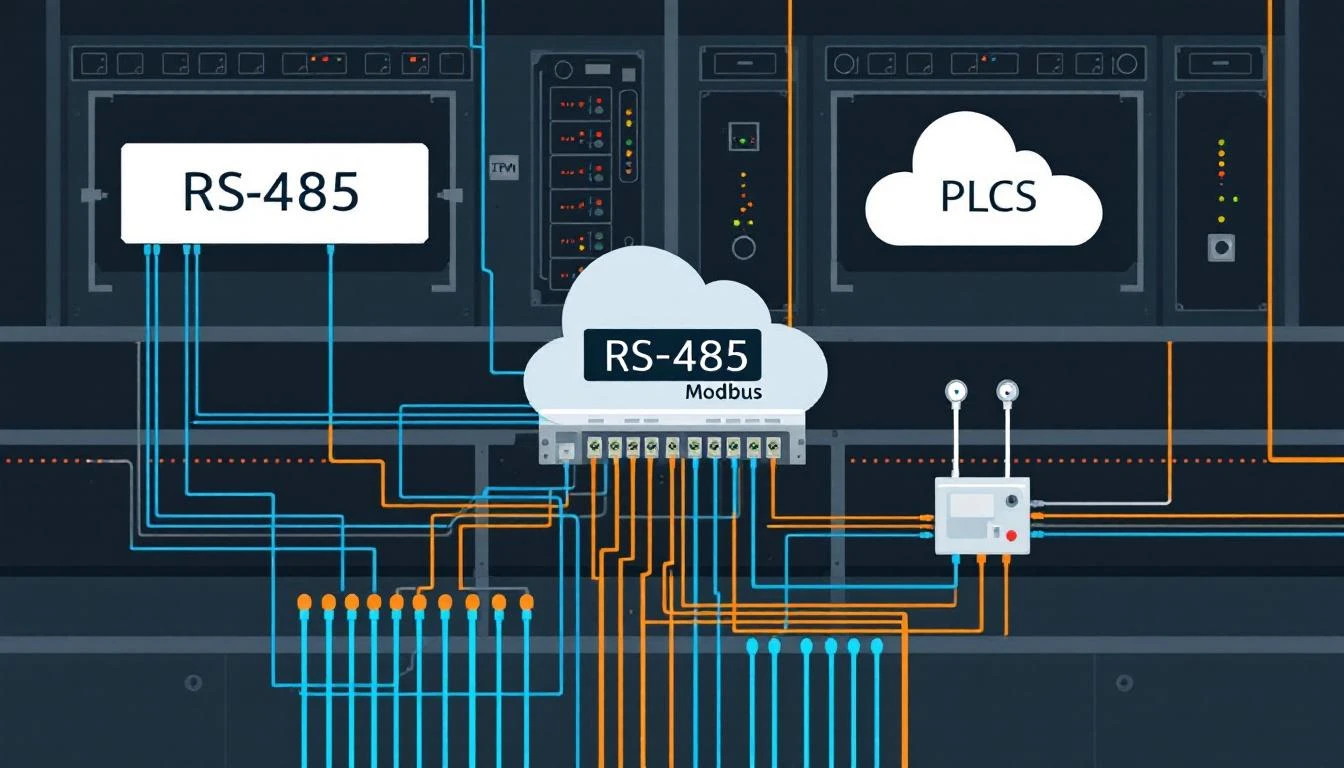
Modbus RTU Serial Communication

Modbus TCP gets all the attention in modern IIoT deployments, but Modbus RTU over RS-485 remains the workhorse of industrial communication. Millions of devices — temperature controllers, VFDs, power meters, PLCs, and process instruments — speak Modbus RTU natively. When you're building an edge gateway that bridges these devices to the cloud, getting the serial link parameters right is the difference between rock-solid telemetry and a frustrating stream of timeouts and CRC errors.

This guide covers the six critical parameters that govern Modbus RTU serial communication, the real-world trade-offs behind each one, and the tuning strategies that separate production-grade deployments from lab prototypes.

The Six Parameters That Control Everything

Every Modbus RTU serial connection is defined by six parameters that must match between the master (your gateway) and every slave device on the bus:

1. Baud Rate

The baud rate determines how many bits per second travel across the RS-485 bus. Common values:

Baud RateBits/secTypical Use Case
96009,600Legacy devices, long cable runs (>500m)
1920019,200Standard industrial default
3840038,400Mid-range, common in newer PLCs
5760057,600Higher-speed applications
115200115,200Short runs, high-frequency polling

The real-world constraint: Every device on the RS-485 bus must use the same baud rate. If you have a mix of legacy power meters at 9600 baud and newer VFDs at 38400, you need separate RS-485 segments — each with its own serial port on the gateway.

Practical recommendation: Start at 19200 baud. It's universally supported, tolerant of cable lengths up to 1000m, and fast enough for most 1-second polling cycles. Only go higher if your polling budget demands it and your cable runs are short.

2. Parity Bit

Parity provides basic error detection at the frame level:

  • Even parity (E): Most common in industrial settings. The parity bit is set so the total number of 1-bits (data + parity) is even.
  • Odd parity (O): Less common, but some older devices default to it.
  • No parity (N): Removes the parity bit entirely. When using no parity, you typically add a second stop bit to maintain frame timing.

The Modbus RTU specification recommends even parity with one stop bit as the default (8E1). However, many devices ship configured for 8N1 (no parity, one stop bit) or 8N2 (no parity, two stop bits).

Why it matters: A parity mismatch doesn't generate an error message — the slave device simply ignores the malformed frame. You'll see ETIMEDOUT errors on the master side, and the failure mode looks identical to a wiring problem or wrong slave address. This is the single most common misconfiguration in Modbus RTU deployments.

3. Data Bits

Almost universally 8 bits in modern Modbus RTU. Some ancient devices use 7-bit ASCII mode, but if you encounter one in 2026, it's time for a hardware upgrade. Don't waste time debugging 7-bit configurations — the Modbus RTU specification mandates 8 data bits.

4. Stop Bits

Stop bits mark the end of each byte frame:

  • 1 stop bit: Standard when using parity (8E1 or 8O1)
  • 2 stop bits: Standard when NOT using parity (8N2)

The total frame length should be 11 bits: 1 start + 8 data + 1 parity + 1 stop, OR 1 start + 8 data + 0 parity + 2 stop. This 11-bit frame length matters because the Modbus RTU inter-frame gap (the "silent interval" between messages) is defined as 3.5 character times — and a "character time" is 11 bits at the configured baud rate.

5. Byte Timeout

This is where things get interesting — and where most tuning guides fall short.

The byte timeout (also called "inter-character timeout" or "character timeout") defines how long the master waits between individual bytes within a single response frame. If the gap between any two consecutive bytes exceeds this timeout, the master treats it as a frame boundary.

The Modbus RTU specification says: The inter-character gap must not exceed 1.5 character times. At 9600 baud with 11-bit frames, one character time is 11/9600 = 1.146ms, so the maximum inter-character gap is 1.5 × 1.146ms ≈ 1.72ms.

What actually happens in practice:

At 9600 baud:  1 char = 1.146ms → byte timeout ≈ 2ms (safe margin)
At 19200 baud: 1 char = 0.573ms → byte timeout ≈ 1ms
At 38400 baud: 1 char = 0.286ms → byte timeout ≈ 500μs
At 115200 baud: 1 char = 0.095ms → byte timeout ≈ 200μs

The catch: At baud rates above 19200, the byte timeout drops below 1ms. Most operating systems can't guarantee sub-millisecond timer resolution, especially on embedded Linux or OpenWrt. This is why many Modbus RTU implementations clamp the byte timeout to a minimum of 500μs regardless of baud rate.

Practical recommendation: Set byte timeout to max(500μs, 2 × character_time). On embedded gateways running Linux, use 1000μs (1ms) as a safe floor.

6. Response Timeout

The response timeout defines how long the master waits after sending a request before declaring the slave unresponsive. This is the most impactful tuning parameter for overall system performance.

Factors that affect response time:

  1. Request transmission time: At 19200 baud, an 8-byte request takes ~4.6ms
  2. Slave processing time: Varies from 1ms (simple register read) to 50ms+ (complex calculations or EEPROM access)
  3. Response transmission time: At 19200 baud, a 40-register response (~85 bytes) takes ~48.7ms
  4. RS-485 transceiver turnaround: 10-50μs

The math for worst case:

Total = request_tx + slave_processing + turnaround + response_tx
= 4.6ms + 50ms + 0.05ms + 48.7ms
≈ 103ms

Practical recommendation: Set response timeout to 200-500ms for most applications. Some slow devices (energy meters doing power quality calculations) may need 1000ms. If you're polling temperature sensors that update once per second, there's no penalty to a generous 500ms timeout.

The retry question: When a timeout occurs, should you retry immediately? In production edge gateways, the answer is nuanced:

  • Retry 2-3 times before marking the device as offline
  • Insert a 50ms pause between retries to let the bus settle
  • Flush the serial buffer between retries to clear any partial frames
  • Track consecutive timeouts — if a device fails 3 reads in a row, something has changed (wiring, device failure, address conflict)

RS-485 Bus Topology: The Physical Foundation

No amount of parameter tuning can compensate for bad RS-485 wiring. The critical rules:

Daisy-chain only. RS-485 is a multi-drop bus, NOT a star topology. Every device must be wired in series — A to A, B to B — from the first device to the last.

Gateway ---[A/B]--- Device1 ---[A/B]--- Device2 ---[A/B]--- Device3
|
120Ω terminator

Termination resistors: Place a 120Ω resistor across A and B at both ends of the bus — at the gateway and at the last device. Without termination, reflections on long cable runs cause bit errors that look like random CRC failures.

Cable length limits:

Baud RateMax Cable Length
96001200m (3900 ft)
192001000m (3200 ft)
38400700m (2300 ft)
115200300m (1000 ft)

Maximum devices per segment: The RS-485 spec allows 32 unit loads per segment. Modern 1/4 unit-load transceivers can push this to 128, but in practice, keep it under 32 devices to maintain signal integrity.

Slave Address Configuration

Every device on a Modbus RTU bus needs a unique slave address (1-247). Address 0 is broadcast-only (no response expected), and addresses 248-255 are reserved.

The slave address is configured at the device level — typically through DIP switches, front-panel menus, or configuration software. The gateway needs to match.

Common mistake: Address 1 is the factory default for almost every Modbus device. If you connect two new devices without changing addresses, neither will respond reliably — they'll both try to drive the bus simultaneously, corrupting each other's responses.

Contiguous Register Grouping: The Bandwidth Multiplier

The most impactful optimization for Modbus RTU polling performance isn't a link parameter — it's how you structure your read requests.

Modbus function codes 03 (Read Holding Registers) and 04 (Read Input Registers) can read up to 125 contiguous registers in a single request. Instead of issuing separate requests for each tag, a well-designed gateway groups tags by:

  1. Function code — holding registers and input registers require different commands
  2. Address contiguity — registers must be adjacent (no gaps)
  3. Polling interval — tags polled at the same rate should be read together
  4. Maximum PDU size — cap at 50-100 registers per request to avoid overwhelming slow devices

Example: If you need registers 40001, 40002, 40003, 40010, 40011:

  • Naive approach: 5 separate read requests (5 × 12ms round-trip = 60ms)
  • Grouped approach: Read 40001-40003 in one request, 40010-40011 in another (2 × 12ms = 24ms)

The gap between 40003 and 40010 breaks contiguity, so two requests are optimal. But reading 40001-40011 as one block (11 registers) might be acceptable — the extra 7 "wasted" registers add only ~7ms of transmission time, which is less than the overhead of an additional request-response cycle.

Production-grade gateways build contiguous read groups at startup and maintain them throughout the polling cycle, only splitting groups when address gaps exceed a configurable threshold.

Error Handling: Beyond the CRC

Modbus RTU includes a 16-bit CRC at the end of every frame. If the CRC doesn't match, the frame is discarded. But there are several failure modes beyond CRC errors:

ETIMEDOUT — No response from slave:

  • Wrong slave address
  • Baud rate or parity mismatch
  • Wiring fault (A/B swapped, broken connection)
  • Device powered off or in bootloader mode
  • Bus contention (two devices with same address)

ECONNRESET — Connection reset:

  • On RS-485, this usually means the serial port driver detected a framing error
  • Often caused by electrical noise or ground loops
  • Add ferrite cores to cables near VFDs and motor drives

EBADF — Bad file descriptor:

  • The serial port was disconnected (USB-to-RS485 adapter unplugged)
  • Requires closing and reopening the serial connection

EPIPE — Broken pipe:

  • Rare on physical serial ports, more common on virtual serial ports or serial-over-TCP bridges
  • Indicates the underlying transport has failed

For each of these errors, a robust gateway should:

  1. Close the Modbus connection and flush all buffers
  2. Wait a brief cooldown (100-500ms) before attempting reconnection
  3. Update link state to notify the cloud that the device is offline
  4. Log the error type for remote diagnostics

Tuning for Specific Device Types

Different industrial devices have different Modbus RTU characteristics:

Temperature Controllers (TCUs)

  • Typically use function code 03 (holding registers)
  • Response times: 5-15ms
  • Recommended timeout: 200ms
  • Polling interval: 5-60 seconds (temperatures change slowly)

Variable Frequency Drives (VFDs)

  • Often have non-contiguous register maps
  • Response times: 10-30ms
  • Recommended timeout: 300ms
  • Polling interval: 1-5 seconds for speed/current, 60s for configuration

Power/Energy Meters

  • Large register blocks (power quality data)
  • Response times: 20-100ms (some meters buffer internally)
  • Recommended timeout: 500-1000ms
  • Polling interval: 1-15 seconds depending on resolution needed

Central Chillers (Multi-Circuit)

  • Dozens of input registers per compressor circuit
  • Deep register maps spanning 700+ addresses
  • Naturally contiguous register layouts within each circuit
  • Alarm bit registers should be polled at 1-second intervals with change detection
  • Process values (temperatures, pressures) can use 60-second intervals

Putting It All Together

A production Modbus RTU configuration for a typical industrial gateway looks like this:

# Example configuration (generic format)
serial_port: /dev/ttyUSB0
baud_rate: 19200
parity: even # 'E' — matches Modbus spec default
data_bits: 8
stop_bits: 1
slave_address: 1
byte_timeout_ms: 1
response_timeout_ms: 300

# Polling strategy
max_registers_per_read: 50
retry_count: 3
retry_delay_ms: 50
flush_between_retries: true

How machineCDN Handles Modbus RTU

machineCDN's edge gateway handles both Modbus TCP and Modbus RTU through a unified data acquisition layer. The gateway auto-configures serial link parameters from the device profile, groups contiguous registers for optimal bus utilization, implements intelligent retry logic with bus-level error recovery, and bridges Modbus RTU data to cloud-bound MQTT with store-and-forward buffering. Whether your devices speak Modbus RTU at 9600 baud or EtherNet/IP over Gigabit Ethernet, the data arrives in the same normalized format — ready for analytics, alerting, and operational dashboards.


Need to connect legacy Modbus RTU devices to a modern IIoT platform? machineCDN bridges serial protocols to the cloud without replacing your existing equipment. Talk to us about your multi-protocol deployment.